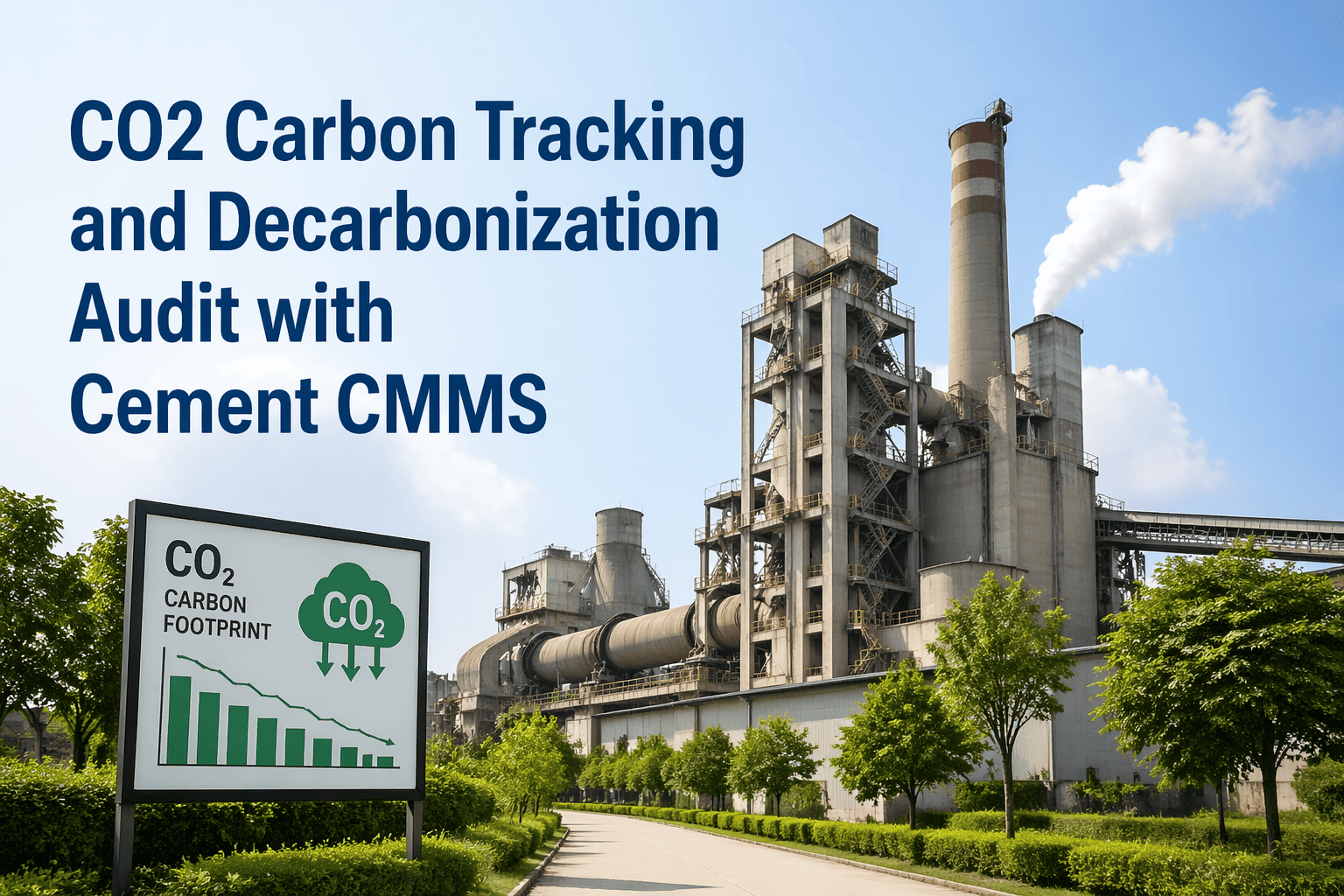
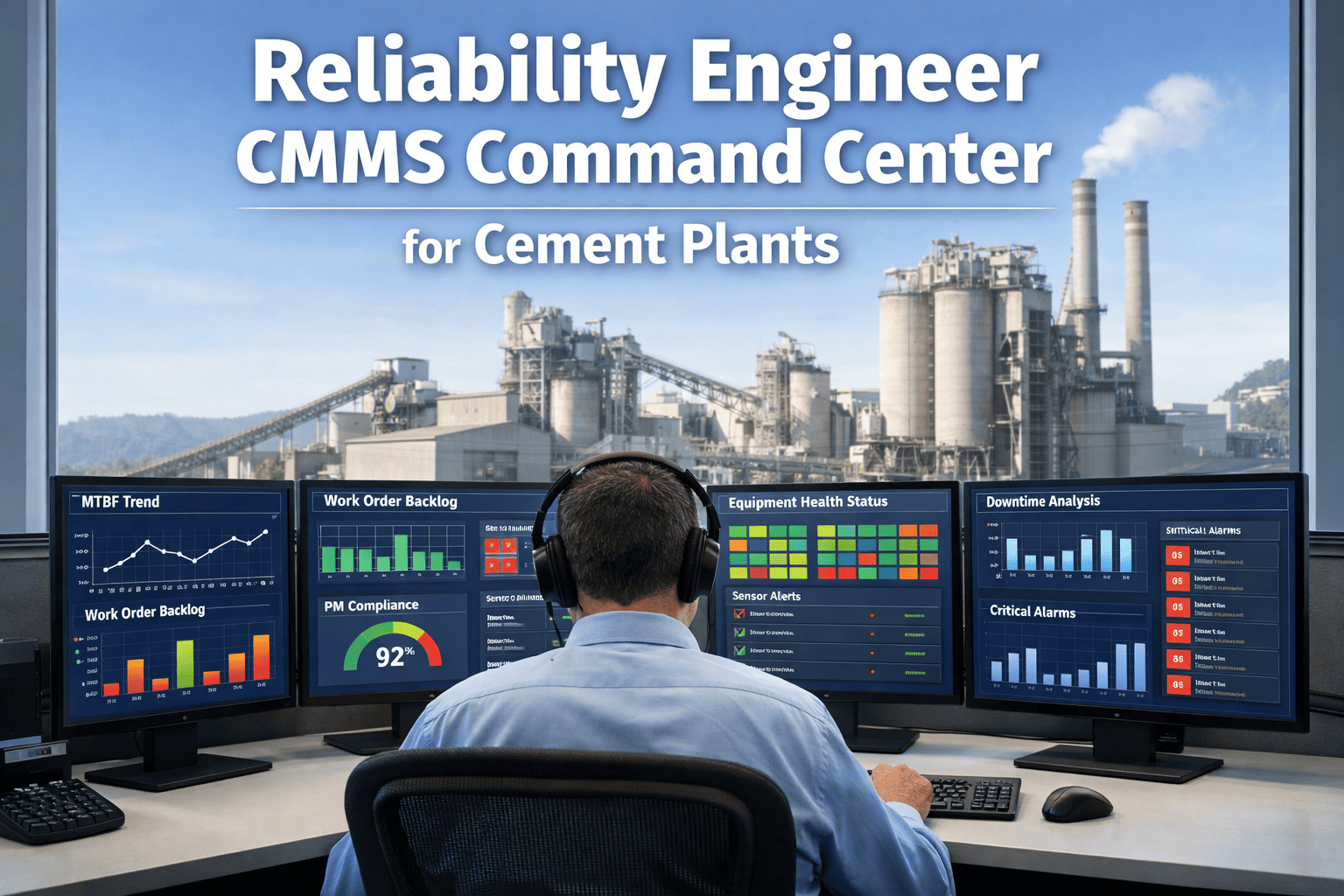
Cement production accounts for roughly 7% of global CO2 emissions, making it one of the hardest industries to decarbonise. The Global Cement and Concrete Association's (GCCA) 2050 Net Zero Roadmap is the first detailed decarbonisation blueprint issued by any global heavy industry, committing 40 major producers — representing 80% of production outside China — to cut emissions 25% by 2030 on the path to full net zero by 2050. For plant engineers, this is not a policy document to file away — it is a live operational mandate that touches clinker ratios, fuel mixes, energy procurement, maintenance programmes, and capital planning every single shift. Translating the GCCA roadmap into plant-level KPIs requires integrated tracking across every lever: clinker factor, alternative fuel rate, thermal energy intensity, CCS readiness, and electrification milestones. OxMaint's CMMS platform helps cement plant teams log, audit, and report on every decarbonisation lever in one connected system — from AFR feed logs to CCS asset maintenance records.
Cement · Decarbonisation · Plant Engineering
GCCA Net-Zero Roadmap for Cement: A Plant Engineer's Action Plan
Clinker Factor · AFR · CCS/CCUS · Electrification · CMMS-Tracked KPIs
The Roadmap at a Glance
2021
Roadmap Launched
GCCA publishes Concrete Future — the industry's first net zero pathway, signed by 40 leading producers covering 80% of global output outside China.
2030
Milestone: -25% CO2
Proportionate reduction of 25% in cement CO2 vs 2020 levels. Equivalent to preventing 5 billion tonnes of CO2 by this date. Clinker factor, AFR, and energy intensity are the primary levers.
2040
CCS/CCUS at Scale
Carbon capture technologies expected to be operating commercially at a significant share of major plants. Process CO2 — unavoidable from calcination — can only be addressed through CCS.
2050
Net Zero Concrete
Full decarbonisation of cement and concrete production across the value chain, aligned with the 1.5°C global climate target.
The 7 Decarbonisation Levers — Mapped to Plant Actions
01
Clinker Factor Reduction
Every percentage point reduction in the clinker-to-cement ratio directly cuts process CO2. Blended cements using fly ash, slag, or calcined clay lower clinker factor from 0.78 average toward 0.60 targets.
KPI: Clinker-to-cement ratio tracked monthly by product type
02
Alternative Fuel Rate (AFR)
Replacing coal and petcoke with biomass, waste-derived fuels, and hydrogen reduces combustion CO2. Leading plants now exceed 80% thermal substitution rate. AFR handling equipment requires dedicated PM programmes.
KPI: Thermal substitution rate (%) logged per kiln per week
03
Thermal Energy Efficiency
Thermal energy intensity of clinker must decrease from 3.6 GJ/t toward 3.1 GJ/t. Preheater efficiency, seal condition, and refractory integrity all directly impact this figure and require systematic maintenance tracking.
KPI: GJ/t clinker tracked against IEA benchmark trajectory
04
Electricity Decarbonisation
Cement plants consume 100 kWh/t cement in electrical energy. Procuring renewable electricity, installing onsite solar or wind, and electrifying auxiliary systems reduces Scope 2 emissions significantly.
KPI: % of consumed electricity from renewable sources
05
CCS and CCUS
Process CO2 from limestone calcination (about 60% of cement emissions) cannot be eliminated by efficiency or fuel switching alone. Carbon capture is the only viable pathway for this fraction — making it a long-term capex planning requirement now.
KPI: CCS readiness score — site assessment, capture rate target, timeline
06
Concrete Mix Optimisation
Concrete producers reducing over-specification and increasing SCM content cut embodied carbon per cubic metre. Plant-level support means supplying SCM-rich blended cements at consistent quality.
KPI: Blended cement volume as % of total output
07
Circular Economy
Co-processing waste as AFR, using industrial by-products as SCMs, and integrating waste heat recovery systems all contribute to circular economy targets in the roadmap framework.
KPI: Tonnes of co-processed waste per year
Map Every Roadmap Lever to a Plant-Level KPI
OxMaint lets your team log AFR substitution rates, clinker factor by product, thermal energy readings, and CCS asset records in one connected CMMS — so your audit trail is always ready and your KPIs are always visible.
CMMS-Tracked Action Plan: What Engineers Must Record
| Decarbonisation Lever |
Asset / Equipment Involved |
CMMS Record Type |
Audit Frequency |
| Clinker Factor |
Weigh feeders, blending silos, finish mills |
Feed ratio logs, blend calibration records |
Weekly |
| AFR Substitution |
AFR storage, dosing conveyors, burner systems |
Fuel composition records, TSR logs, burner PM |
Daily / Weekly |
| Thermal Efficiency |
Preheater cyclones, kiln seals, refractory |
Temperature profiles, seal inspection, heat loss reports |
Monthly |
| Electricity (Scope 2) |
Mills, fans, compressors, VFDs |
kWh/t records, renewable energy certificates, VFD PM |
Monthly |
| CCS Readiness |
Absorbers, compressors, cooling systems |
Equipment register, baseline performance, PM schedule |
Quarterly |
| Waste Co-Processing |
Waste storage, dosing systems, emissions monitors |
Waste intake logs, CEMS readings, compliance records |
Daily |
Clinker Factor Deep Dive: The Fastest Near-Term Lever
0.78
Global Average Clinker-to-Cement Ratio (2020)
0.60
Target Ratio Implied by 2030 GCCA Milestone
-18%
CO2 Reduction Achievable From Clinker Factor Alone
50%
Maximum Clinker Replacement Achievable With LC3
SCMs That Enable Clinker Reduction
Ground granulated blast-furnace slag (GGBS) can replace 30–70% of clinker while improving durability. Class F fly ash enables 20–35% replacement. LC3 — limestone calcined clay cement — achieves up to 50% clinker substitution using widely available low-grade clay. Each SCM requires different handling, storage, and feed rate calibration.
Maintenance Implications of High SCM Blends
Weigh feeders and dosing equipment handling materials with different bulk densities and moisture sensitivity need more frequent calibration. Finish mills processing harder slag require adjusted grinding programmes. CMMS records for each SCM feed system must track calibration intervals, feed rate accuracy, and moisture alarms.
Quality Risks Without Systematic Tracking
Inconsistent SCM feed rates cause clinker factor variance that shows up as strength failures at 28 days — by which time the batch is already dispatched. CMMS-logged feed ratio data creates the audit trail to identify feed equipment drift before quality incidents occur.
AFR Programme: From Fuel Switch to Maintenance Strategy
1
Fuel Intake and Storage Systems
Alternative fuels — tyre-derived fuel, biomass, refused-derived fuel (RDF), waste oils — arrive with variable calorific value and composition. Storage systems need moisture protection, explosion risk controls, and dedicated housekeeping PMs that differ entirely from coal stockpile management.
2
Dosing and Feed Conveyors
AFR dosing equipment handles heterogeneous, often abrasive material. Conveyor wear rates increase by 30–60% compared to uniform solid fuel systems. Preventive maintenance intervals must reflect actual material conditions — which vary by fuel batch — not generic equipment schedules.
3
Burner and Combustion Monitoring
High AFR substitution rates alter flame shape and heat release profiles in the kiln. Burner tip inspection frequency must increase, and combustion zone temperatures must be logged continuously. A thermal substitution rate above 60% requires a dedicated burner PM programme tracked separately from the main kiln schedule.
4
Emissions Compliance Documentation
Co-processing waste fuels requires continuous emissions monitoring (CEMS) records linked to each fuel batch. Regulatory audits expect traceability from waste intake through combustion to stack emissions. A CMMS that connects fuel records to emissions logs removes the manual reconciliation burden during audits.
Frequently Asked Questions
What is the GCCA Net Zero Roadmap and why does it matter for plant engineers?
The GCCA 2050 Net Zero Roadmap is the cement industry's collective commitment to full decarbonisation by 2050, with a 25% reduction milestone by 2030. For plant engineers, it defines seven specific decarbonisation levers — clinker factor, AFR, energy efficiency, electrification, CCS, concrete optimisation, and circular economy — each of which requires operational changes, new equipment, and systematic performance tracking. Find out how
OxMaint tracks these KPIs across your plant.
How does clinker factor reduction affect maintenance requirements?
Higher SCM blends introduce materials with different bulk densities, grindability indices, and moisture sensitivity into the process. Weigh feeders, dosing conveyors, and finish mills all need adjusted calibration and PM intervals to handle slag, fly ash, or calcined clay alongside clinker. Without updated maintenance schedules, feed accuracy degrades and product quality variances follow.
Which decarbonisation lever delivers the fastest near-term CO2 reduction?
Clinker factor reduction offers the fastest, lowest-cost near-term emissions reduction. Existing plants can increase SCM blending with relatively modest capital investment compared to CCS. The 2030 milestone target of moving the global average clinker-to-cement ratio from 0.78 to approximately 0.60 is achievable primarily through blended cement expansion.
How does a CMMS support GCCA roadmap compliance reporting?
Roadmap compliance requires documented evidence across every lever — AFR substitution logs, clinker factor records by product, energy intensity data, and CCS readiness assessments. A CMMS like
OxMaint links equipment maintenance records to operational performance data, creating an audit-ready trail that covers both regulatory requirements and voluntary reporting frameworks like GCCA's own reporting platform.
When should cement plants start planning for CCS/CCUS?
CCS planning should start now. Process CO2 from limestone calcination represents 60% of cement emissions and cannot be addressed by any other lever. Site assessment, geological storage evaluation, and equipment specification are decade-long processes. Plants that defer CCS planning risk missing 2040 deployment windows and face potentially large carbon cost exposure as free ETS allowances phase out after 2026.
OxMaint CMMS for Cement
Turn the GCCA Roadmap Into a Plant-Level Audit Trail
Log clinker factor, AFR substitution rates, thermal energy readings, and CCS asset records in one connected platform. Every lever tracked. Every KPI visible. Every audit ready.