Title: Cement CBAM Data Audit Checklist for Exporters | Slug: cement-cbam-data-audit-checklist-for-exporters | Meta: Cement CBAM Data Audit Checklist for Exporters. Use structured field checks, condition indicators, maintenance actions, and escalation criteria to improve cement.
For cement exporters to the EU, CBAM turns plant data into a commercial requirement: importers need verified embedded-emissions figures for your clinker and cement, and if your data cannot be verified they may fall back on default values that are usually less favourable. The weak point is rarely the calculation — it is unreliable meters, undocumented lab results and missing records behind it. Use this checklist to give your sustainability managers, plant environmental leads and finance teams preparing CBAM data for EU customers a structured, traceable inspection framework — every check below is logged in your OxMaint CMMS with timestamps, readings and escalation status so nothing depends on memory or a paper binder.
Carbon & CBAM · Compliance Data Readiness
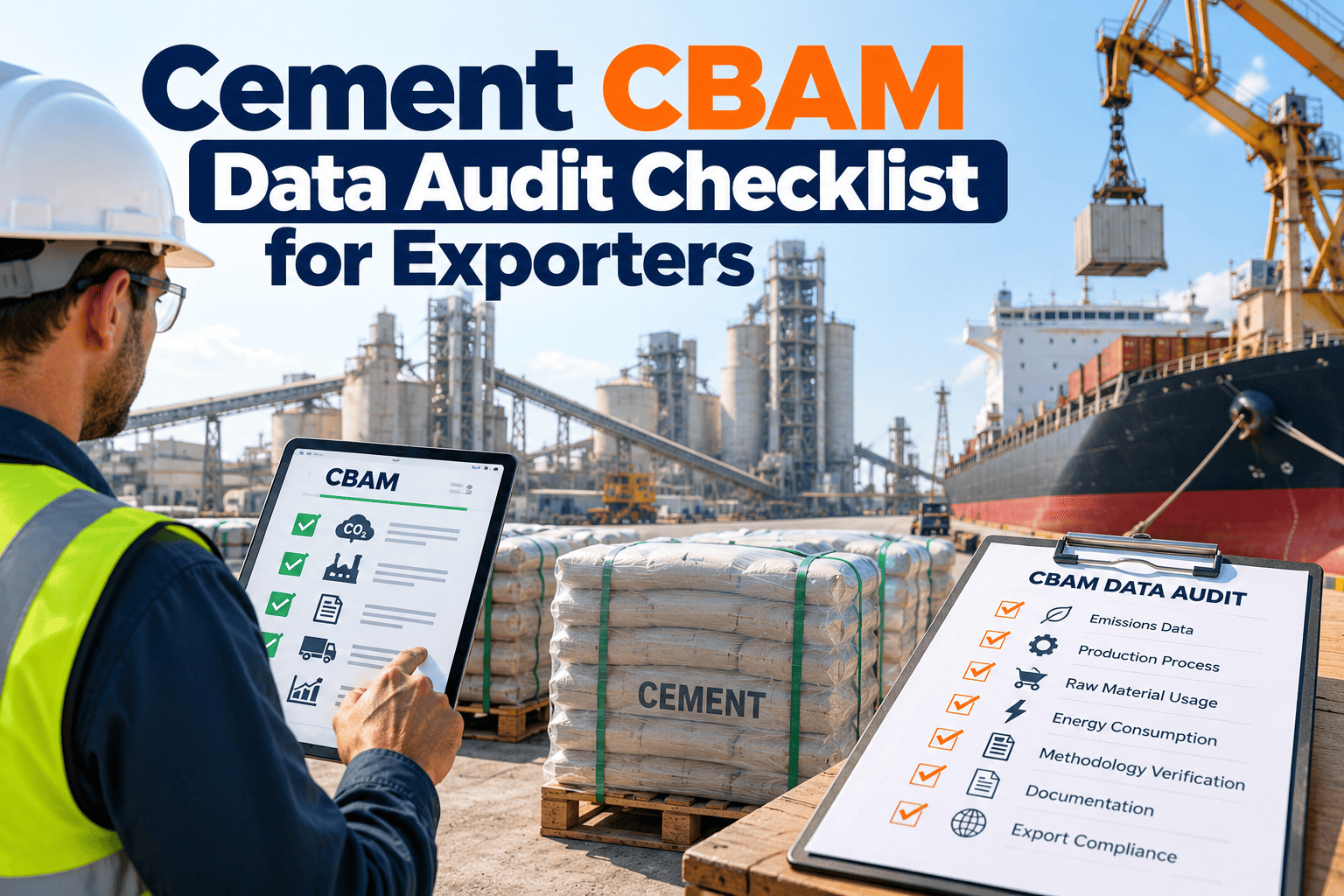
Cement CBAM Data Audit Checklist for Exporters
A data audit checklist for cement CBAM readiness: installation scope and CN codes, production and activity data, fuel and emission factors, process emissions, electricity, metering and calibration, and verification records. Rules and templates evolve, so confirm current requirements against official EU CBAM guidance.
7Inspection Categories
27Check Points
5Frequency Tiers
100%Data Traceability Goal
Where CBAM Data Most Often Breaks Down for Cement Exporters
Unverifiable DataMissing evidence forces the use of default values and weakens your customer position
Uncalibrated MetersFuel, weighbridge and power meters without calibration records undermine activity data
Wrong System BoundaryMixing installations or products produces incorrect embedded-emissions figures
Weak Emission FactorsMissing fuel analysis or biomass evidence leads to conservative factors
Mass Balance GapsClinker, cement and additive balances that do not reconcile fail review
Late Data DeliveryImporters waiting for data may shift volume to suppliers who respond faster
DDaily / Shift
WWeekly
MMonthly
QQuarterly
AAnnual
Category 01
Installation Scope & Product Mapping
Everything downstream depends on the boundary. A clear definition of the installation, the products sold to the EU and their CN codes keeps data attributable to the right goods.
Installation boundary documented — describe the production units included (quarry-to-cement or clinker plus grinding), the monitored sources and any shared utilities; boundary diagrams should match the monitoring planAEnvironmental Manager · Installation boundary document
Exported products mapped to CN codes — list clinker and each cement type shipped to the EU with its CN code, and confirm customer documentation uses the same codesQExport Compliance Lead · Product-to-CN mapping
Clinker factor by product documented — record the clinker-to-cement ratio and additive content of each exported product with supporting recipe dataMQuality Manager · Product composition record
Monitoring methodology approved and version controlled — confirm the methodology document is current, approved internally and updated for any plant changeAEnvironmental Manager · Methodology version log
Category 02
Production & Activity Data
Embedded emissions are calculated per tonne of product, so tonnes, stocks and shipments must reconcile. This is where auditors look first.
Clinker production reconciled to kiln feed and stocks — compare clinker produced with raw meal consumed and stock movements; investigate variance beyond your internal toleranceMProduction Accountant · Clinker balance reconciliation
Cement production and dispatch reconciled to weighbridge and invoices — match mill output, silo stock and shipped tonnes to dispatch records for EU-bound productMLogistics / Finance · Dispatch reconciliation
Alternative raw materials and additives quantified — record quantity and source of gypsum, slag, fly ash, limestone and other additives, with delivery documentsMQuality Manager · Additive consumption record
Cement kiln dust and bypass dust accounted for — record quantities removed and returned, as they affect process-emission calculationsMProcess Engineer · Dust balance record
Category 03
Fuels & Emission Factors
Fuel combustion is a major emission source, and the emission factor is only as defensible as the analysis behind it. Biomass and waste fuels need evidence of their biogenic fraction.
Fuel consumption by type reconciled to purchase and meter data — compare consumption to deliveries and stock changes for coal, petcoke, gas, diesel and alternative fuelsMEnergy Manager · Fuel balance record
Fuel analysis current for calorific value and carbon content — keep laboratory results at the frequency in your methodology, using accredited labs where requiredQLaboratory Manager · Fuel analysis certificates
Biomass fraction of alternative fuels evidenced — document the method (for example sampling, analysis or supplier declarations) and retain results; unsupported biogenic claims should be treated as fossilQEnvironmental Manager · Biomass fraction evidence
Emission factor sources recorded — record the origin and version of each factor, and confirm calculations are using the current valueAEnvironmental Manager · Emission factor register
CBAM data quality starts at the meter and the lab bench. OxMaint tracks calibration due dates for weighbridges and flow meters, stores lab certificates against assets, and keeps a timestamped trail of every check — so the evidence your verifier asks for is already organised.
Category 04
Process Emissions & Calculation Integrity
Calcination of limestone is the largest share of cement emissions. Raw meal composition and kiln inputs must be well documented, and the calculation should be reproducible by an outsider.
Raw meal composition and calcination factor documented — keep raw meal analysis and the calculation approach (clinker-based or raw meal-based) used in the methodologyMLaboratory Manager · Raw meal analysis record
Non-carbonate carbon in raw materials considered — document analysis of organic carbon in raw materials where relevantALaboratory Manager · Raw material carbon analysis
Emission calculation workbook locked and reviewed — protect formulas, record the reviewer and keep prior versions; check totals against the previous periodQSustainability Manager · Calculation review sign-off
Embedded emissions per tonne cross-checked against benchmarks — compare results against previous periods and industry ranges; investigate large deviations before data leaves the plantQSustainability Manager · Benchmark check
Category 05
Electricity & Indirect Emissions
Where indirect emissions apply to your product, electricity records and grid emission factors must be as traceable as fuel records.
Electricity consumption metered and reconciled to utility invoices — compare plant meters with billing meters and document any differenceMEnergy Manager · Electricity reconciliation
Electricity source and emission factor evidence retained — keep grid factor source, any PPA documents and on-site generation records, per applicable rulesASustainability Manager · Electricity factor evidence
Waste heat recovery or self-generation allocation documented — document how electricity from on-site generation is measured and allocatedAEnergy Manager · Allocation method record
Category 06
Metering, Calibration & Data Systems
Reliable metering is a maintenance topic. A meter without a calibration certificate is a data quality risk, and gaps in data logging weaken the audit trail.
Calibration certificates current for all relevant meters — check weighbridges, belt scales, flow meters and power meters; schedule recalibration before expiryMInstrument Technician · Calibration register
Meter uncertainty assessed and documented — record accuracy class and estimated uncertainty for each major source streamAInstrument Technician · Uncertainty assessment
Data gaps and estimates logged — list periods where data was missing or estimated, the method used and who approved itMData Owner · Data gap register
Access control and change log for data systems checked — confirm who can modify production and emissions data, and review change logsQIT / Data Owner · Data integrity review
Category 07
Verification & Customer Reporting
Importers must have their declarations verified by an accredited verifier, so they rely on you for clear evidence. A ready evidence pack shortens verification.
Evidence pack assembled per product and period — compile methodology, reconciliations, lab results, calibration certificates and calculation, indexed for retrievalQSustainability Manager · Evidence pack index
Customer data request template completed and reviewed — check that figures sent to importers match the verified calculation, with a record of who approved releaseQExport Compliance Lead · Customer data release log
Verifier findings tracked to closure — log each non-conformity or recommendation, owner and due date; repeat findings point to a systemic gapASustainability Manager · Corrective action register
Records retention confirmed — verify storage location and retention period against current EU requirements and your customer contractsACompliance Officer · Retention policy check
Reliability KPIs
Six Metrics That Show Whether Your CBAM Data Is Audit-Ready
| Metric | How to Measure | Target | Frequency |
|---|
| Meter Calibration Currency | Meters with valid certificate / Meters in scope | 100% | Monthly |
| Clinker Balance Variance | Difference between produced and reconciled clinker | Within internal tolerance | Monthly |
| Fuel Analysis Coverage | Required analyses completed / Required | 100% | Quarterly |
| Evidence Pack Completeness | Items present / Items required | 100% | Quarterly |
| Verifier Open Findings | Open non-conformities past due date | Zero | Quarterly |
| Customer Data Turnaround | Days from request to approved data release | Within contract SLA | Per request |
FAQs
Frequently Asked Questions
Why do cement exporters need a CBAM data audit?
EU importers need embedded-emissions data for the cement and clinker they bring in, and that data is subject to verification. An internal audit finds missing evidence and uncalibrated meters before a verifier or customer does.
What happens if CBAM data cannot be verified?
The importer may have to rely on default values, which are generally less favourable than actual measured data. Confirm the current default-value rules in official EU guidance, as they are updated periodically.
Which data sources are most important for cement?
Clinker and cement production, fuel consumption and analysis, raw meal and calcination data, and where applicable electricity. Reconciliations tying these to purchases, stocks and shipments are what auditors examine most closely.
How does maintenance affect CBAM data quality?
Measured data relies on calibrated weighbridges, belt scales, flow meters and power meters. Missed calibrations and unrepaired instruments create data gaps and uncertainty, so metering belongs in your preventive maintenance plan.
Digitize CBAM Readiness
Every Meter Calibrated. Every Record Traceable. Every Customer Request Answered.
OxMaint links calibration schedules, lab certificates and reconciliation checks into one timestamped record so your CBAM evidence pack is ready when customers and verifiers ask.