Clinker is the most carbon-intensive component of cement, and every tonne of clinker a plant avoids producing removes both calcination CO2 and the fuel burned to make it. Lowering the clinker factor through supplementary cementitious materials, calcined clay or higher-performance grinding sounds like a pure process decision, but it depends on mills, separators, feeders, weighing systems and dryers running consistently. When those assets drift, the blend drifts, quality margins shrink and plants quietly revert to higher clinker content. A structured maintenance management platform keeps the equipment behind a low clinker factor in a controlled state.
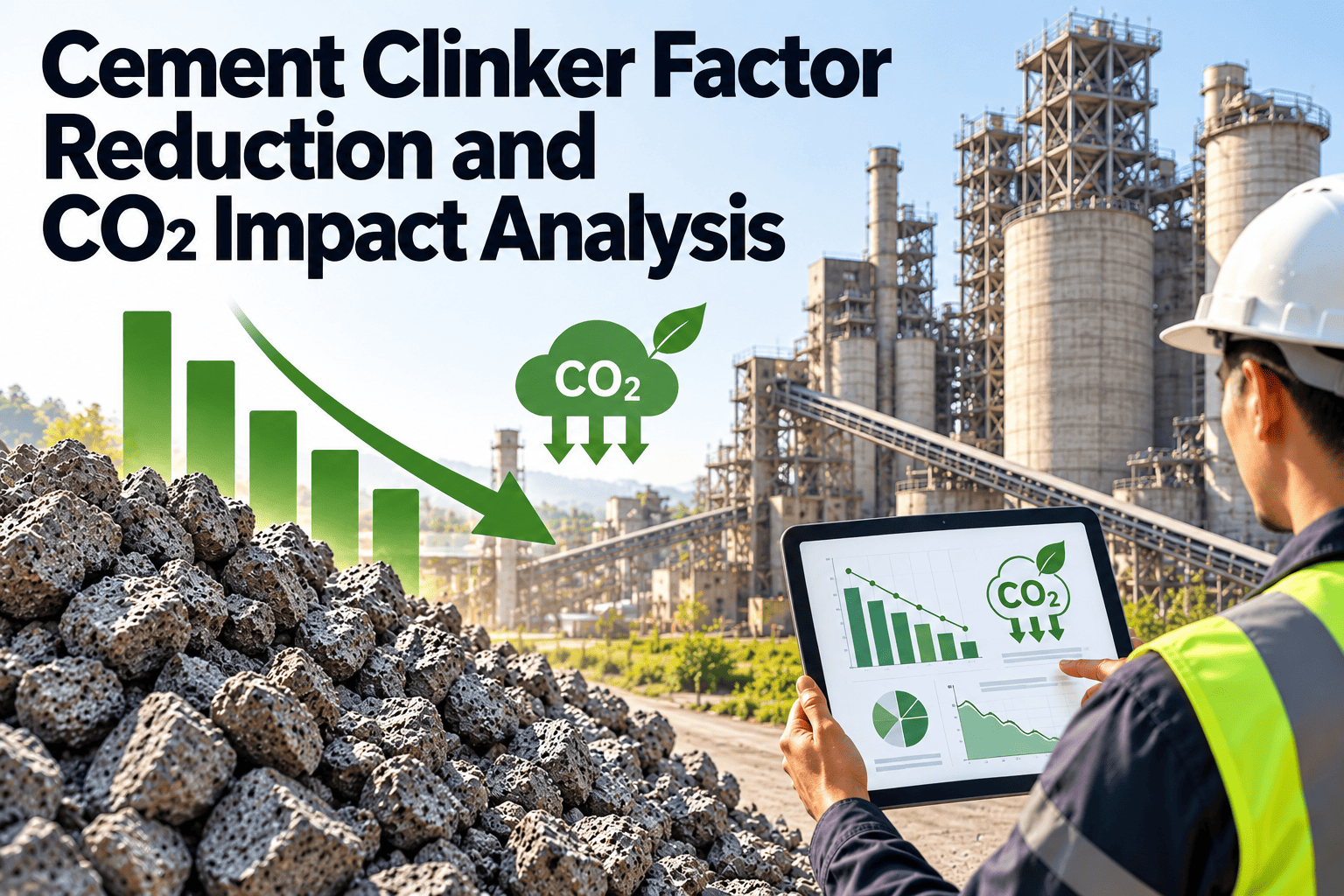
Clinker Factor Reduction and CO2 Impact Analysis for Cement Plants
Cutting the clinker-to-cement ratio only pays off when grinding, dosing and blending equipment stay reliable. Track the CO2 benefit and protect it with maintenance that never lets the blend slip.
Illustrative clinker factors: each step lowers CO2 per tonne of cement
Why the clinker factor drives the CO2 equation
Where the emissions come from
- Calcination of limestone releases process CO2 that no fuel switch can remove, roughly half a tonne per tonne of clinker.
- Kiln fuel adds combustion CO2, which varies with thermal energy demand and fuel mix.
- Electricity for raw and cement grinding adds indirect emissions that depend on mill efficiency.
- Clinker factor multiplies all of these, so reducing it lowers emissions per tonne of cement without touching kiln chemistry.
Illustrative arithmetic
CO2 per t cement = clinker factor x CO2 per t clinker
At an assumed 0.85 t CO2 per tonne of clinker, moving from 0.75 to 0.70 avoids about 0.043 t CO2 per tonne of cement, or roughly 42,500 t a year on 1 million tonnes. Use your own plant factors for real planning.
Clinker substitution routes and their equipment demands
| Route | Typical constituent | Equipment that must stay reliable | Quality risk when it fails |
|---|
| Granulated slag blending | Ground granulated blast furnace slag | Slag dryer, vertical mill, feeders | Moisture swings, fineness variation |
| Fly ash addition | Fly ash from power stations | Silo aeration, dosing weighfeeders, conveyors | Inconsistent dosing, loss on ignition drift |
| Limestone filler | Ground limestone in Portland-limestone cements | Cement mill, separator, mill fans | Strength loss from coarse particle fraction |
| Calcined clay | Calcined clay with limestone | Clay calciner, cooler, grinding circuit | Reactivity variation, water demand |
| Natural pozzolan | Volcanic ash or similar | Dryer, crusher, ball or roller mill | Moisture and grindability changes |
How a clinker reduction decision flows through the plant
1
Set the target
Choose cement types and standards that permit lower clinker content.
2
Secure materials
Confirm supply, moisture and grindability of each additive.
3
Prove the circuit
Verify feeders, mills and separators can hold fineness consistently.
4
Monitor and hold
Track strength, fineness and equipment health against the new blend.
Where lower clinker blends go wrong in the plant
Failure point
Likelihood
Effect on clinker factor
Weighfeeder calibration drift
High
Over-dosing clinker to stay safe on strength
Separator wear or vane damage
Medium
Coarser product, lower strength, more clinker needed
Additive dryer outage
Medium
Wet material forces a return to higher clinker content
Mill liner or grinding media wear
High
Lost fineness and higher specific energy
Silo aeration blockages
Low
Erratic additive flow, unstable blend
Before and after a maintenance-backed reduction program
Without controlled maintenance
- Feeders calibrated when someone remembers
- Separator wear found at the next quality complaint
- Operators add extra clinker as a buffer
- CO2 savings exist on paper but not at the mill
With scheduled, recorded maintenance
- Calibration checks scheduled and logged per feeder
- Separator and liner inspections tied to wear intervals
- Quality margins stay stable, so buffers can be trimmed
- Savings are supported by equipment records
Protect your clinker reduction gains with reliable equipment
Connect mill, feeder and separator maintenance to the blend targets your process team sets.
Maintenance tasks that sustain a low clinker factor
Dosing and weighing
- Scheduled belt-scale and weighfeeder calibration
- Load cell and idler inspection
- Chute and hopper blockage rounds
Grinding and classification
- Liner, roller and grinding media wear checks
- Separator vane and rotor inspection
- Mill fan vibration and bearing temperature trends
Material preparation
- Dryer burner and temperature control checks
- Silo aeration pad inspection
- Conveyor and bucket elevator condition rounds
Using work orders to keep each task accountable
- Preventive maintenance schedules assign calibration and wear checks to named teams.
- Inspection checklists on mobile devices capture readings at the point of work.
- Corrective work orders record fixes, spares used and downtime for each event.
KPIs that connect maintenance to CO2 performance
Clinker factor
Tracked per cement type against target
Feeder accuracy
Calibration results and deviation trend
Mill availability
Planned versus unplanned stops
Specific energy
Grinding kWh per tonne by mill
PM compliance
Completed critical tasks on schedule
Cement standards that allow lower clinker content
Standards families to review
- EN 197-1 groups common cements into CEM I to CEM V, with CEM II, III, IV and V allowing progressively more main constituents besides clinker.
- ASTM C595 covers blended hydraulic cements, while ASTM C1157 is performance based and does not prescribe composition.
- In India, BIS standards such as IS 1489 for Portland pozzolana cement and IS 455 for Portland slag cement already assume blended production, and IS 16415 covers composite cement.
- Always confirm the current edition and your customers' specifications before changing a product.
Why this matters to maintenance
- Standards set the quality window, not the equipment condition needed to stay inside it.
- A narrower quality margin means less tolerance for feeder error and fineness drift.
- Each additional constituent adds another feeder, silo and transport route to maintain.
Worked example: what each clinker step is worth
| Clinker factor | CO2 per tonne of cement (clinker only) | Avoided versus 0.75, per 1 million tonnes of cement |
|---|
| 0.75 | 0.6375 t | Baseline |
| 0.70 | 0.5950 t | About 42,500 t CO2 |
| 0.65 | 0.5525 t | About 85,000 t CO2 |
- The table assumes 0.85 t CO2 per tonne of clinker as a placeholder. Replace it with your own verified plant figure.
- It counts clinker emissions only. Drying, grinding and transport of additives add some emissions back, so net savings are slightly lower.
- Avoided CO2 is only real if the lower factor is held. A feeder error that adds back one percentage point of clinker erases part of the gain.
Technology and trends shaping clinker reduction
Calcined clay and limestone
- Calcined clay cements are attracting interest because suitable clays are widely available.
- They add a calcining step with its own burner, cooler and fan assets.
- Reactivity depends on stable calcination temperature, so thermal equipment condition matters.
Changing SCM supply
- Fly ash and slag supply depends on power and steel production, which vary by region.
- Plants are looking at stockpiled ash, alternative pozzolans and processed materials.
- Each new material needs its own handling, drying and dosing checks.
Grinding and measurement
- High-efficiency separators and grinding aids help meet strength at lower clinker content.
- Online particle size and composition analysis tighten control.
- Instruments only help if they are calibrated and maintained on schedule.
Reporting, compliance and evidence
What teams are usually asked for
- Clinker factor and CO2 intensity figures for internal and public reporting
- Records supporting energy and emissions schemes that apply to the plant
- Quality test evidence for each blended cement grade
- Verification that weighing and measuring equipment is calibrated
What maintenance records can supply
- Calibration certificates and dates for feeders, belt scales and analyzers
- Inspection history for mills, separators and dryers
- Work orders showing when equipment faults affected production
- Audit-ready history by asset instead of scattered files
Requirements differ by country and scheme, and they change, so confirm current rules with your sustainability and compliance team.
Common reasons clinker reduction targets slip
| Pitfall | What it looks like | Preventive response |
|---|
| Safety buffer creep | Operators add clinker whenever strength looks marginal | Fix the equipment causes of variation, then review buffers with quality |
| Unrecorded calibration | Feeder readings trusted without recent verification | Scheduled calibration with sign-off and due-date alerts |
| Wet additive handling | Blocked chutes and uneven flow after rain or dryer faults | Dryer, cover and chute inspection routes |
| Separator wear ignored | Product gets coarser while mill settings stay unchanged | Wear inspections tied to throughput and product quality |
| Fragmented ownership | Process, quality and maintenance each hold part of the picture | Shared asset history and monthly joint reviews |
A 90-day maintenance roadmap for a clinker reduction trial
1
Days 1 to 15
List every asset in the blend path from additive storage to cement silo, and rank them by effect on quality.
2
Days 16 to 40
Create calibration, wear and aeration tasks for the top-ranked assets, with named owners.
3
Days 41 to 70
Run the lower-clinker blend and record equipment faults beside strength and fineness results.
4
Days 71 to 90
Review which faults forced clinker back up, fix the repeat causes and decide the next step.
Questions for the monthly clinker and reliability review
Process and quality
- Which cement grades ran below target clinker factor, and which did not?
- Where did strength or fineness results force extra clinker into the blend?
- Did any additive change its moisture or grindability this month?
Equipment
- Which feeders, scales or analyzers missed a calibration date?
- Which mills, separators or dryers had unplanned stops in the blend path?
- Which failures repeated, and what was the recorded cause?
Decisions
- Which repairs should move into the next planned stop?
- Which inspection intervals need shortening or lengthening?
- Is the plant ready to test the next lower clinker factor?
Practical notes for common assets
- Weighfeeders: compare totalized material against stock movements, not only against the calibration test, because buildup can appear between checks.
- Dryers: log burner and outlet temperature trends so moisture problems are linked to a cause instead of being treated as random.
- Separators: record rotor speed, vane condition and product fineness together so wear shows up as a trend.
- Silos and aeration: inspect pads and blowers on schedule, since poor discharge shows up first as uneven blend quality.
Key terms for cross-team discussions
- Clinker factor: the mass of clinker per unit mass of cement, usually reported as a ratio or percentage.
- Supplementary cementitious materials: slag, fly ash, calcined clay, natural pozzolans and similar constituents that replace part of the clinker.
- Process emissions: CO2 released by limestone calcination, independent of the fuel used.
- Specific energy: grinding electricity per tonne of product, which rises when mills or separators lose efficiency.
- Fineness: particle size distribution of the ground product, which strongly influences strength development.
- Blend stability: how consistently the planned proportions reach the cement mill over a shift.
- Calibration drift: gradual loss of weighing or analyzer accuracy between verification dates.
- Repeat failure: the same fault on the same asset within a review period, a sign the root cause remains.
Using Oxmaint for clinker reduction reliability
Capabilities that matter here
- Asset management for mills, separators, feeders, dryers and fans
- Preventive maintenance and inspection scheduling
- Work orders with spares and labor history
- Dashboards and reporting for reliability reviews
Condition-based workflows
- Log vibration, temperature and wear readings against each asset.
- Raise work orders when readings cross agreed limits.
- Share maintenance history with process and quality teams.
Frequently asked questions
What is the clinker factor in cement?
It is the share of clinker in finished cement. A lower factor means more supplementary materials, which reduces CO2 per tonne of cement.
Does lowering clinker content affect equipment?
Yes. Dryers, mills, separators and feeders handle more additive material, so wear and calibration need closer control.
How do I estimate the CO2 benefit?
Multiply the clinker factor change by your plant CO2 per tonne of clinker, then by annual cement output. Verify with site data.
Can a CMMS support this work?
It schedules calibration and wear checks and records results. You can
book a demo to see the workflow.
Where should a plant start?
Begin with the dosing and grinding assets that most affect blend stability. You can
get started on one circuit first.
Keep every tonne of avoided clinker avoided
Give your maintenance team the schedules, records and visibility that hold lower clinker factors in place.