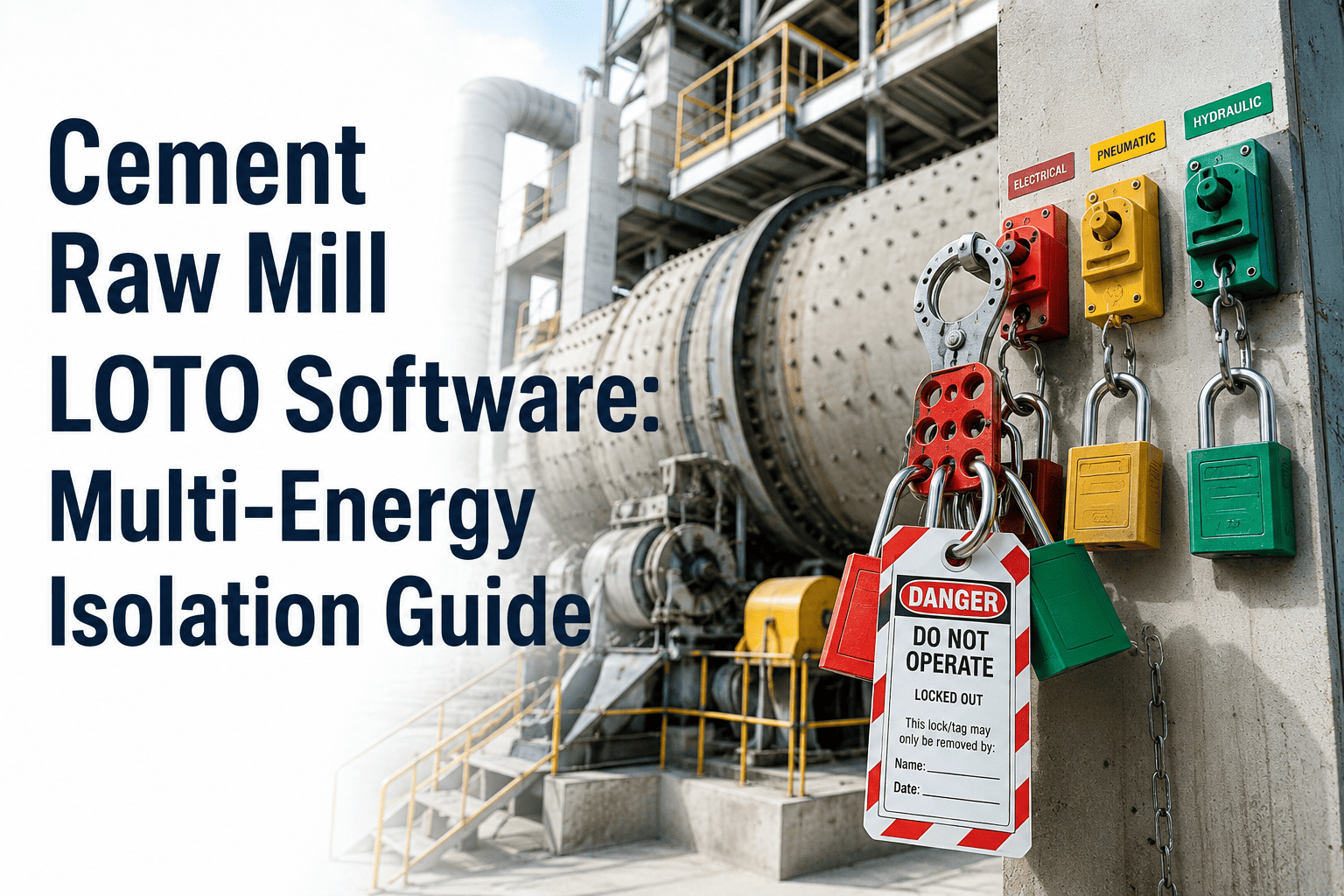
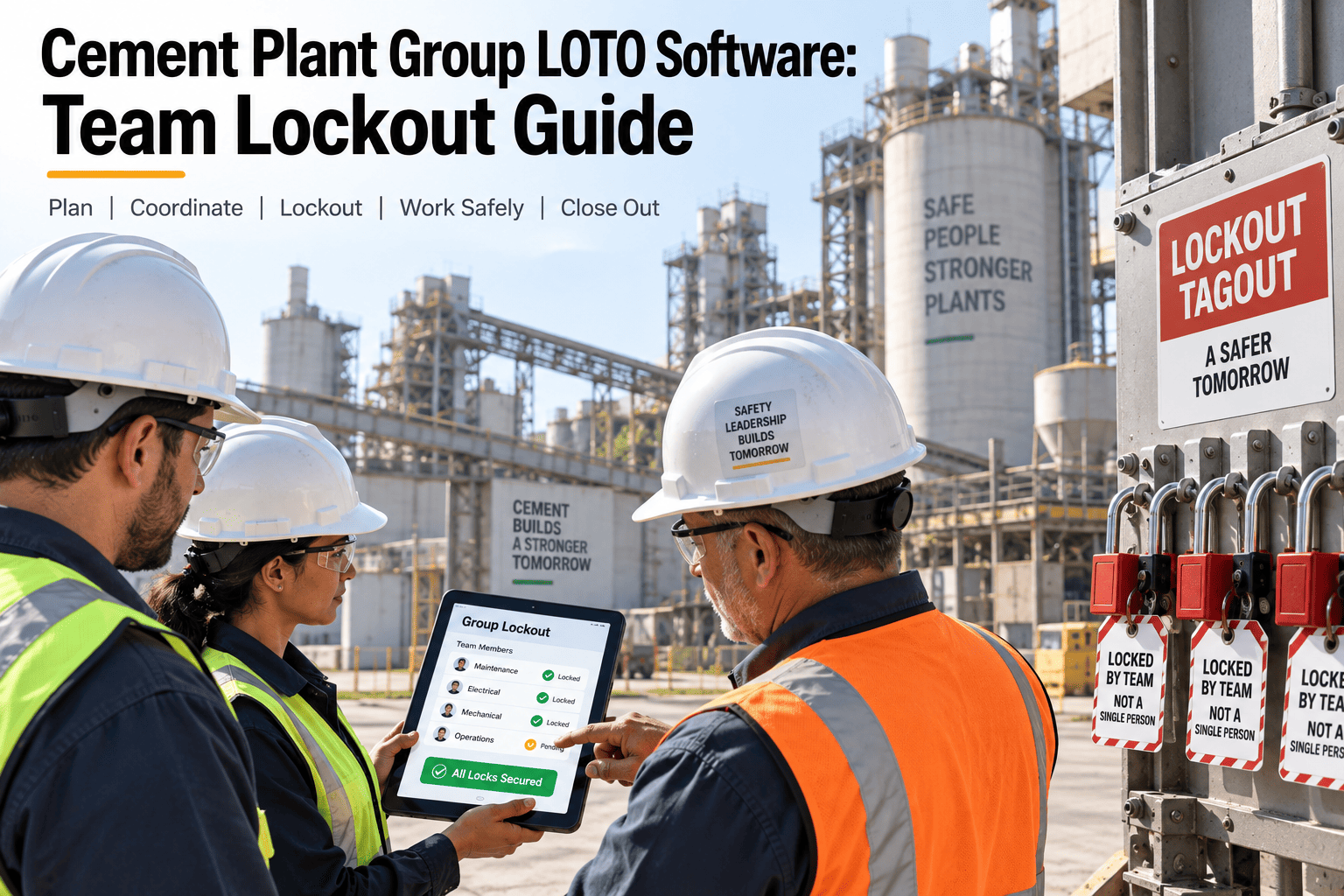
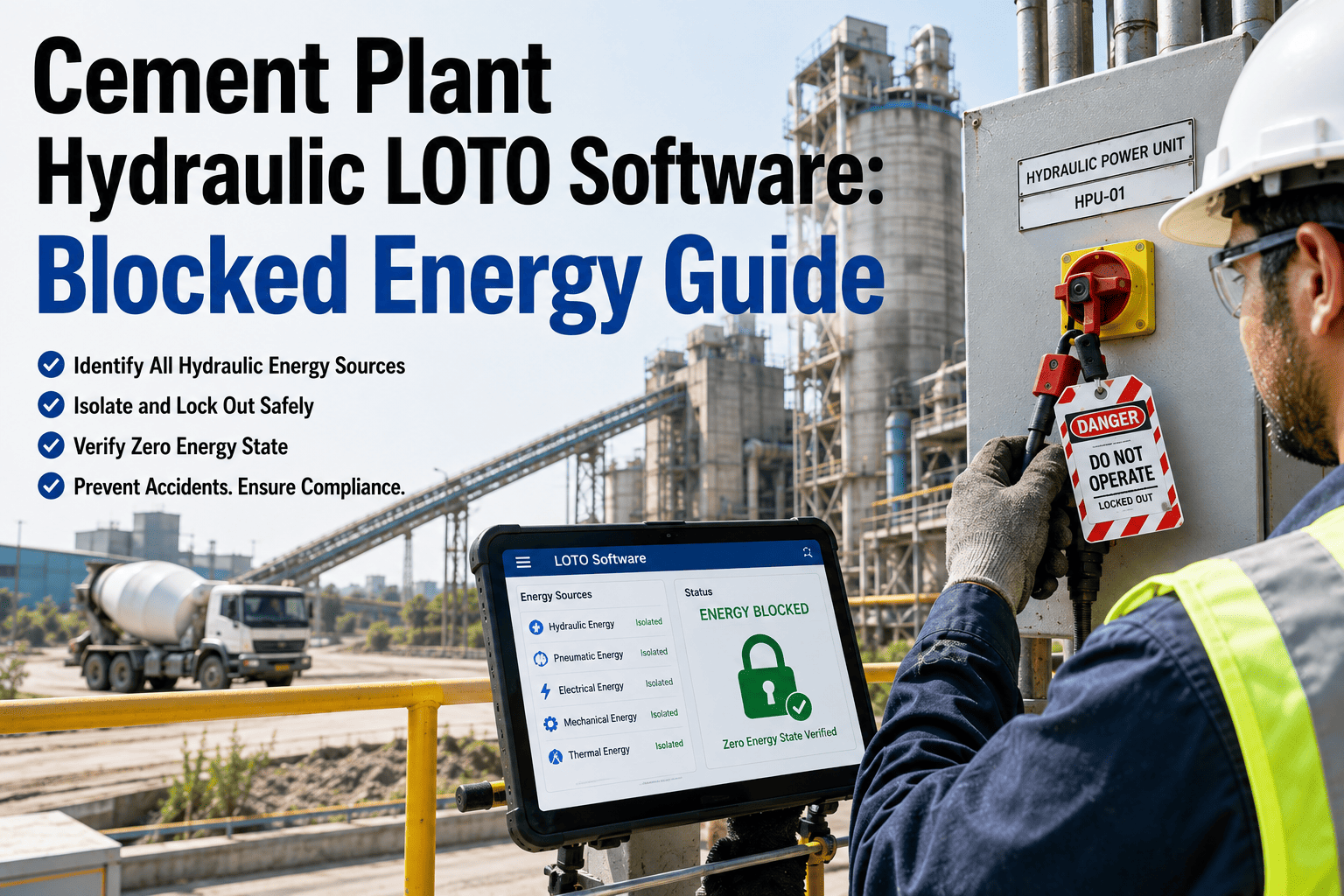
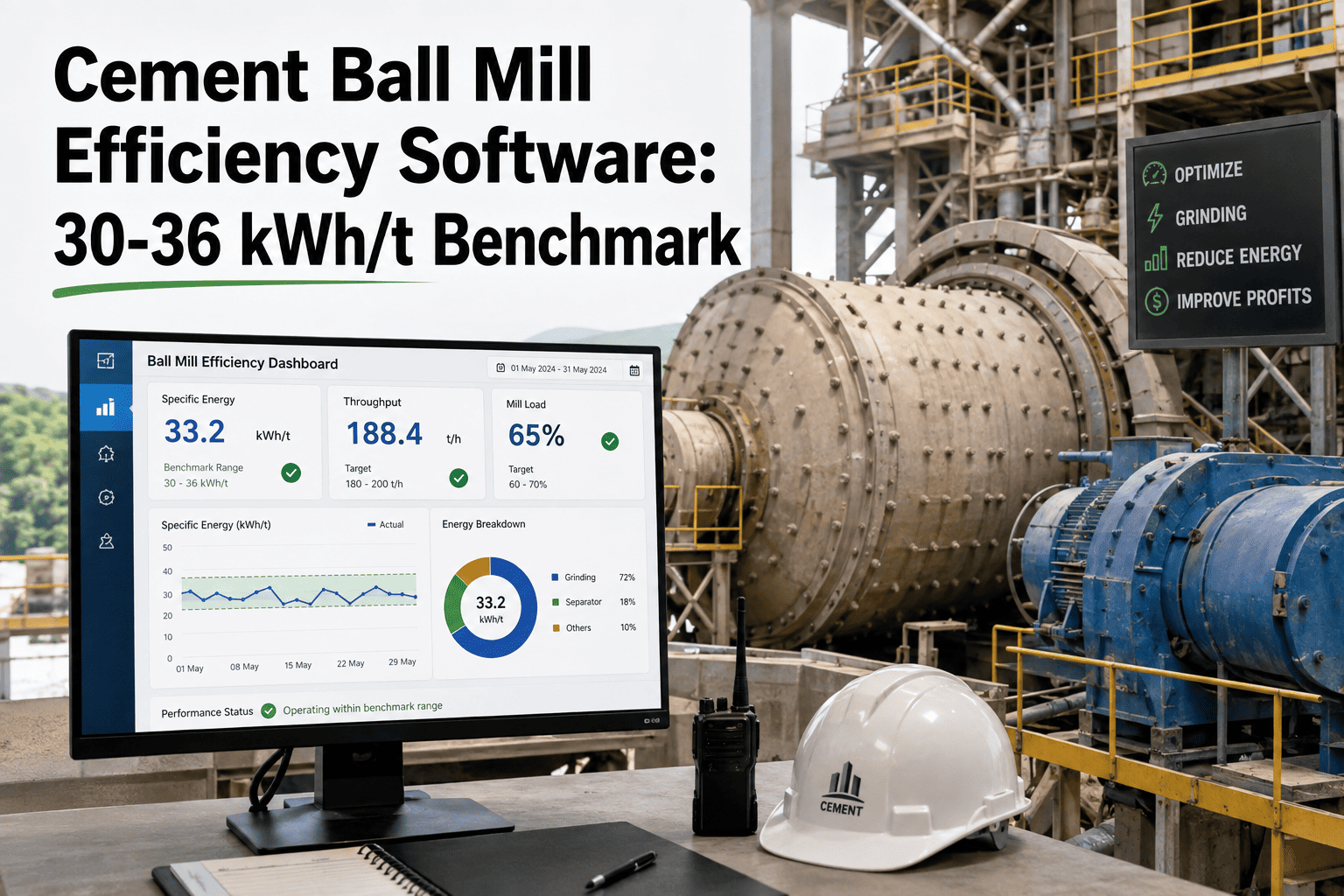
A cement raw mill is never truly "off" the moment the drive motor stops. A vertical roller mill can hold thousands of pounds of hydraulic pressure in its accumulators long after the pump shuts down, ready to drop a grinding roller onto anyone working beneath it. A ball mill can keep turning under its own momentum for several minutes after power is cut, driven by tonnes of steel ball charge inside the shell. Electrical, hydraulic, pneumatic, gravitational, and stored rotational energy all exist inside the same machine at the same time, and a paper lockout procedure written with one energy source in mind routinely leaves the other four unaddressed on the tag itself. Sign in to OxMaint to build a multi-energy raw mill isolation program that tracks every energy source, every isolation point, and every verification step in one digital record.
Digital LOTO · Raw Mill Safety
Cement Raw Mill LOTO Software Built for Machines With Five Different Energy Sources at Once
A raw mill is not one hazard, it is five stacked on top of each other. Electrical, hydraulic, pneumatic, gravity, and stored rotational energy all live inside the same VRM or ball mill circuit, and paper permits routinely miss at least one of them because nothing on the form forces a technician back to check it. OxMaint turns raw mill isolation into a guided, mill-type-specific digital workflow that requires a logged reading at every energy source before the next step unlocks — so a skipped accumulator check or an unverified coast-down can't quietly slip through on a busy shift.
5
energy types
present in a typical raw mill circuit at once
12–18
min
average ball mill coast-down time after motor stop
1
missed point
is enough to turn a routine isolation into a fatality
100%
digital trail
of every isolation, verification, and sign-off with OxMaint
Why Raw Mill Isolation Is Harder Than Almost Any Other Cement Asset
Most rotating equipment in a cement plant has one dominant energy source to control — cut the power and the hazard is largely gone. A raw mill breaks that assumption. Whether it is a vertical roller mill grinding limestone, clay, and additives to feed the kiln, or a ball mill running the same duty in an older or parallel circuit, the machine is simultaneously electrical, hydraulic, pneumatic, mechanical, gravitational, and in many plants thermal as well. A technician who isolates the motor breaker and walks in underneath a raised grinding roller, or steps inside a mill shell that is still coasting down, has completed a fraction of the job while believing it is finished. Because these energy sources don't announce themselves the way an energized breaker does — a pressurized accumulator looks identical to a depressurized one from across the room — the checklist itself has to carry the burden of remembering what a rushed technician might not. OxMaint's raw mill LOTO workflow builds that checklist automatically from the asset record and will not let a work order close out until every applicable energy source has been isolated and its zero-energy state confirmed with an actual reading.
Electrical
Main Drive, Auxiliaries, Controls
Main mill motor, lubrication pump motors, hydraulic power unit motor, separator or classifier drive, and local control panels each need their own breaker or disconnect locked, tagged, and individually verified dead with a meter — not assumed dead because the master feeder upstream is open.
Hydraulic
Roller Loading and Tramp Relief Systems
VRM roller loading cylinders are backed by nitrogen-charged accumulators that hold system pressure for hours, sometimes an entire shift, after the hydraulic pump stops. Bleeding accumulator pressure to zero and confirming it on a gauge is a distinct, mandatory step — locking out the pump motor alone leaves the stored pressure fully intact.
Pneumatic
Dust Collector and Damper Actuators
Pulse-jet bag filter cleaning cycles, pneumatic damper actuators, and rotary airlock valves on the mill circuit all run off compressed air lines that stay charged until the line is manually bled and physically blocked, entirely independent of whatever electrical isolation has already been applied to the same equipment skid.
Gravity
Raised Rollers, Hoppers, and Classifier Cages
A lifted grinding roller, a loaded feed hopper sitting above the mill throat, or a suspended classifier rotor cage all store gravitational energy that only a mechanical block, pin, or chain can restrain, because no amount of electrical or hydraulic isolation removes the weight itself or the fall path beneath it.
Rotational
Coast-Down of Table, Rotor, or Shell
A VRM grinding table or a ball mill shell loaded with steel charge keeps rotating for minutes after the motor is de-energized, driven by momentum the drive was overcoming a second earlier. Entry before a confirmed full stop and brake engagement is one of the most frequently reported near-miss triggers on raw mill work orders.
Thermal
Hot Gas Circuit and Residual Heat
Raw mills that use kiln exhaust or cooler air for material drying carry hot gas ducting directly into the mill housing, often above 200°C at the inlet. Damper isolation and a logged cool-down interval both need to be confirmed before internal access, especially before liner replacement or roller inspection work.
None of these six energy sources are exotic or rare — every raw mill on a modern cement line has some combination of them, and most plants already have procedures that name each one somewhere in a manual. The failure point is rarely knowledge, it is consistency: a procedure that lives in a binder gets followed carefully the first few times and then drifts as crews rotate, contractors fill in, and production pressure builds. A digital checklist that regenerates itself from the asset record every single time closes that drift, because it doesn't rely on a technician remembering which version of the procedure applies to which mill.
Every Energy Source, One Digital Permit, Zero Skipped Steps
OxMaint builds a raw mill isolation checklist that adapts to your mill type — VRM or ball mill — and will not let a technician close out a permit until every applicable energy source has been isolated, verified, and photographed with a timestamp attached to the work order.
VRM vs Ball Mill — How Isolation Requirements Actually Differ
A vertical roller mill and a ball mill grind the same raw feed to the same fineness target, but the energy profile a technician faces at each machine is meaningfully different, and the isolation sequence that keeps one safe can leave a dangerous gap on the other. Treating both mill types with an identical checklist is how a hydraulic accumulator step gets skipped on a VRM because the template was written for a ball mill's rotational hazard, or how a coast-down verification gets rushed on a ball mill because the template was built around a VRM's hydraulic bleed-down. Sign in to OxMaint to configure mill-type-specific isolation templates that match the actual equipment running on your floor, rather than a generic rotating-equipment permit.
Vertical Roller Mill
Ball Mill
Dominant stored energy risk
Hydraulic accumulator pressure on roller loading system
Rotational inertia of shell and steel ball charge
Typical coast-down time
3–6 minutes for table rotation to fully stop
12–18 minutes depending on charge weight and mill diameter
Isolation points typically required
7–9, including hydraulic bleed-down and accumulator gauge check
5–6, weighted toward drive lockout and brake verification
Gravity hazard location
Raised grinding rollers must be mechanically blocked before entry
Feed chute and elevator loading above the inlet trunnion
Verification method before entry
Zero-energy check on hydraulic gauge plus zero-speed on table
Zero-speed confirmation plus manual bar-over test on the shell
Digital tracking priority
Accumulator pressure log tied directly to the work order
Coast-down timer tied to permit issue time
The practical takeaway for a maintenance planner is that a "raw mill LOTO" work order template cannot be a single generic document if a plant runs both mill types, or is planning to add a VRM alongside an existing ball mill circuit. The equipment-specific detail — which gauge to read, how long to wait, which mechanical block fits which roller assembly — has to be attached to the asset itself so it travels with the work order automatically, rather than depending on whichever technician happens to remember the difference that day.
From Work Order to Verified Isolation — How the Digital Sequence Runs
A raw mill isolation procedure is only as strong as its weakest step, and paper permits fail most often at the handoff points — between shift changes, between departments, or between the electrician who kills the breaker and the mechanic who climbs inside the mill an hour later. Each handoff is a place where context gets lost: the paper tag says a lock was applied, but it doesn't say whether the accumulator gauge was actually read, or whether the second shift even knew a hydraulic isolation was pending when they came on. OxMaint replaces every one of those handoff gaps with a single digital record that every trade signs into and out of, in order, with no way to jump ahead. Book a demo to see the full raw mill isolation sequence running on a live work order from start to restart.
1
Identify
The work order pulls the mill-type-specific energy source list automatically from the asset record — VRM or ball mill — so the technician sees every applicable isolation point, including the ones easy to forget, before a single lock is applied to anything.
2
Notify
Affected operators, control room staff, and adjacent crews receive a mobile alert that the mill is being taken out of service, with the specific energy sources scheduled for isolation listed so no one attempts a remote start during the work.
3
Isolate
Each lock, tag, and mechanical block is scanned or photographed against its specific point on the checklist as it is physically applied — electrical breakers, hydraulic valves, pneumatic lines, and gravity blocks are all logged individually, by name, not as one bundled step.
4
Verify
Zero-energy checks — a voltage test, an accumulator gauge reading, a zero-speed confirmation, a bar-over test — are entered into the record as actual data points, not checkboxes, so a supervisor reviewing the permit can see the reading behind every sign-off.
5
Restore
Locks can only be released in the software once every trade that applied one has signed off individually to confirm their people are clear, and a try-out-before-restart step is required and logged before the mill is handed back to the operator.
The Real Cost of a Missed Raw Mill Isolation Step
A skipped isolation step on a raw mill rarely announces itself in advance. It shows up as a startled technician backing away from a roller that dropped six inches, or a mechanic feeling residual rotation on a shell they believed was fully stopped. Most of these events never become injuries, but every one of them is a warning that the isolation record for that job had a gap in it somewhere, and a warning that goes unrecorded on paper is a warning the next shift never hears about.
Near Miss
Roller Drop Under Partial Pressure
Accumulator bled partway but not confirmed at zero on a gauge. Roller settles under residual pressure during work, most often reported during liner or wear plate inspection with hands or tools already positioned beneath the assembly.
Near Miss
Entry Before Full Coast-Down
Technician enters the mill body on a fixed-timer assumption rather than a zero-speed device reading, and residual shell or table rotation is felt or heard before work begins, most common on ball mills with heavier charge loads.
Cost Driver
Extended Unplanned Downtime
A near miss during a raw mill isolation almost always halts the entire job for a full re-verification cycle, turning a planned four-hour maintenance window into a full-shift stoppage while the isolation is redone and re-inspected from step one.
Cost Driver
Incomplete Investigation Records
When the only record of an isolation is a paper tag with initials and a time, an EHS team investigating a near miss has no way to reconstruct which reading was taken, in what order, or whether a step was silently skipped under time pressure.
None of these outcomes require a serious injury to be expensive. A re-verification cycle alone can cost a shift of production on a mill that is already a bottleneck in the raw grinding circuit, and a near miss with no usable record behind it teaches the plant nothing it can act on for the next job. The fix is not asking technicians to move slower or fill out more paperwork — it is making the record itself impossible to falsify or skip, so the fast, correct path and the fully-documented path are the same path.
Classifying Raw Mill Isolation Points by Risk — What Gets Extra Scrutiny
Not every isolation point on a raw mill carries the same consequence if it is missed. OxMaint's raw mill templates weight each energy source by the severity of what happens if it is skipped, so the highest-risk steps — the ones most likely to be rushed under production pressure — get an extra verification requirement built into the digital permit.
Routine
Auxiliary Motor Lockout
Lubrication pumps and small auxiliary drives around the mill periphery. Single-person lock and standard tag, verified with a voltage test before entry into the immediate work area — low consequence if delayed, still mandatory on every permit.
Elevated
Pneumatic Line Isolation
Compressed air feeding dust collector actuators, dampers, and airlocks on the mill circuit. Requires an explicit line bleed confirmation, not just valve closure, since residual pressure trapped downstream of a closed valve can still actuate a device.
High
Main Drive and Coast-Down
Main motor lockout plus a mandatory wait period for full rotational stop of the table, rotor, or shell. A zero-speed device reading is required before the entry permit will unlock in the software, not a fixed timer alone.
Critical
Hydraulic Accumulator Bleed-Down
Stored pressure in VRM roller loading accumulators that persists independently of the pump. Requires a second-verifier gauge check confirming true zero pressure before any technician is authorized to work beneath a grinding roller.
Frequently Asked Questions
These are the questions maintenance planners, EHS managers, and mill technicians ask most often when they are moving a raw mill isolation program from a paper-based system to a digital one, or setting up isolation procedures for a raw grinding circuit for the first time.
How many energy sources does a cement raw mill actually have?
Most raw mills have five active energy sources at any given time: electrical, hydraulic, pneumatic, gravitational, and stored rotational energy in the coasting shell or table, with a sixth thermal source in plants where kiln exhaust gas is routed through the mill for material drying.
Sign in to OxMaint to generate the complete energy source list matched to your specific mill configuration.
Why is hydraulic accumulator pressure such a common miss on VRM isolation?
Accumulators are purpose-built to hold pressure independently of the pump, so a technician can correctly lock out the hydraulic power unit motor and still leave the roller loading system fully pressurized and capable of movement. A physical gauge reading at the accumulator is the only reliable confirmation of true zero energy.
How long should entry be delayed after a ball mill is shut down?
Coast-down time varies with charge weight, shell diameter, and bearing condition, typically running 12 to 18 minutes, and should always be confirmed with a zero-speed device or bar-over test rather than a fixed timer alone, since wear and lubrication condition can extend the actual stop time.
Can OxMaint apply different isolation checklists to VRM and ball mill assets automatically?
Yes. Each mill is tagged by type in the CMMS asset record, and the isolation checklist that populates on the work order matches that mill type automatically, including the correct verification method for its dominant stored energy risk.
Book a demo to see a raw mill asset configured this way inside the platform.
Does digital LOTO tracking actually help during an audit or incident investigation?
Every lock application, gauge reading, and sign-off is timestamped and attached to the work order, giving investigators and auditors an exact sequence of who isolated what, when each step was verified, and who authorized the eventual restart — without relying on a paper log that can be incomplete, illegible, or simply missing.
Your Raw Mill Has Five Energy Sources. Does Your LOTO Procedure Cover All Five?
OxMaint builds mill-type-specific digital isolation checklists for VRM and ball mill circuits, verifies every energy source with a logged reading instead of a checkbox, and keeps a complete, timestamped record of every lockout from first lock to final restart.