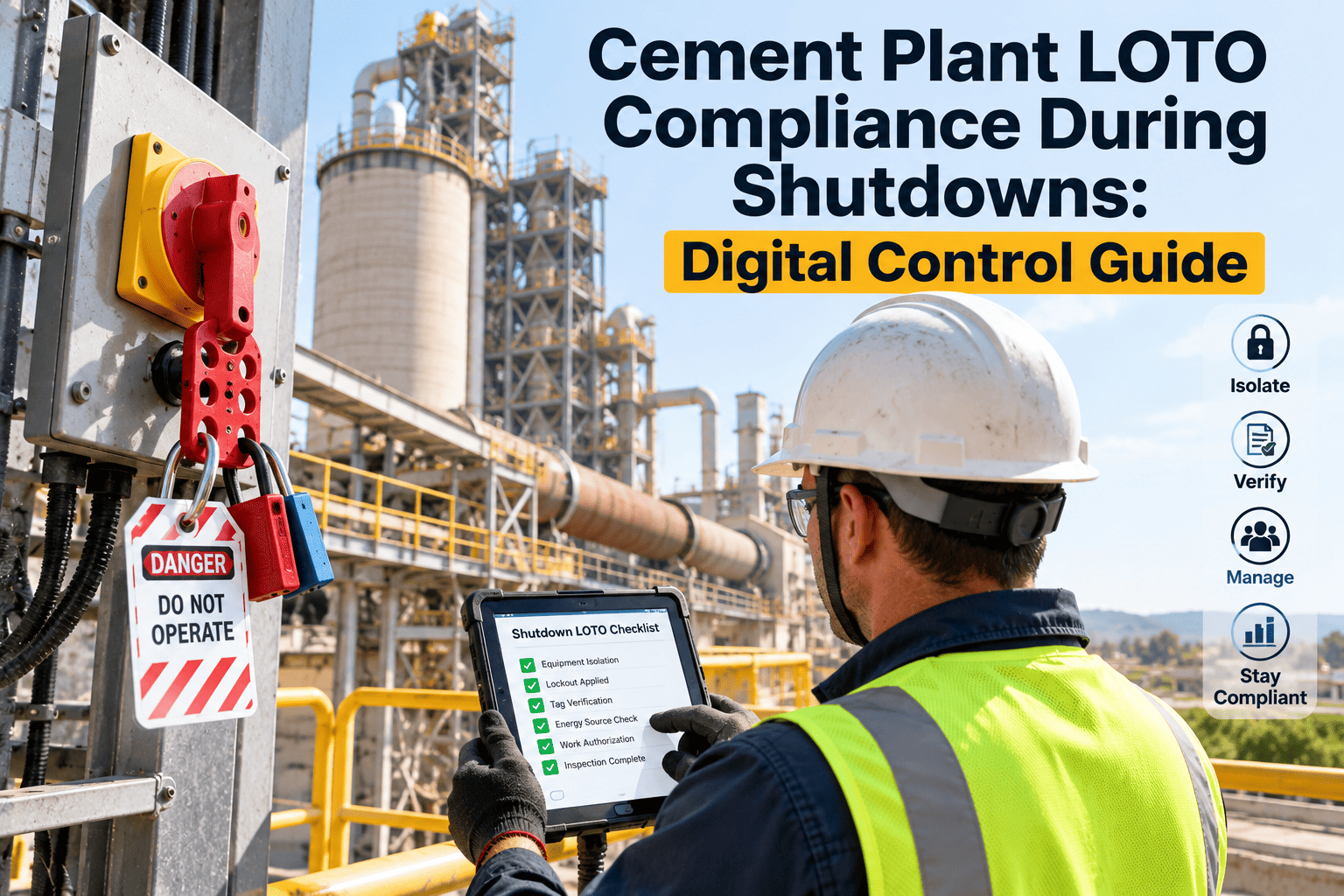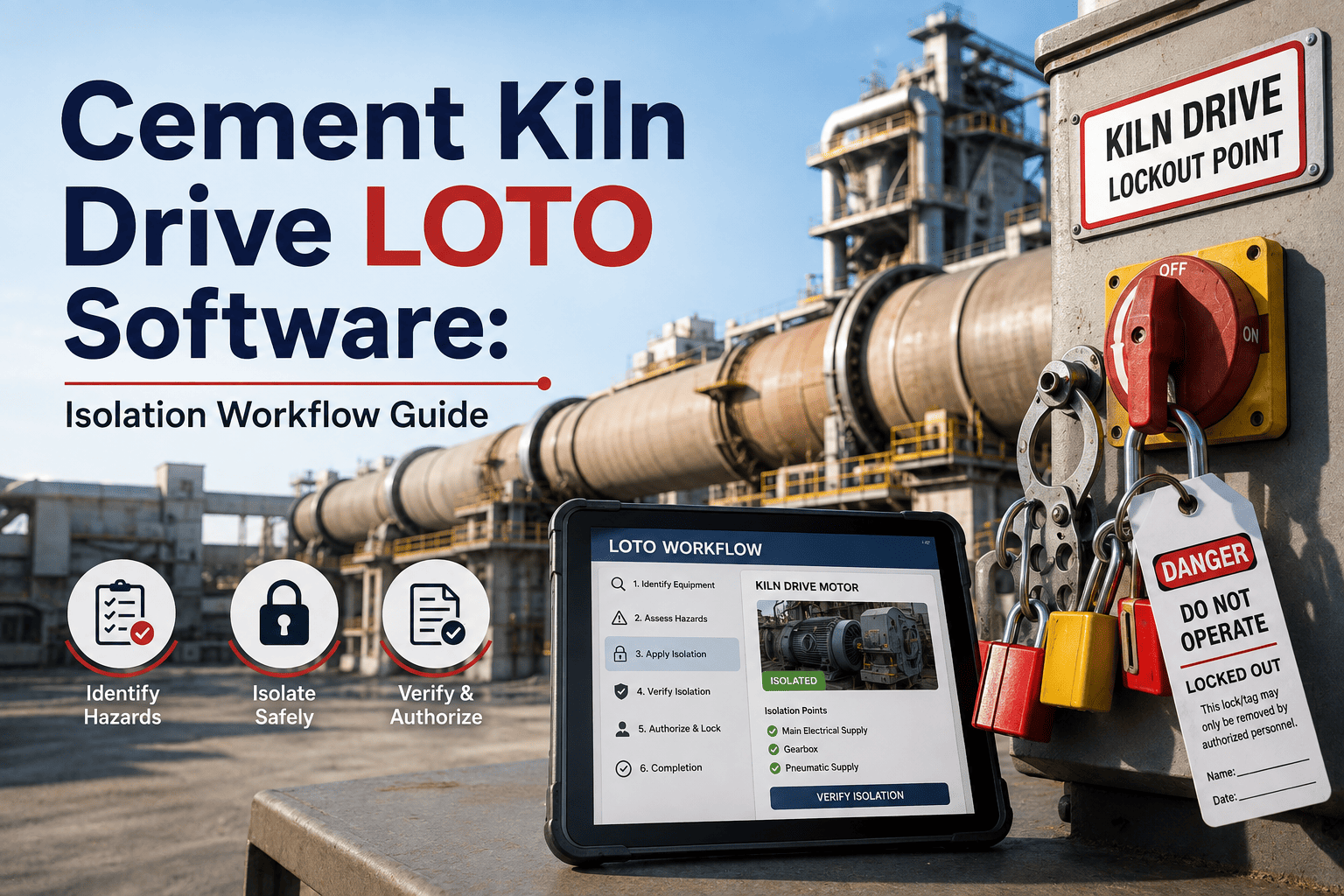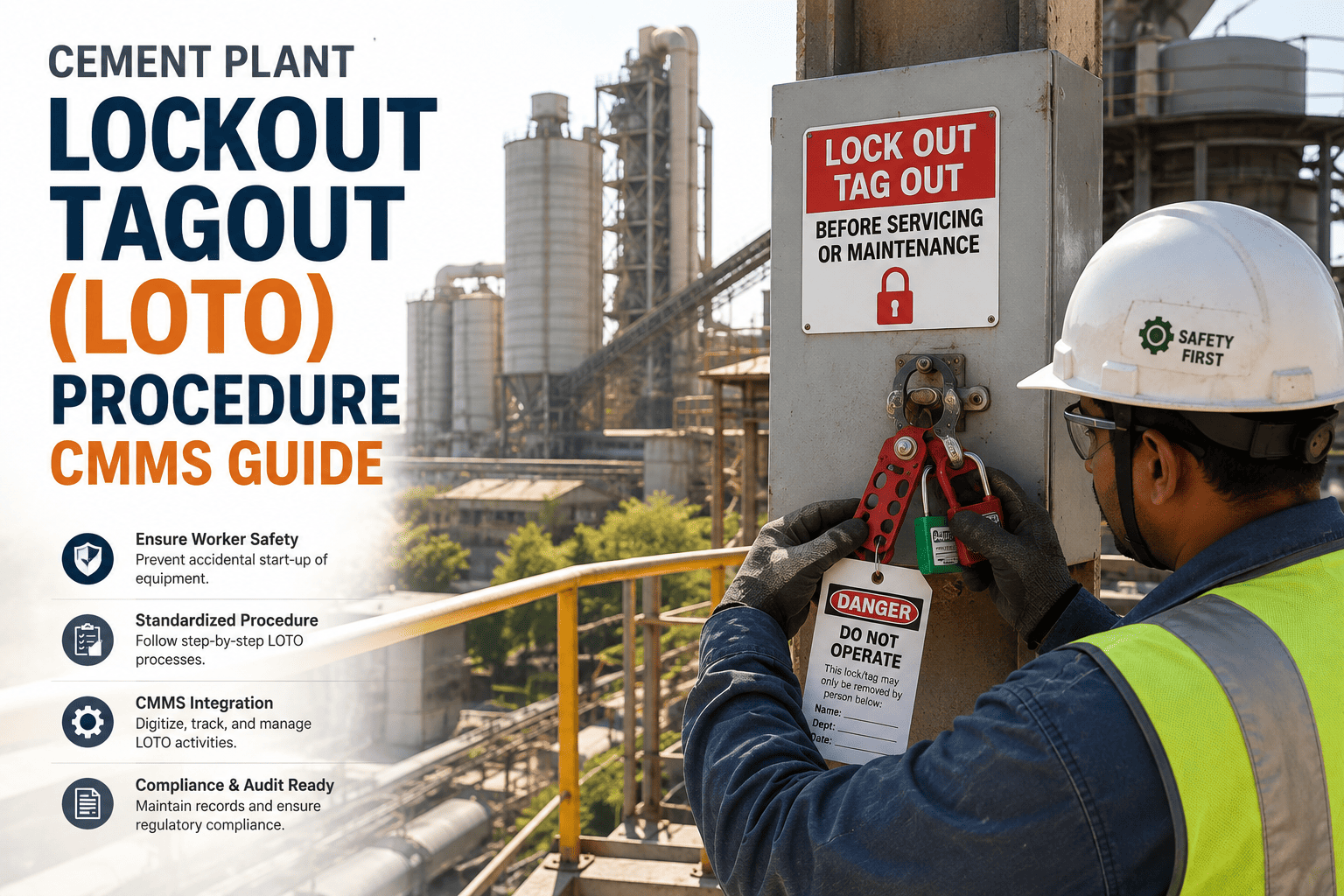
Lockout tagout violations rank among OSHA's most cited findings in cement manufacturing, and a single missed energy isolation step on a kiln drive or ball mill can cost a plant six figures in penalties and lost production. This guide breaks down the cement-specific LOTO procedures for crushers, conveyors, mills, and kiln drives, and shows how CMMS-based digital LOTO turns paper compliance into a defensible, audit-ready record. You can Start Free Trial at any point to see the workflow live.
Is every energy source on your kiln drive truly isolated before a mechanic touches it?
Across U.S. cement plants, 29 CFR 1910.147 remains one of the top three most-cited OSHA standards every year — and the average serious violation now exceeds $16,000. A defensible lockout tagout program identifies every energy source, verifies zero-state, and logs each step in a CMMS so an auditor can rebuild the timeline in minutes, not days.
The 6-Step LOTO Execution Flow for Cement Assets
From pre-shift lockout on a roller crusher to mill re-energization, every isolation follows the same six-gate sequence. Skipping verification at Step 5 is where 70% of serious LOTO incidents originate.
Notify & Document the Task
Operators log the work order in the CMMS, list affected assets (kiln drive, ID fan, preheater fan), and notify all affected shifts before any breaker is touched.
Map Every Energy Source
Electrical, hydraulic, pneumatic, thermal, stored kinetic, and gravitational — a ball mill alone carries residual heat and a loaded charge that must be released before entry.
Disconnect & Block Energy
Open the main disconnect, close bleed valves, chock the conveyor belt, and block the crusher jaw. Each device gets a unique CMMS-tracked lock and tag.
Apply Locks & Tags
Each authorized worker applies a personal padlock to the group lockbox. The CMMS records the worker ID, lock serial, timestamp, and GPS coordinates of the isolation point.
Test Zero-Energy State
Attempt start from the control room, then test voltage at the motor terminals and confirm bleed-down pressure reads zero. This is the step most commonly skipped — and most commonly fatal.
Remove Locks & Re-energize
Workers remove personal locks in reverse order, the CMMS confirms all locks are returned, and a controlled re-energization sequence restarts the kiln or mill line.
Energy Sources by Cement Plant Equipment
A cement plant runs on at least six energy types across dozens of high-hazard assets. The table below maps each major equipment class to its isolation points and the stored energy that injures workers when ignored.
| Equipment | Energy Types | Primary Isolation Points | Stored Energy Risk | Verify Before Entry |
|---|---|---|---|---|
| Kiln Drive | Electrical, Mechanical, Thermal | Main motor breaker, auxiliary drive coupling | Residual rotation, 350°C+ shell heat | Zero RPM, shell temp <50°C |
| Ball Mill | Electrical, Gravitational, Kinetic | Motor disconnect, clutch lock pin | Loaded media charge (90+ tons) | Mill chocked, clutch pinned |
| Conveyor Belt | Electrical, Gravitational, Pneumatic | Drive motor, take-up winch lock | Belt tension, counterweight drop | Take-up pinned, belt chocked |
| Crusher | Electrical, Hydraulic, Mechanical | Motor breaker, hydraulic relief block | Jaw tension, trapped oversize rock | Hydraulic pressure = 0, jaw cleared |
| ID / Preheater Fan | Electrical, Kinetic, Thermal | Fan motor VFD disconnect, damper lock | Coast-down inertia (8–12 min) | Zero RPM confirmed, damper closed |
How a CMMS Makes LOTO Defensible
Paper tags fail audits because they cannot prove who did what, when, and in what order. A CMMS captures the digital trail that turns a clipboard ritual into evidence-grade compliance.
Equipment-Specific Procedures
Each asset carries its own digital lockout procedure — energy sources, isolation points, and verification steps attached directly to the work order, so no mechanic works from memory.
Time-Stamped Audit Trail
Every lock applied, verified, and removed is logged with worker ID, asset ID, and timestamp. An OSHA inspector's document request that once took three days now exports in under 90 seconds.
Mandatory Verification Gates
The CMMS blocks work-order advancement until the zero-energy test is photo-confirmed, making it structurally impossible to skip Step 5 — the step that prevents fatalities.
Group Lockbox Management
Multi-craft jobs on a kiln line require a group lockbox. The CMMS tracks every personal lock on the box and alerts the supervisor if a lock is still attached at shift change.
A 1.8-MTPA Plant Cuts LOTO Dwell Time by 64%
A mid-size cement plant running two kiln lines and 14 grinding mills was averaging 47 minutes of lockout dwell time per maintenance event — most of it spent locating procedures and chasing shift supervisors for signatures.
"The digital procedure is on the mechanic's tablet before they reach the disconnect. We cut lockout time by 30 minutes per event and our last OSHA audit closed with zero LOTO findings — the inspector reviewed six months of records in one afternoon."
— Reliability Manager, 1.8 MTPA Cement Plant, TexasStop gambling with paper tags on a 1,400°C kiln.
Deploy CMMS-based LOTO across your cement plant in under two weeks. Your auditors, mechanics, and insurance underwriter will all sleep better.
Cement Plant LOTO — Answers That Hold Up in an Audit
Does OSHA require energy isolation for pneumatic and stored energy, not just electrical?
Yes. 29 CFR 1910.147 covers all hazardous energy — electrical, hydraulic, pneumatic, mechanical, thermal, chemical, and gravitational. In a cement plant, stored energy in a loaded ball mill or pressurized conveyor take-up is just as lethal as a 4,160V kiln drive. Every energy source must be isolated, blocked, and verified before any servicing begins.
How does a CMMS prove LOTO compliance during an OSHA inspection?
The CMMS generates a time-stamped audit trail for every isolation event: which worker applied which lock, at what asset, at what time, and when the zero-energy verification was photo-confirmed. Inspectors can filter by date, asset, or worker and export the full chain in minutes. To see this in action, Book a Demo and we will walk through a sample audit export.
What is the most common LOTO failure point in cement plants?
Skipping the zero-energy verification step. Mechanics trust the disconnect is open and skip testing for residual voltage, stored pressure, or rotational inertia. The CMMS closes this gap by blocking the work order from advancing until a verification photo or sensor reading is attached — making the skip structurally impossible.
How often should cement plant LOTO procedures be re-audited?
OSHA requires an annual inspection of each energy control procedure by an authorized employee other than the one using it. Cement plants with high equipment-modification rates — new grinding aids, kiln upgrades, conveyor extensions — should audit quarterly. The CMMS auto-schedules these reviews and flags any procedure that has not been inspected within 12 months.
Can digital LOTO handle group lockout on a multi-craft kiln shutdown?
Yes. A CMMS group lockbox module tracks every personal lock applied to the box, alerts the supervisor if a lock remains at shift change, and prevents re-energization until all locks are electronically returned. For a full kiln shutdown involving mechanical, electrical, refractory, and instrumentation crews, Start Free Trial to test the group lockout workflow on your own asset register.
Turn LOTO from a clipboard ritual into a defensible safety system.
Join the cement plants using Oxmaint to lock out faster, verify every time, and pass every audit without scrambling for paper records.
Free 14-day trial · No credit card