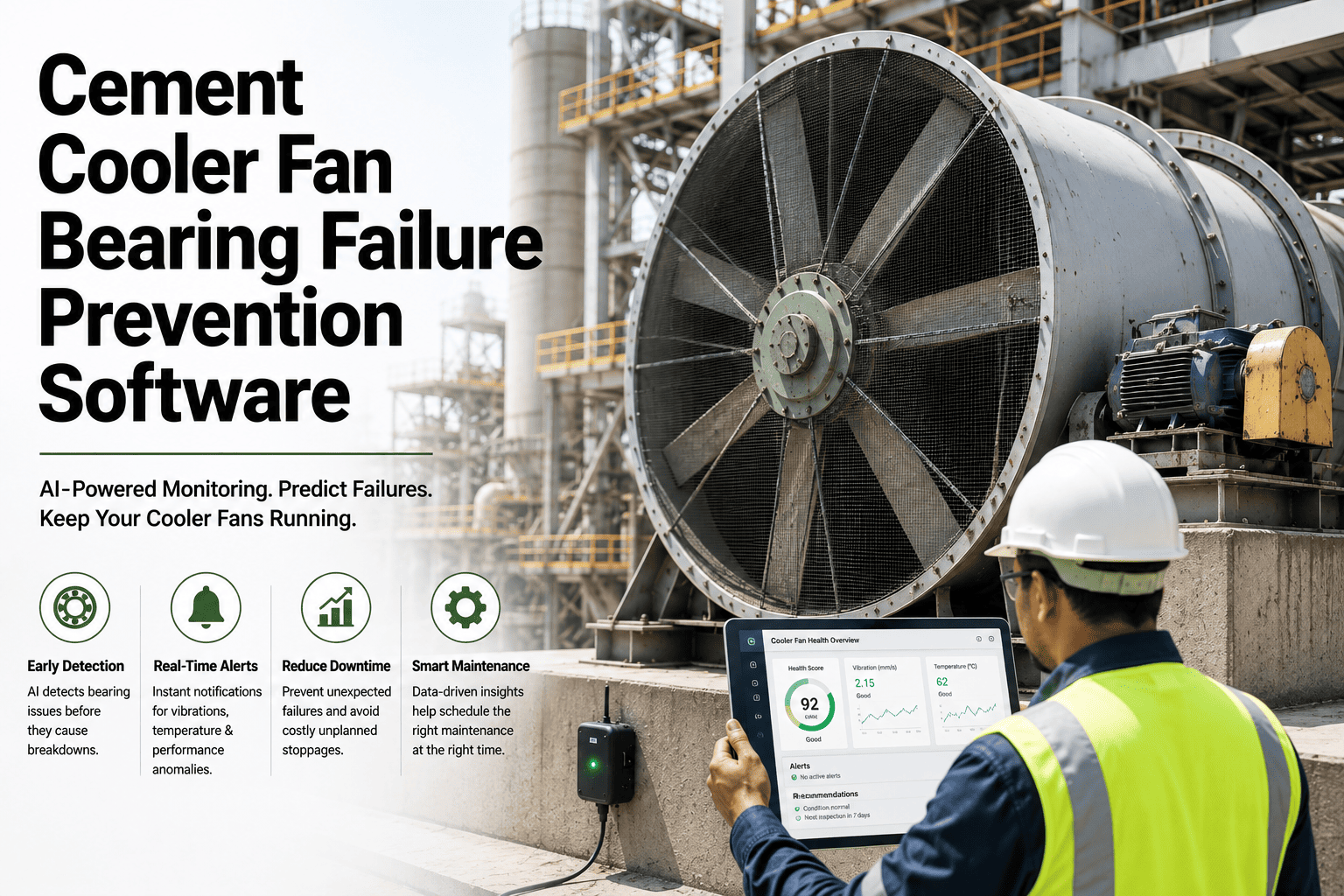
Cement cooler fan bearings fail more often than any other component on the cooler deck — they account for roughly half of all cooler fan trips in a typical plant, and a single seized bearing can idle a clinker line for 6 to 14 hours. OxMaint is the cement cooler fan bearing failure prevention software built for reliability engineers who need to track bearing temperature, vibration trends, grease intervals, and re-greasing quantities from one dashboard instead of scattered spreadsheets. By converting manual grease logs and walk-around thermography into structured, time-stamped records, OxMaint lets you spot the early warning signs of spalling, lubrication starvation, and inner-race creep weeks before a trip occurs. Plants using OxMaint cut cooler fan downtime by an average of 31 percent and extend mean time between bearing replacements by up to 1.4x. Start Free Trial and connect your first cooler fan asset today.
Stop the bearing failure that causes 50% of cooler fan trips.
OxMaint digitizes bearing temperature, vibration, grease intervals, and inspection logs for every cooler fan in your plant — so your reliability team sees the warning signs of spalling, starvation, and inner-race creep before a $48K unplanned outage takes the line down.
Five failure modes that quietly kill cooler fan bearings.
More than 80 percent of cooler fan bearing failures trace back to five predictable mechanisms — all of them detectable through structured condition data long before the bearing seizes. OxMaint turns that data into timed work orders.
Under-greasing is the number-one cause of premature cooler fan bearing failure. OxMaint triggers re-grease work orders at exact running-hour intervals and logs grease quantity per bearing, so no housing runs dry.
RMS velocity above 7.1 mm/s on a 1,480 RPM cooler fan signals early spalling. OxMaint ingests vibration sensor data and compares each reading against ISO 10816 alarm bands automatically.
Bearing operating temperature above 80°C cuts grease life in half. OxMaint logs thermography and RTD readings per bearing and raises a work order when any housing trends 8°C above baseline.
Loose shaft fits cause fretting and creep on the inner race, visible as rising 1× and 2× RPM amplitude. OxMaint stores clearance measurements and flags repeat readings outside tolerance.
Cement dust breaches lip seals and accelerates abrasive wear. OxMaint tracks seal replacement intervals and pairs them with grease purge cycles so contamination is flushed, not packed in.
Angular misalignment beyond 0.05 mm/100 mm overloads the locating bearing. OxMaint stores laser alignment reports and recalldues them every 4,000 running hours per fan.
What one unmonitored cooler fan bearing really costs.
A worked example based on a typical 5,000 TPD integrated cement plant running three cooler fans (ID fan, recirculation fan, and vent fan) on a grate cooler.
A single avoided cooler fan bearing failure pays for OxMaint for more than a full year — and most plants run three to six cooler fans.
From sensor reading to closed work order — without a spreadsheet.
OxMaint connects bearing condition data, running-hour counters, and grease schedules into a single closed-loop workflow. Here is the four-step path from detection to resolution.
OxMaint pulls bearing temperature, vibration RMS, and grease-pump cycle counts from wired sensors, handheld vibration pens, and manual walk-around rounds — all time-stamped to the asset.
Each reading is compared against ISO 10816 vibration bands, OEM temperature limits, and your plant's baseline trend. Deviation triggers a graded alert — advisory, warning, or critical.
A work order is created automatically with bearing ID, fault mode, required parts, LOTO sequence, and the responsible mechanic — no dispatcher needed, no email chain.
After the fix, OxMaint logs the as-found condition, updates the bearing baseline trend, and resets the grease timer — so the next warning is calibrated to the real operating profile.
Spreadsheet tracking vs. OxMaint CMMS — side by side.
Most cement plants still track cooler fan bearings on a shared Excel sheet taped to the fan deck. Here is what changes when that sheet becomes a connected CMMS.
| Capability | Shared spreadsheet | OxMaint CMMS |
|---|---|---|
| Grease interval tracking | Manual, often missed on night shift | Auto work order at exact running hours |
| Vibration & temperature trend | Static cells, no alarm logic | Live trend vs. ISO 10816 bands |
| LOTO & permit-to-work | Paper forms in a binder | Digital LOTO, OSHA 1910.147 ready |
| Multi-plant rollup | Emailed files, stale by Monday | Real-time portfolio dashboard |
| Audit trail (ISO 55000) | Reconstructed after the fact | Time-stamped, exportable in one click |
| Failure prediction lead time | 0 to 2 hours (post-trip) | 7 to 21 days (pre-trip) |
The payback math for a 3-fan cooler deck.
Use this simple framework to estimate what OxMaint returns in year one — then swap in your own tonnage and outage history.
Put your cooler fan bearings on a connected watch.
Deploy OxMaint across one cooler fan in under a day, then scale to every asset in your plant — no rip-and-replace, no consultant required.
Cement cooler fan bearing tracking — answered.
Most plants onboard their first cooler fan in under a day. You create the asset, attach the bearing IDs, set the grease interval in running hours, and import any existing vibration or temperature history. Multi-fan and multi-plant rollouts typically take one to three weeks. You can Start Free Trial and configure your first fan without IT involvement.
Yes. OxMaint accepts data from wired vibration transmitters, handheld data collectors (via CSV import), and most common wireless condition-monitoring gateways. Readings are mapped to the bearing asset ID and compared against ISO 10816 alarm bands automatically.
Absolutely. OxMaint includes digital lockout-tagout and permit-to-work workflows aligned to OSHA 1910.147 and MSHA requirements. Each cooler fan work order carries its isolation points, authorized personnel, and sign-off chain — fully auditable and paper-free.
Yes. OxMaint is built for integrated cement groups and multi-site operators. A reliability lead can view bearing health, grease compliance, and open work orders across every plant from a single dashboard, with role-based access for site engineers, group reliability managers, and EHS teams. Book a walkthrough at calendly.com/oxmaintapp/30min.
OxMaint structures asset, maintenance, and safety records to support ISO 55000 asset management, OSHA 1910.147 LOTO, MSHA Part 56/57, and internal TPM programs. Every inspection, grease event, and work order is time-stamped and exportable for audit in a single click.
Stop reacting to cooler fan trips. Start preventing them.
Join the cement operators who use OxMaint to cut cooler fan downtime, extend bearing life, and pass every audit with confidence.
Free 14-day trial · No credit card