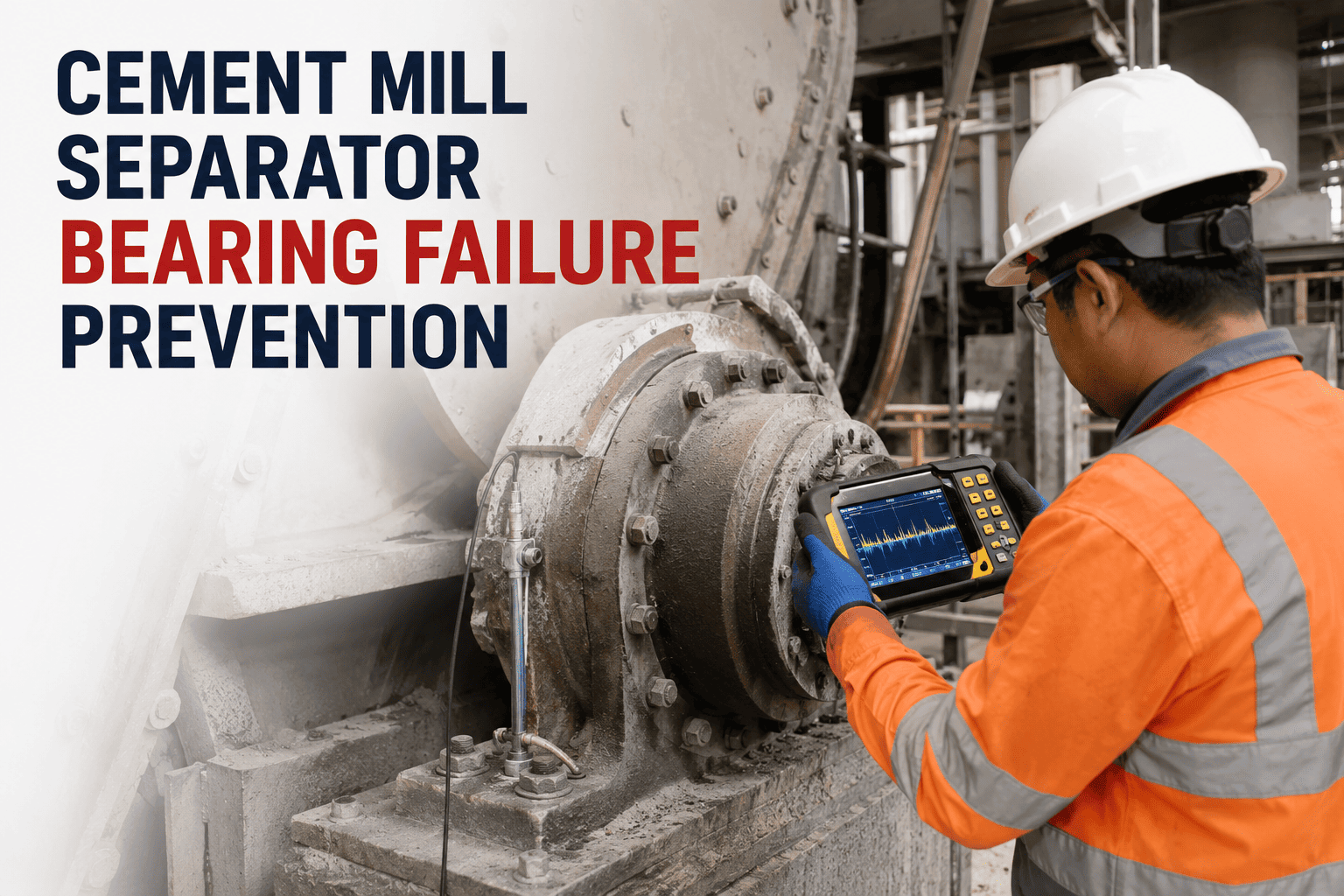
A separator drive bearing rarely fails without warning — it fails without anyone watching. Motor current signature analysis on separator drives can now flag stator winding degradation and bearing wear three to five weeks before failure, turning what would have been a $95,000 emergency motor replacement into a $22,000 planned intervention during a scheduled window. Yet most cement plants still send a technician on a monthly or quarterly handheld vibration round, a schedule built for slow-developing faults on equipment that does not deteriorate slowly. Oxmaint's predictive maintenance module closes that detection gap for the separator bearings sitting between your mill and your product quality.
Cement Mill Separator Bearing Failure Prevention
The separator sits between the mill and the product — and its bearings fail on a timeline measured in weeks, not months. Here is the failure curve, the detection window, and the maintenance workflow that catches it early.
Why Separator Bearings Deserve Their Own Monitoring Program
The separator is not the mill's biggest asset, but it is the one controlling the fineness of every tonne that leaves the circuit. A degrading separator bearing changes drive vibration and current draw before it changes product quality — which means the plants watching only Blaine and residue data are always finding out last. CMMS-driven inventory management also determines whether the correct bearing is on the shelf when the alert fires.
Lubrication Starvation
Grease intervals set by calendar rather than running hours leave separator bearings under-lubricated during high-throughput periods, accelerating raceway wear.
Misalignment After Reline
Separator internals are frequently disturbed during mill relines. Drive alignment is rarely re-verified afterward, introducing a persistent load imbalance.
Dust Ingress
Seal degradation allows fine cement dust into the bearing housing, contaminating grease and accelerating abrasive wear far faster than fatigue alone.
Variable Load Cycling
Frequent separator speed changes to chase fineness targets subject the bearing to repeated load transients that a fixed-speed drive would never see.
A $340K Emergency Repair vs an $18K Planned Bearing Change — Same Failure, Different Timing
Continuous monitoring on separator drives converts catastrophic mechanical failure into a scheduled maintenance line item, with three to five weeks of lead time to plan the intervention around production.
Three Signals, One Bearing Health Score
No single sensor tells the whole story on a separator drive. Oxmaint combines three independent data streams into one bearing health score so a genuine defect is distinguished from normal operating variation.
Vibration Spectrum
Tracks BPFO, BPFI, BSF and FTF defect frequencies against baseline to catch bearing-specific fault signatures.
Motor Current Signature
Subtle current draw changes reveal bearing drag and load imbalance three to five weeks ahead of periodic inspection.
Bearing Temperature Trend
Housing temperature drift confirms the mechanical picture and helps rule out false alarms from ambient or process heat.
Cost of Reactive vs Predictive — Separator Bearing Events
| Response mode | Typical cost | Downtime | Lead time to plan |
|---|---|---|---|
| Reactive — bearing seizes in service | $95,000+ | 2–4 days | None — emergency response |
| Route-based monthly vibration | $45,000–$60,000 | 1–2 days | Days, if defect caught in time |
| Continuous predictive monitoring | $18,000–$22,000 | Scheduled window | 3–5 weeks |
Frequently Asked Questions
How early can a separator bearing defect actually be detected?
With continuous vibration and motor current monitoring, defect frequencies associated with early-stage bearing wear can typically be identified three to five weeks before a functional failure would occur. This window exists because sub-surface fatigue and early spalling generate detectable frequency signatures well before vibration amplitude or temperature rise enough for a technician to notice during a routine walkaround. Book a demo to see the detection window mapped for your separator fleet.
Is monthly handheld vibration analysis enough for separator bearings?
For slow-developing faults on general rotating equipment, periodic handheld analysis is often adequate. Separator bearings under variable load cycling can progress from first detectable defect to failure within six to eight weeks, meaning a monthly round can miss the entire early-warning window entirely. Plants relying solely on monthly rounds are effectively finding most bearing defects at the temperature-alarm stage, which leaves little time to plan the repair.
What is the difference between BPFO and BPFI in a bearing fault reading?
BPFO refers to the ball pass frequency outer race, and BPFI refers to the ball pass frequency inner race — both are calculated defect frequencies specific to a bearing's geometry and rotational speed. A vibration spectrum showing energy concentrated at one of these frequencies, rather than general broadband noise, is a strong indicator of a developing race defect rather than imbalance or misalignment. ABC classification for spare parts helps ensure the correct replacement bearing is stocked once a defect is confirmed.
Can motor current signature analysis replace vibration monitoring on separator drives?
Motor current signature analysis is a strong complementary technique rather than a replacement — it is highly effective at detecting electrical faults and bearing-induced load changes through current draw patterns, but vibration analysis remains more precise for pinpointing the specific bearing component and fault stage. Combining both, as Oxmaint does in its bearing health score, produces fewer false positives than either technique used alone. Start free in Oxmaint to combine both signals on your separator assets.
How does a separator bearing failure actually affect cement quality, not just downtime?
As a separator bearing degrades, drive vibration and load imbalance can subtly affect separator speed stability and classification efficiency before the bearing fully fails, producing inconsistent Blaine fineness or off-spec residue in the finished product. This means a bearing issue can generate a quality non-conformance well before it generates a mechanical alarm, which is why linking bearing health data to product quality trends closes an investigation gap most plants do not realize exists.
Give Your Separator Bearings the Same Monitoring Rigor as Your Kiln
Vibration, motor current, and temperature — combined into one bearing health score, with work orders generated automatically weeks before failure.