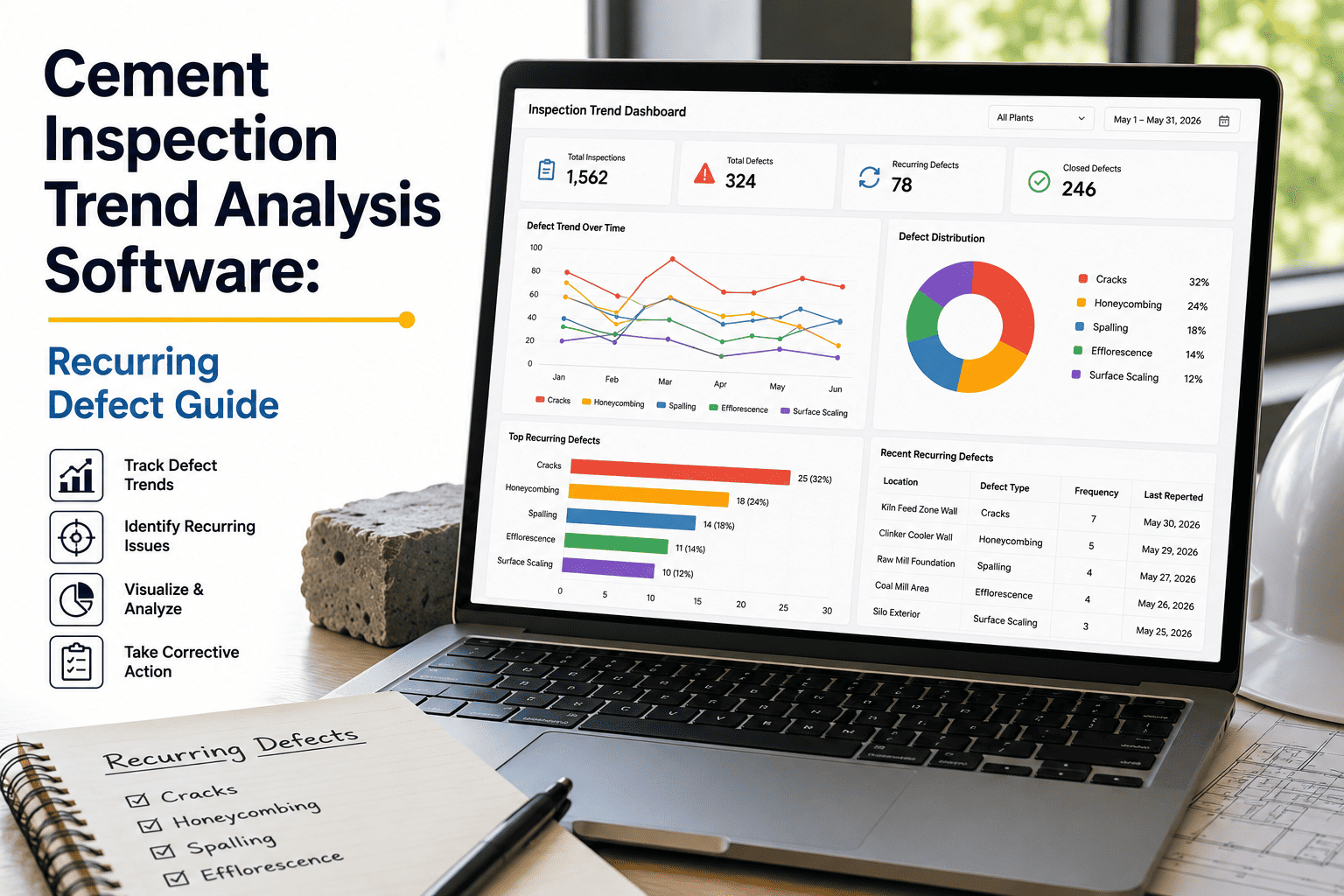
A crack in a preheater cyclone gets patched in March. It reopens in July. It reopens again in November. Three work orders, three technicians, three isolated repairs — and nobody in the plant ever connects the dots because the inspection sheets live in three different binders. This is how cement plants lose millions to failures that were never actually unpredictable, only unconnected. Cement inspection trend analysis turns scattered inspection observations into a single defect history per asset, using a platform like OxMaint CMMS.
Cement Inspection Trend Analysis Software
Every inspection observation, connected across shifts, checkpoints, and shutdowns — so the fourth repeat failure never gets a chance to happen.
Most cement plants inspect diligently. Very few ever look backward across those inspections to see what keeps coming back — and that blind spot is where the expensive failures live.
70%
Failures Are Repeats
Of rotating-equipment breakdowns trace back to a defect noted once and never tracked again
3-5
Rounds Missed
Prior inspection cycles where the defect was already visible before the stoppage
1,200+
Checkpoints Per Plant
Typical inspection checkpoints across kiln, mills, coolers and conveyors
40%
Lower MTTR
Reported reduction in repair time when defect history is visible on-site
The Core Problem: A defect noted on a paper sheet in March is invisible to the technician standing at the same checkpoint in July. Without a connected history, every recurrence looks like a first occurrence.
A trend is only visible once individual observations are connected. Here is how one noted defect becomes plant-wide intelligence.
Technician records a defect against the exact asset tag and checkpoint during a routine round — vibration, heat, wear, leak, or noise.
The system checks the same checkpoint's history and flags whether this defect has been logged before, and how often it recurs.
Recurring defects appear on a reliability dashboard ranked by frequency, downtime cost, and days-to-repeat.
Reliability teams launch a root-cause work order instead of another repair, closing the loop paper logs never close.
One repeat defect. One missed pattern. One preventable stoppage. OxMaint links every inspection to asset history automatically, so recurring defects surface on their own.
These are the defect families that show up again and again across kiln, mill, and material-handling inspections.
R
Rotating Equipment Defects
Bearing & vibration drift: slow creep on kiln support rollers and fan bearings, often cleared informally instead of trended
Girth gear wear: tooth wear and lubrication faults on kiln and mill gears, caught visually but rarely logged with measurements
S
Structural & Refractory Defects
Refractory spalling: localized brick loss in the burning zone reappearing at the same shell coordinates after every relining
Coating buildup: preheater and calciner blockages repeating at the same cyclone stage across shutdowns
M
Material Handling Defects
Belt misalignment: conveyor tracking corrected on the spot but recurring weekly at the same transfer point
Seal & gasket leakage: kiln inlet and outlet leaks noted as minor each time, masking a growing wear pattern
The gap between the two isn't effort — it's whether yesterday's observation is visible today.
Reliability teams shouldn't have to remember what a checkpoint looked like last time. Let the system remember for them.
The Challenge
The reliability team suspected recurring failures were driving cost but had no way to prove which defects kept repeating across 1,400 inspection checkpoints, since every observation lived on a separate paper sheet.
Solution Implemented
Inspection checklists moved into OxMaint's trend engine, linking every checkpoint to its full defect history and auto-flagging repeats above a set frequency threshold.
Results (6 Months)
Repeat Defects Caught Early:
58%
Unplanned Kiln Stops:
-31%
Root-Cause Launch Speed:
4.2x Faster
What counts as a recurring defect in a cement plant?
Any issue logged at the same checkpoint more than once within a defined window, such as a bearing that overheats every few weeks.
OxMaint flags these automatically instead of leaving the pattern to memory.
How is trend data different from a maintenance history log?
A maintenance log records what work was done. Trend analysis records what was observed at each checkpoint over time, so patterns emerge even before a work order is raised.
Can OxMaint trend defects across multiple kiln lines?
Yes, checkpoints roll up by asset type across lines and sites, so a pattern common to every kiln's tyre section is visible plant-wide.
Book a demo to see it live.
Does trend analysis replace preventive maintenance?
No, it strengthens it. Preventive schedules tell you when to inspect; trend analysis tells you what to look for based on what has failed there before.
How soon do recurring patterns become visible?
Most plants see their first meaningful recurrence flags within four to six weeks, once two or three inspection cycles have run through the system.
Every recurring failure investigation reaches the same conclusion: the defect was seen before, just never remembered. Paper sheets don't cross-reference themselves. Trend-aware inspection does — turning every observation into intelligence the next technician can actually use.
Turn Every Inspection Into Defect Intelligence
OxMaint connects every checkpoint, every shift, and every observation into one trend history your reliability team can act on.