Recurring failures quietly drain cement plants of capacity and margin — a single kiln bearing that fails every 14 months, a conveyor that spills clinker after every outage, a fan that vibrates above ISO 10816 alarm limits three times a year. Defect elimination is the reliability discipline that converts those repeat incidents into resolved history by treating every failure as a defect to be engineered out, not a work order to be closed. A CMMS-driven defect elimination program gives maintenance teams the structure to log defects at the source, perform repeat-failure analysis, apply root-cause discipline, and track corrective action to closure. Start your Start Free Trial to see how Oxmaint turns recurring failures into permanent fixes.
What if your most repeated work order simply never reopened?
A typical cement plant logs 3 to 7 recurring equipment defects per month — the same failure signatures returning across kiln bearings, conveyor drives, and process fans. A structured defect elimination program closes the loop on each one permanently, converting monthly firefights into resolved history.
Repeat failures are a budget line, not a maintenance problem
When the same defect returns, you pay for it every cycle — parts, labor, downtime, and the secondary damage it causes downstream. Industry benchmarking across heavy process industries puts the fully-loaded cost of a single medium-severity recurring kiln-side failure at $18,000 to $65,000 per event.
A single recurring girth-gear lubrication defect costs a mid-size kiln roughly $42,000 per year in premature wear, unplanned outages, and emergency labor.
Recurring conveyor spillage incidents average 11 hours of cleanup plus unplanned downtime per occurrence, multiplying through every shift delay.
Without defect elimination, a typical cement-plant work order reopens up to 5 times before the underlying failure mode is actually engineered out.
A 180-asset cement plant spending $42K per year on a single recurring kiln-bearing defect typically recovers full program cost within the first closed defect — then compounds savings across every additional repeat failure eliminated.
The four defect signatures that haunt cement plants
Most recurring failures in cement operations cluster into four well-known modes. Recognizing the signature is the first step to engineering it out — each one has a proven corrective path when tracked inside a CMMS.
Kiln bearing recurring failure
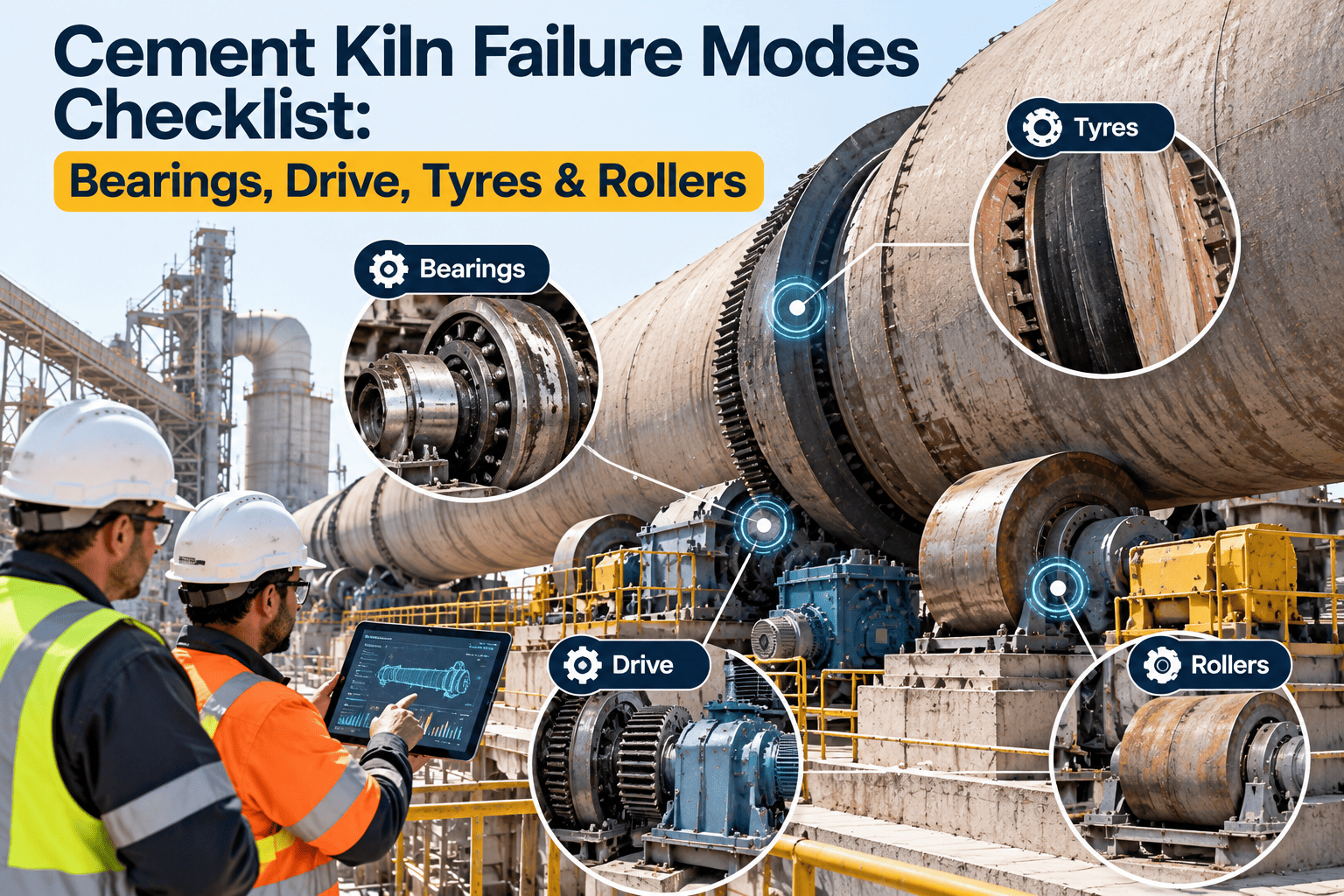
Repeat high-temperature bearing failures on kiln support stations, tire pads, and thrust rollers. Root causes usually trace to lubrication breakdown, misalignment, or thermal-expansion stress — not bearing quality. A single 4,500 kW kiln can lose 18–30 hours per event.
Persistent conveyor spillage
Clinker, raw meal, and cement conveyors that spill at transfer points after every outage. The defect returns because skirt rubber, chute liners, and belt tracking are treated as cleanup tasks instead of engineered fixes. Spillage costs mount at $1,200–$4,500 per incident in labor and lost material.
Fan vibration patterns
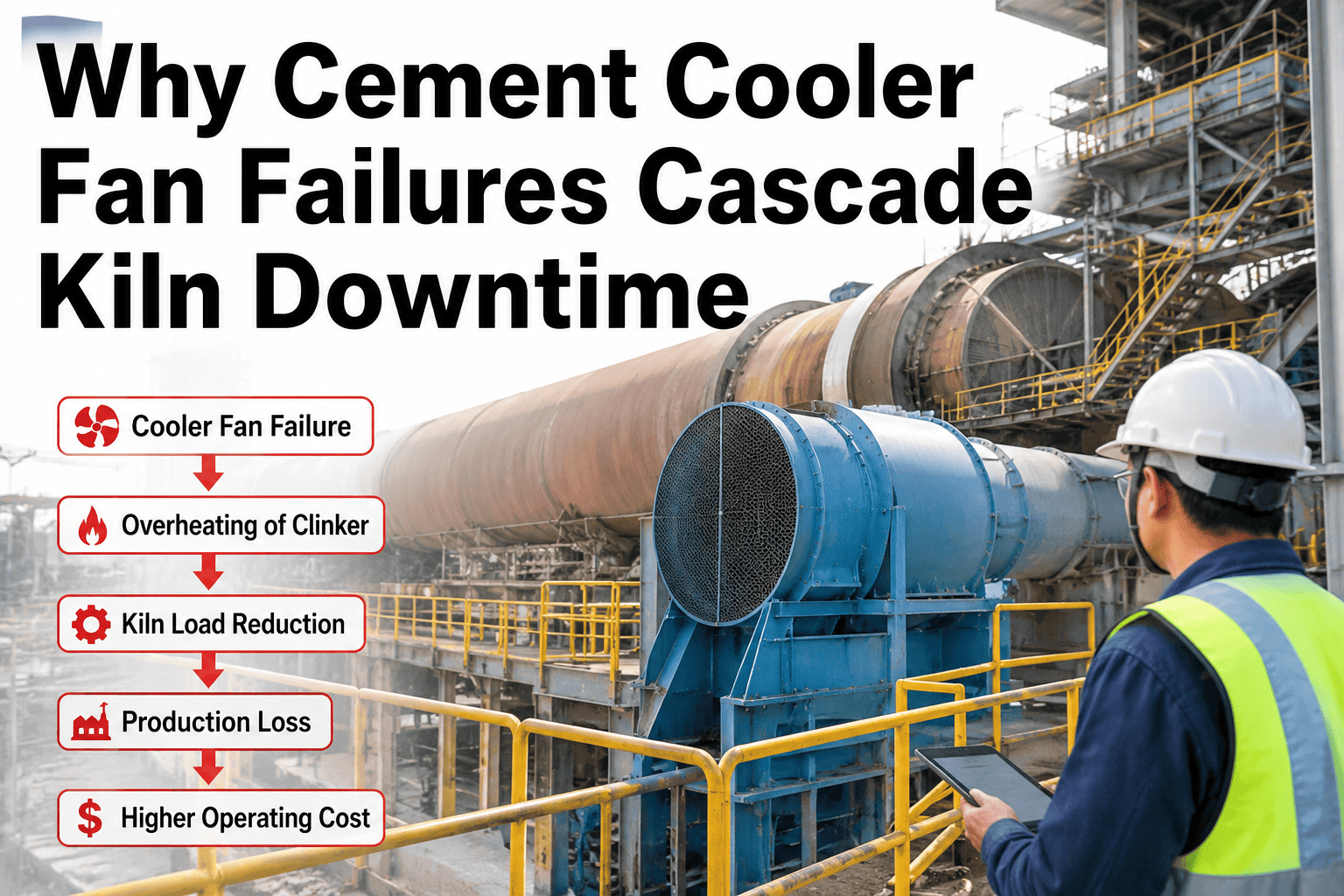
Preheater, cooler, and baghouse fans that cross ISO 10816 alarm zones repeatedly. Dust buildup on impellers, foundation looseness, and resonance at operating speed drive recurring vibration events that shut down gas flow and kiln stability within minutes.
CMMS-based defect tracking gaps
When the CMMS records only the symptom ("bearing hot") and never the defect mode ("lubrication breakdown from degraded grease"), the same failure is reopened indefinitely. Defect elimination starts with structured failure coding at the work-order closeout step.
From repeat incident to resolved history — the five-phase loop
Defect elimination is not a single RCA event. It is a closed loop that moves from detection through engineered correction to verification — tracked end-to-end inside the CMMS so no defect falls through the cracks.
Log the defect at the source
Operators, inspectors, and condition-monitoring systems flag deviations in the CMMS as defects — not just work orders. A temperature rise on a kiln bearing is logged with its asset, position, reading, and timestamp within minutes of detection.
Repeat-failure analysis on linked history
The CMMS surfaces every prior failure on that asset — same component, same failure mode, same symptom pattern. If the defect has returned within 24 months, it is escalated for root-cause analysis instead of a routine repair.
Engineered corrective action, not a patch
The team designs a permanent fix — upgraded bearing housing, re-engineered chute geometry, automatic greasing system, or fan-balancing protocol. The corrective action is documented in the CMMS with owner, due date, and expected failure-free interval.
Confirm the fix held across one full cycle
After the corrective action, the asset is monitored for one complete operating cycle. If the defect signature does not reappear within the previously observed recurrence window, the defect is marked resolved. If it returns, the loop restarts at Phase 2.
Convert to resolved history with full traceability
The resolved defect is archived with its root cause, corrective action, verification data, and cost-avoidance figure. This becomes the plant's reliability knowledge base — the same failure mode will never require analysis from scratch again.
What one recurring kiln bearing really costs you
Use this formula to size the prize on your worst repeat offender. The numbers below are drawn from a worked example: a 4,500-ton-per-day plant with a kiln support bearing that fails every 14 months.
| Defect Signature | Recurrence | Cost per Event | Annual Cost | Resolution Window |
|---|---|---|---|---|
| Kiln bearing failure | 14 months | $28,000 | $108,000 | 3–6 weeks |
| Conveyor spillage | 2–4 weeks | $2,800 | $39,200 | 1–2 weeks |
| Fan vibration event | 2 months | $9,500 | $57,000 | 2–4 weeks |
| Hydraulic system leak | 1 month | $1,400 | $16,800 | 1 week |
| Baghouse damper sticking | 3 months | $4,200 | $16,800 | 2–3 weeks |
Five recurring defects on one plant = $237,800 per year in avoidable cost. Eliminate three of them in the first year and the program pays for itself several times over.
A 180-asset plant, one year, three defects eliminated
Consider a 180-asset cement plant spending $42K per year on a recurring kiln-bearing defect, $39K on conveyor spillage, and $57K on fan vibration events — a combined $138K in annual recurring-defect cost. Here is what happens when the defect elimination loop runs for 12 months.
Detection and baseline
All three defects logged in the CMMS with structured failure coding. Repeat-failure history surfaces 4, 6, and 3 prior events respectively. Root-cause analysis completed on kiln bearing and conveyor.
Engineered correction
Kiln bearing gets upgraded lubrication system and realignment protocol. Conveyor transfer point re-engineered with hardwearing chute liners and auto-tracking. Fan vibration RCA initiated — resonance identified.
Verification cycle
Kiln bearing passes one full 14-month recurrence window without defect signature. Conveyor spillage eliminated across 3 outages. Fan vibration corrected after foundation stiffening and dynamic balancing.
Closure and savings capture
All three defects converted to resolved history. CMMS records $108K in verified cost avoidance. Plant MTBF rises 23% and unplanned downtime drops 31% year over year — program cost recovered in Month 4.
Every month without defect elimination is a month you pay for the same failure twice
See how Oxmaint's CMMS-driven defect elimination program structures repeat-failure analysis, root-cause discipline, and corrective-action tracking into one closed loop — built for cement plant reliability teams.
Defect elimination for cement plants — answered
How is defect elimination different from preventive maintenance?
Preventive maintenance follows a time-based schedule — inspect, lubricate, replace on interval. Defect elimination goes further: it identifies the root cause of recurring failures and engineers that failure mode out permanently. PM reduces the probability of failure; defect elimination removes the defect that causes it. The two work together inside a CMMS, but only defect elimination closes the loop on repeat events.
How long does it take to eliminate a recurring cement-plant defect?
For most equipment defects in cement operations — kiln bearings, conveyor spillage, fan vibration — the full loop runs 4 to 12 weeks from detection to verified resolution. Complex defects involving major component redesign or extended procurement can take 3 to 6 months. The CMMS tracks the defect through every phase so nothing stalls. You can Book a Demo to see the timeline workflow in action.
What should a CMMS capture to support defect elimination?
At minimum: structured failure-mode coding aligned to ISO 14224, linked failure history per asset, root-cause analysis records, corrective-action tracking with owner and due date, verification data across one full operating cycle, and resolved-defect archives. Without structured failure coding at work-order closeout, the CMMS records symptoms — not defects — and the same failure reopens indefinitely.
Which cement-plant defects deliver the fastest payback?
The highest-payback defects are those with short recurrence cycles and high downtime cost — fan vibration events (2-month cycle, $9.5K per event), conveyor spillage (2–4 week cycle, $2.8K per event), and hydraulic system leaks (1-month cycle, $1.4K per event). Eliminating these three alone typically recovers full program cost within the first quarter. Kiln-bearing defects have higher individual cost but longer verification windows.
Can defect elimination work alongside our existing TPM or RCM program?
Yes — defect elimination complements TPM and RCM rather than replacing them. TPM provides the operator-level detection network that feeds defects into the CMMS. RCM provides the analytical framework for identifying failure modes. Defect elimination adds the missing piece: a closed loop that ensures each identified failure mode is actually engineered out and verified, not just analyzed. Start your Start Free Trial to integrate it with your current program.
Turn your recurring failures into resolved history
Join cement-plant reliability teams using Oxmaint to detect, analyze, correct, and close defects permanently — with full CMMS traceability from first signal to verified resolution.
Free 14-day trial · No credit card