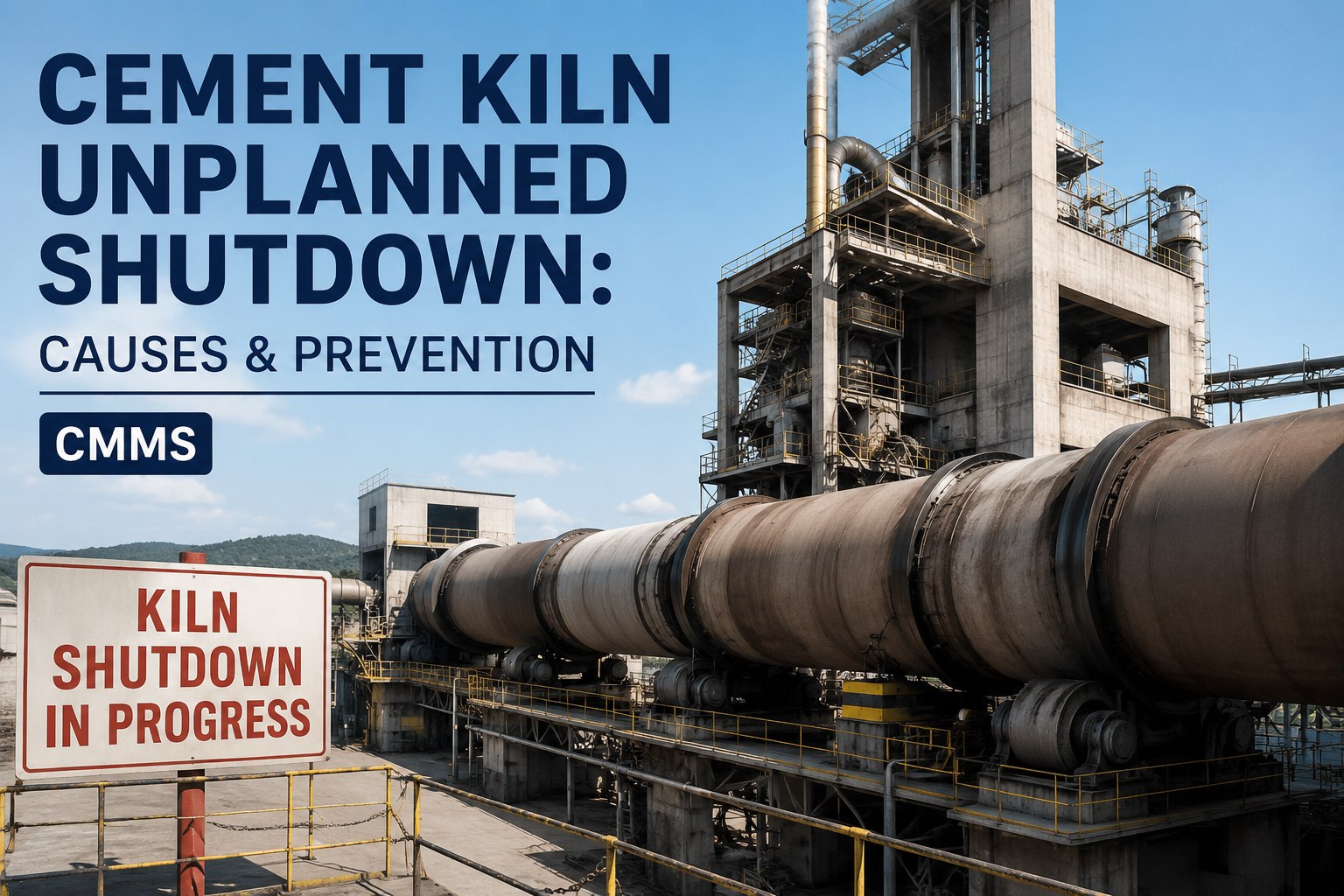
A cement kiln shutdown is not a maintenance event, it is a countdown. Every hour the kiln sits cold costs a plant real clinker tonnage, and every hour under-inspected means the next campaign runs on a shell, a seal, or a burner nobody actually verified. A single major shutdown compresses refractory teardown, shell scanning, tyre and trunnion checks, seal replacement, and burner realignment into a window measured in days, and each of those checks has to be logged, photographed, and signed off before relight. Reliability teams who once ran this on paper checklists and disconnected spreadsheets are now moving the entire kiln inspection campaign onto a connected platform, and you can see how that works by visiting this scheduling page for a walkthrough.
Cement Plant Reliability · Kiln Shutdown & Campaign Inspection
Cement Kiln Inspection Software Built Around the Shutdown Campaign, Not a Generic Checklist
Cover refractory condition, shell ovality, tyre and trunnion wear, seal clearance, and burner alignment across every shutdown window, with a photo attached to every finding and a record your next audit can actually trust.
6
critical kiln zones inspected in every shutdown campaign
72 hrs
average length of a mid-campaign cement kiln shutdown window
1 mm
shell ovality change per rotation that can flag a refractory zone for early replacement
100%
photo-backed findings possible when inspections are logged on a mobile device, not paper
See the kiln inspection workflow running on a live sandbox before your next shutdown window opens.
Why the Inspection Scope Matters
Six Zones That Decide Whether Your Next Kiln Campaign Runs Clean or Runs Short
A kiln does not fail as one part. It fails as a chain of small, individually survivable problems that nobody connected in time. A refractory hot spot, a trunnion out of alignment, and a burner pipe drifting off-centre can each look minor in isolation, and together they explain most of the unplanned kiln stops a plant records in a year. The six zones below are where a shutdown inspection earns its cost, because each one hides damage that is invisible while the kiln is running.
Zone 01
Refractory Lining
Brick wear, chemical attack, and hot spots are tracked zone by zone across the burning, transition, and calcining sections, with condition scored against the heat count since last relining.
Zone 02
Kiln Shell & Ovality
Shell thickness and out-of-round measurements, taken at rest and during slow rotation, reveal thinning caused by refractory loss long before a shell crack becomes visible.
Zone 03
Tyre & Trunnion Assembly
Riding ring clearance, trunnion roller wear, and axial thrust are checked together, because tyre migration and trunnion misalignment usually accelerate each other.
Zone 04
Girth Gear & Pinion
Backlash, tooth wear pattern, and lubrication film condition are logged with photographs, since gear damage develops gradually and is easy to under-report on paper.
Zone 05
Inlet & Outlet Seals
Seal clearance directly drives false air infiltration, kiln draft, and fuel consumption, so every seal gap is measured and recorded, not estimated by eye.
Zone 06
Burner & Firing System
Burner pipe alignment, nozzle wear, and primary air setting are re-verified after every shutdown, because a drifted burner quietly damages the refractory it is aimed near.
The Shutdown Inspection Checklist
What Should Be a Logged, Photo-Backed Finding in Every Shutdown Report
Every finding below should leave the shutdown with a method, a measurement, and a photo attached to the work order, not a verbal handover between shifts. This is the structure most cement reliability teams build their digital inspection form around.
| Inspection Item |
Method |
Typical Frequency |
Risk if Missed |
| Refractory thickness & hot spot mapping |
Thermal scan plus physical measurement |
Every shutdown |
Shell burn-through, unplanned mid-campaign stop |
| Shell ovality & thickness scan |
Laser or ultrasonic shell scanner |
Major shutdowns |
Undetected thinning leading to shell crack |
| Tyre-to-riding-ring clearance |
Feeler gauge, running clearance log |
Every shutdown |
Tyre migration, uneven shell wear |
| Trunnion roller alignment |
Laser alignment check |
Annual or major shutdown |
Axial thrust damage, bearing failure |
| Girth gear backlash & tooth wear |
Backlash gauge, visual pattern check |
Every shutdown |
Gear tooth breakage, drive train stoppage |
| Inlet and outlet seal gap |
Physical gap measurement, all points |
Every shutdown |
False air ingress, higher fuel consumption |
| Burner pipe alignment & nozzle wear |
Centreline check against kiln axis |
Every shutdown |
Flame impingement on refractory |
Walk the Platform Before Your Next Shutdown
See Every One of These Checks Running as a Mobile Inspection Form
Reading a checklist is one thing. Watching a technician complete it offline, attach a photo to a refractory hot spot, and have it appear as a work order the moment connectivity returns is another. A short walkthrough shows exactly how this fits your current shutdown routine.
The Campaign Timeline
Before, During, and After the Shutdown Window — Where Inspection Actually Happens
Inspection is not a single day inside the shutdown. It starts before the kiln stops rotating and continues well after it is relit, and each phase below produces data the next one depends on.
Phase 1
Pre-Shutdown Scope Lock
Running inspection data, condition scores, and open findings from the last campaign are pulled together to build the shutdown work scope before the kiln stops.
Phase 2
Cooldown & Access Prep
Permits for hot work, confined space, and height access are activated in sequence with the cooldown curve, so inspection teams enter as soon as it is safe, not later.
Phase 3
Zone-by-Zone Inspection
Refractory, shell, tyre, trunnion, gear, seal, and burner checks run in parallel crews, each logging findings with photographs directly against the kiln asset record.
Phase 4
Findings Triage & Repair
Findings are sorted into fix-now, monitor, and defer categories against the remaining shutdown hours, with parts availability checked before a repair is committed to the plan.
Phase 5
Pre-Relight Verification
Every must-close finding is verified closed, seal clearances are rechecked after final assembly, and a signed readiness record is generated before ignition is authorised.
Phase 6
Post-Relight Monitoring
Shell temperature, vibration, and draft readings are watched closely in the first days after relight, feeding directly into the scope of the next scheduled shutdown.
Paper Logs vs a Connected Inspection Record
Why Cement Plants Are Moving Kiln Shutdown Inspections Off Paper
A paper clipboard survives a kiln shutdown environment badly, and the record it produces survives an audit even worse. The comparison below is the pattern reliability teams describe most often once they switch.
Evidence
Handwritten Note vs Timestamped Photo
A written "seal gap acceptable" cannot be reviewed later. A timestamped photo against the exact seal point can be checked by anyone, any time.
Handover
Verbal Shift Handover vs Live Work Order
Findings shouted across a noisy shutdown site get lost. A finding logged as a work order is visible to the next shift the moment it is saved.
History
Filed Paper vs Searchable Campaign History
Comparing this campaign's refractory wear against the last three requires digging through old binders on paper, and a single search on a connected record.
Safety
Manual Permit Tracking vs Interlocked Permits
A paper permit board relies on memory to enforce sequence. A digital permit can block a work order from starting until it is actually active.
What a Digital Record Adds
The Practical Difference a Photo-Backed Inspection Makes Once the Kiln Is Running Again
The value of a digital kiln inspection record shows up after the shutdown closes, not during it. These are the four places reliability teams say it matters most.
Trend Tracking
Refractory Wear Across Campaigns
Condition scores and photos from three or four campaigns sit side by side, turning a guess about remaining refractory life into a trend line planners can act on.
Audit-Ready Evidence
Compliance
When a safety or insurance audit asks for proof a seal gap was measured, the answer is a search, not a request to the archive room.
Vendor Accountability
Contractor Sign-Off With Evidence
Refractory and shell-scan contractors close their scope against photo-backed findings, reducing disputes over what was actually inspected and repaired.
Faster Next Scope
Planning
The next shutdown's work scope starts from this campaign's closed and deferred findings instead of a blank page and institutional memory.
From the Field
What Reliability Leads Say About Moving Kiln Inspections Off Paper
Rated 5 / 5
Our shell scan contractor used to hand us a PDF report weeks after the shutdown closed. Now the ovality readings sit next to the refractory photos from the same zone, taken the same day, and planning the next campaign takes a fraction of the time it used to.
RT
Ravi Tandon, CMRP
Kiln Reliability Engineer, South Asian Cement Plant
Rated 5 / 5
The seal clearance data used to live in someone's notebook. The first time an auditor asked for evidence and we pulled up a timestamped photo in ten seconds instead of promising to send it later, that alone justified the switch for our whole plant.
EM
Elena Marchetti, IEng
Maintenance Manager, European Cement Operations
Rated 4 / 5
Trunnion alignment findings used to get deferred quietly when the shutdown ran long. Now every deferred item shows up automatically at the top of the next shutdown scope, so nothing sits unresolved for more than one campaign without someone noticing.
DO
David Okafor
Plant Engineering Lead, West African Cement Group
Frequently Asked Questions
Cement Kiln Inspection Software — Common Questions From Reliability Teams
Can technicians complete kiln inspections offline inside the kiln during a shutdown?
Yes. Forms and photos are captured offline inside the kiln and sync automatically once the device reconnects.
Start a free trial to test it on your own device.
Does the platform replace our shell scanning or vibration monitoring contractor?
No, it connects to their data. Shell scan and vibration readings feed in as attachments or sensor inputs against the same kiln asset record used for manual findings.
How do findings from one shutdown carry forward into the next campaign's scope?
Deferred and monitor-only findings stay open against the kiln asset and surface automatically when the next shutdown scope is being built, so nothing gets forgotten between campaigns.
Can permits like hot work or confined space block an inspection work order from starting?
Yes. A work order tied to a hazardous inspection point can be configured to stay blocked until the matching permit is active, which keeps the interlock enforced automatically.
Is there a walkthrough before we commit this to an actual shutdown window?
Book a demo and we will walk through your last shutdown checklist on a live sandbox before you rely on it for a real campaign.
Cement Kiln Inspection Software · OxMaint
Take the Next Shutdown Off Paper Before the Kiln Goes Cold
Refractory condition, shell ovality, tyre and trunnion wear, seal clearance, and burner alignment all belong in one photo-backed record your next campaign, your next contractor, and your next audit can all trust equally.