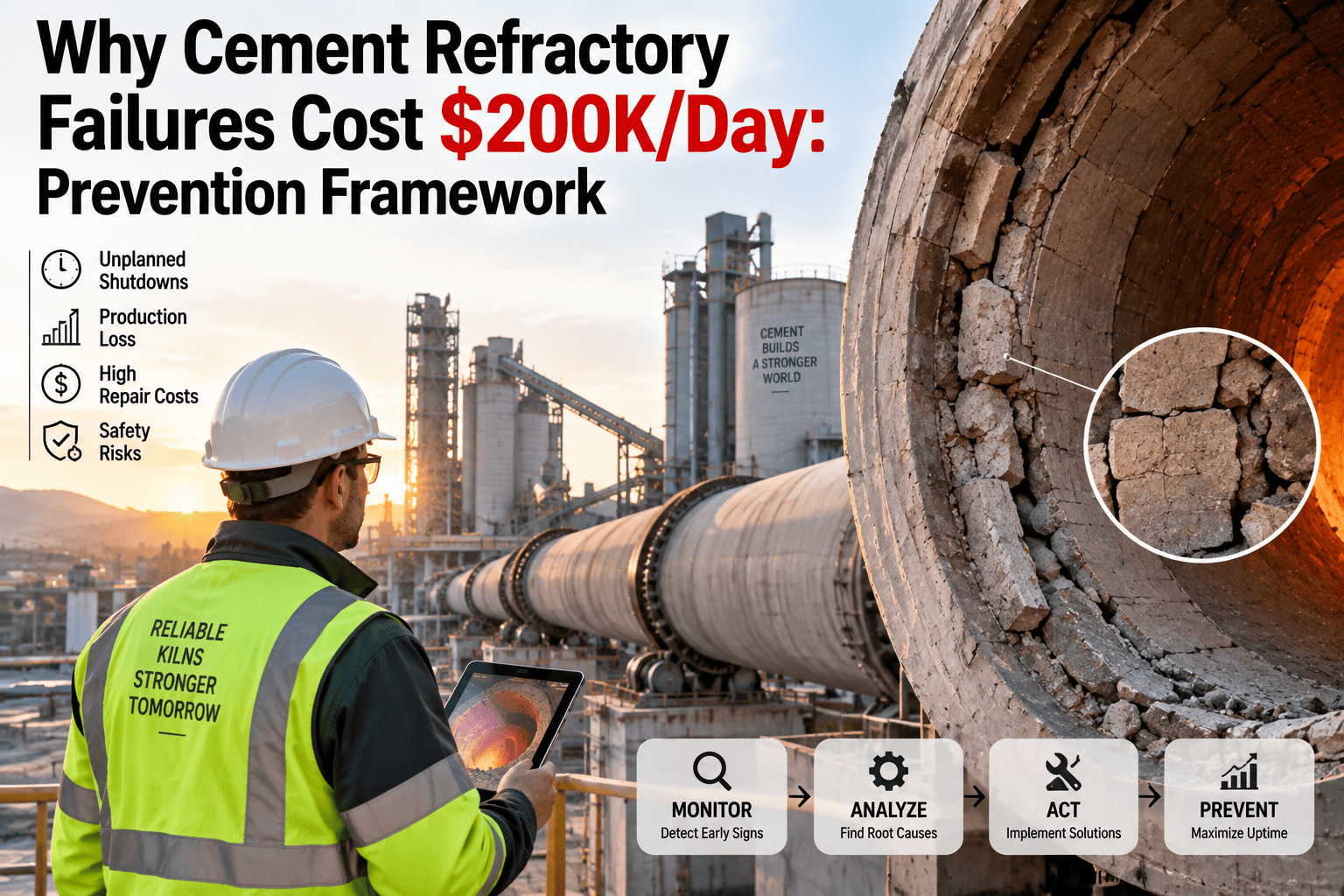
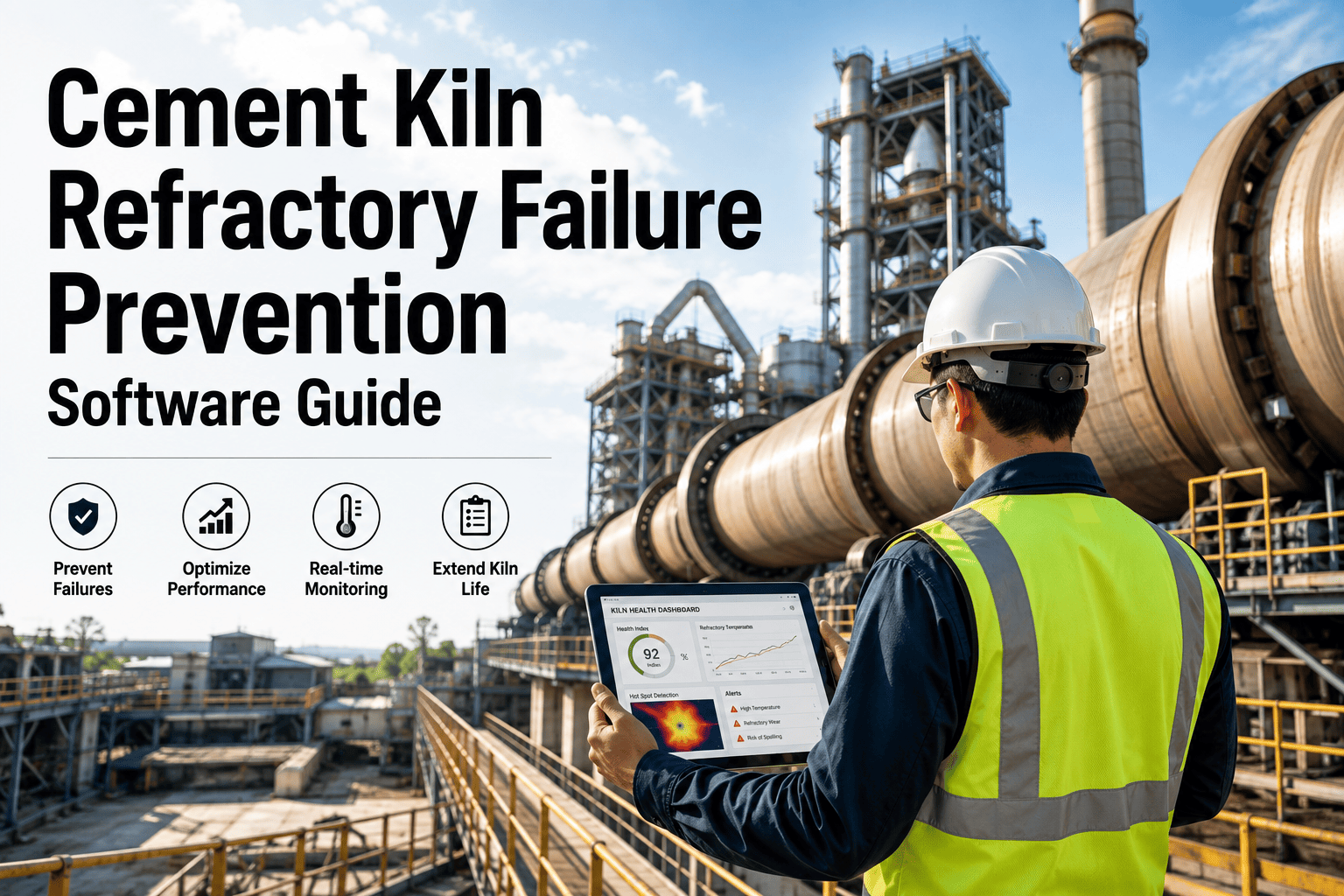
Refractory lining is the single most expensive consumable in a cement plant—and its failure is the single most expensive event. A typical kiln reline costs $800,000 to $1.5 million in materials alone, but the real financial damage comes from unplanned failures: an emergency refractory shutdown adds 5–10 days of lost production worth $1.5–5 million on top of the repair cost. The difference between a refractory lining that lasts 8 months and one that lasts 18 months isn't the brick—it's the maintenance program behind it. Plants with disciplined refractory monitoring and maintenance programs achieve 30–50% longer lining campaigns, turning what most facilities treat as a crisis into a predictable, optimized lifecycle. This guide covers the complete refractory maintenance framework—from zone-by-zone monitoring to data-driven replacement scheduling.
Refractory Cost
Share of total kiln maintenance spend
Premature Failures
Caused by poor monitoring practices
Life Extension
Achievable with proactive maintenance
Avg. Reline Cost
Materials + labor for full kiln reline
The economics are clear: extending a refractory campaign by even 3 months saves $300,000–$500,000 in deferred reline costs and avoided production losses. Start your free OXmaint trial to begin tracking refractory wear data zone-by-zone and optimize your replacement timing.
Understanding Kiln Zones: Where Refractory Lives and Dies
Not all refractory wears the same way. Each zone of the kiln faces different thermal, chemical, and mechanical stresses—and requires different brick types, monitoring intervals, and replacement strategies. Understanding zone-specific behavior is the foundation of every successful refractory management program.
Zone 1
Inlet / Preheater
600–900°C
Zone 2
Upper Transition
900–1,200°C
Zone 3
Burning Zone
1,350–1,500°C
Zone 4
Lower Transition
1,100–1,350°C
Zone 5
Outlet / Nose Ring
1,000–1,200°C
Highest wear rate
High wear rate
Moderate wear
Lower wear
Refractory Type
Dense castable or 42% alumina brick
Primary Wear Mechanism
Abrasion from raw meal; thermal cycling at kiln inlet seal
Typical Lining Life
18–36 months
Key Monitoring
Shell temperature scan; visual check at inlet seal for material buildup
Common Failure Mode
Seal damage allowing hot gas bypass → accelerated brick erosion
Refractory Type
70% alumina brick or spinel brick
Primary Wear Mechanism
Chemical attack from alkali salts (K₂O, Na₂O, SO₃, Cl); thermal stress
Typical Lining Life
12–24 months
Key Monitoring
Shell scanner; alkali condensation analysis; brick core samples
Common Failure Mode
Alkali infiltration causing brick expansion → ring formation → spalling
Refractory Type
Basic magnesia-spinel or dolomite brick (14–20% Cr₂O₃-free)
Primary Wear Mechanism
Thermo-chemical corrosion from clinker liquid; coating loss/instability; thermal shock
Typical Lining Life
8–18 months (campaign-defining zone)
Key Monitoring
Continuous shell scanner (every 15 min); coating stability; flame shape analysis
Common Failure Mode
Unstable coating → exposed brick surface → rapid hot-face wear → hot spot → emergency stop
⚠ Campaign-Defining Zone: The burning zone almost always determines when the kiln must shut down for reline. Every dollar spent extending burning zone life has a direct ROI in avoided shutdown days.
Refractory Type
Magnesia-spinel or 70% alumina brick
Primary Wear Mechanism
Mechanical stress from clinker nodule impact; thermal cycling; coating instability
Typical Lining Life
10–20 months
Key Monitoring
Shell scanner; vibration analysis for brick loosening; tyre/shell gap measurement
Common Failure Mode
Ovality causing brick crushing → localized spalling → hot band development
Refractory Type
High-alumina castable or silicon carbide composite
Primary Wear Mechanism
Severe abrasion from falling clinker; thermal shock from cooler air ingress
Typical Lining Life
6–14 months
Key Monitoring
Visual inspection during cooler checks; shell temperature at nose ring section
Common Failure Mode
Mechanical erosion from clinker impact → castable breakout → shell damage risk
Pro Tip: Track refractory thickness readings zone-by-zone in your CMMS after every shutdown inspection. Trending wear rates over multiple campaigns reveals which zones are underperforming and whether operational changes (fuel mix, feed chemistry, flame position) are accelerating or slowing wear.
Schedule a free demo to see how OXmaint tracks refractory lifecycle data across campaigns.
The 5 Stages of Refractory Degradation
Refractory doesn't fail suddenly—it degrades through predictable stages. Catching degradation at Stage 2 or 3 gives you weeks to plan. Missing it until Stage 4 means emergency action.
New Lining Conditioning
Week 1–4
Fresh brick develops protective coating. Shell temperatures stabilize. Initial micro-cracking is normal as lining adjusts to operating temperature.
Action: Follow refractory supplier's heat-up curve precisely. Log baseline shell temperatures for every scanner position in CMMS.
Stable Operation
Month 2–8
Coating is well-established and protecting brick. Shell temperatures consistent. Wear rate at designed pace. This is the productive phase of the campaign.
Action: Monitor shell temperatures weekly. Track any coating loss events. Document operational upsets that stress the lining.
Accelerated Wear
Month 8–14
Brick thickness reduces past 50%. Coating becomes less stable—forming and shedding more frequently. Shell temperature baseline begins creeping upward. Individual hot spots may appear temporarily.
Action: Increase scanner monitoring to every shift. Begin planning replacement window. Adjust flame position to protect weakening areas.
Critical Wear
Month 14–18
Brick at <40% original thickness in burning zone. Persistent hot spots appearing. Shell temperature alarms triggered frequently. Coating struggles to adhere to worn brick surface.
Action: Lock in shutdown date. Order refractory materials. Mobilize contractor crews. Reduce kiln feed rate to lower thermal stress on remaining lining.
Emergency / Failure
Beyond Safe Limit
Red shell spots visible at night. Shell deformation risk. Brick-through events possible—clinker contacting kiln shell directly. Catastrophic failure can permanently damage shell plate.
Action: Emergency kiln stop. Reaching this stage indicates a monitoring failure—the kiln should never operate this far into degradation.
Never Miss a Refractory Warning Sign Again
Automate shell temperature tracking, trend wear rates, and schedule relines at the optimal time—setup takes 10 minutes
Refractory Monitoring Methods: What to Measure and When
?️
Continuous Shell Scanner
CONTINUOUS
What it measures: External shell surface temperature at every rotation
Why it matters: Detects hot spots, coating loss, and progressive thinning before visible damage
Alert threshold: >350°C sustained or >50°C above baseline at any scanner position
CMMS integration: Auto-generate work order when threshold exceeded for 2+ consecutive scans
?
Thermal Imaging (IR Camera)
WEEKLY
What it measures: Full-shell thermal profile in higher resolution than fixed scanners
Why it matters: Catches localized hot spots between scanner positions; validates scanner data
Best practice: Scan at same time of day to minimize ambient temperature variation
CMMS integration: Upload thermal images to asset record; compare trend over campaign
?
Brick Thickness Measurement
EVERY SHUTDOWN
What it measures: Remaining refractory thickness by zone using laser or mechanical gauges
Why it matters: Only direct measurement of remaining brick life; validates scanner interpretations
Minimum data: Readings at every meter along kiln axis, 4 points around circumference
CMMS integration: Log by zone and position; trend wear rate (mm/month) to predict replacement date
?
Brick Core Sample Analysis
ANNUAL
What it measures: Chemical infiltration depth, structural integrity, mineralogical changes
Why it matters: Reveals hidden damage not visible externally—alkali penetration can weaken brick from inside
Sample locations: Burning zone + upper transition (highest chemical attack zones)
CMMS integration: Attach lab reports to refractory asset record; flag if infiltration exceeds 30% depth
?
Kiln Shell Ovality Survey
ANNUAL
What it measures: Shell roundness deviation from true circle at each tyre station
Why it matters: Ovality >0.5% of diameter causes brick crushing and premature spalling
Critical areas: Under tyres; mid-span between supports; nose ring section
CMMS integration: Trend ovality over time; trigger mechanical inspection if rate of change increases
Plants tracking all five monitoring methods in a centralized CMMS predict reline timing within ±2 weeks—versus ±2 months for plants using only shell scanners. Sign up for free and start building your refractory monitoring dashboard today.
8 Factors That Shorten Refractory Lining Life
Refractory life isn't just about brick quality—operational practices have an equal or greater impact. These are the controllable factors that most plants underestimate.
SEVERE
Unstable Kiln Coating
Frequent coating loss and reformation creates thermal shock cycles on the brick surface. Plants with more than 5 coating loss events per month see 40% shorter lining campaigns.
SEVERE
Frequent Kiln Stops
Every cold start thermally shocks the lining. The expansion/contraction cycle opens joints and loosens brick. Plants averaging more than 4 unplanned stops per year lose 3–5 months of lining life.
HIGH
Poor Flame Shape / Position
A long, lazy flame or flame impingement on the lining creates localized overheating. Proper burner adjustment is one of the cheapest ways to extend lining life.
HIGH
High Alkali / Sulfur in Raw Mix
Volatile cycles of K₂O, Na₂O, SO₃, and Cl condense on cooler brick surfaces, causing chemical attack and brick expansion that leads to spalling.
MODERATE
Overloading / High Feed Rate
Running above rated capacity increases material bed depth and mechanical abrasion on the lining, especially in transition zones. Even 5% overload accelerates wear measurably.
MODERATE
Poor Brick Installation Quality
Incorrect mortar thickness, improper keying, or mixing brick types within a zone leads to differential wear and early joint failures.
MODERATE
Shell Ovality / Mechanical Issues
Shell deformation from tyre creep, roller misalignment, or thermal bowing crushes brick at the tight spots. Ovality >0.5% of diameter is the threshold for concern.
MODERATE
Slow Heat-Up After Shutdown
Rushing the heat-up curve to resume production thermally shocks fresh or cooled brick. Every refractory supplier provides a curve—following it adds 1 day but saves months of life.
Key Insight: Log every operational upset (trip, coating loss, overload event, abnormal fuel use) in your CMMS and correlate it with refractory wear rate changes. Plants that do this identify their top 2–3 lining killers within the first campaign and eliminate them for the next—gaining 3–6 months of additional lining life at zero material cost.
Refractory Lifecycle Cost: The Business Case for Better Monitoring
Reactive Approach
10-month avg. campaign | 1.2 relines/year
Refractory materials
$1,440,000
Installation labor
$360,000
Emergency expediting
$180,000
Lost production (extra 4 days/yr)
$1,600,000
Total Annual Cost
$3,580,000
VS
Proactive Monitoring
16-month avg. campaign | 0.75 relines/year
Refractory materials
$900,000
Installation labor
$225,000
Monitoring program cost
$85,000
Lost production (planned stops only)
$400,000
Total Annual Cost
$1,610,000
$1,970,000
Annual Savings with Proactive Refractory Management
Track Refractory Lifecycle Data That Saves Millions
Zone-by-zone wear tracking, automated inspection reminders, campaign history—no credit card required
When to Replace: The Reline Decision Framework
The optimal reline timing balances remaining brick life against the cost of an unplanned failure. Replace too early and you waste usable brick. Replace too late and you risk shell damage costing 10x the reline.
CONTINUE RUNNING
Burning zone brick >50% thickness • Shell temps stable within 20°C of baseline • Coating well-established • No persistent hot spots • Wear rate consistent with previous 3 months
PLAN REPLACEMENT — 60-90 Day Window
Burning zone brick 35–50% thickness • Shell temps trending upward • Coating becoming unstable • Hot spots appearing and resolving • Wear rate accelerating beyond historical norm
SCHEDULE RELINE — Next 30 Days
Burning zone brick <35% • Shell temps consistently >300°C at any location • Multiple simultaneous hot spots • Coating barely adhering • Wear rate >5mm/month in critical zone
EMERGENCY STOP — Immediate Action Required
Shell temp >400°C sustained • Visible red shell at night • Shell deformation detected • Brick-through risk • Continuing operation risks permanent shell damage ($2M+ repair)
Frequently Asked Questions
How long should a cement kiln refractory lining last?
Burning zone lining typically lasts 8–18 months depending on brick quality, operational stability, raw mix chemistry, and maintenance practices. Upper and lower transition zones last 12–24 months, while inlet and outlet zones can achieve 18–36 months. Plants with mature monitoring programs consistently hit the upper end of these ranges.
What is the biggest factor affecting refractory lining life?
Coating stability in the burning zone is the single most influential factor. Stable coating protects the brick from direct chemical and thermal attack. Frequent coating loss events—caused by kiln trips, flame instability, or raw mix variability—can reduce lining life by 40% or more. Controlling coating stability through operational discipline is more impactful than upgrading brick quality.
How much does a full kiln reline cost?
A full reline for a 5,000 TPD kiln typically costs $800,000–$1.5M in refractory materials plus $200,000–$400,000 in installation labor. However, the indirect cost of the required 12–16 day shutdown—$350,000–$500,000 per day in lost production—often exceeds the direct reline cost by 3–5x, making shutdown duration the primary cost driver.
What shell temperature indicates refractory failure?
Normal burning zone shell temperature runs 180–280°C. Temperatures above 350°C sustained for more than 2 hours indicate significant refractory thinning or coating loss and warrant investigation. Temperatures above 400°C indicate critical brick wear with shell damage risk and typically require kiln shutdown. Any temperature rise of >50°C above established baseline deserves immediate attention.
How does a CMMS help with refractory management?
A CMMS transforms refractory management from reactive to data-driven by: storing zone-by-zone thickness measurements across campaigns, trending wear rates to predict optimal replacement timing, auto-generating inspection work orders at defined intervals, linking operational events (trips, coating loss) to wear acceleration, and maintaining a complete history that improves brick selection and vendor evaluation for future campaigns.
Should you do partial or full kiln relines?
Partial relines (burning zone only) are more common and cost-effective when other zones have >50% remaining life. Full relines make sense when multiple zones are nearing end-of-life simultaneously or when the plant wants to maximize the interval before the next shutdown. A CMMS with zone-by-zone tracking data makes partial vs. full decisions much more precise.
Ready to Extend Your Kiln Lining Life?
Get started in under 10 minutes. Free forever for small teams.