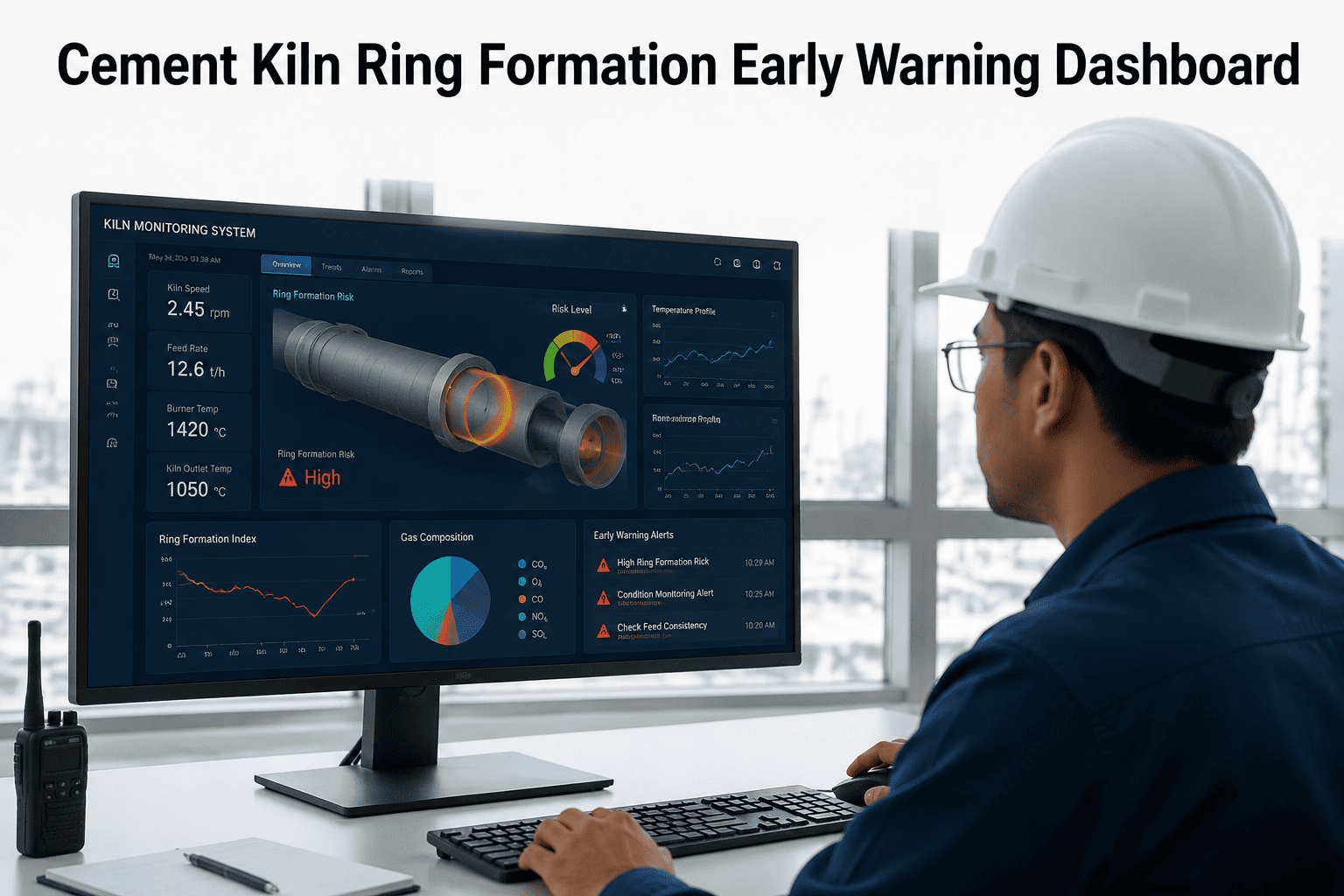
A ring inside a rotary kiln rarely announces itself in time. It begins as a thin band of sticky liquid phase fusing to the refractory in the burning or transition zone, and by the time it visibly chokes the material bed, the plant is already sliding toward an emergency stoppage that costs tens of thousands of dollars an hour. Yet the signals that precede it — shell temperature drift, cold-band patterns, kiln drive torque trends and clinker quality swings — are measurable days or weeks ahead of the failure. An early-warning dashboard pulls those scattered readings into one ring-risk picture. Sign in to OxMaint to build a kiln ring-formation early-warning dashboard, or book a demo to see it mapped onto a live shell profile.
The Cost Of A Missed Ring
What A Single Ring-Driven Stoppage Actually Costs
$20K–$85K
Cost per hour of unplanned kiln downtime in lost clinker, emergency labour and restart fuel
5–14 days
Typical time to cool, reline and reheat a kiln after a ring forces a refractory failure
3–5%
Annual clinker output lost to kiln downtime in reactive plants — under 1% with structured predictive maintenance
Days–Weeks
Advance warning that thermal and process signals give before a ring restricts flow — if someone is watching the trend
Know Your Enemy
Three Chemistries Behind Most Kiln Rings
Rings are not random. Each type has its own chemistry, its own preferred zone and its own fingerprint in the data. Reading that fingerprint early is the whole game.
S
Sulfur Rings
Form when the molar sulfur-to-alkali ratio in the system climbs above roughly 1.2, leaving free SO₃ circulating. They favour the start of the burning zone and tend to harden fast, making early sulfur-cycle awareness essential.
Sp
Spurrite Rings
Driven by carbonate and high carbon-dioxide conditions in the lower transition zone, where loose feed-end temperature control lets the band grow. They sit uphill of the burning zone and quietly raise free lime as the burning zone shifts.
A
Alkali & Chloride Rings
Built from low-melting potassium salts and chlorides volatilising and re-condensing in the cooler transition and feed-end zones. They dam material flow and lift kiln draft long before the shell shows anything obvious.
Anatomy Of A Buildup
The Four Stages From Sticky Film To Shutdown
A ring follows a predictable path. The earlier on this path you catch it, the cheaper and calmer the fix — a burner tweak instead of a fortnight of cold-kiln repair.
1
Seeding
Local overheating in a zone of peak radiative heat overproduces liquid phase. The first sticky film bonds to the lining. Nothing is visible from outside — but the thermal pattern has already shifted.
2
Growth
Every rotation deposits more material. The band thickens into a measurable accretion and insulates the shell, producing a tell-tale cold band on the circumferential scan that trends wider day by day.
3
Flow Restriction
The ring dams the material bed. Kiln drive torque and motor amps drift, draft and pressure-drop change, and free lime and liter weight wander as the burning zone migrates under the obstruction.
4
Crisis Or Breakout
The ring either blocks flow and forces a stop, or breaks out, releasing partly-burned material that cools the kiln and pushes reaction zones downhill. By now every option is expensive.
Catch The Ring At Stage One, Not Stage Four
OxMaint turns your shell scanner feed, kiln drive data and clinker quality readings into a single ring-risk dashboard that flags a forming band while it is still a burner adjustment — not a cold-kiln emergency.
The Dashboard
Six Signals The Early-Warning Dashboard Watches Together
No single reading proves a ring is forming — but together these signals draw a clear picture. OxMaint correlates all of them on one screen so the trend, not the absolute value, raises the flag.
01
Shell Temperature Pattern
Cold bands where buildup insulates the shell, and hot spots where coating is lost, mapped zone by zone from circumferential scan data every rotation.
02
Kiln Drive Torque & Amps
A changing coating or ring shifts the torque the drive must deliver. The dashboard tracks the trend over time rather than a misleading single reading.
03
Kiln Draft & Pressure Drop
As a ring narrows the bore, resistance to gas flow rises. A creeping pressure-drop trend is often the first hint of an alkali or chloride band forming.
04
Clinker Quality Drift
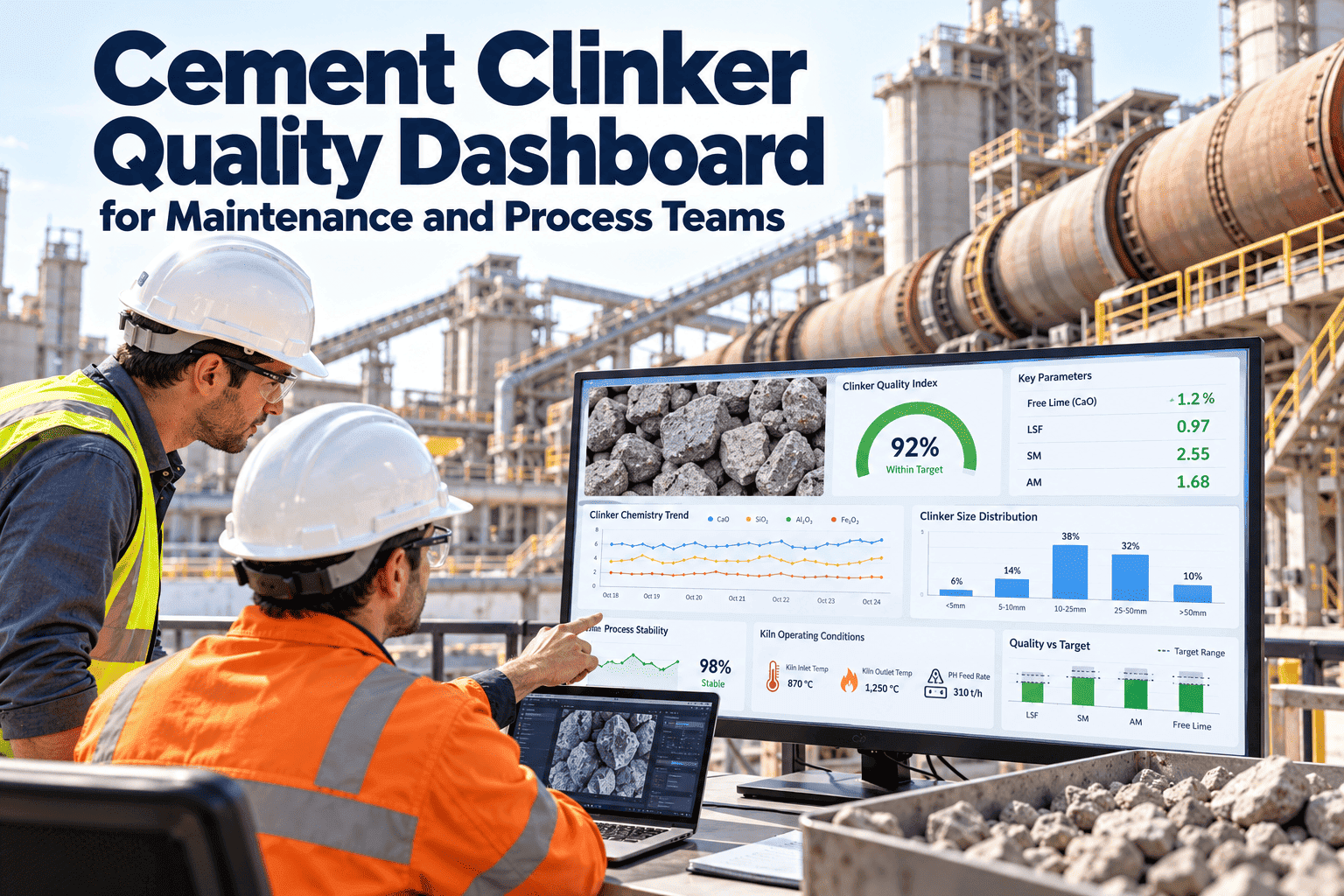
Free lime and liter weight wandering out of band signal that the burning zone has migrated — a classic downstream symptom of a growing accretion.
05
Refractory & Coating History
Live signals are overlaid on reline records and prior ring locations, so a band that recurs at the same metre mark is recognised instantly.
06
Inspection & Cleaning Logs
Air-wash, water-lance and manual cleaning interventions feed back into the same record, building a closed loop of what worked at each location.
Signal To Action
How A Trend Becomes A Scheduled Intervention
1
Detect The Drift
OxMaint ingests shell-scan, kiln-drive and process data and flags a cold band, torque trend or pressure rise the moment it moves outside its normal envelope.
2
Correlate The Cause
By combining several signals at once, the dashboard separates a forming ring from refractory damage or coating loss — cutting the false alarms that waste maintenance hours.
Sign in to configure your signal envelopes.
3
Alert The Right People
A ring-risk alert reaches the control room and reliability team with the zone, the trend chart and the likely ring type, so the response is informed, not guessed.
4
Schedule The Fix
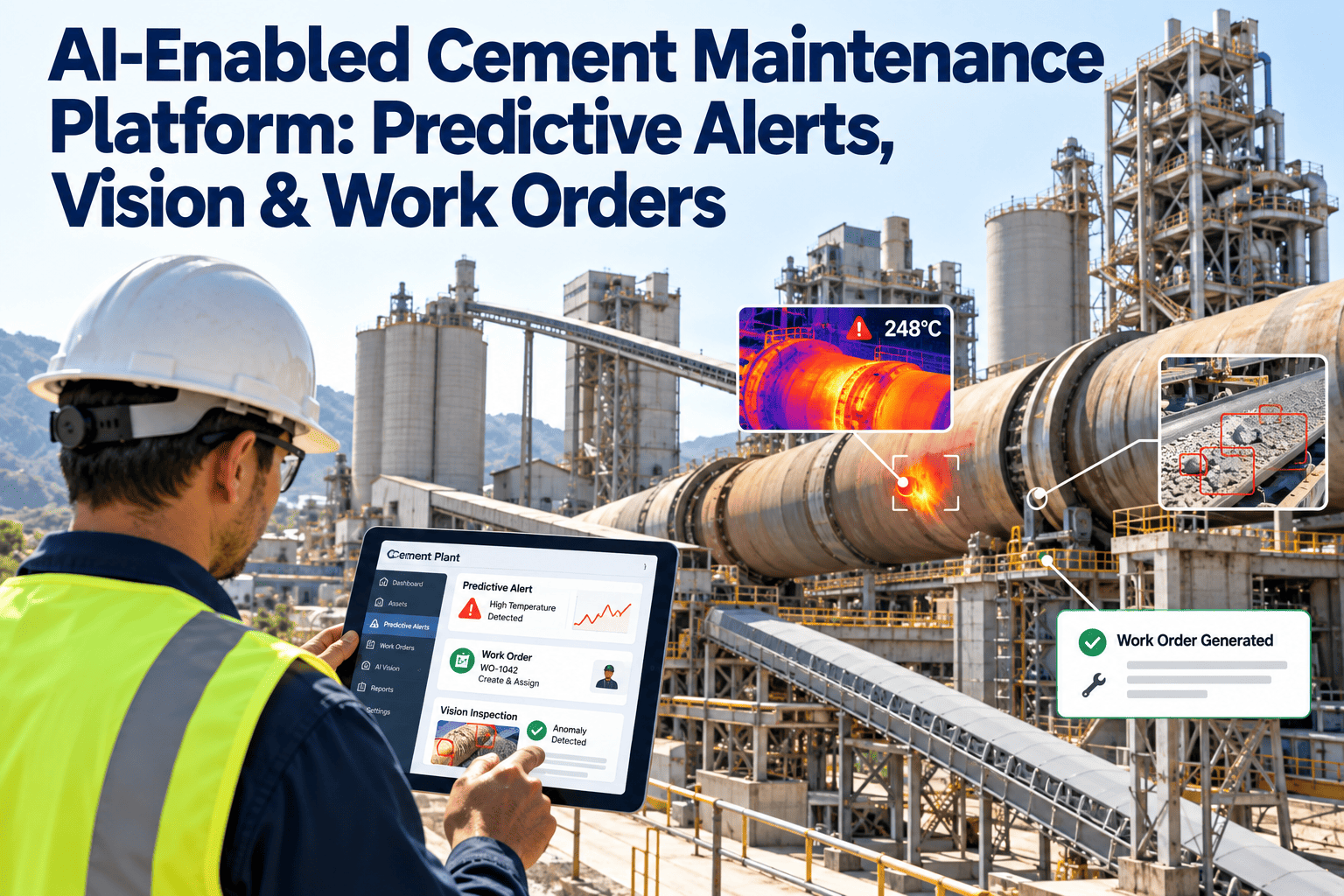
The alert raises an inspection or work order with the kiln-risk context attached, letting the team plan a burner tweak or controlled clean instead of an emergency stop.
Book a demo to see the workflow.
Reference Matrix
Ring Type, Signature And Dashboard Response
| Ring Type |
Typical Zone |
Leading Indicator |
Dashboard Trigger |
Recommended Action |
| Sulfur Ring |
Burning zone start |
S/alkali ratio above 1.2, hardening cold band |
Cold-band growth plus sulfur-cycle flag |
Reduce sulfur input, adjust flame, plan air-wash |
| Spurrite Ring |
Lower transition |
Free-lime drift, cold band uphill of burning zone |
Cold-band trend plus free-lime alert |
Stabilise feed-end temperature, raise back-end heat |
| Alkali / Chloride Ring |
Transition to feed end |
Volatile-cycle buildup, rising kiln draft |
Pressure-drop trend plus alkali flag |
Manage bypass and chloride, controlled cleaning |
| Coating / Clinker Ring |
Burning zone |
Kiln torque and amp trend, hot-cold pattern |
Torque trend plus thermal-pattern alert |
Burner and secondary-air adjustment, scheduled clean |
| Rhino Horn (burner tip) |
Burner nose and nose ring |
Flame-shape change, nose-ring wear |
Burner-view alert plus nose-ring inspection due |
Burner cleaning and alignment check |
Indicators are calibrated to your kiln, feed chemistry and instrument set. Book a demo to tune these triggers for your shell profile.
From The Field
What Kiln Reliability Teams Tell Us
“
Every ring we ever fought left a trail in the data first — a cold band creeping wider, the drive amps nudging up, free lime drifting for a week. The problem was never a lack of signals. It was that those signals lived in four different systems and nobody put them on one screen. The moment we trended them together, rings stopped being surprises. We caught them while a burner adjustment still solved the problem, and our unplanned kiln stops dropped sharply. That single picture is worth more than any one fancy sensor.
What You Get
What The Ring-Formation Dashboard Delivers
Unified View
One Ring-Risk Picture
Shell scan, kiln drive, draft and clinker quality on a single dashboard, mapped to the kiln length so risk is read by zone, not by guesswork across separate systems.
Early Alerts
Trend-Based Warnings
Alerts fire on the movement of a signal, not just a threshold breach, catching a forming band days or weeks before it restricts material flow.
Fewer False Alarms
Cause Separation
Correlating multiple signals tells a ring apart from refractory damage or coating loss, so the team chases real risks instead of chasing noise.
Work Orders
Action With Context
Every alert can raise an inspection or work order carrying the zone, trend and likely ring type, so the response is planned and properly resourced.
History
Recurrence Memory
Reline records and past ring locations are kept against the asset, so a band that returns to the same metre mark is recognised on day one of its next appearance.
Integration
Works With Your Stack
Connects to existing shell scanners, DCS and SCADA feeds and your maintenance records, so the dashboard adds intelligence without replacing trusted instruments.
Common Questions
Kiln And Reliability Teams Ask These
How early can OxMaint flag a forming ring before it stops the kiln?
It depends on the ring type and how fast it grows, but the signals that precede a ring — a widening cold band, a torque trend, a rising pressure drop — usually appear days to weeks before flow is restricted. By trending them together, the dashboard surfaces the risk while a burner or air adjustment can still solve it.
Sign in to set your early-warning envelopes.
We already run a kiln shell scanner — does this replace it?
No. OxMaint is built to work alongside your existing scanner and process instruments, not to replace them. It takes the shell-temperature feed and combines it with kiln drive, draft and clinker quality data to turn raw thermal images into a ring-risk trend with maintenance actions attached.
Book a demo to see it on your scanner data.
Which signals does the ring-formation dashboard actually monitor?
It watches shell temperature patterns, kiln drive torque and motor amps, kiln draft and pressure drop, and clinker quality readings like free lime and liter weight. These are overlaid on refractory history and past ring locations so each signal is read in context. No single reading raises a flag — the combined trend does.
Sign in to connect your data sources.
Can it tell a ring apart from refractory damage to avoid false alarms?
Yes, and that separation is the point. A hot spot usually means coating or refractory loss, while a growing cold band paired with a torque and draft shift points to a forming ring. By correlating several signals at once, the dashboard isolates the likely cause so the team is not pulled away by noise.
Book a demo to walk through the logic.
Does the dashboard automatically raise inspections and work orders?
It can. When a ring-risk alert crosses your chosen trigger, OxMaint raises an inspection or work order carrying the affected zone, the trend chart and the suspected ring type. That context lets planners schedule a controlled intervention rather than reacting to a stoppage on the day it happens.
Sign in to set up automated work orders.
The Next Ring Is Already Seeding In Your Kiln Data
Plants that trend their thermal and process signals together catch rings while they are still cheap to fix — fewer emergency stoppages, less refractory damage, steadier clinker quality. Free trial, no implementation fees, your kiln signals mapped to a single ring-risk dashboard within weeks.