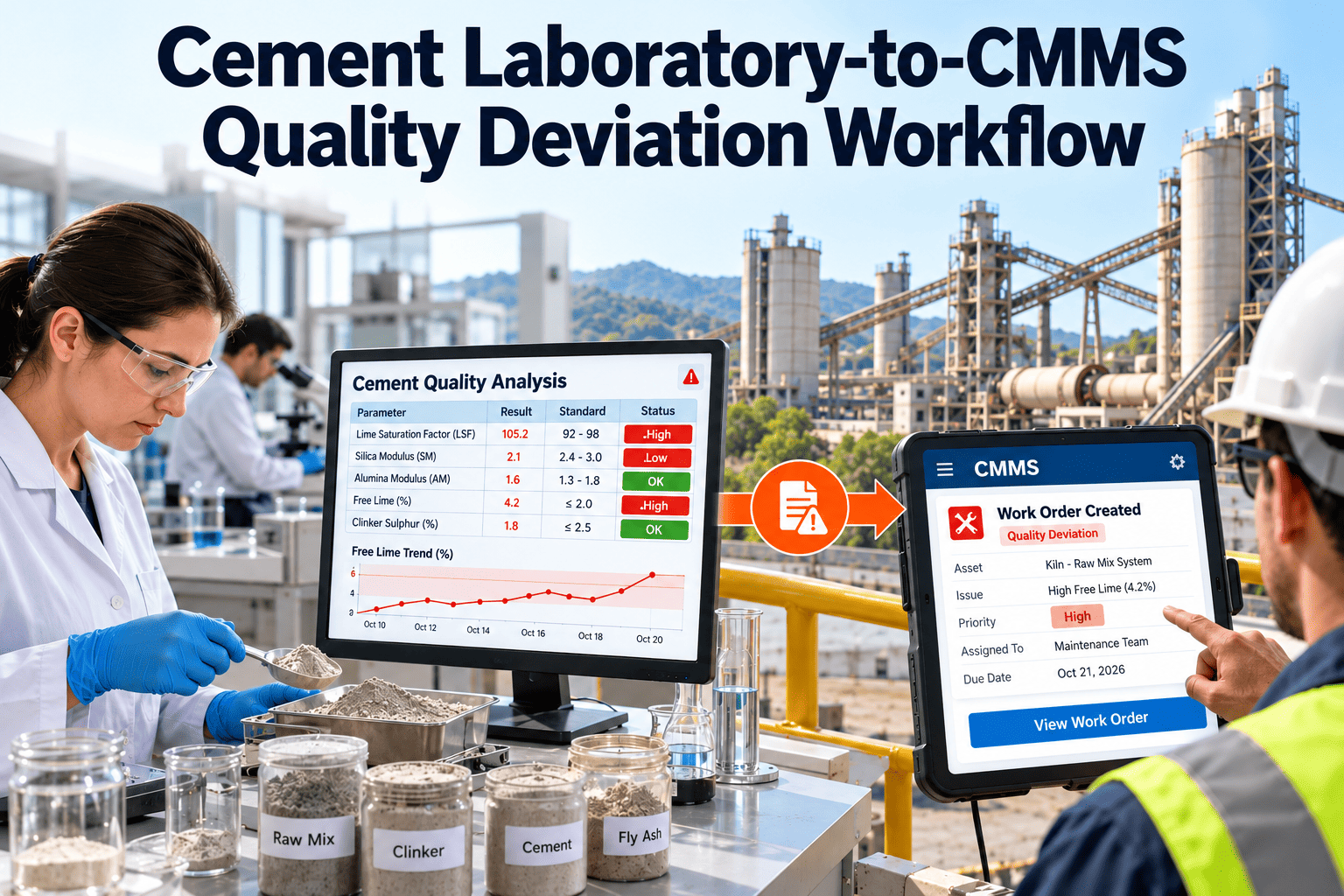
When a cement laboratory flags an out-of-range result, the useful question is what in the plant caused it and who is fixing it. In many plants the answer travels by phone call, shift handover or spreadsheet, so equipment causes are found late and repeat deviations go unnoticed. A defined handoff between laboratory, process control and maintenance turns each deviation into a traceable action. Recording that action against an asset in a CMMS closes the loop between quality data and equipment condition.
Cement Laboratory-to-CMMS Quality Deviation Workflow
Route fineness, chemistry, strength and setting-time deviations to the right team, link them to the asset, and track the fix to closure.
Laboratory
Result outside limit
Process control
Confirm and assess
Maintenance
Inspect and repair
Quality
Verify and close
Where the handoff usually breaks
No asset reference
The deviation names a product or silo, not the mill, separator or feeder involved.
No owner or deadline
Everyone sees the result and nobody is assigned to investigate it.
No closure evidence
Repairs finish but nobody confirms that later samples returned to range.
From laboratory result to maintenance action
| Deviation | Equipment to check first | Typical maintenance action |
|---|---|---|
| Cement fineness out of range | Cement mill, separator, mill fan | Inspect separator, liners and air flow |
| Sulfate or additive dosing deviation | Gypsum and additive feeders | Calibrate weighfeeders, check chutes |
| Raw meal chemistry swing | Raw feeders, sampler, analyzer | Verify calibration and sampler operation |
| High free lime in clinker | Kiln feed system, burner, cooler | Inspect feed metering and burner condition |
| Moisture above limit in additive | Dryer, storage, conveying | Check dryer burner, seals and covers |
| Strength variation | Grinding circuit, blending system | Review mill wear and dosing records |
Deviation triage levels
Level 1
Minor drift. Log it, add an inspection to the next scheduled round.
Level 2
Repeat or growing drift. Raise a work order with an owner and due date.
Level 3
Product at risk. Escalate immediately, assign urgent corrective work and notify quality.
Define your own thresholds with quality and process managers, and write them into the work order template.
Give every quality deviation an owner and an asset
Replace phone calls and loose notes with traceable work orders.
Information every deviation work order should carry
Sample referencePoint, time, shift and method
Parameter and limitMeasured value against specification
Linked assetMill, separator, feeder, silo or kiln system
Priority and ownerTriage level, responsible person, due time
Findings and fixCause, action taken, parts used
VerificationFollow-up sample result and sign-off
Common laboratory parameters and the equipment behind them
| Parameter | What a deviation may indicate | Assets to link |
|---|---|---|
| Sulfate content | Gypsum dosing error or feeder fault | Gypsum feeder, weighing system, sampling point |
| Loss on ignition | Additive dosing or moisture change | Additive feeders, storage, dryer |
| Residue on sieve or surface area | Grinding or separation change | Mill, separator, mill fan |
| Setting time | Sulfate balance or temperature issue | Gypsum dosing, mill cooling systems |
| Strength results | Fineness, clinker quality or blend change | Grinding circuit, dosing, clinker handling |
| Clinker free lime | Raw mix or burning problem | Raw feeders, kiln feed, burner, cooler |
Ruling out the sample and the method first
Sampling checks
- Was the sample taken at the right point and time?
- Was the sampler working normally?
- Was the sample stored and labeled correctly?
- Does a repeat sample confirm the value?
Instrument checks
- Was the instrument verified recently?
- Do reference samples give expected results?
- Did preparation equipment such as crushers or presses change?
- Has the operator method changed?
Sorting causes into three groups
Equipment cause
A feeder, mill, separator, sampler or instrument is not performing, so the work order goes to maintenance.
Material cause
Raw material, clinker or additive properties changed, so the action goes to process or supply teams.
Method cause
Sampling or testing practice was inconsistent, so the action goes to the laboratory.
Record the group on every closed deviation so monthly reviews show which cause dominates.
Roles in the deviation workflow
Laboratory
Flags the result, confirms the sample and states the parameter and limit.
Process control
Assesses process changes, picks the likely asset and sets the triage level.
Maintenance
Inspects, repairs and records cause, action and parts used.
Measures that show whether the workflow works
Time to first responseFrom flagged result to assigned owner
Time to closureFrom flag to verified follow-up result
Repeat deviationsSame parameter and asset recurring in a period
Cause mixEquipment, material and method shares
Records completenessShare of deviations with linked asset and cause
Overdue verification tasksCalibration or inspection tasks past due
A 60-day plan to launch the workflow
Days 1 to 30
- List the parameters that matter most and the assets that influence each.
- Agree triage levels and response expectations with quality and process managers.
- Build a work order template with the fields listed earlier.
Days 31 to 60
- Run the workflow on one product line and one shift pattern.
- Review closed deviations weekly and refine asset links and cause groups.
- Extend to other lines once the records are consistent.
Mistakes that undermine the handoff
- Creating a work order for every small drift, which buries real problems.
- Closing work orders without a follow-up laboratory result.
- Leaving the asset field blank because the cause is not yet known.
- Letting each shift use its own wording for causes and actions.
- Skipping the monthly review, so repeat patterns are never discussed.
Using Oxmaint for the workflow
Capabilities used
- Work orders created from deviation records
- Asset hierarchy for the grinding and raw circuits
- Inspection checklists on mobile devices
- Compliance records and audit history
Reports to review
- Deviations by asset and cause
- Time from flag to closure
- Repeat deviations after repair
- Open items by team and shift
Frequently asked questions
Who should raise the work order?
Agree one role, usually process control or the laboratory supervisor, so nothing depends on informal calls.
Do all deviations need a work order?
No. Use triage levels so minor drift is logged and only repeat or serious items create corrective work.
How do we prove a fix worked?
Record the follow-up laboratory result on the same work order before closing it.
Is this useful for audits?
Linked records show cause and action clearly. You can book a demo to see how it is recorded.
How do we start small?
Pick one recurring deviation, such as fineness, and get started with its asset records.
Close the gap between the laboratory and the plant floor
Turn each quality deviation into an assigned, traceable and verified maintenance action.