Bag filter jamming, separator bearing failures, false air ingress, and feed fluctuations account for 68% of all raw mill downtime events — yet each one leaves a clear digital fingerprint in sensor and operational data days before it becomes a production stop. The raw mill sits at the critical upstream chokepoint of every cement process: when it stops, the kiln stops. A single unplanned raw mill shutdown can cost 4 hours of lost clinker output from fan bearing failure alone, and separator bearing defects can drive even higher downtimes when replacement bearings are not staged in the storeroom. This article explains exactly how a CMMS transforms raw mill maintenance from reactive firefighting into scheduled precision — mapping each failure mode to its detection signal, its PM trigger, and its CMMS work order. Sign up free on OxMaint and activate a cement raw mill PM template on day one, or book a 30-minute demo to see raw mill condition monitoring live in a cement plant environment.
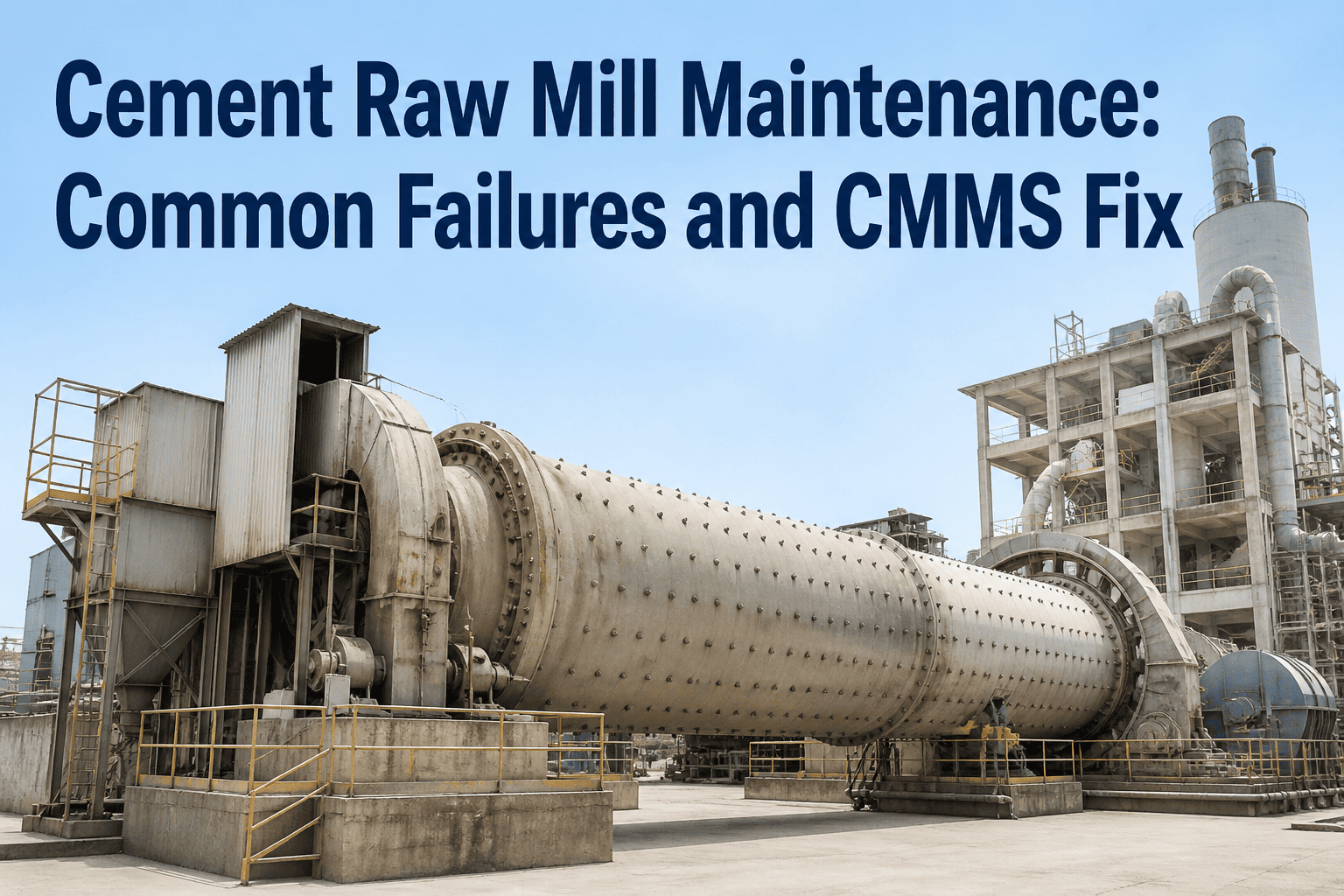
Cement Raw Mill Maintenance: Common Failures and the CMMS Fix
Bag filter jamming, separator bearing spalling, false air ingress, and feed fluctuations cause 68% of all raw mill downtime — and every failure mode has a digital signature that a CMMS catches before the shutdown happens.
Why the Raw Mill Is Your Most Upstream Risk
The raw mill converts limestone, clay, and corrective materials into kiln feed. It runs continuously, upstream of the entire clinker production chain. When it stops unexpectedly, the kiln feed silo empties within hours, the kiln must slow or stop, and thermal cycling damages the refractory lining in ways that compress campaign life by weeks. A single raw mill failure is never just a raw mill problem — it is a plant-wide production event.
The 4 Raw Mill Failure Modes — Detection Signals and CMMS Response
Each raw mill failure mode produces early warning signals in operational data. The gap between plants that catch these signals and plants that don't is not sensor hardware — it is whether those signals route into a CMMS that creates a work order automatically rather than sitting in a shift log no one reads on Monday morning.
The ID fan creates the negative pressure that draws gas through the bag filter. Fan bearing seizure from imbalance or poor lubrication is the primary cause of unplanned baghouse shutdowns. Dust buildup on the impeller causes 1× running-speed imbalance. Compartment DP sustained above 200 mm WC despite adequate pulsing signals a blocked or blinded bag section. A sudden DP drop in a previously high-DP compartment may indicate bag failure — not cleaning success.
Vibration and DP thresholds auto-generate investigation work orders before the bearing seizes. Bag life forecasting shifts 68% of emergency replacements to planned kiln shutdown windows. Pulse cleaning cycle compliance is tracked by PM schedule — not by whoever happens to walk past the controller.
The dynamic air separator classifies ground material and returns oversize particles to the mill. Its bottom bearing carries the full rotor load and operates in an abrasive, dusty environment. Bearing spalling in a separator progresses through inner and outer race defect frequencies detectable by FFT vibration analysis weeks before the bearing temperature rises. When temperature drift is the first signal you observe, bearing replacement is already urgent rather than scheduled.
ML models trained on cement-specific bearing spalling failure libraries classify anomalies with confidence scores and remaining useful life estimates. Predicted failures auto-generate CMMS work orders with pre-populated task lists, parts from storeroom inventory, and scheduling windows aligned with the next planned production stop — not the emergency that follows seizure.
False air ingress through worn mill seals, inspection door gaskets, and expansion joints dilutes the hot gas stream that dries and conveys material through the mill. It raises specific power consumption, reduces drying capacity, forces the operator to reduce feed rate, and masks the actual thermal efficiency of the circuit. False air is invisible to operators who are not tracking differential pressure and oxygen readings systematically. By the time production notices the throughput impact, seal degradation is typically severe.
CMMS tracks O₂ trend and specific power consumption per shift. When deviation exceeds configured threshold, a seal inspection work order is auto-generated. Seal replacement is a low-cost planned job — but only if it is identified before the feed rate impact compounds over weeks of degraded operation and disguises itself as a process problem rather than a maintenance problem.
Raw mill feed systems — rotary feeders, belt weighers, and recirculating bucket elevators — are prone to wear-and-tear mechanical faults that cause erratic feed rate. Inconsistent feed destabilises mill differential pressure, increases vibration, and causes repeated operator interventions that prevent the circuit from reaching steady-state efficiency. Screw conveyor blockages are common after shutdowns as cement dust hardens on contact with moisture in idle equipment.
Belt weigher calibration is scheduled on CMMS meter-based triggers — not calendar date alone — so drift is caught before it biases kiln feed chemistry. Rotary feeder and elevator PM intervals are linked to production tonnage data, ensuring inspection frequency scales with actual wear rather than arbitrary calendar cycles that over-service low-utilisation equipment and under-service high-utilisation equipment.
Raw Mill PM Schedule — From Shift Checks to Annual Overhaul
Asset-specific PM intervals are the foundation of raw mill reliability. The following framework reflects the actual inspection frequency required to catch each failure mode before it causes downtime — using a mix of time-based and meter-based triggers that only a CMMS can manage consistently across shifts and crew rotations.
| Component | Shift / Daily | Weekly | Monthly | Annual / Overhaul |
|---|---|---|---|---|
| Mill Main Bearing | Oil temp and pressure, vibration reading, oil colour check | Oil sample sent for analysis, bearing housing visual | Vibration baseline comparison, oil cleanliness ISO 4406 check | Full bearing inspection, white metal condition, shaft alignment |
| Dynamic Separator | Bearing temperature, product fineness sample, drive current | Bottom bearing lubrication, blade condition visual | Vibration spectrum analysis, blade wear measurement, air seal check | Bearing replacement (condition-based), full blade set inspection, cage inspection |
| Bag Filter / ID Fan | Compartment DP per shift, fan bearing temp and vibration | Impeller dust buildup visual, pulse valve function test | Fan bearing vibration baseline, bag sample inspection, hopper discharge check | Full bag set replacement (life forecast), impeller erosion check, casing inspection |
| Mill Seals and Gaskets | O₂ reading at outlet, mill inlet temperature | Inspection door and flange visual for air ingress signs | Seal air fan function test, O₂ trend analysis, specific power review | Full seal replacement programme, expansion joint inspection, rotary seal service |
| Rotary Feeder / Belt Weigher | Feed rate standard deviation, drive current, belt weigher zero | Belt weigher span calibration check, feeder wear visual | Belt weigher full calibration, feeder liner thickness measurement | Full feeder rotor and liner replacement, belt weigher recalibration, drive service |
| Mill Liner | Motor current (indirect wear indicator), vibration level | Discharge grate visual check for blinding or breakage | Liner thickness measurement at 12 points, bolt torque check | Full liner replacement (tonnage-based), shell internal inspection, diaphragm slot measurement |
How CMMS Turns Sensor Data into Scheduled Work Orders
The technical gap in most cement plants is not sensor hardware — it is the step between a data point and a maintenance decision. Raw mills generate thousands of sensor readings per shift. Without a CMMS routing those readings into actionable work orders, they accumulate in historians and dashboards that no one acts on until a failure forces the issue.
Raw Mill Maintenance KPIs — What to Track and Why
These five metrics, tracked automatically in a CMMS, tell you whether your raw mill maintenance programme is preventing failures or just documenting them after they happen.