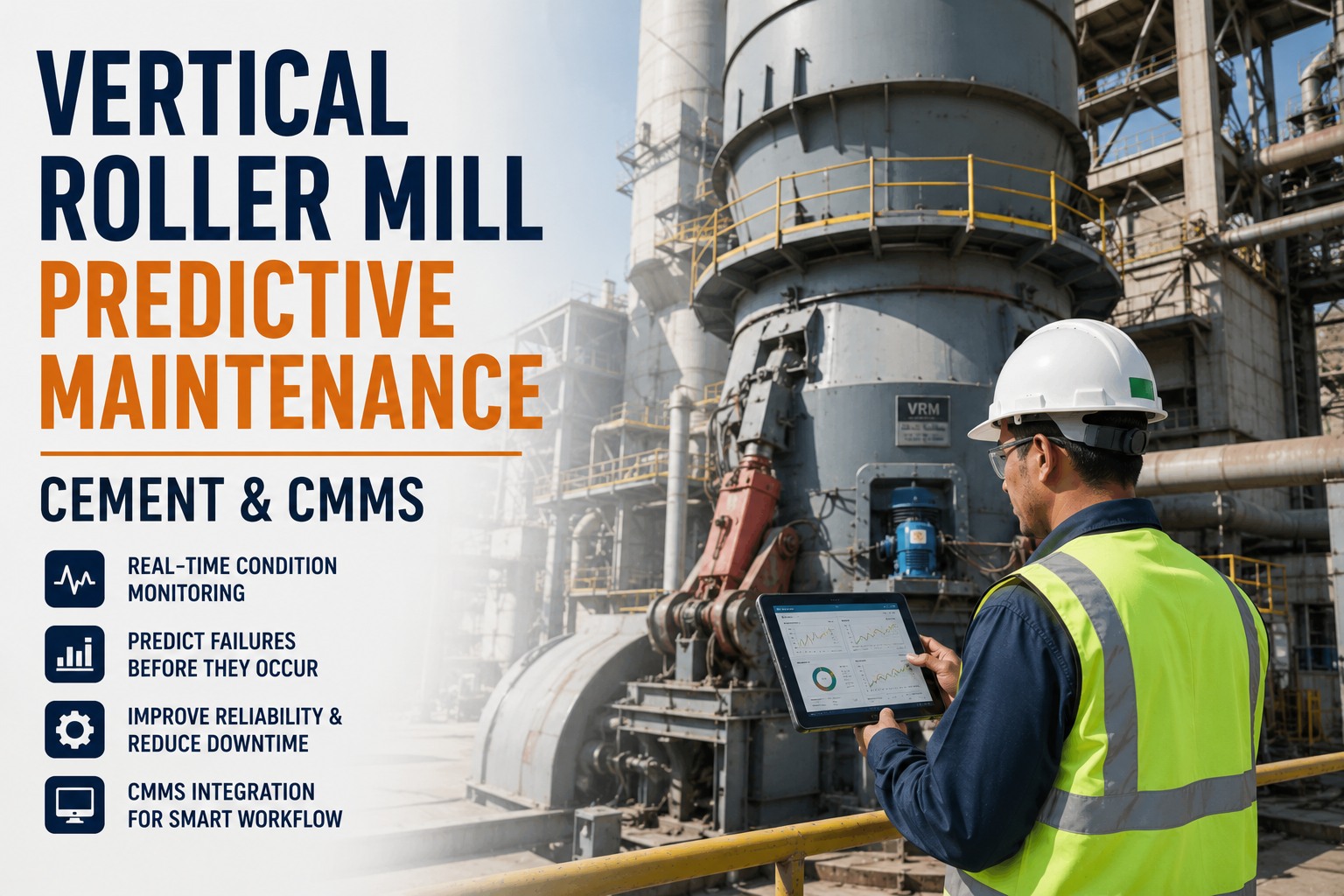
Vertical roller mills concentrate an unreasonable share of plant power, downtime risk and grinding capacity into one asset — a single VRM outage often idles the entire kiln line and burns six-figure margins per week. This guide maps the high-value failure modes (roller segment wear, table liner fatigue, gearbox torsional stress, hydraulic system drift, separator bearing health) to a practical VRM predictive maintenance program anchored in CMMS workflows. For cement operations that have already moved beyond break-fix, pairing vibration and oil analytics with structured work orders is the fastest lever to lift mill availability above 92%. Start a structured rollout today with Start Free Trial or read on for the full condition-monitoring blueprint.
What would 11 extra grinding days per year do for your kiln line?
A 500 tph VRM running 7,800 hours annually loses roughly 39,000 tonnes of finished cement per single unplanned 7-day outage. Modern VRM predictive maintenance — combining vibration trending, oil debris tracking and CMMS-driven work orders — consistently lifts mill availability from 86% to 94%, recovers 600–900 running hours per year and pushes mechanical MTBF past 18 months.
One asset, four failure modes, the whole line at risk
A modern VRM draws 3,500–6,500 kW and processes 200–600 tph of raw meal or cement. Because there is no redundant mill standing by, every unplanned stop cascades directly into clinker-to-cement ratio penalties, missed dispatch windows and contracted shortfall charges.
A vertical roller mill is the single point of failure for the grinding circuit. The plant that knows its VRM's vibration signature at 4 a.m. — before the table liner spalls — is the plant that makes budget.
Where VRM value actually leaks — and how CMMS catches it early
VRM failures rarely arrive unannounced. Each of the four critical subsystems emits measurable precursor signals 2–12 weeks before functional failure. The CMMS converts those signals into triggered work orders.
Roller & Table Liner Wear
Hardfaced segments lose 8–15 mm of profile per 2,000 operating hours, directly raising specific power consumption 0.4–0.8 kW·h/t and reducing throughput 3–6%. A CMMS tracks hardfacing cycles, segment weight loss and ultrasonic thickness readings, auto-generating a re-build work order at the 70% remaining-life threshold.
Gearbox & Main Bearing
The planetary/multi-stage gearbox carries 90% of mill torque. ISO 10816 vibration velocity above 7.1 mm/s RMS on the output shaft, combined with ferrous particle count >150 ppm in oil analysis, flags pitting or bearing race fatigue 6–10 weeks before catastrophic failure — saving a $400K–$900K gearbox rebuild.
Hydraulic System Health
Grinding pressure hydraulics (typically 80–180 bar) drift as accumulator nitrogen charge leaks and proportional valve response degrades. A 10% pressure drop cuts grinding efficiency and produces coarser product. CMMS scheduling of accumulator recharge every 4,000 hours and oil sampling every 1,000 hours prevents silent throughput loss.
Separator & Fan Bearings
The dynamic separator runs 100–300 rpm with critical cage and fan bearings. Vibration spike energy (g·se) above 0.8 and temperature rise >15°C above baseline indicate lubrication starvation or early inner-race fatigue — caught through weekly CMMS-issued route-based data collection, not annual inspection.
The weekly route that catches 80% of failures before they escalate
This is the inspection backbone used by VRM reliability programs at plants running >92% availability. Each item feeds directly into the CMMS as a route task with pass/fail thresholds.
Roller Assembly
6 tasks- Vibration velocity at roller housing (alarm >11.2 mm/s)
- Hydraulic grinding pressure vs. setpoint (±5% band)
- Roller clearance / gap measurement (mm)
- Segment thickness — ultrasonic (min 25 mm)
- Lubrication grease feed — flow + pressure
- Bearing temperature (alarm >85°C)
Table & Grinding Bed
5 tasks- Table liner thickness — ultrasonic at 8 positions
- Grinding bed stability (mill ΔP trend)
- Feed gate / damper position
- Mill differential pressure (70–120 mbar norm)
- Foreign-object / tramp metal detector test
Gearbox & Drive
6 tasks- ISO 10816 vibration at input / intermediate / output
- Oil sample — particle count, viscosity, water (Karl Fischer)
- Oil filter differential pressure
- Motor stator winding temperature
- Coupling alignment — laser (max 0.05 mm)
- Gearbox breather / desiccant condition
Hydraulics & Separator
6 tasks- Accumulator nitrogen pre-charge (within 10% of hydraulic setpoint)
- Proportional valve response time
- Separator cage bearing vibration (spike energy)
- Separator bearing temperature (<75°C)
- Seal air pressure differential
- Hydraulic oil cleanliness (ISO 4406 <18/16/13)
What a CMMS-driven VRM program actually pays back
A 180-asset cement plant spending $42K/yr on VRM reactive maintenance parts and $310K/yr in unplanned outage margin loss typically sees payback in under 9 months after deploying condition-based workflows.
At 7,800 h/yr, moving from 86% to 94% availability recovers 624 running hours — equivalent to ~11 full grinding days.
At 400 tph and $28/t margin, each recovered hour returns $11,200 in gross margin before emergency-spare savings.
| Metric | Reactive Program | Predictive CMMS | Delta |
|---|---|---|---|
| VRM Availability | 84–87% | 92–95% | +7 pts |
| Unplanned Outages / Year | 6–9 | 1–2 | −75% |
| MTBF (mechanical) | 9–12 months | 18–24 months | +100% |
| Emergency Parts Spend | $42K/yr | $11K/yr | −74% |
| Outage Margin Loss | $310K/yr | $58K/yr | −81% |
| Specific Energy (kW·h/t) | 17.2 | 15.6 | −9.3% |
| Annual Program Cost | $28K | $46K | +$18K |
| Net Annual Benefit | — | — | $206K/yr |
Two VRMs, 12 months, one CMMS rollout
A 3.4 MTPA plant operating two 380 tph cement VRMs rolled out condition-based monitoring through a CMMS in Q1. Within 11 months: roller vibration trending caught an inner-race bearing defect 7 weeks before failure (saved ~$680K in gearbox + outage cost); accumulator drift was corrected on the second mill (recovered 18 tph throughput); and emergency work orders dropped from 34 to 9. Net documented benefit: $412K in year one on a $46K program investment — a 9× return.
From break-fix to predictive in 90 days
A disciplined CMMS-driven rollout moves a VRM from reactive to condition-based in three monthly phases — each delivering measurable availability gains.
Baseline & Asset Register
Build VRM asset hierarchy in CMMS (mill → subsystem → component). Upload OEM manuals, record baseline vibration spectra, oil samples, hydraulic pressures and bearing temperatures. Define 12 critical failure modes and link each to a measurement threshold.
Route-Based Monitoring Live
Weekly vibration routes, monthly oil sampling and daily hydraulic-pressure logs entered into the CMMS. Configure automatic work-order generation when any value crosses the alarm threshold. Train operators and maintenance technicians on pass/fail criteria.
Condition-Based Scheduling
Shift from calendar-based overhauls to condition-based: plan the next VRM major maintenance window around the lowest-confidence component, not the calendar. First quantified availability uplift typically appears in weeks 8–12.
Ready to move your VRM from reactive to predictive?
Deploy a CMMS workflow that catches roller wear, gearbox fatigue and hydraulic drift weeks before they become outages.
VRM predictive maintenance, answered
The five questions cement reliability managers ask most before moving a vertical roller mill onto a predictive CMMS workflow.
How is VRM predictive maintenance different from preventive maintenance?
Preventive maintenance follows fixed calendar intervals (e.g., inspect rollers every 4,000 hours) regardless of actual condition. Predictive maintenance uses real-time and route-based data — vibration spectra, oil debris counts, hydraulic pressure trends — to trigger work orders only when a threshold is crossed. This typically cuts planned maintenance hours 25–40% while extending mean time between failures, because you act on evidence rather than assumption.
Which VRM sensors deliver the highest ROI first?
Start with vibration accelerometers on the gearbox output shaft and roller housings (ISO 10816 compliance), plus oil sampling ports on the gearbox and hydraulic circuit. These two data streams alone catch roughly 70% of high-cost VRM failures 4–10 weeks in advance. Add separator bearing spike-energy sensors and ultrasonic thickness gauging for the table liner in phase two. You can pilot the full workflow in Start Free Trial without changing your existing sensors.
How long does a CMMS rollout for a VRM take?
A focused rollout reaches a live condition-based workflow in 60–90 days: month one builds the asset register and baselines, month two activates routes and alarm thresholds, month three shifts scheduling from calendar to condition. Plants with an existing CMMS asset hierarchy can compress this to 4–6 weeks. The first measurable availability uplift typically appears in weeks 8–12.
What does a CMMS actually do for VRM roller and table wear?
The CMMS stores every hardfacing cycle, segment weight record and ultrasonic thickness reading against the specific roller position. When remaining liner life drops to the 70% threshold, the system auto-generates a work order with the correct part numbers, torque specs and safety permits — so the next grinding-bed resurface is scheduled into a planned window, not triggered by a throughput collapse at 3 a.m.
Can predictive maintenance extend VRM gearbox life?
Yes — and this is usually the single largest saving. Early detection of bearing race fatigue, gear pitting or lubrication degradation through combined vibration and oil analysis regularly extends a VRM gearbox from a 10-year to a 14–16 year service life, avoiding a $400K–$900K premature rebuild. Book a walkthrough of the gearbox monitoring workflow at Book a Demo.
Stop losing grinding days to failures you can see coming
Deploy VRM predictive maintenance with a CMMS built for cement — condition-based work orders, vibration trending and oil analysis in one workflow.
Free 14-day trial · No credit card