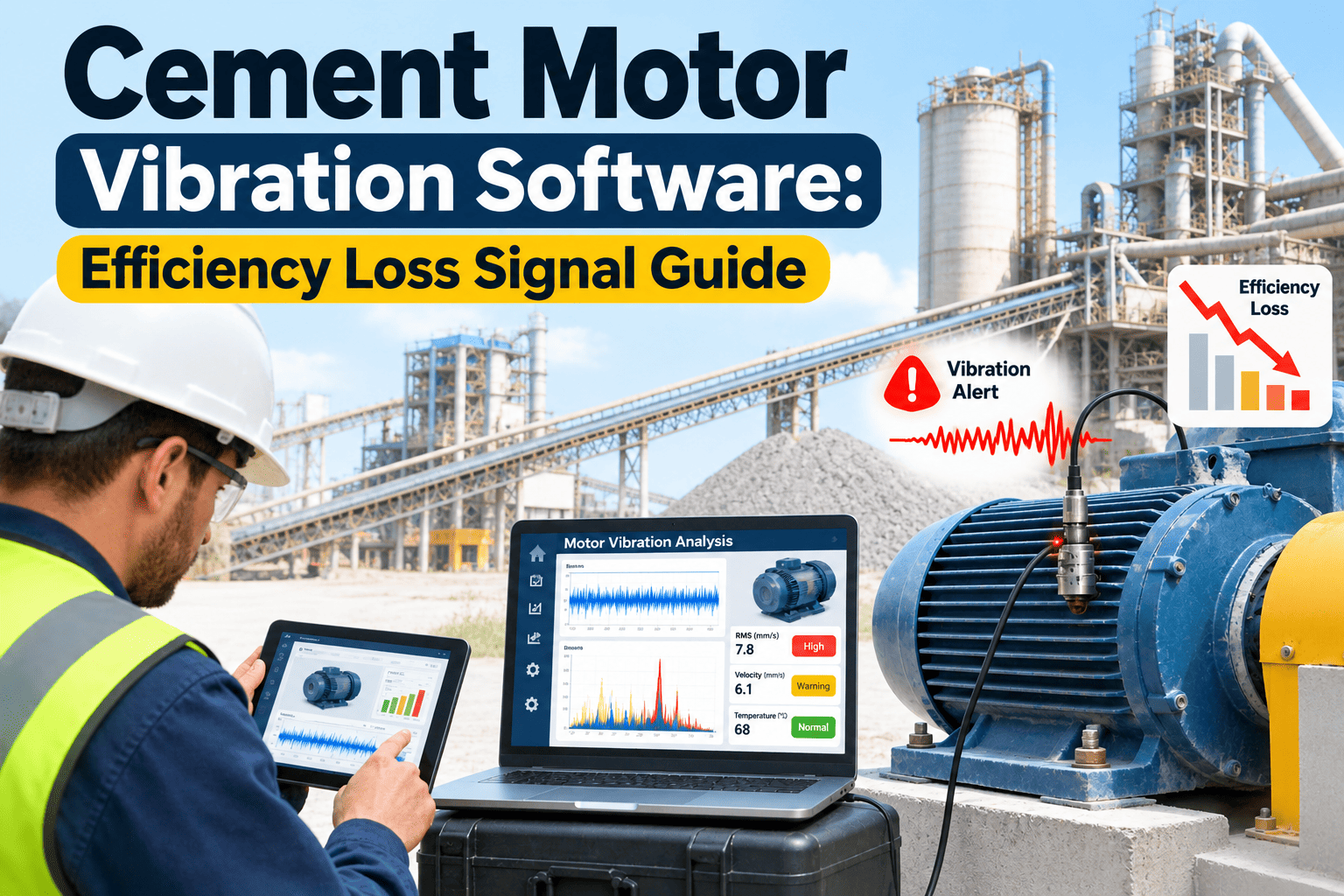
A cement plant motor rarely fails without warning — it fails without anyone reading the warning. A bearing that's eight weeks from seizure is already pushing motor amperage 3 to 5% above baseline and nudging vibration velocity past its first alarm zone, but on most plant floors those two numbers live on different screens read by different people. One integrated cement group lost an ID fan motor to bearing seizure that had been visible in amperage trends for eleven days before the trip — the unplanned stop cost four days of kiln downtime. Sign in to OxMaint to fuse vibration and amperage data into one efficiency-loss signal, or book a demo to see it running against your own motor fleet.
A Bearing Doesn't Fail Suddenly — It Draws More Amps and Vibrates Harder for Weeks First
Vibration alone tells you a fault exists. Amperage tells you the motor is already working harder to compensate. OxMaint tracks both together across kiln drives, ID fans, and mill motors — turning a quiet efficiency loss into a scheduled bearing swap instead of a trip.
The ISO 10816 Zones — and Why Vibration Alone Misses the Early Ones
ISO 10816-3 classifies rotating machinery condition into four zones, from a newly commissioned machine through immediate shutdown. The zones give reliability teams a globally recognized scale, but a fault sitting quietly inside Zone A or B rarely trips a vibration alarm — it shows up first as a small, steady rise in motor amperage as the mechanism compensates for developing friction or imbalance.
What Failing Bearings Look Like Across Your Motor Fleet
The same underlying fault — a wearing bearing, a growing imbalance, a shifting coupling — produces a different signature depending on which motor it's attached to. Recognizing the asset-specific pattern is what turns a raw vibration reading into a specific, actionable finding.
Two Signals, One Fault, One Work Order
OxMaint fuses vibration velocity, motor amperage, and bearing temperature against a load-normalized baseline for every critical motor — so a developing fault is flagged the moment both signals agree, not after one of them finally crosses a fixed threshold.
Vibration-Only Monitoring vs Fused Vibration + Amperage
Vibration monitoring is the highest-leverage predictive tool on a cement plant floor, but read alone it still misses the earliest, quietest stage of most bearing and imbalance faults. Sign in to OxMaint to see the fused signal running against your own motor baselines.
| Vibration-Only | OxMaint Fused Signal | |
|---|---|---|
| Earliest detectable stage | Zone B–C, once amplitude crosses threshold | Zone A–B, once amperage drift and vibration agree |
| False alarm rate | Higher with fixed thresholds | Reduced with load-normalized, asset-specific baselines |
| Load and speed variation | Can mask true severity on VSD-driven motors | Normalized against real-time speed and load |
| Diagnostic detail | Requires a specialist to interpret the spectrum | Fault classification and likely component attached to alert |
| Work order generation | Manual, after analyst review | Automatic, with spares availability checked first |
| Baseline establishment | Fixed ISO thresholds applied indefinitely | Facility-specific baseline replaces fixed limits after initial run-in |
From Signal to Bearing Swap — How the Alert Becomes a Work Order
A vibration or amperage reading that never reaches a technician's hands protects nothing. OxMaint's alert pipeline moves a developing fault from raw sensor data to a scheduled repair without waiting for a shift review.
Frequently Asked Questions
Somewhere on Your Motor Fleet, Amperage Is Already Drifting. Is Anyone Watching It Alongside Vibration?
OxMaint fuses vibration, amperage, and bearing temperature into one efficiency-loss signal across kiln drives, ID fans, and mill motors — so a quiet drift becomes a scheduled repair, not an unplanned stop.