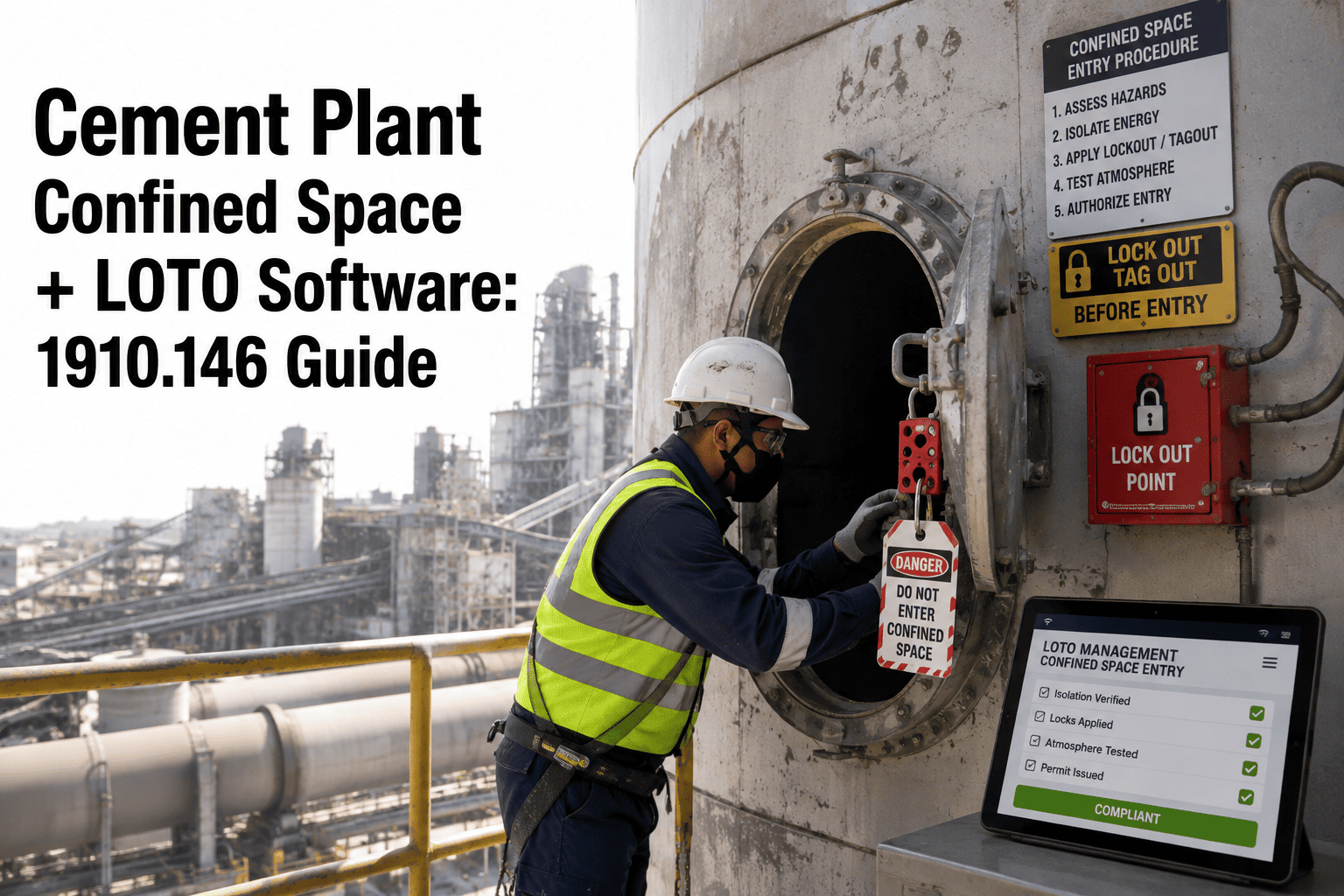
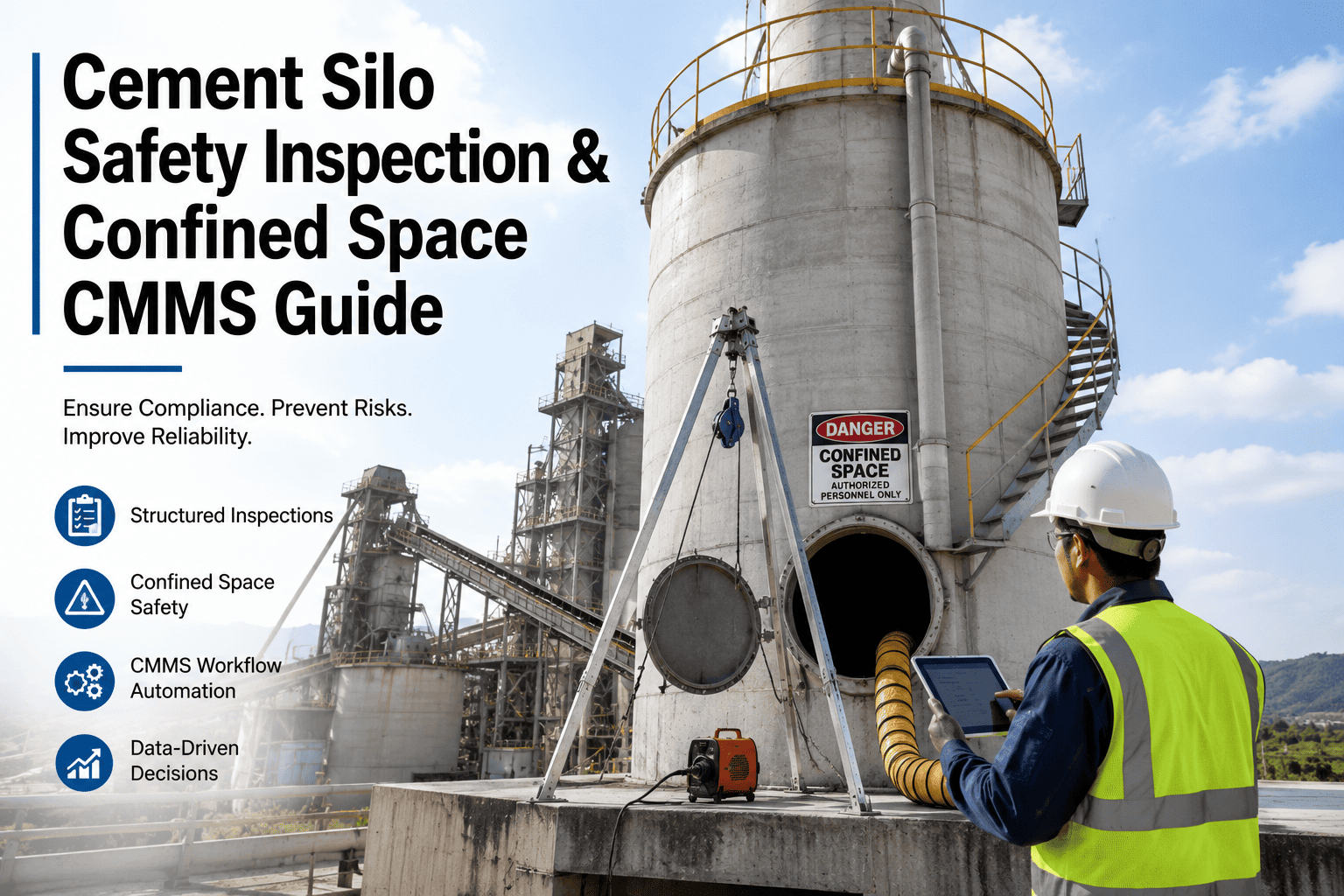
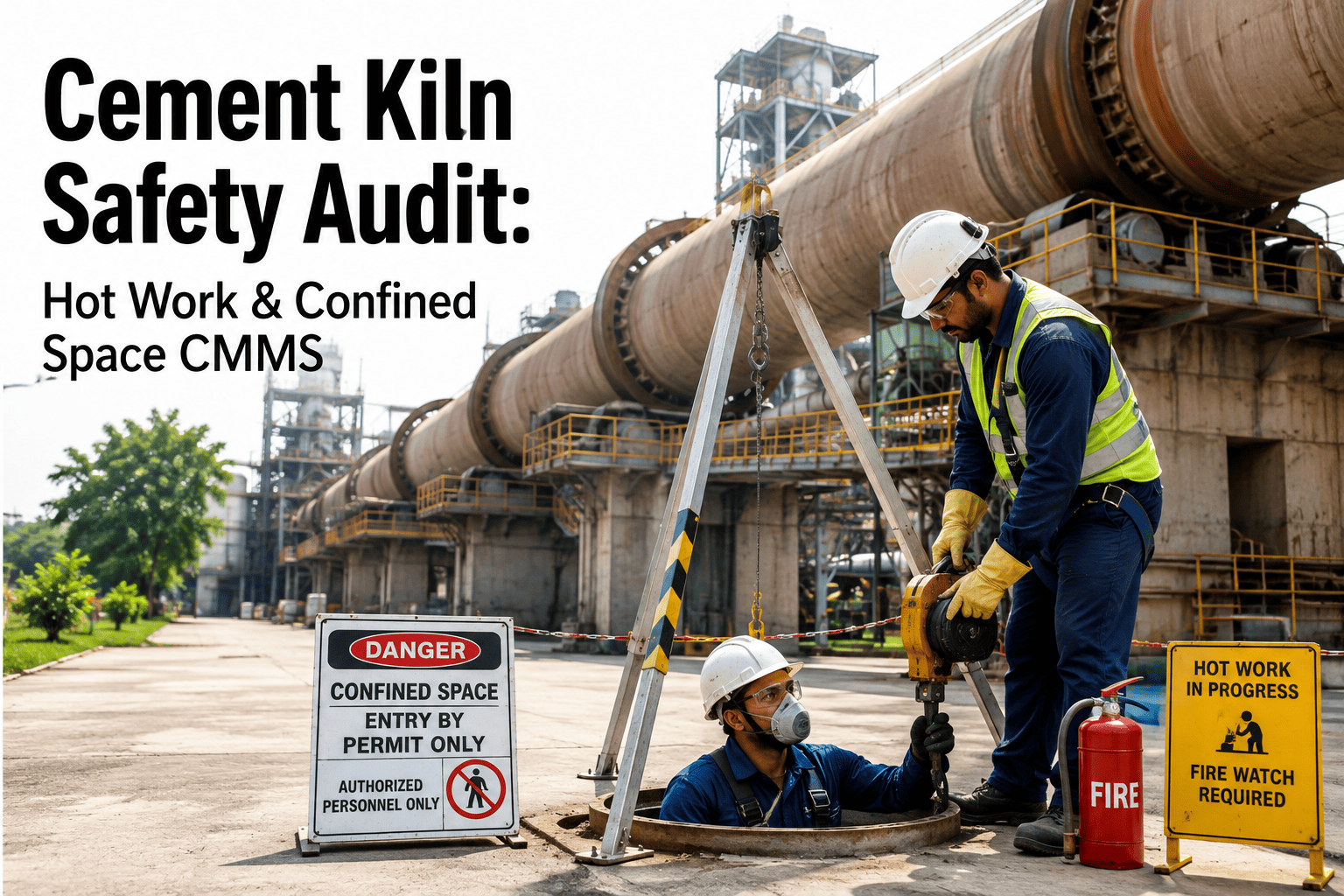
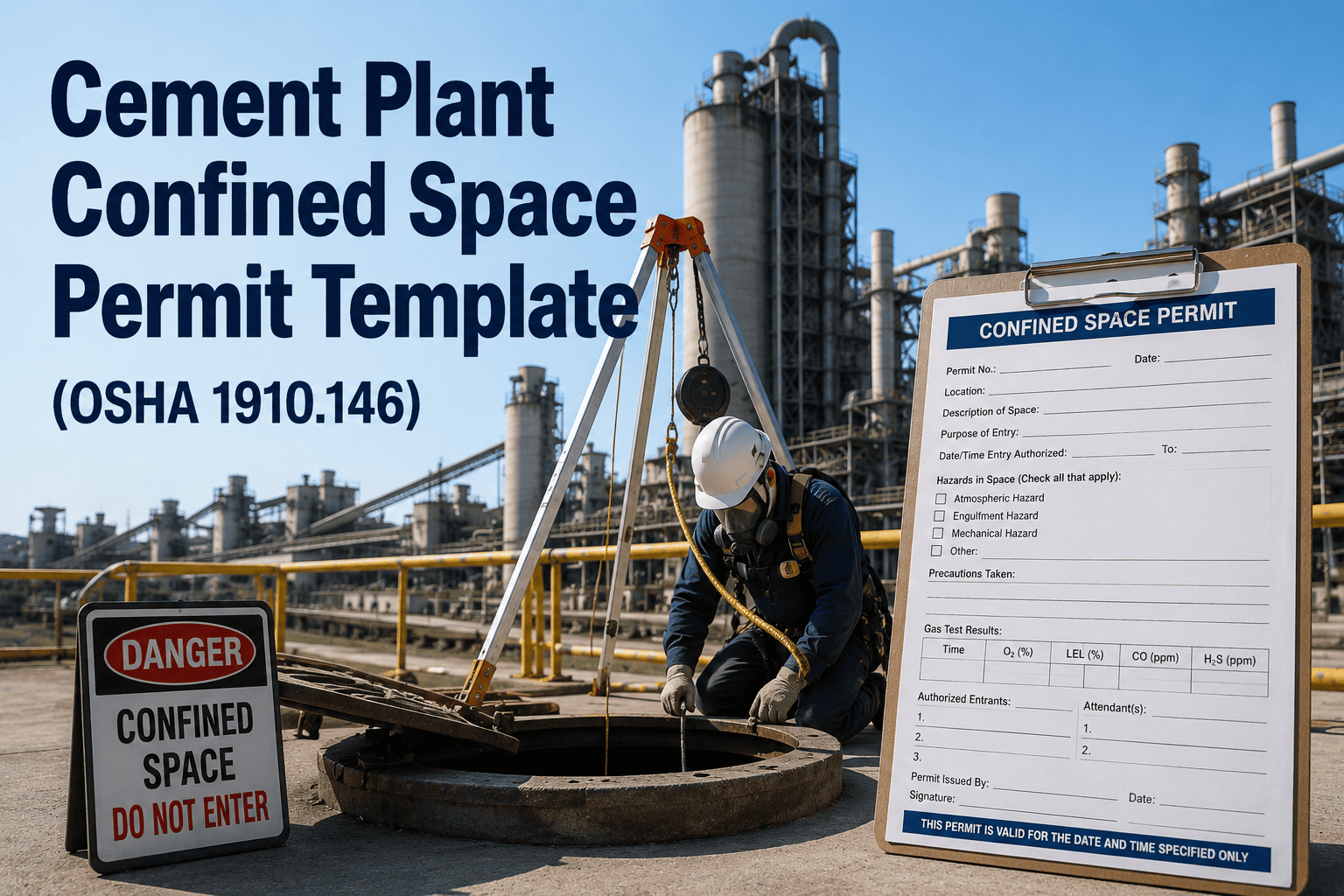
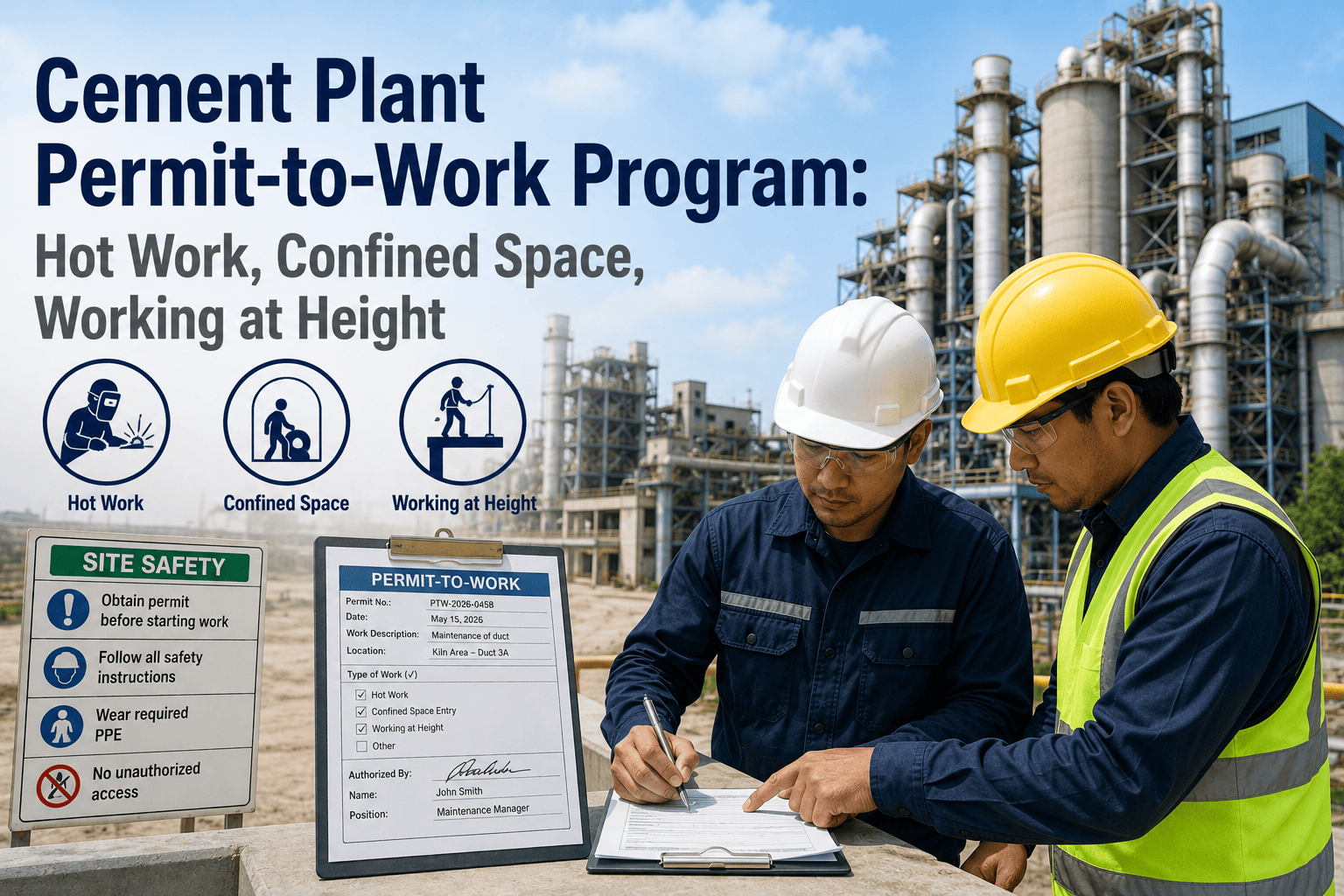
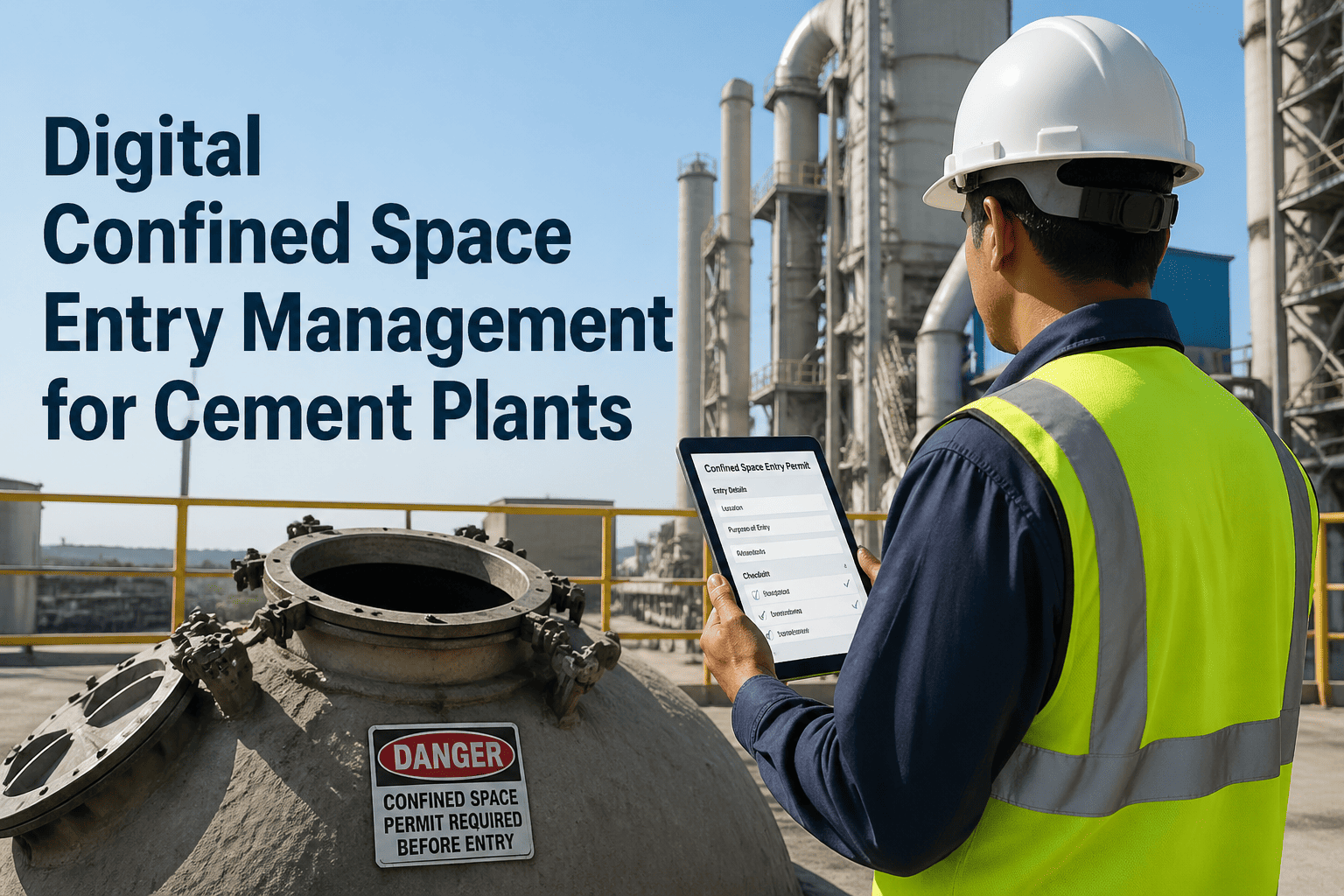
Cement plants are dense with permit-required confined spaces — silos, hoppers, preheater vessels, mill interiors, dust collectors, and underground pit structures that demand rigorous pre-entry control before any person enters. OSHA 1910.146 mandates atmospheric testing, attendant assignment, a written rescue plan, and documented permit issuance before entry into any permit-required confined space, and violations carry some of the highest per-instance penalties in industrial safety. In the cement industry, where dust accumulations, CO buildup from incomplete combustion, and oxygen displacement from CO2 in storage vessels create real atmospheric hazards, a missed pre-entry step is not a paperwork oversight — it is a life-safety event. Paper-based confined space programs consistently fail when permits are lost, atmospheric readings go unrecorded, or attendant assignments are made verbally and never documented. A CMMS-integrated confined space program closes every one of these gaps: permits are issued digitally, atmospheric data is recorded at the work order level, attendant assignments are timestamped, and rescue plans are attached to each entry before the entry team approaches the opening. OxMaint brings every confined space entry in your cement plant into a single traceable, audit-ready system. Start your free trial and bring your cement plant confined space program into OSHA 1910.146 compliance today.
OSHA 1910.146 Compliance · Confined Space Safety · Cement Plants
Cement Plant Confined Space Pre-Entry Checklist
Atmospheric testing, attendant assignment, rescue planning, and permit issuance — structured for cement plant spaces: raw meal silos, clinker hoppers, mill chambers, and preheater vessels. Every entry. Every reading. Every sign-off. Documented.
Atmospheric Hazards Found in Cement Plant Confined Spaces
Oxygen Deficiency
Below 19.5%
Raw meal silos, clinker bunkers, storage domes — CO2 displacement during curing or decomposition
Carbon Monoxide (CO)
OSHA PEL: 50 ppm
Kiln pits, preheater tower base, coal storage — incomplete combustion residuals
Combustible Dust / Gas
LEL Below 10%
Coal mill interiors, dust collector housings, raw coal bunkers
Hydrogen Sulfide (H2S)
OSHA Ceiling: 20 ppm
Wastewater pits, wet process areas, underground drainage channels
Pre-Entry Checklist
OSHA 1910.146 Confined Space Pre-Entry: Cement Plant Permit Sequence
Complete each section before any entry team member approaches the confined space opening. All readings, names, and times must be documented in the CMMS work order before the entry permit is issued.
Step 1
Space Classification & Permit Type
Space classified as permit-required confined space (PRCS) confirmed in plant confined space register
CMMS asset record for this space retrieved — last entry date, previous atmospheric readings, known hazards noted
Entry permit number generated in CMMS — linked to work order, asset record, and entry team names
Entry supervisor named and confirmed — authorized under plant PRCS program with valid certification
Step 2 — CRITICAL
Atmospheric Testing (Before Entry)
Calibration of multi-gas detector verified and documented — calibration date within validity period
Oxygen level tested from outside before entry: Result ___% (acceptable range: 19.5%–23.5%)
Carbon monoxide (CO) tested: Result ___ ppm (OSHA PEL: 50 ppm TWA / IDLH: 1,200 ppm)
Combustible gas / LEL tested: Result ___% LEL (entry requires below 10% LEL)
Hydrogen sulfide tested where applicable: Result ___ ppm (OSHA ceiling: 20 ppm)
All atmospheric readings logged in CMMS permit form with timestamp and instrument serial number
Continuous monitoring confirmed — detector worn by entrant for duration of entry
Step 3
Isolation & Energy Control
All mechanical energy isolated per LOTO procedure — LOTO permit number recorded in confined space permit
All material inflows physically blanked or blinded — no reliance on closed valves alone
Purge and ventilation system active — verified mechanical ventilation delivering fresh air to lowest point
Agitators, augers, and rotating internals confirmed locked out — zero energy verified
Adjacent spaces checked for common walls or interconnecting ducts that could introduce hazardous atmosphere
Step 4
Attendant Assignment & Communication
Attendant named in CMMS permit — confirmed they will remain outside the space for the entire entry duration
Communication method established and tested before entry — radio channel, code signals, or voice contact confirmed
Attendant briefed on rescue initiation procedures — knows when and how to activate rescue without entering the space
Attendant has no other duties that could distract from monitoring entry team — confirmed and logged
Entry team count confirmed — attendant knows number of entrants and can account for all at any time
Step 5
Rescue Plan & Emergency Readiness
Written rescue plan attached to CMMS entry permit — specific to this space, not generic
Rescue method confirmed: non-entry retrieval system rigged OR entry rescue team on standby at space
Tripod and retrieval line installed and load-tested where required — rated for heaviest entrant plus equipment
Emergency services contact confirmed — local rescue team or plant emergency response team notified of entry
Nearest AED, first aid, and oxygen resuscitation equipment location confirmed and communicated to all entry team members
Step 6
PPE & Equipment Verification
Supplied-air respirator or SCBA available and inspected where atmospheric hazard cannot be eliminated
Full body harness fitted and inspected — D-ring positioned at back, webbing free of cuts and chemical damage
Safety boots, hard hat, and chemical-resistant gloves confirmed per space-specific PPE matrix in work order
Explosion-proof lighting confirmed if combustible atmosphere possible — no open-flame lighting permitted
All tools and equipment inventoried before entry — same inventory reconciled on exit to prevent foreign object retention
Step 7
Post-Entry Closeout & Permit Cancellation
All entrants exited and accounted for — attendant confirms entry team count matches permit
All tools and materials removed from space — inventory check completed
Entry permit cancelled in CMMS — cancelled permit archived with atmospheric reading data attached
Space re-secured — access covers, hatches, and guards replaced and fastened
Energy isolation restored per LOTO procedure — LOTO permit closed and linked back to confined space permit record
Permit-Required Spaces in Cement Plants
Where OSHA 1910.146 Applies in Your Plant — Space by Space
| Space / Location |
Primary Atmospheric Hazard |
Engulfment Hazard |
Recommended Monitoring |
Permit Required |
| Raw meal silo interior |
O2 deficiency (CO2 from limestone) |
Raw meal engulfment |
O2, CO2 continuous |
Yes |
| Clinker storage bunker |
CO, O2 deficiency, high heat |
Clinker engulfment |
O2, CO, temperature |
Yes |
| Ball mill chamber (interior) |
Residual dust, O2 displacement |
None (fixed internals) |
O2, combustible dust |
Yes |
| Preheater cyclone interior |
CO, O2, high heat residual |
Sticky buildup collapse |
O2, CO, temperature |
Yes |
| Baghouse hopper interior |
Combustible dust, O2 displacement |
Dust engulfment |
O2, LEL, CO |
Yes |
| Coal bunker interior |
CO, methane (CH4), combustible dust |
Coal engulfment |
O2, CO, CH4, LEL |
Yes |
| Underground cable tunnels |
O2 deficiency (stagnant air) |
None |
O2 pre-entry |
Evaluate |
| Wastewater / settling pit |
H2S, O2 deficiency |
Liquid engulfment |
O2, H2S, CO |
Yes |
Every confined space entry needs a permit. Every permit needs a record. OxMaint tracks both.
Issue permits digitally, log atmospheric readings at the work order level, assign attendants with timestamps, and generate OSHA 1910.146 compliance summaries in minutes — not hours.
Common Questions
What Cement Plant Safety Managers Ask About OSHA 1910.146 Compliance
Does every silo and hopper in a cement plant require a confined space permit?
Any space that meets the OSHA 1910.146 definition of a permit-required confined space — large enough to bodily enter, limited means of entry/exit, and containing a known hazard — requires a written permit before entry. Raw meal silos, clinker bunkers, and preheater vessels all qualify. OxMaint maintains a digital confined space register linked to each asset so the permit requirement is flagged automatically.
Book a demo to see how OxMaint manages confined space registers for cement plants.
Can atmospheric testing done two hours before entry satisfy OSHA 1910.146?
No. OSHA requires that atmospheric testing be performed as close to the time of entry as practicable using equipment calibrated within its valid period. Readings taken hours earlier do not account for atmosphere changes. OxMaint's permit form timestamps each atmospheric reading and flags readings that fall outside the pre-entry window to prevent non-compliant entry authorization.
What are the OSHA record retention requirements for confined space entry permits?
OSHA 1910.146(e)(6) requires that cancelled entry permits be retained for at least 12 months. Many cement plants retain records longer for audit readiness. OxMaint archives all permits with atmospheric data, attendant names, and entry timestamps — retrievable by date, space, or entry supervisor.
Start your free trial to see the permit archive feature.
What qualifies someone as an attendant under OSHA 1910.146?
OSHA requires the attendant to be stationed outside, maintain continuous count of entrants, remain free of other duties that could distract, and be capable of initiating rescue procedures without entering the space. Certification training must be documented. OxMaint tracks attendant training records and blocks permit issuance for spaces where no certified attendant has been assigned.
How does a CMMS improve confined space compliance beyond paper permits?
Paper permits are lost, atmospheric readings go unrecorded, and expired certifications go undetected. OxMaint enforces every step digitally: mandatory atmospheric reading fields, attendant assignment before permit issuance, automatic rescue plan attachment, and 12-month+ archive. Compliance gaps that appear in audits become preventable system events.
Book a demo to see the complete OxMaint confined space workflow.
OSHA 1910.146 · Cement Plant Confined Space · CMMS-Tracked Permits
Every Atmospheric Reading. Every Attendant Assignment. Every Rescue Plan. Tracked in OxMaint.
Stop managing confined space permits on clipboards that get lost in the field. OxMaint digitizes every entry permit, enforces pre-entry atmospheric testing requirements, archives cancelled permits for OSHA compliance, and generates audit-ready confined space reports on demand — for every space, every shift, every entry.