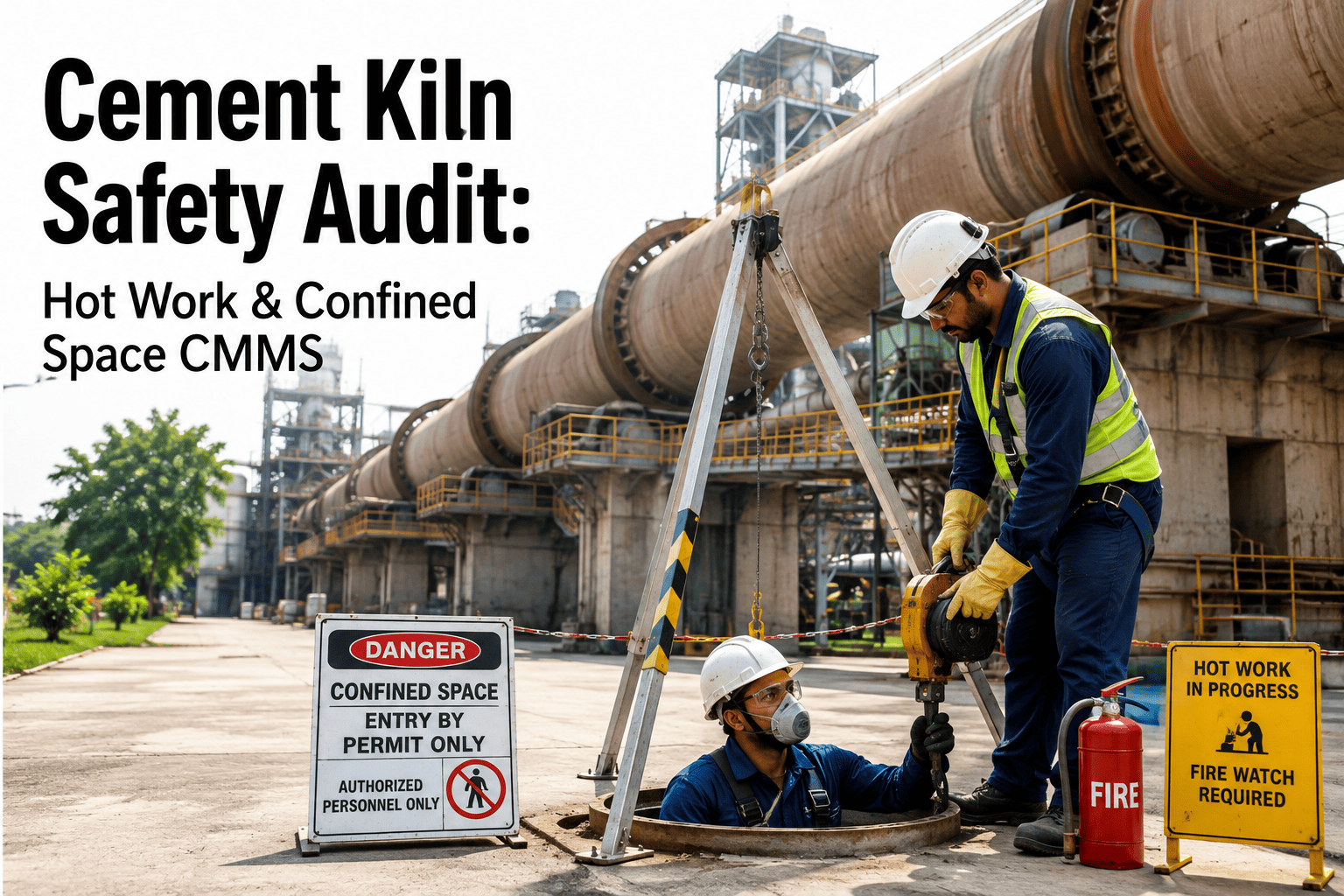
Welding, cutting, grinding, and any open-flame or spark-producing activity in a cement plant introduces fire and explosion risk in environments where combustible coal dust, raw petroleum coke, lubricant residues, and hydraulic fluid accumulate on equipment surfaces, structural steel, and conveyor frames. NFPA 51B provides the standard for fire prevention during welding and cutting operations, requiring area surveys, fire watch assignment, hot work authorization, and documented permit sign-off before any ignition-producing activity begins. In cement plants specifically, hot work near coal mills, dust-laden conveyor galleries, bag filters, and fuel storage areas demands a level of pre-work hazard control that generic permit forms cannot adequately capture. Every year, industrial hot work incidents result in multi-million dollar equipment losses, production outages, and fatalities — and the overwhelming majority are preceded by a missing or inadequate permit, a fire watch who left the area early, or a hot work zone that was not fully surveyed for combustible materials before work began. OxMaint's CMMS integrates NFPA 51B-aligned hot work permits directly with work orders, asset records, and fire watch assignments — ensuring no permit is issued without a completed area survey and no work order is closed without a post-work fire watch sign-off. Start your free trial and bring your cement plant hot work program into full NFPA 51B compliance today.
NFPA 51B · Hot Work Safety · Cement Plant Operations · OxMaint
Cement Plant Hot Work Permit Checklist (NFPA 51B)
Fire watch assignment, area survey, combustible clearance, and permit sign-off — structured for hot work in cement plant high-risk zones: coal mill buildings, conveyor galleries, bag filter structures, and fuel storage areas.
Cement Plant Hot Work Risk Zones — Hazard Level by Area
Extreme Risk
Coal Mill Building
Coal dust, methane, combustible atmosphere — hot work typically prohibited without full area purge and air monitoring
Extreme Risk
Coal Bunker Area
Stored fuel, accumulated dust, closed structure — requires written exemption or full hot work prevention alternative
High Risk
Bag Filter / Baghouse
Combustible dust accumulation on filter bags, hoppers, and housing — full clearance and isolation required
High Risk
Conveyor Gallery
Belt material, spillage, dust buildup, lubricant residue — 35-foot radius survey mandatory before any cutting or welding
Moderate Risk
Kiln Drive Platform
Lubricating oils, grease, hydraulic systems — surface cleaning and drip tray installation before hot work
Moderate Risk
Cement Mill Building
Cement dust is not typically combustible but hydraulic and lube oil systems require isolation and shielding
NFPA 51B Permit Checklist
Hot Work Permit: Step-by-Step Authorization Checklist for Cement Plants
Complete all items before hot work begins. This sequence follows NFPA 51B (2021 edition) and must be documented in your CMMS work order before permit authorization. A permit that is not issued before work starts is a non-compliant permit — there are no retroactive authorizations under NFPA 51B.
Area Survey — Before Permit Issuance
Work area surveyed within 35 feet (10.7 m) of hot work location — all combustibles identified
Combustible materials moved or removed from the hot work zone — or shielded with fire-resistant blankets
Floor swept or vacuumed — no accumulated dust, coal fines, or raw meal within work zone
Equipment surfaces wiped free of oil, grease, and hydraulic fluid within the hot work radius
Adjacent areas below work zone inspected — sparks and slag can travel beyond immediate work area
Atmospheric test conducted where combustible dust or vapors could be present — reading logged in CMMS permit
Work area classified: normal hot work zone OR restricted hot work area requiring special authorization
Equipment & Controls — Before Work Starts
Welding / cutting equipment inspected — cables, hoses, regulators, and connections in serviceable condition
Compressed gas cylinders secured upright and stored away from heat sources — caps on when not in use
Fire extinguisher (minimum 2A:20B:C) positioned within 30 feet of work — condition and last service date checked
Portable water supply or hose available where fire risk warrants — confirmed operational before work starts
Sprinkler systems confirmed active — no impairments or shutoffs in the hot work area during the permit period
Drip shields or catch pans installed below work zone to capture molten slag and sparks
Permit period start time and expiry time recorded in CMMS — no work outside the authorized time window
Fire Watch — Assignment & Responsibilities
Fire watch named in CMMS permit — full name, contact, and certification status recorded
Fire watch confirmed trained in fire extinguisher use and plant emergency alarm procedures
Fire watch has no other duties during hot work — confirmed present and fully attentive at all times
Fire watch duration defined: minimum 30 minutes post-work per NFPA 51B — duration recorded in permit
Fire watch coverage for areas below and adjacent — not only at the direct work location
Fire watch sign-off time after post-work period recorded in CMMS — permit cannot be closed without this entry
Authorization Sign-Off & CMMS Linkage
Hot work permit number generated in CMMS and linked to the maintenance work order
Permit authorized by shift supervisor or area manager — digital sign-off with timestamp in CMMS
Worker performing hot work acknowledged permit conditions — signature logged
Fire watch acknowledged duties and post-work monitoring obligation — signature logged
Permit issued before any ignition source is introduced into the work area — no retroactive authorization
Post-work permit closure: fire watch end time, final area inspection result, work order closed in CMMS
Hot work incidents are prevented at the permit stage — not after the fire starts.
OxMaint issues NFPA 51B-aligned hot work permits digitally, enforces fire watch assignment before authorization, links every permit to its maintenance work order, and archives all records for compliance audit retrieval.
Why Permits Fail
The 5 Reasons Hot Work Incidents Happen in Cement Plants
01
Area Survey Skipped Under Time Pressure
Maintenance teams under shutdown pressure perform the 35-foot combustible survey verbally or skip it entirely. Residual coal dust or lube oil in an adjacent area ignites from spatter that was never in the plan. A CMMS-enforced area survey checklist cannot be bypassed before permit issuance.
02
Fire Watch Left Area Before 30-Minute Post-Work Period
NFPA 51B requires fire watch for a minimum 30 minutes after hot work ends. In practice, fire watch personnel leave when the welder packs up. Most delayed-ignition hot work fires occur in this 30-minute window. CMMS permit closure requires fire watch sign-off at the correct time.
03
Permit Issued After Work Already Started
Retroactive permits are NFPA 51B violations that OSHA treats as serious. A CMMS that generates permit numbers before work order execution ensures the permit sequence is correctly followed — there is no way to begin a work order without a valid permit number.
04
Hot Work in Restricted Area Without Special Authorization
Coal mill buildings, fuel storage, and areas with active combustible atmosphere require special authorization beyond a standard permit. Plants without a risk-zone classification in their permit system have no mechanism to flag that standard procedures are insufficient for the location.
05
No Record When Insurance or Regulator Investigates
After a hot work incident, the first thing investigators request is the permit, the area survey record, and the fire watch sign-off. Paper permits are routinely missing. A CMMS archives every permit with its full data set — atmospheric readings, sign-offs, timestamps — and retrieves any record in seconds.
Common Questions
NFPA 51B Hot Work Permits in Cement Plants — What Safety Teams Need to Know
How long must cement plants retain hot work permit records under NFPA 51B?
NFPA 51B does not specify a minimum retention period, but OSHA recordkeeping requirements and insurance policy conditions typically require a minimum of three years. Permit records that include atmospheric readings, area survey results, and fire watch sign-offs are essential evidence in post-incident investigations. OxMaint archives all permits indefinitely with full data attached.
Book a demo to see OxMaint's permit archive and retrieval system.
Does NFPA 51B apply to grinding and angle grinder work as well as welding?
Yes. NFPA 51B covers all operations that produce sparks, heat, or open flames — including grinding, cutting, brazing, soldering, and thermal spraying. Many cement plant incidents involve grinders used without a permit because the work was classified as "not welding." OxMaint's hot work permit system classifies all ignition-producing activities, not only arc welding, so no spark-producing work bypasses the permit requirement.
What is the required fire watch duration after hot work ends under NFPA 51B?
NFPA 51B requires fire watch for a minimum of 30 minutes after hot work is complete. Where smoldering fires could develop behind walls, above ceilings, or inside equipment, extended monitoring may be required. OxMaint's permit closure requires the fire watch end timestamp — a permit cannot be closed without it.
Start your free trial and see the CMMS fire watch tracking feature.
Can hot work be performed in a cement plant coal mill building?
Coal mill buildings are classified as restricted hot work areas under NFPA 51B due to combustible coal dust and potential methane accumulation. Hot work in these areas requires atmospheric testing confirming LEL below 10%, a formal restricted-area exemption, full area purge before entry, and continuous air monitoring during the work. Most plants prohibit coal mill hot work entirely and require cold-cutting alternatives wherever possible.
What happens when a hot work permit expires during a multi-shift job?
An expired permit must be re-issued — the area survey, combustible clearance, fire watch assignment, and authorization sign-off must all be repeated for each new permit period. Work may not continue under an expired permit. OxMaint sends automatic alerts when a permit approaches expiry and requires supervisor re-authorization before hot work can resume.
Book a demo to see OxMaint's permit expiry management.
NFPA 51B · Hot Work Safety · Cement Plant CMMS Integration
Issue Every Hot Work Permit Digitally. Track Every Fire Watch. Close Every Work Order With a Full Audit Trail.
OxMaint enforces NFPA 51B-aligned hot work permit sequences digitally, requires fire watch assignment before authorization, enforces the post-work monitoring sign-off before permit closure, and archives every permit with full area survey data — accessible in seconds when an auditor or insurer asks for records.