Crusher failures are among the most expensive unplanned events a cement quarry can absorb. A jaw crusher feeding the primary crusher circuit at 800 to 1,200 tonnes per hour does not fail slowly — jaw plate wear progresses predictably until it doesn't, toggle seat cracking happens between shifts, and pitman bearing failures arrive with 48 hours of thermal warning that no one catches because the lubrication PM was overdue. Secondary and tertiary crushers face the same pattern: impact blow bars and hammer tips wear in cement limestone at rates that vary significantly by feed size, hardness, and throughput — yet most cement quarries still plan crusher rebuilds on calendar intervals that have no connection to actual wear data. OxMaint's CMMS gives cement quarry maintenance teams the structured wear tracking, PM scheduling, and rebuild lifecycle management to run crushers at rated capacity without the reactive rebuild cycles that dominate most quarry maintenance budgets. Book a demo to see how OxMaint transforms crusher maintenance at your cement quarry.
Crusher Maintenance · Cement Quarries
Jaw, Impact, and Hammer Crusher PM — Tracked from Wear Data, Not the Calendar
OxMaint gives cement quarry maintenance teams CMMS-driven wear records, rebuild histories, and RUL projections for every crusher in the circuit — so you plan rebuilds, not react to them.
The Real Cost of Reactive Crusher Maintenance
Most quarry maintenance managers know the planned rebuild cost for their primary jaw crusher. Very few know the actual total maintenance cost — because reactive failures generate costs that never appear in the rebuild budget: emergency OEM parts at 2× list price, two-shift repair crews at overtime, clinker inventory drawdown, and reduced kiln utilisation while the quarry catches up.
4–6 hrs
Typical unplanned jaw crusher downtime per event
2.4×
Average cost premium on emergency vs planned crusher parts
68%
Of crusher failures preceded by detectable wear indicators 30+ days prior
3.1×
Higher rebuild frequency when wear parts replaced reactively vs proactively
Crusher Types in Cement Quarries — What Each One Demands
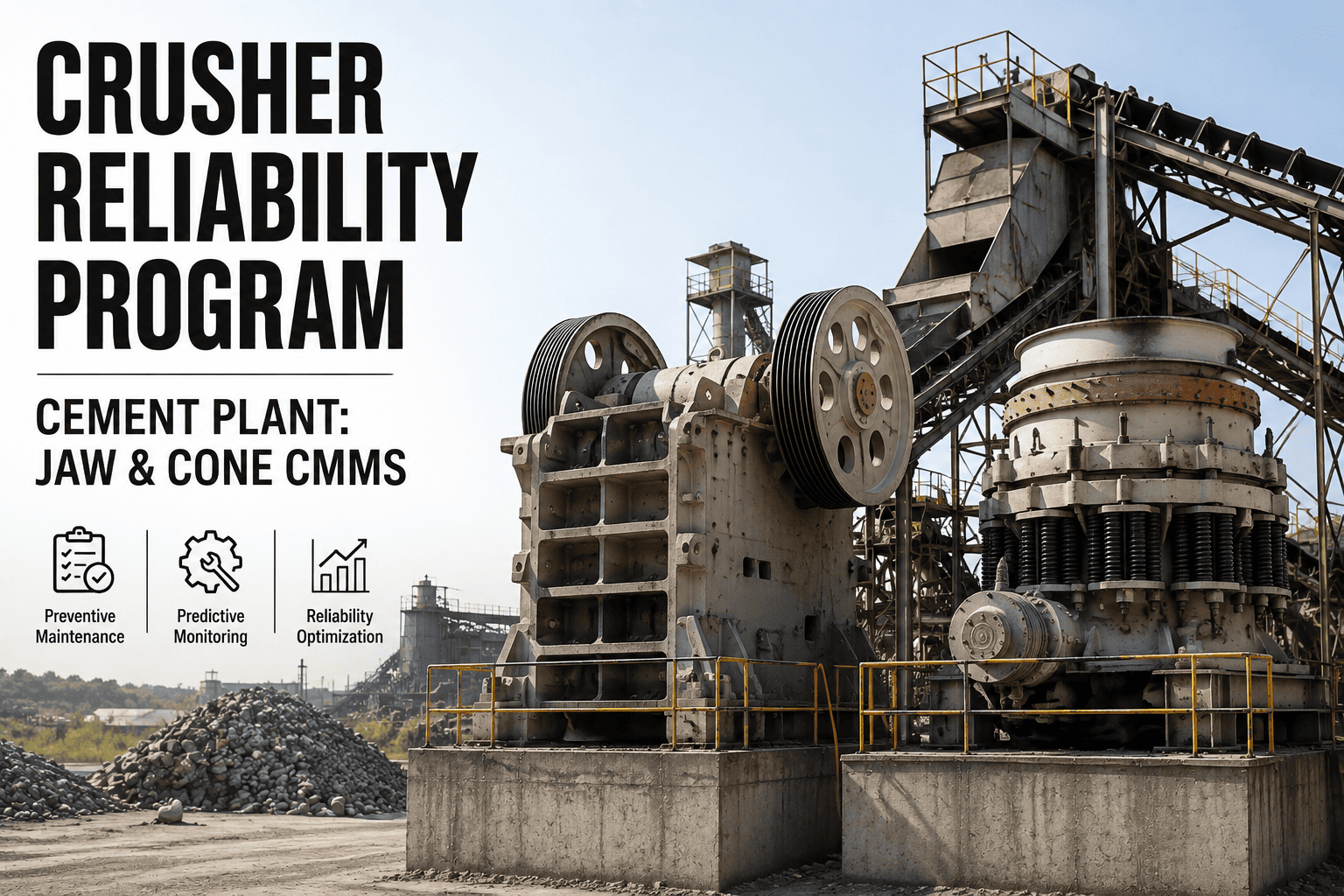
Cement quarries typically operate two to three stages of size reduction, and each crusher type has fundamentally different failure modes, wear parts, and maintenance requirements. A single PM template across all crusher types is a guarantee of either over-maintained jaw crushers or under-maintained impact crushers — both expensive in different ways.
Primary Stage
Jaw Crusher
Key Wear Parts
Fixed and swing jaw plates — manganese or ceramic composite
Toggle seat and toggle plate — high-load fatigue components
Pitman eccentric shaft bearings — grease lubrication critical
Check plates and side liners
Primary failure signal: jaw plate wear profile measurement at CSS setting
Secondary Stage
Impact Crusher
Key Wear Parts
Blow bars — chrome iron or ceramic-reinforced
Impact apron liners — primary and secondary aprons
Rotor discs and locking bolts
Breaker plate liners
Primary failure signal: blow bar weight loss and CSS gap increase
Secondary/Tertiary Stage
Hammer Crusher
Key Wear Parts
Hammers — manganese steel or white iron
Hammer pins and discs
Breaker plates and screen bars
Rotor shaft bearings
Primary failure signal: hammer weight loss per tonne crushed
High-Silica / Hard Rock
Mineral Sizer
Key Wear Parts
Sizer picks and segments
Drum shell wear liners
Drive shaft and gearbox seals
Sprocket and chain assembly
Primary failure signal: pick wear profile and throughput rate decline
One CMMS for All Four Crusher Types — With Wear-Specific PM Templates
OxMaint ships with crusher PM templates calibrated for jaw, impact, hammer, and mineral sizer equipment — built from cement quarry operational data, not generic mining guides.
What CMMS-Tracked Crusher Records Actually Look Like
Effective crusher maintenance records are not just work order histories — they are structured wear data sets that allow trend analysis, RUL calculation, and rebuild planning 60 to 90 days ahead of the actual shutdown. Here is what OxMaint captures for each crusher in the quarry circuit.
Wear Part Registry
Each wear part set is registered with installation date, batch weight, material grade, and OEM part number. Weight-out measurements at removal are recorded against the same record — so the tonnes-per-kg consumption rate is calculated for every part set, not estimated from catalogue data.
CSS and Product Size Log
Closed-side setting measurements are logged at every PM and after every adjustment. Product size grading results from the QC lab are linked back to the crusher record — so the relationship between CSS drift and product oversize is tracked and used to refine the adjustment schedule.
Bearing and Lubrication Records
Bearing temperature readings, grease consumption, and oil analysis results are logged against each bearing position. Oil analysis turnaround from the lab generates a work order in OxMaint when viscosity or contamination thresholds are exceeded — not when the next PM is due.
Rebuild History and Cost Ledger
Each crusher rebuild is recorded as a structured event: downtime hours, labour hours by trade, parts list with costs, and production tonnes recovered per tonne of stone processed post-rebuild. This builds the plant's actual cost-per-tonne-crushed metric, not the OEM estimate.
Vibration Baseline and Trend
Vibration readings at defined measurement points on the crusher frame and bearing housings are logged at every PM. OxMaint plots the trend and generates a predictive alert when readings exceed the established baseline by a configurable threshold — before the bearing fails, not after.
Lifecycle and RUL Projection
Using the actual wear rates calculated from your own data — not OEM averages — OxMaint projects the remaining useful life of each wear part set and schedules the next rebuild window on the plant's maintenance calendar automatically.
Jaw Crusher PM: The Minimum Viable Inspection Program
| Inspection Item |
Frequency |
Record in CMMS |
Alert Threshold |
| Jaw plate wear profile (top, middle, bottom) |
Weekly |
Thickness measurement at 3 points, wear photo |
Minimum profile depth — OEM specification |
| CSS setting measurement |
Every shift |
Lead ball or laser measurement result |
CSS > product spec upper limit |
| Toggle plate and toggle seat condition |
Weekly |
Visual condition rating, any cracks noted |
Any crack indication — immediate work order |
| Pitman bearing temperature |
Daily |
Drive and non-drive side temperature |
+15°C above established baseline |
| Flywheel key and guard condition |
Weekly |
Key torque check, guard condition, any movement |
Any key fretting — immediate work order |
| Feed chute and deflector wear |
Monthly |
Liner thickness measurement, impact zone condition |
Liner below 20mm — plan replacement |
Frequently Asked Questions
Q
How does OxMaint handle crusher PM scheduling across multiple crusher circuits?
OxMaint's asset hierarchy supports multiple crusher circuits each with independent PM schedules, wear records, and rebuild histories. Each circuit's crushers can be scheduled around the quarry blast programme and kiln demand — with OxMaint generating work orders based on wear data triggers, not just calendar dates.
Book a demo to see the multi-circuit view.
Q
Can we track wear part consumption by material feed type — different limestone hardness from different quarry faces?
Yes. OxMaint work orders can be tagged with feed material type, source face, and UCS (unconfined compressive strength) where available. This allows the wear data to be segmented by material hardness — so you know whether the higher blow bar consumption this quarter is because of the harder face being worked, not a maintenance issue.
Sign up free to explore this.
Q
Does OxMaint support crusher rebuild management — not just routine PM?
OxMaint supports full rebuild project management — multi-task work orders, parts reservation from storeroom, contractor resource planning, and rebuild cost capture. The rebuild record links directly to the crusher's wear history so the cost-per-tonne-crushed metric is automatically updated each rebuild cycle.
Q
How do we get our existing crusher records migrated into OxMaint?
OxMaint's onboarding team handles data migration from spreadsheets, existing CMMS exports, and PDF maintenance records. Most quarries complete primary crusher history migration in the first week. Historical wear data is retained and used immediately for RUL baseline calculations from day one of operation.
Start Tracking Crusher Wear Data
Your Next Unplanned Crusher Failure Is Already Showing Up in the Wear Data
Start with your primary jaw crusher. Build three months of CSS, wear profile, and bearing temperature records. OxMaint will show you your first RUL projection in week one — and your first planned rebuild in month three.