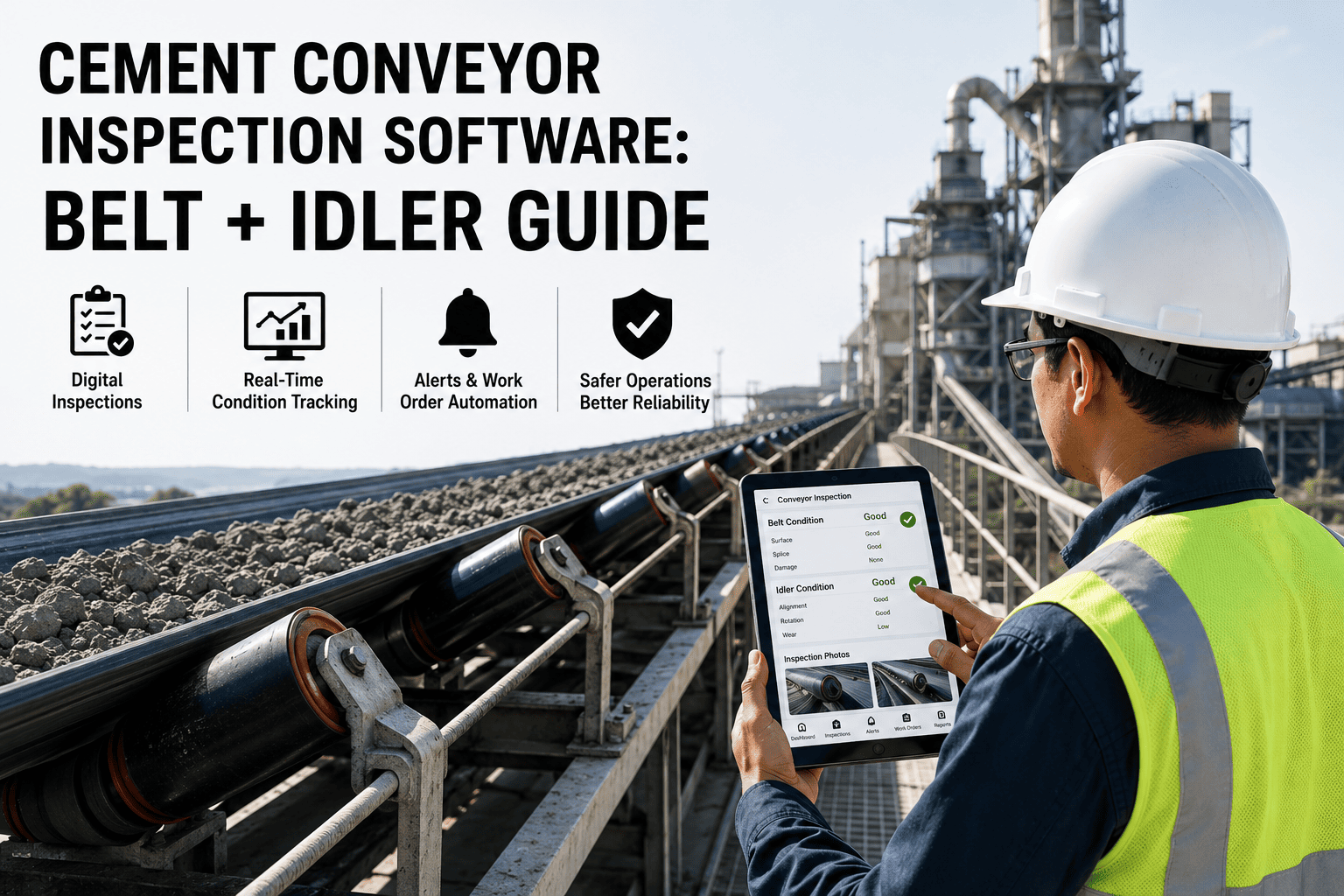
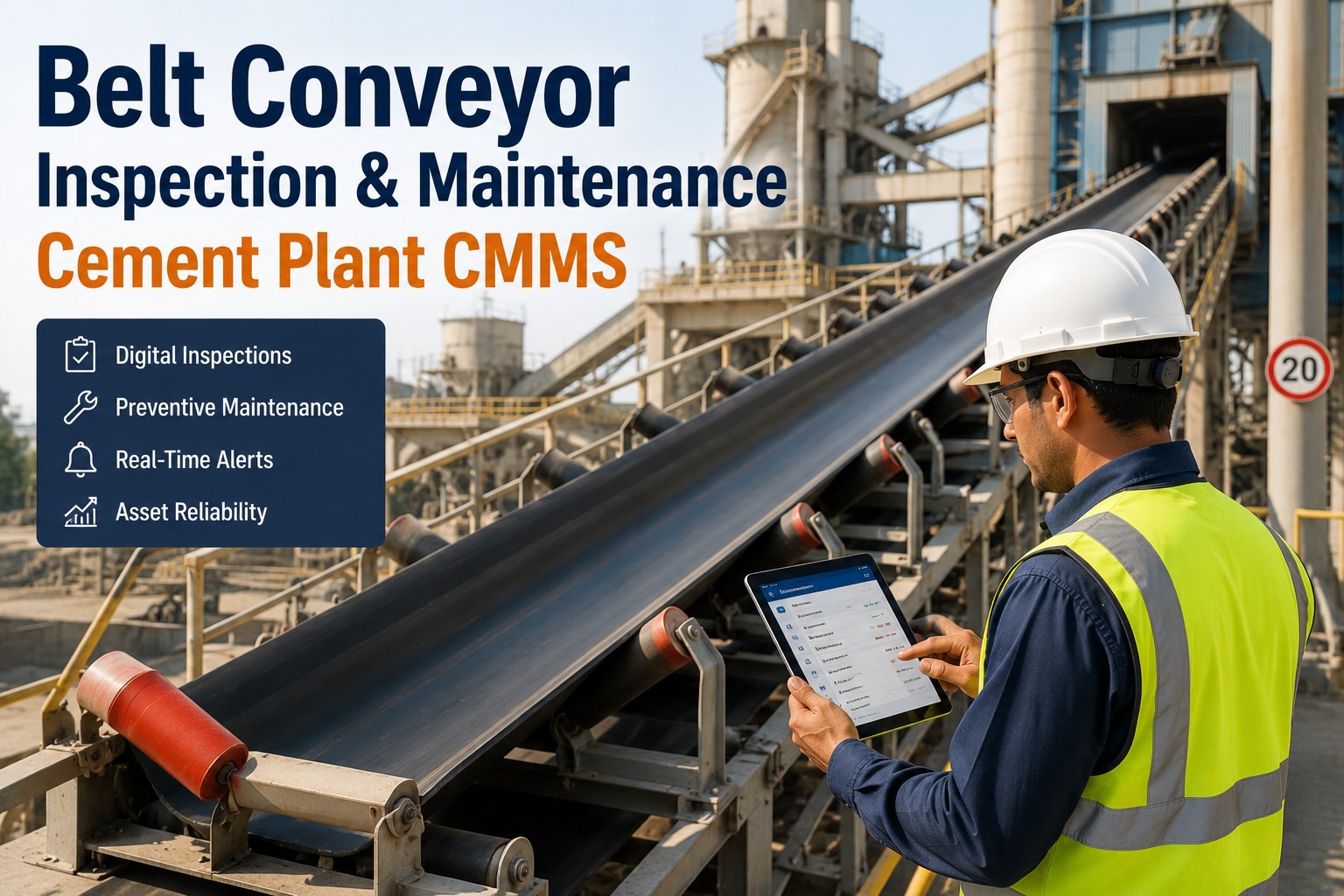
Cement plant conveyor systems are the circulatory system of production — a single belt failure can cascade into kiln starvation, clinker discharge backup, and unplanned shutdowns lasting 8 to 24 hours. Yet most cement plants still manage belt condition through visual walk-downs, paper-based inspection sheets, and tribal knowledge held by one or two veteran conveyor technicians. When those technicians retire or move on, splice life estimation, belt tracking knowledge, and idler failure patterns go with them. OxMaint's CMMS gives cement plant maintenance teams a structured, digital framework to track vulcanization records, idler replacement cycles, belt RUL estimates, and conveyor audit trails — so the knowledge stays in the system, not in someone's head. Book a demo to see how OxMaint transforms conveyor maintenance at cement plants.
Conveyor Maintenance · Cement Plants
Vulcanization Records, Idler PM, and Belt RUL — All in One CMMS
From raw material limestone conveyors to finished cement dispatch belts, OxMaint tracks every splice, idler rotation, and belt wear metric — so you catch failures before they cost you a shift.
Why Conveyor Failure Hits Cement Plants Harder Than Any Other Industry
In cement manufacturing, conveyors operate under extreme dust loading, abrasive material, high temperatures near the kiln, and continuous 24/7 duty cycles that other industries rarely face. A quarry feed belt handling 1,200 tonnes per hour of crushed limestone generates splice stress and trough wear rates that OEM vulcanization schedules rarely account for — because those schedules are built for average duty, not cement duty.
01
Cement-Specific Abrasion
Clinker, raw meal, and quarry limestone are among the most abrasive bulk materials conveyed anywhere. Standard idler and belt wear rates from general industry guides underestimate actual wear by 40 to 60% in most cement plants.
02
High-Temperature Zones
Clinker conveyors downstream of the cooler carry material at 80–120°C, accelerating belt compound degradation and reducing splice life. Heat-resistant belt grades require different vulcanization pressure-time profiles that must be tracked per splice event.
03
Dust and Seal Failure
Cement dust penetrates idler seals 3–5× faster than coal or aggregate dust. Without PM intervals calibrated to cement service, idlers seize before scheduled replacement — turning a $40 idler change into a $4,000 belt damage event.
04
Continuous Duty Cycle
Most cement plant conveyors run 22 to 24 hours per day, 330+ days per year. Fatigue loading on splice cords accumulates faster than calendar-based PM schedules account for — making tonnage-based tracking essential, not optional.
Belt Vulcanization: What Should Be Tracked and Why
A hot vulcanized splice is the strongest joint a conveyor belt can have — but only when performed correctly and tracked precisely. Splice life in cement service is determined by four factors: cure temperature and dwell time, cord alignment accuracy, belt tension at the splice point, and cumulative tonnes carried since last splice. Without records, you are guessing on all four.
Splice Date and Location
Belt ID, conveyor number, splice position (distance from head pulley), and the technician who performed the work — linked to the asset in the CMMS.
Cure Parameters
Press temperature (°C), cure time (minutes), and pressure (bar) — compared against the belt manufacturer's specification for that belt grade and thickness.
Belt Grade and Specification
Cover grade (e.g., DIN Y, N, or W for heat-resistant), top/bottom cover gauge, carcass type, and rated tension — ensuring the right vulcanization profile is applied.
Cumulative Tonnes at Splice
Tonnage carried since the last splice — the primary driver of cord fatigue and the most reliable indicator of remaining splice life in cement service.
Post-Splice Inspection
Visual and pull-test results after cure, belt tracking observations during first-run commissioning, and any skew corrections made to the splice.
Next Splice Due
Calculated RUL (remaining useful life) in tonnes and estimated calendar date — auto-generated by OxMaint based on the plant's historical splice life data for that belt.
Idler Maintenance: From Reactive Replacement to PM-Driven Programs
A typical 300-metre quarry feed conveyor carries 180 to 240 idler sets. Replacing them one at a time when they seize costs 6 to 10× more in labour and belt damage than a structured PM replacement program. The challenge is that idler failure rates in cement plants vary significantly by zone — dust loading, material spillage, and misalignment all create hotspots that a uniform PM interval misses completely.
Phase 1
Zone-Based Condition Mapping
Divide each conveyor into zones — loading zone, carry run, return run, discharge zone. Record idler failure history by zone to identify failure hotspots. OxMaint maps this spatially so patterns are visible, not buried in spreadsheet rows.
Phase 2
Differentiated PM Intervals
Set different PM inspection frequencies by zone based on failure history — not a single interval for the whole conveyor. Loading zones may need quarterly bearing checks; clean carry-run zones may be annual. OxMaint schedules and tracks both.
Phase 3
Thermal and Acoustic Baseline
Record infrared temperature readings and acoustic emission levels for idler sets at each PM visit. Trend deviation from baseline — a 15°C rise in bearing temperature is a reliable leading indicator of seizure within 30 to 60 days in cement service.
Phase 4
CMMS-Triggered Replacement
When a threshold is exceeded or a PM interval is due, OxMaint auto-generates a work order with the idler set location, part number, and last-replacement history — so technicians arrive at the conveyor with the right part, not an empty trolley.
Stop Replacing Idlers After They Seize Your Belt
OxMaint builds you a zone-differentiated idler PM program from your own failure history — automatically.
Belt Tracking: Root Causes and CMMS Documentation
Belt mistracking is the leading cause of edge wear, belt damage at structure members, and premature vulcanization failures in cement plants. Most tracking corrections are made by operators using training rolls — without recording what was adjusted, when, or why. Without that record, the same misalignment recurs every rainy season, every material change, or every time a new operator starts the belt.
| Tracking Issue |
Common Root Cause in Cement |
What to Record in CMMS |
OxMaint Outcome |
| Carry-side drift to one side |
Off-centre loading from chute wear or skirtboard gap |
Chute condition, skirtboard gap measurement, material drop point |
WO linked to chute PM — fixes root cause, not symptom |
| Return-side drift at tail |
Tail pulley misalignment or belt stretch asymmetry |
Tail pulley bearing temperatures, alignment measurements, stretch readings |
Trend on bearing temps triggers PM before pulley damage |
| Seasonal tracking drift |
Thermal expansion of structure or moisture-induced belt camber |
Ambient temperature at adjustment, belt camber measurement, adjustment made |
Pattern detection surfaces seasonal recurrence — permanent fix scheduled |
| Post-splice tracking change |
Splice skew or cord angle deviation during vulcanization |
Splice quality record, skew measurement, training roll positions after splice |
Splice quality linked to tracking history — identifies technician or equipment issue |
Belt RUL: Moving From Calendar-Based to Condition-Based Replacement
Replacing a conveyor belt on a fixed calendar schedule in cement service is almost always wrong — either too early (wasting $40,000–$120,000 of remaining belt life) or too late (running a belt to failure and losing a weekend to an emergency change). Remaining useful life estimation based on actual wear data is the only approach that optimises both cost and reliability.
Cover Gauge Trending
Record top and bottom cover gauge measurements at standardised locations during every PM visit. Plot wear rate per tonne or per month. OxMaint calculates the point at which cover gauge reaches the OEM minimum and projects the calendar date — your replacement deadline with margin built in.
Splice Life Tracking
Each vulcanized splice has a finite fatigue life in tonnes carried. OxMaint accumulates throughput data against each splice record and calculates the percentage of expected life consumed — so you know which splice on a 400-metre belt is closest to end-of-life before it tells you at 2am.
Cord Damage Indexing
Steel cord belt inspection with electromagnetic testing generates a cord damage index per metre of belt. Record these inspection results in OxMaint linked to the belt asset — track how the damage index grows between inspections to calculate how many more tonnes the carcass can safely carry.
Frequently Asked Questions
Q
How does OxMaint handle conveyors that span multiple process areas?
OxMaint's asset hierarchy lets you link a single conveyor asset to multiple parent areas — quarry, raw mill, kiln feed, and finish mill — so work orders, PM schedules, and belt records appear in all relevant area views. Each zone's idler PM can be managed independently while all data rolls up to a single belt asset record.
Book a demo to see the asset structure in action.
Q
Can we track vulcanization contractor work orders the same way as internal repairs?
Yes. OxMaint supports external contractor work order assignment with the same closure fields as internal technicians — cure parameters, post-splice inspection results, and parts used. Contractor work orders are linked to the same asset record and included in splice life calculations. You get a complete splice history regardless of who performed the work.
Q
How do we migrate our existing belt records from spreadsheets into OxMaint?
OxMaint supports bulk import of historical belt data via CSV templates. During onboarding, the implementation team maps your existing spreadsheet columns to OxMaint fields and imports historical splice records, cover gauge readings, and idler replacement history. Most plants complete belt record migration in the first week of onboarding.
Sign up free to start.
Q
Does OxMaint integrate with our process historian to pull conveyor throughput data automatically?
OxMaint integrates with common process historians and SCADA systems via API to pull throughput data automatically — eliminating manual tonne accumulation for splice life calculations. Where integration is not available, throughput data can be imported via daily CSV or entered manually at PM closure. Both approaches feed the same RUL calculation.
Start Your Conveyor PM Program
Every Conveyor Belt Failure You Prevent Pays for OxMaint Many Times Over
Start with your three highest-risk conveyors. Build the splice and idler records. See your first RUL projection in week one. OxMaint connects to your existing asset registry and work order system — no disruption to current operations.