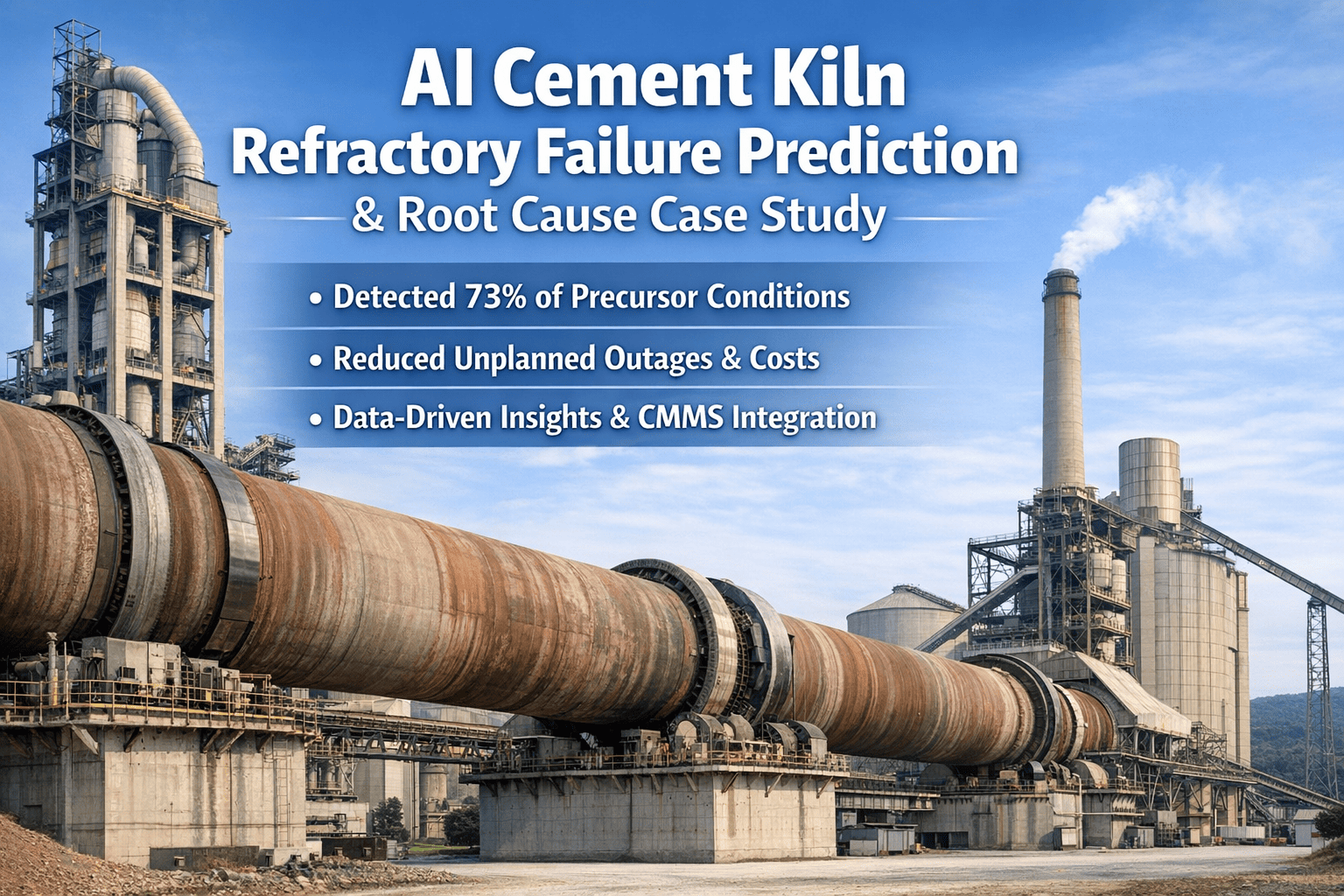
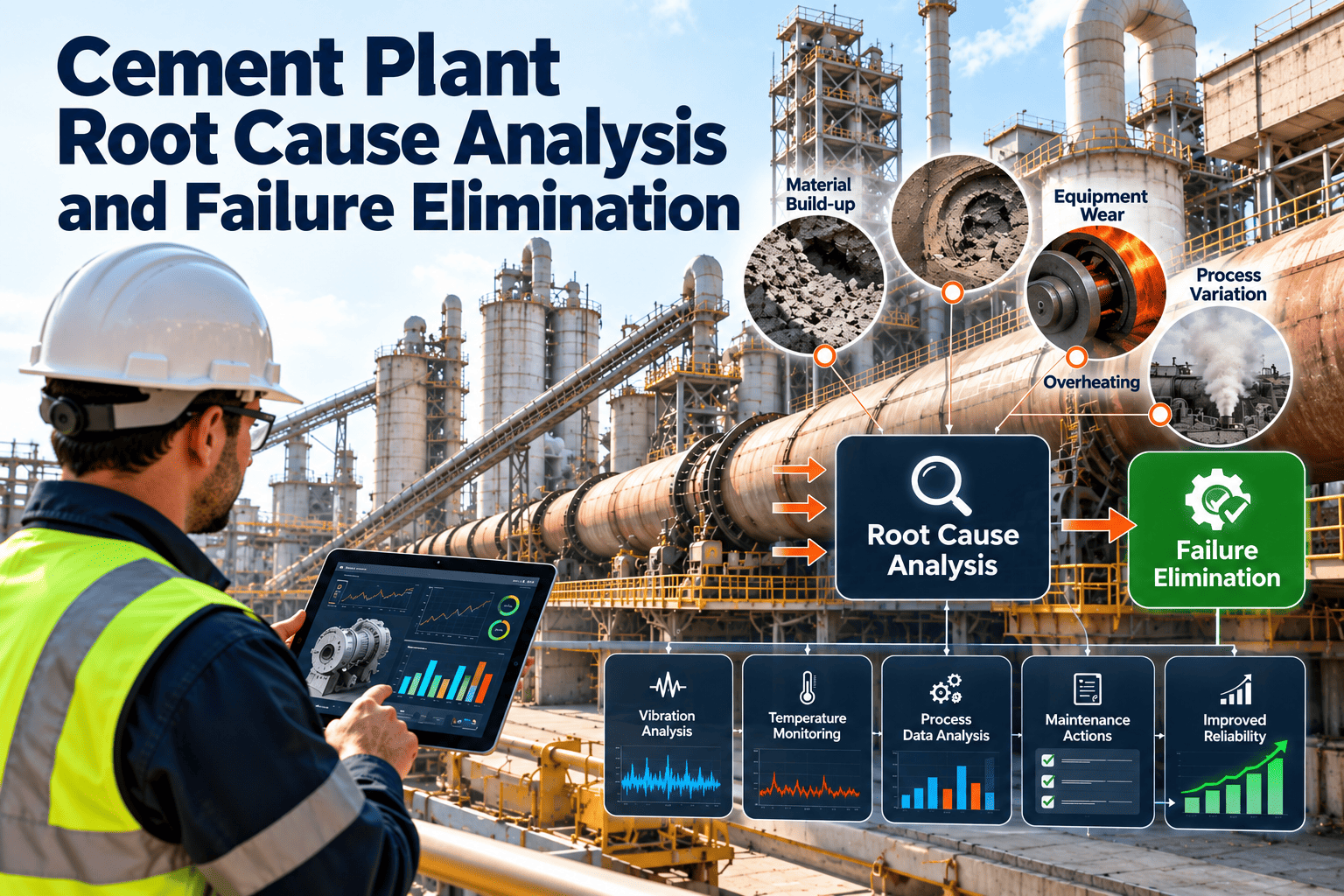
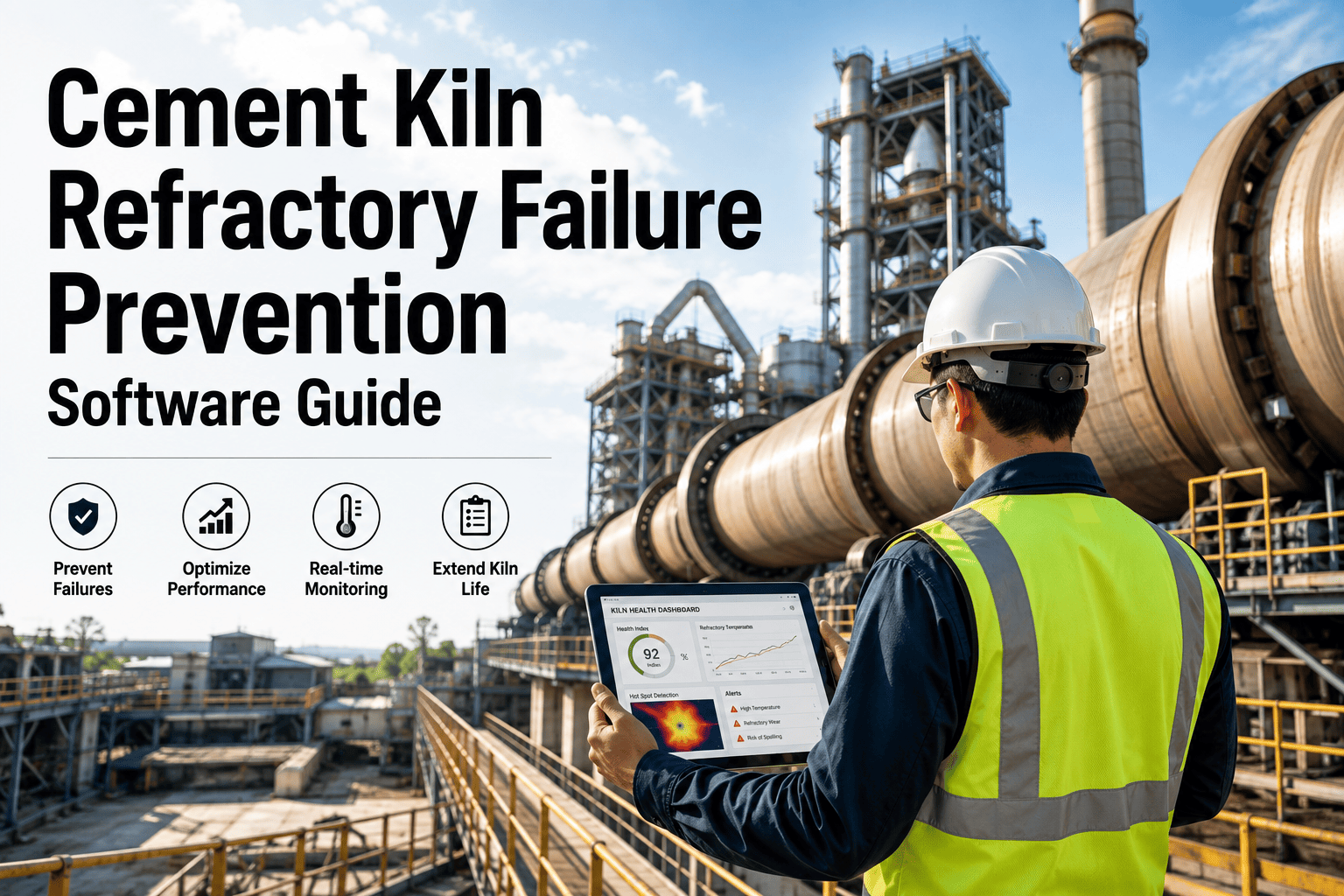
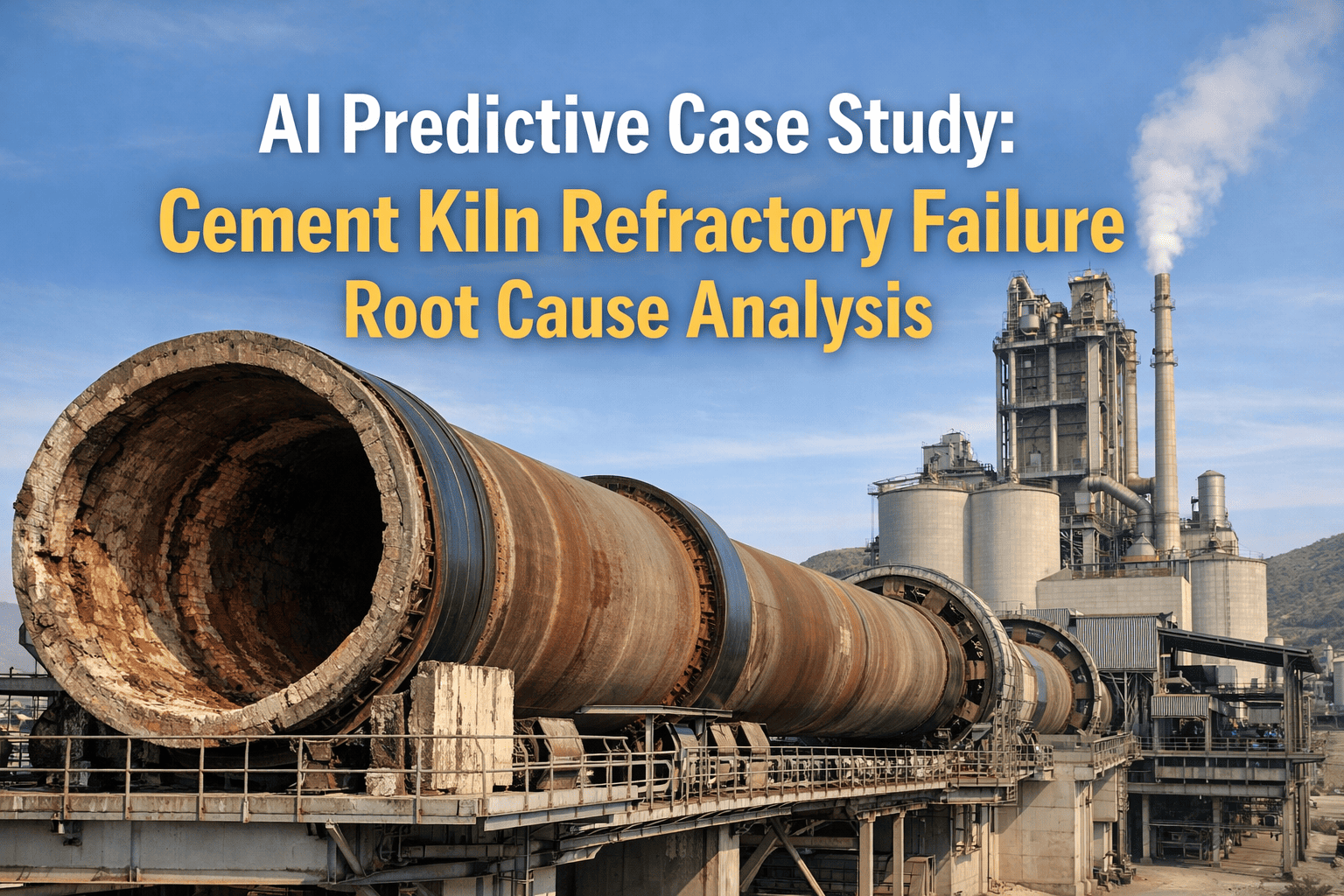
Cement kilns run at over 1,400°C — and when the refractory lining fails without warning, the cost is not just a repair bill. It is 10 to 21 days of lost production, emergency contractor mobilisation, and accelerated wear on adjacent equipment. AI-driven predictive maintenance is changing this: plants integrating sensor data with machine learning models are now detecting refractory degradation weeks before shell overheating becomes a crisis. Sign in to OxMaint to connect your kiln condition data directly to work orders and maintenance schedules, or book a demo to see how AI-driven refractory monitoring flows into your CMMS automatically.
Case Study · Cement Plant AI
AI Refractory Failure Prediction for Cement Kilns: Root Cause Analysis & CMMS Integration
How cement plants are using AI to detect 73% of refractory precursor conditions before costly breakdowns — cutting unplanned outages, reducing emergency spend, and building maintenance decisions on real data instead of calendar guesses.
73%
Precursor conditions detected before failure with AI monitoring
10–21
Days of unplanned downtime avoided per prevented kiln stoppage
3–5×
Cost of emergency refractory repair vs planned maintenance
48hr
Typical early warning window AI models provide before critical shell temperature rise
Why Refractory Failures Are the Most Expensive Unplanned Event in Cement
Cement kiln refractory is not a consumable — it is the structural barrier between 1,450°C process temperatures and the kiln shell. When it degrades unevenly or fails, the consequences cascade: shell overheating leads to shell deformation, which stresses tyre and riding ring components, which accelerates mechanical wear across the entire rotary system. A single unplanned refractory failure can trigger three to four additional component replacements beyond the lining itself.
Traditional monitoring relies on periodic shell temperature scans and visual inspections during planned stops. These approaches have a fundamental limitation: they measure the outcome of degradation, not its onset. By the time a hotspot is visible on a shell scanner, refractory thinning has already progressed to a point where intervention is urgent rather than planned.
Refractory Degradation Timeline
Week 1–3
Microcracking begins. Thermal conductivity shifts. AI detects anomaly in shell temp gradient.
Week 4–6
Brick spalling accelerates. Power draw fluctuates. Traditional scanners begin showing marginal readings.
Week 7+
Shell hotspot visible. Emergency stop required. Repair cost 3–5× planned maintenance.
What AI Models Actually Monitor: The Signal Stack
01
Shell Temperature Gradient
Rate of change between adjacent shell zones, not just absolute values. Gradient shifts of 15–25°C over 12 hours are flagged as early indicators.
02
Kiln Drive Power Draw
Refractory spalling changes the kiln's internal mass distribution. Motor current anomalies correlate with brick loss 2–3 weeks before thermal evidence appears.
03
Inlet / Outlet Gas Temps
Localised refractory thinning disrupts heat transfer profiles. Gas temperature deviations from baseline combustion models indicate specific zone problems.
04
Tyre & Riding Ring Flex
Shell deformation from refractory-driven hot spots is measurable through tyre slip and mechanical flex sensors before it becomes visible externally.
05
Feed Chemistry Variability
High-alkali feed cycles accelerate brick corrosion. AI models incorporating raw mix data predict chemistry-driven degradation spikes 10–14 days in advance.
06
Combustion Zone Stability
Flame position drift changes the thermal load on specific refractory zones. Burner pipe positioning data adds predictive precision to zone-level risk scoring.
Turn Refractory Findings Into Tracked Work Orders
AI detects the precursor. OxMaint converts it into an assigned, prioritised work order — with asset history, image evidence, and repair records in one place.
Root Cause Analysis: What AI Traces After a Failure
When a refractory failure does occur, AI-assisted root cause analysis compresses the investigation from weeks to hours. Instead of manually correlating historian data across a dozen systems, RCA tools pull the signal stack from the 30 days preceding failure and apply pattern matching against a library of known failure modes. This surfaces the most probable contributing factors — feed chemistry excursion, burner position drift, excessive kiln speed under underfed conditions — ranked by statistical weight.
| Root Cause Category |
Key Indicators in Data |
Average Lead Time Before Failure |
Prevention Action |
| Alkali Attack |
Feed LSF spikes, coating loss events, irregular burnability index |
14–21 days |
Feed chemistry correction, magnesia brick substitution in affected zone |
| Thermal Shock |
Rapid start-up rate, frequent short stops, inlet temp cycling |
3–7 days |
Revised start-up ramp protocol, reduced stop frequency in affected campaign |
| Mechanical Abrasion |
Ovality index, tyre slip increase, shell flexion amplitude rise |
21–35 days |
Tyre adjustment, kiln alignment survey, brick anchoring review |
| Coating Collapse |
Zone-specific shell temp jump, feed rate drop, flame length deviation |
6–12 hours |
Coating rebuild protocol, burner retraction, feed rate stabilisation |
| Refractory Age |
Campaign duration exceeding statistical wear model, cumulative heat dose |
30–60 days |
Planned partial reline at next stop, zone-level brick life tracking in CMMS |
How the AI-to-CMMS Workflow Actually Works
1
Continuous Sensor Ingestion
Shell scanners, thermocouples, power meters, and historian systems feed real-time data into the AI platform at configurable intervals — typically every 5 to 15 minutes for kiln assets.
2
Anomaly Scoring & Pattern Matching
The model scores each reading against a multi-variable baseline and compares current signal combinations against historical failure precursor patterns. Risk score updates every cycle.
3
Alert Generation with Context
When risk score crosses defined thresholds, an alert is generated — not just a temperature alarm, but a structured finding: zone, probable cause, severity, recommended action window.
4
Work Order Creation in OxMaint
The structured finding flows directly into OxMaint as a work order — asset ID, defect description, zone reference, priority classification, and supporting data attached. No manual re-entry.
5
Repair Execution & Record Closure
Technicians receive the work order, execute the intervention, and close it in OxMaint with repair details, brick type used, zone extent, and post-repair temperature readings.
6
Model Feedback & Accuracy Improvement
Closed work orders feed back into the AI model — confirming which signals preceded actual failures and refining the prediction accuracy for each kiln's specific operating conditions.
Results: What Plants Implementing AI Refractory Monitoring Report
40–60%
Reduction in unplanned kiln stoppages
Across plants with 12+ months of AI monitoring deployment
25–35%
Decrease in annual refractory spend
Through planned partial reLines replacing emergency full replacements
6–8 weeks
Extended campaign life per kiln
By intervening at zone level before whole-lining failure cascades
<48 hours
Root cause identification post-failure
vs 2–3 week manual investigation — enabling faster recurrence prevention
Frequently Asked Questions
How long does it take for an AI model to become accurate for a specific kiln?
Most AI models require 3 to 6 months of operational data — ideally including at least one refractory event — to build a reliable baseline for a specific kiln. Plants with good historian data from the previous 12 to 24 months can accelerate this significantly by training on historical records.
Book a demo to discuss how OxMaint supports your data onboarding process.
Can AI prediction work on older kilns without modern sensor arrays?
Yes — basic AI refractory monitoring can operate on as few as three to four data streams: shell scanner output, drive power, and gas temperatures. More sensors increase precision but are not required to generate useful predictions.
Sign in to OxMaint to see how existing sensor data integrates with the platform.
What happens when the AI flags a risk but the kiln cannot be stopped?
AI alerts are graded by severity and time-to-critical — not every flag requires an immediate stop. The system generates a risk-rated work order with a recommended intervention window, allowing production and maintenance teams to plan the stop at the lowest-cost opportunity rather than reacting to an emergency.
How does root cause analysis output connect to future maintenance planning?
RCA outputs are stored against the asset record in OxMaint alongside the work order. When planning the next campaign, maintenance engineers can review every previous failure, its identified cause, and the intervention taken — building a plant-specific knowledge base that improves reline specification and zone-level brick selection over time.
Stop Reacting to Refractory Failures. Start Predicting Them.
OxMaint connects AI-generated kiln condition alerts to work orders, asset history, and repair records — so every precursor signal becomes a documented, tracked maintenance action, not just an alarm that gets acknowledged and forgotten.