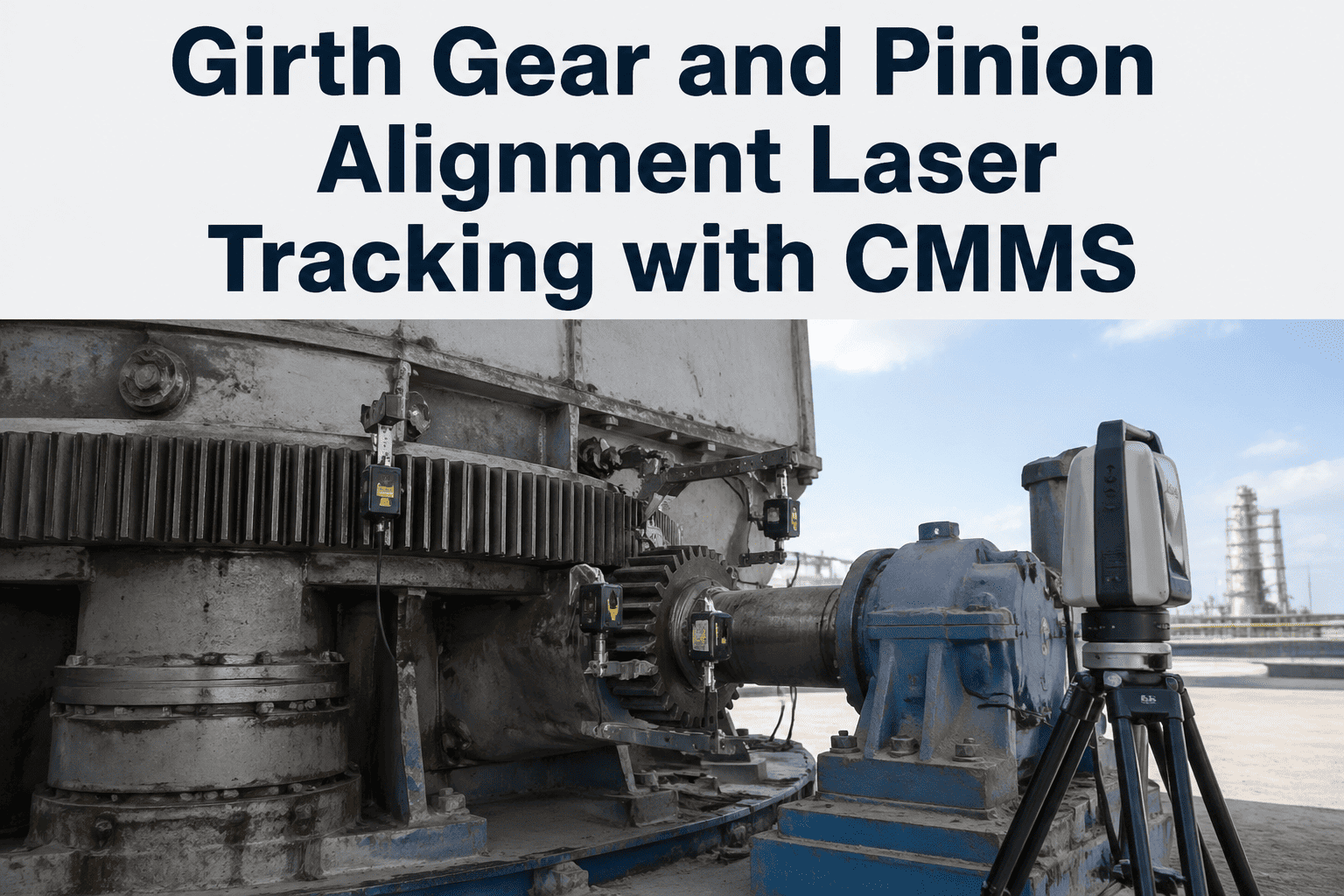
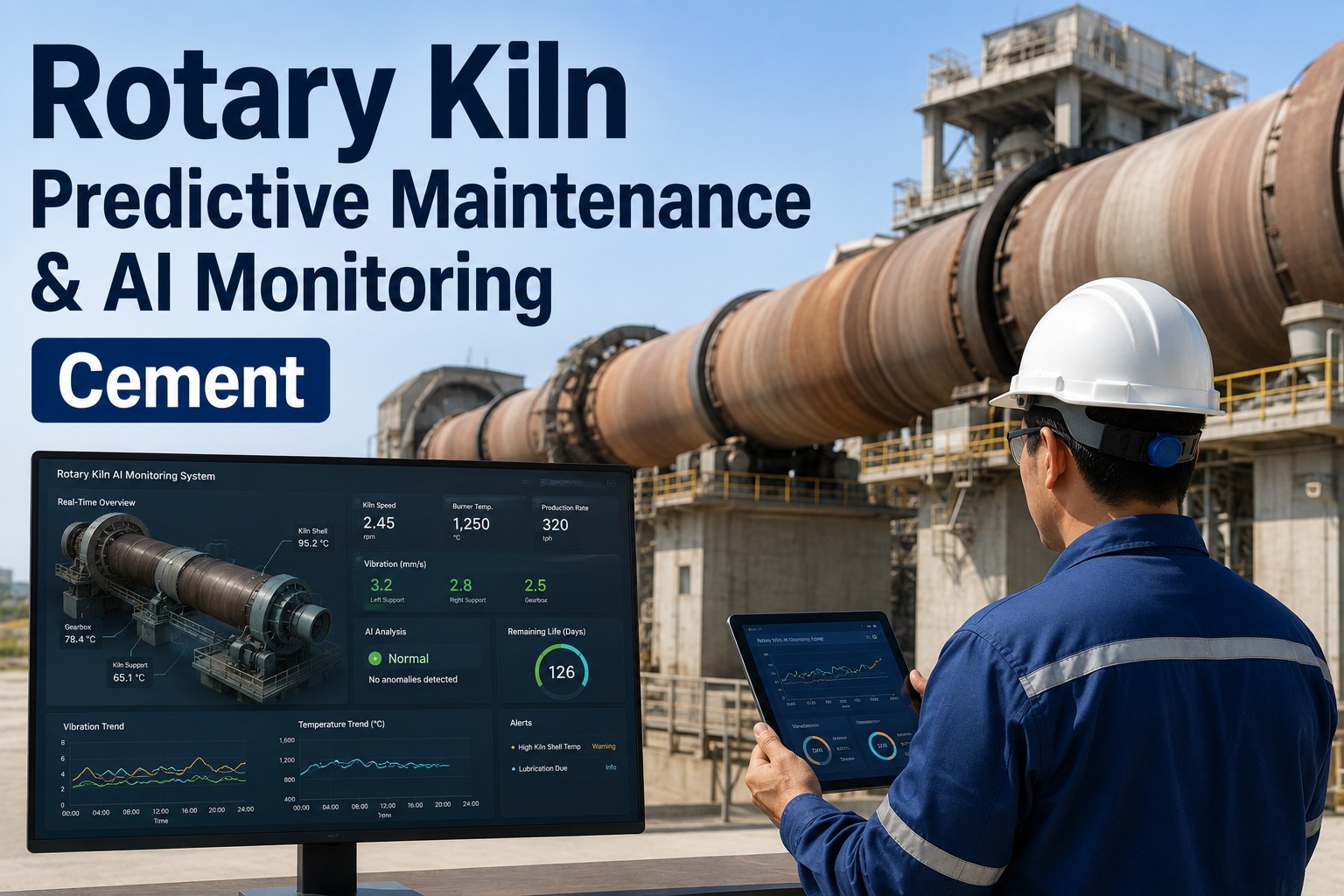
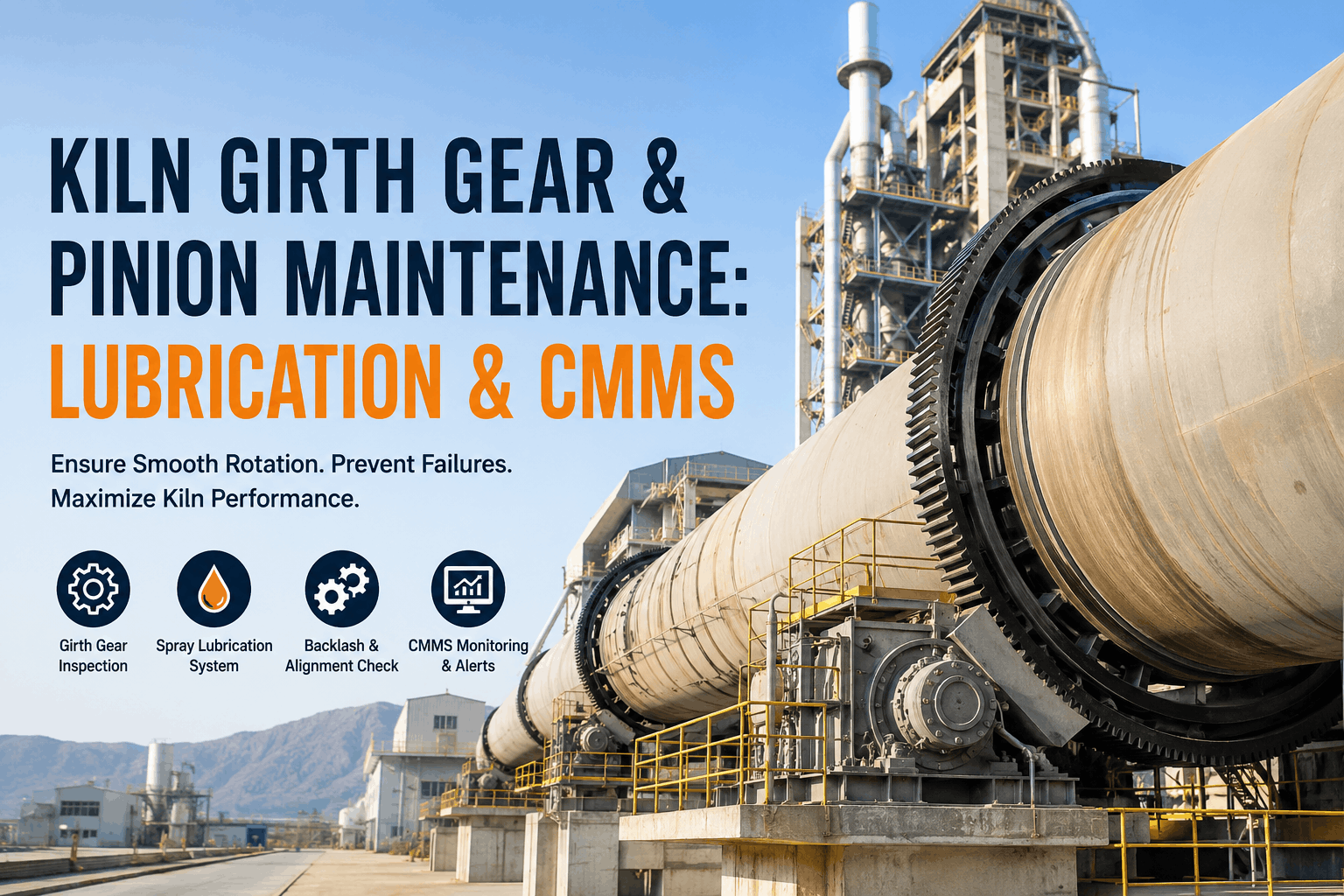
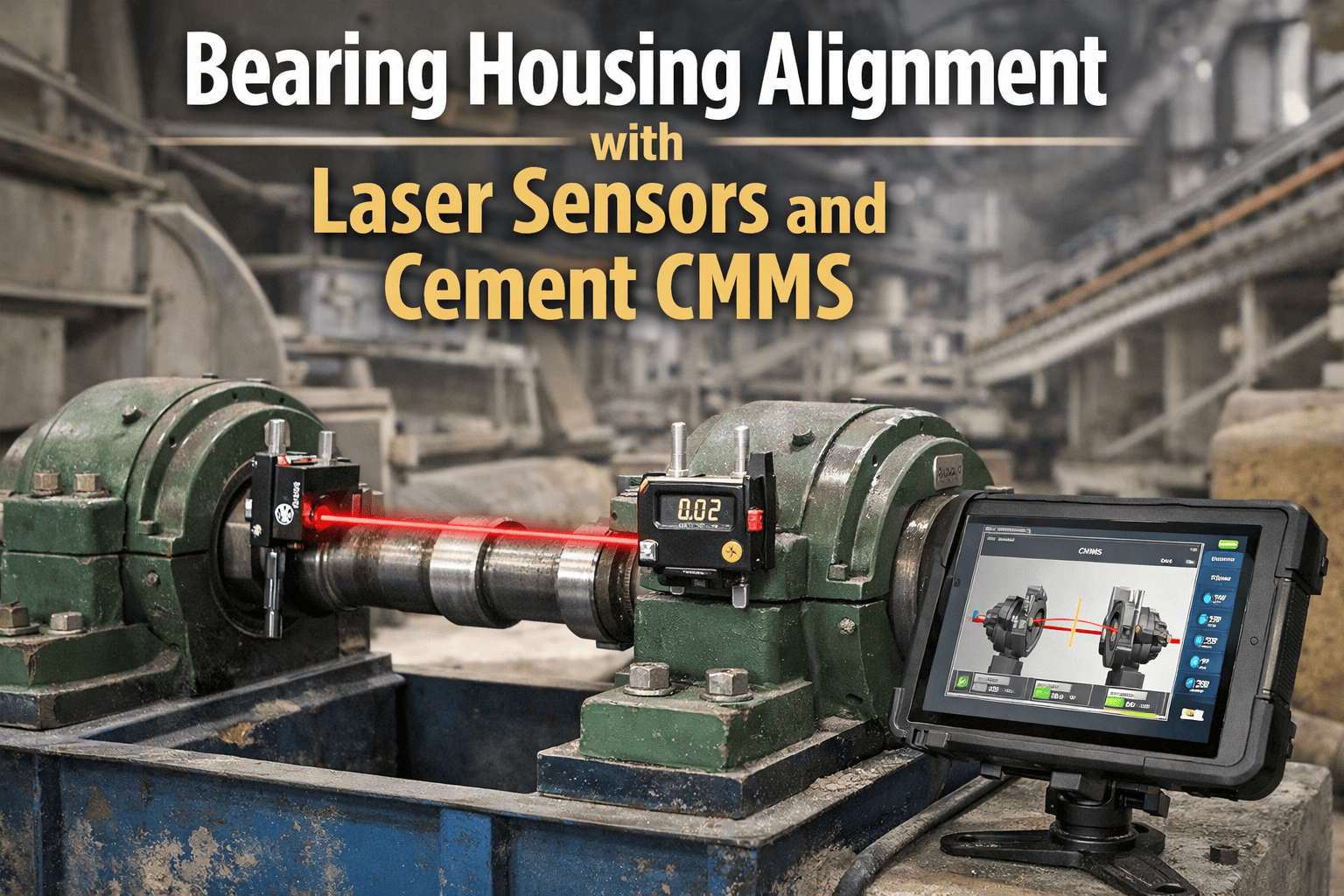
The 4.2 MTPA cement plant had been hearing it for months — a faint, irregular click from the kiln girth gear, audible only when the plant was unusually quiet. The maintenance superintendent dismissed it as "normal kiln noise." The vibration team ran their quarterly check and reported "within tolerance." Then on the 11th of March, during a routine planned outage, a millwright placed a magnetic dial indicator on the pinion bearing housing and discovered 1.4 mm of axial migration — three times the correctable limit. The girth gear had been grinding metal-on-metal against the pinion for an estimated 14 weeks. Replacement cost came in at $1.6 million. Downtime totalled 26 days. The plant ordered a laser alignment monitoring system the following Monday — and that single decision became the case study every cement plant in the region now references when their auditors ask about gear alignment monitoring. Sign in to OxMaint to start tracking your kiln gear alignment data, or book a demo to see the laser-CMMS integration in action.
$800K–$2.5M
Cost of unplanned girth gear replacement on a cement kiln, including parts, contractor labour, and emergency freight
14–30 days
Typical downtime for emergency girth gear replacement, including kiln cool-down, removal, fitting, and hot ramp-up
12–18 weeks
Average duration that detectable alignment drift goes uncorrected in plants without continuous laser monitoring
85%
Reduction in unplanned downtime on critical rotating assets when laser alignment data feeds into CMMS work-order scheduling
Case Study Profile
A 4.2 MTPA Integrated Cement Plant — Before Continuous Alignment Monitoring
Plant Capacity
4.2 MTPA · 11,500 TPD clinker
Critical Drive
Single kiln · 14 m girth gear · 320 teeth
Inspection Method
Manual quarterly · Dial indicator · Paper logs
Alignment History
Last hot alignment 22 months prior to incident
Annual PM Compliance
61% on rotating equipment register
Reactive Maintenance Spend
$1.4 M annually · 38% of total maintenance budget
The Drift Timeline — How Imperceptible Misalignment Becomes a $1.6M Failure
Misalignment is rarely sudden. It is a slow, measurable drift across months — driven by foundation settlement, thermal cycling, base bolt creep, and shell ovality. This is exactly how the case study plant's drift progressed before the laser system caught it.
Month 1
Baseline · 0.2 mm Axial Drift
Within acceptable tolerance. Plant temperatures normalising after a planned outage. No alarms, no work orders, no concern from the maintenance team.
Month 3
First Indicator · 0.45 mm Drift
Foundation settling on the drive-side pier shifts the pinion housing 0.25 mm laterally. Without continuous monitoring, the drift is invisible to operations. Manual quarterly inspection due in 6 weeks.
Month 6
Threshold Crossed · 0.75 mm Drift
Tooth contact pattern starts concentrating on one face of the gear. Backlash exceeds upper limit by 15%. Quarterly check uses dial indicator on a single point — misses the asymmetric wear pattern. Cleared for continued operation.
Month 9
Wear Acceleration · 1.05 mm Drift
Pinion teeth showing visible scuffing on the load face. Spray lubrication coverage drops as alignment shifts the gear face out of optimal nozzle pattern. Heat signature on pinion bearing rises 4°C above baseline. No correlation made.
Month 11
Audible Indicator · 1.30 mm Drift
Faint clicking detected during quiet plant conditions. Vibration sensor catches new high-frequency component but does not exceed alarm threshold. Maintenance superintendent attributes the noise to "normal kiln operation."
Month 12
Discovery · 1.40 mm Drift
Routine planned outage. A millwright with 30 years of kiln experience places a dial indicator on the pinion bearing housing. The reading is so far out of spec that he calls the superintendent before completing the measurement. The decision is made the same day to schedule emergency replacement.
OxMaint · Girth Gear Alignment CMMS
Drift is invisible until it costs $1.6 million. OxMaint connects laser alignment sensors to your maintenance system so every 0.05 mm of migration becomes a tracked, scheduled, correctable event.
The Three Misalignment Failure Modes Laser Tracking Catches Early
A girth gear and pinion can drift out of alignment in three distinct ways — each with a different signature, different consequence, and different correction window. Continuous laser tracking distinguishes between them in real time.
01
Axial Migration
Differential thermal expansion or pier settlement shifts the pinion sideways relative to the gear face. Tooth contact moves to one edge of the gear face, creating a stress concentration line.
Correction Window
8–14 weeks before face damage becomes irreversible
Laser signal: lateral position drift of pinion housing centre
02
Backlash Drift
Base bolt creep or shell ovality changes the centre-to-centre distance between gear and pinion. Backlash drifts above or below the spec range. Excess backlash causes shock loading; insufficient backlash causes binding and heat.
Correction Window
4–10 weeks before tooth pitting accelerates
Laser signal: top-clearance variance across rotation
03
Angular Misalignment
Foundation tilt or kiln crank causes the pinion shaft to rotate at a slight angle relative to the gear plane. Tooth contact pattern becomes wedge-shaped — heavy at one end, light at the other. Most damaging mode if undetected.
Correction Window
2–6 weeks before catastrophic tooth fracture risk
Laser signal: angular deviation between pinion and gear axis
04
Runout & Concentricity Drift
Shell ovality from thermal cycling causes the girth gear to run eccentrically relative to the kiln centreline. The gear-pinion gap varies through every rotation, causing pulsing load on the pinion bearings and uneven tooth-face wear that is invisible to single-point dial indicator checks.
Correction Window
6–12 weeks before bearing fatigue accelerates
Laser signal: cyclic gap variation across full rotation
The Laser Sensor to CMMS Data Flow — From Reading to Work Order
A laser displacement sensor by itself is just a measurement device. Its diagnostic value emerges only when readings flow into a maintenance system that knows what to do with them. Here is how the integration runs at the case study plant.
Stage 1
Continuous Laser Reading
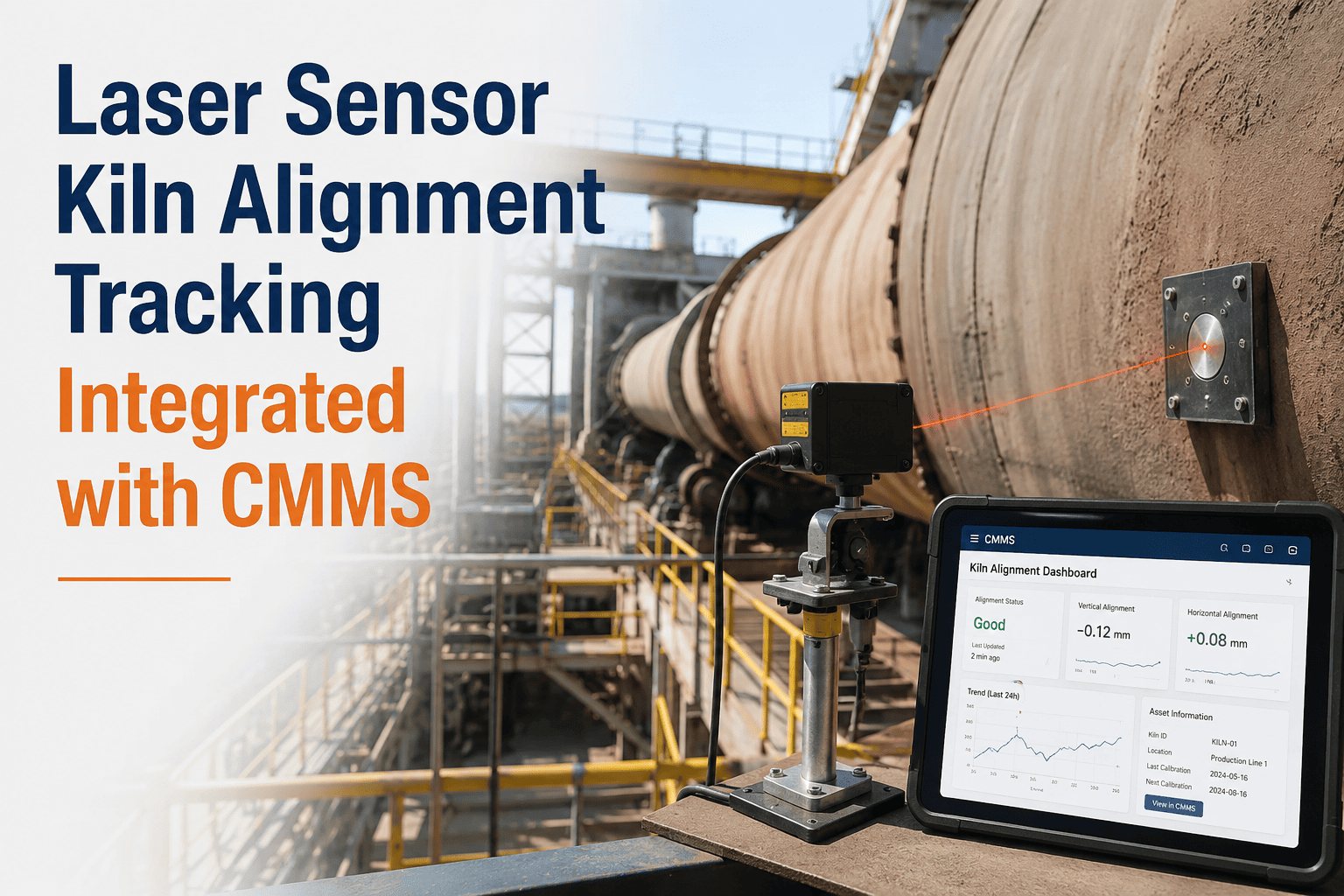
Three laser displacement sensors mounted on the pinion bearing housing measure axial position, radial position, and angular orientation every 60 seconds. Resolution: 0.01 mm. Range: ±10 mm from baseline.
Stage 2
Trend Computation
OxMaint computes 7-day, 30-day, and 90-day rolling trends per axis. Thermal cycling effects are filtered out using kiln shell temperature correlation. Pure mechanical drift is isolated from operational fluctuation.
Stage 3
Threshold Detection
Three escalating thresholds are configured per asset: warning at 0.3 mm cumulative drift, alert at 0.6 mm, and critical at 1.0 mm. Each threshold triggers a different downstream workflow with the appropriate urgency.
Stage 4
Work Order Generation
Warning triggers an inspection task at next planned outage. Alert triggers a hot alignment scheduling discussion. Critical triggers an immediate planning meeting and a kiln stop schedule. Each work order links back to the laser data that created it.
Stage 5
Closed-Loop Verification
Post-correction, the laser data shows the alignment back within baseline. The work order closes with attached before-and-after readings. The drift history is preserved for the next correction cycle and for asset lifecycle planning.
Stage 6
Lifecycle Pattern Learning
Each drift-correction cycle is logged with its trigger threshold, time-to-correct, and outcome. Over 12 months, the system learns the plant's specific drift signature — driven by foundation conditions, thermal patterns, and operating cycle — and refines its threshold settings automatically.
Before vs After — 18 Months After Laser-CMMS Integration
The case study plant deployed laser alignment sensors on the kiln girth gear, the raw mill ball mill girth gear, and the cement mill drive. These are the operational outcomes 18 months later, measured against the pre-integration baseline.
| Metric |
Before Laser-CMMS |
After 18 Months |
Improvement |
| Unplanned Gear-Related Stops |
4 events / year |
0 events / year |
100% reduction |
| Emergency Replacement Spend |
$1.4 M / year |
$180 K / year |
87% reduction |
| Average Drift Detection Time |
12–18 weeks |
Under 48 hours |
Continuous monitoring |
| Hot Alignment Frequency |
22 months between |
Scheduled per drift trend |
Demand-based |
| PM Compliance on Drives |
61% |
96% |
+35 points |
| Spray Lubrication Effectiveness |
Manual visual check |
Aligned-face verified |
Sensor confirmed |
| Insurance Premium Impact |
Standard rate |
Risk discount applied |
7% premium reduction |
| Annual Production Hours Recovered |
Baseline |
+412 production hours |
$3.2 M output value |
Scroll horizontally to view all columns on smaller screens
The CFO Perspective — Investment vs Prevented Loss
A laser-CMMS alignment system is justified on a single prevented gear failure. The case study plant's finance team built the approval case on three numbers — the same three numbers any cement plant CFO can apply to their own asset register.
Investment
$95 K
One-time installation cost — three laser sensors, signal conditioners, OxMaint configuration, baseline alignment verification, and technician training across the kiln, raw mill, and cement mill drives.
Annual Operating
$28 K
OxMaint subscription, sensor calibration service, and the labour for monthly correlation review by the maintenance planning team. Less than 0.05% of annual maintenance budget for the plant.
Single Failure Prevented
$1.6 M
Cost of the original girth gear emergency — including parts, expedited freight, contractor overtime, and the production loss from 26 days of kiln downtime. One prevented event covers the system 16 times over.
Year-1 Net Benefit
$1.27 M
Documented savings from prevented unplanned stops, reduced emergency repair spend, and recovered production hours — net of system investment and operating cost. Validated by the plant's internal finance audit team.
OxMaint · Cement Plant Reliability CMMS
Your kiln girth gear is either being measured continuously, or it is silently drifting toward the next $1.6 million emergency. OxMaint puts laser alignment data into the same system as your work orders, parts inventory, and maintenance crew.
Frequently Asked Questions — Laser Alignment Tracking and CMMS Integration for Girth Gears
OxMaint · Girth Gear Alignment · Cement Plant Reliability CMMS
A girth gear that fails unplanned costs $1.6 million and 26 days of production. A laser-CMMS alignment programme that prevents it costs less than 6% of a single failure event. The case study plant ran the math once and never went back to manual quarterly checks.
Continuous laser displacement monitoring. Drift trend computation. Threshold-based work order generation. Closed-loop alignment verification. All built into OxMaint's reliability CMMS for cement plants.