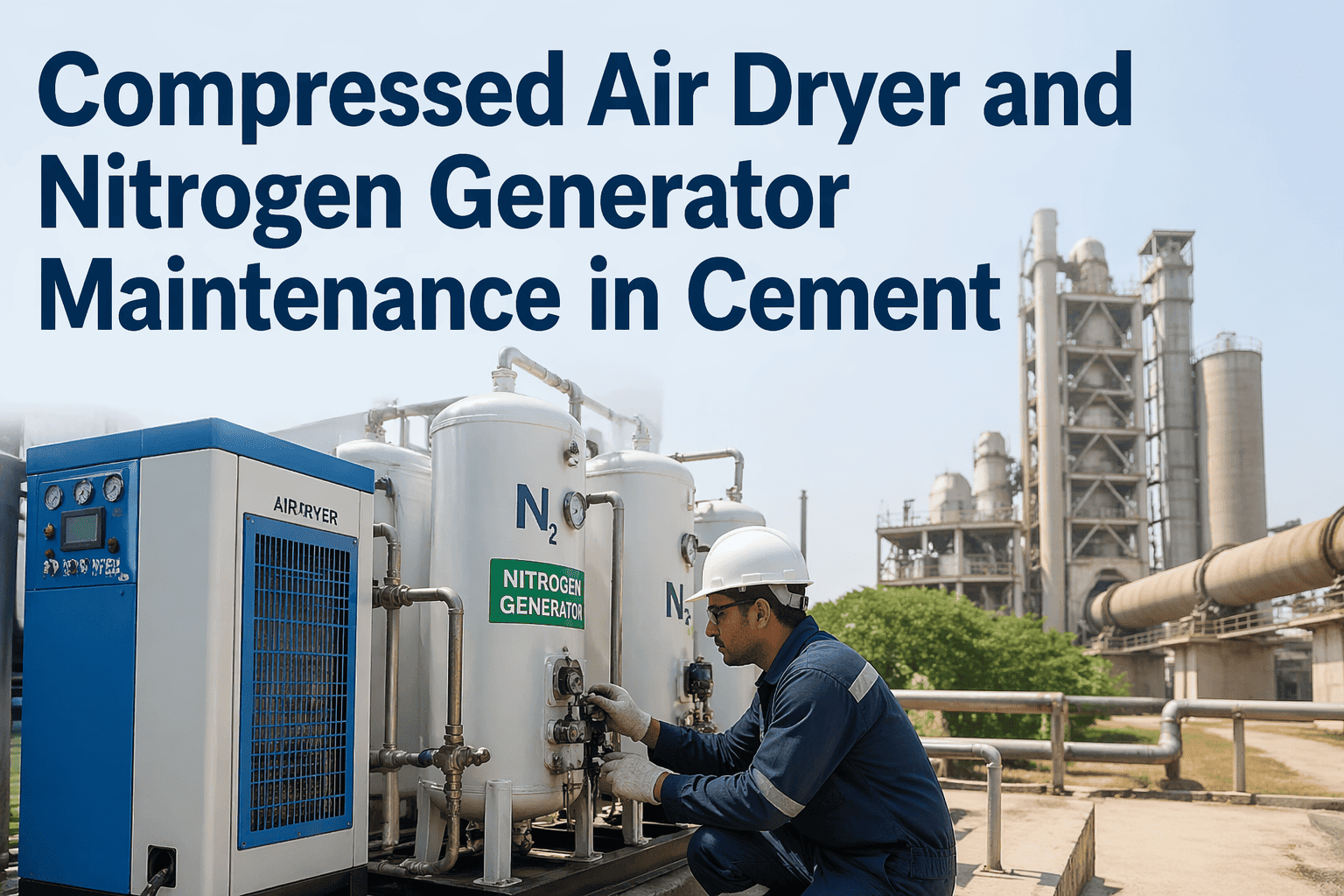
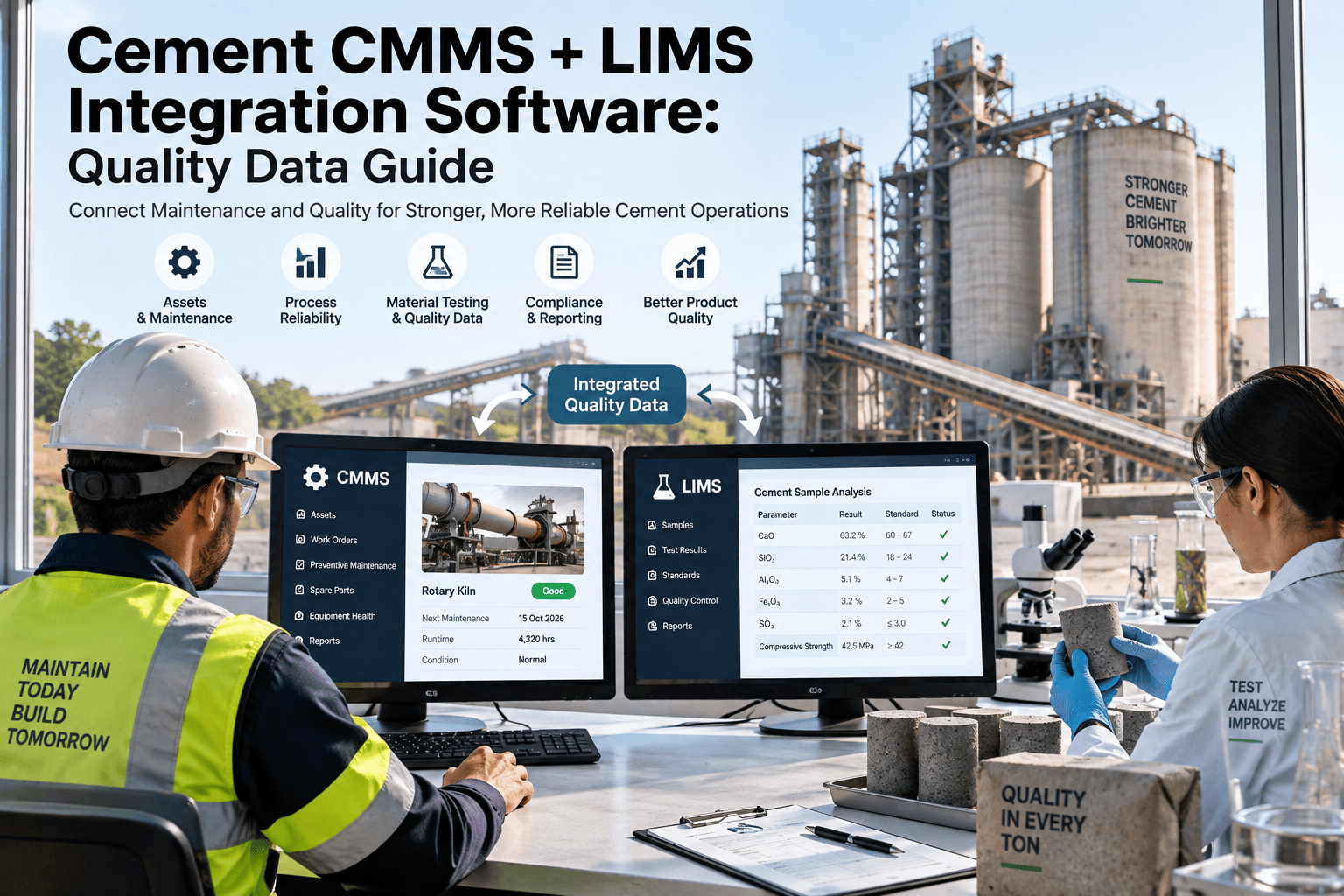
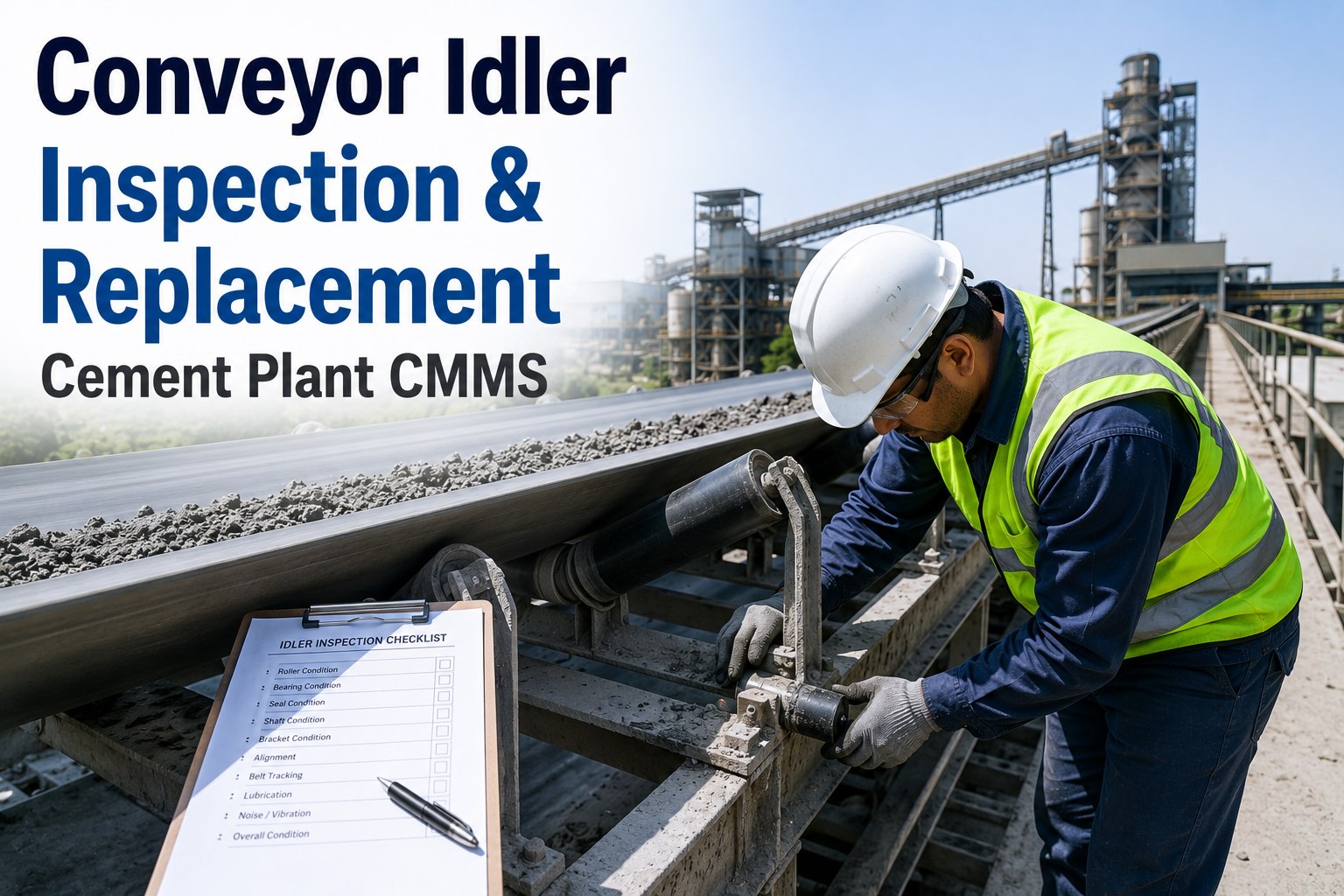
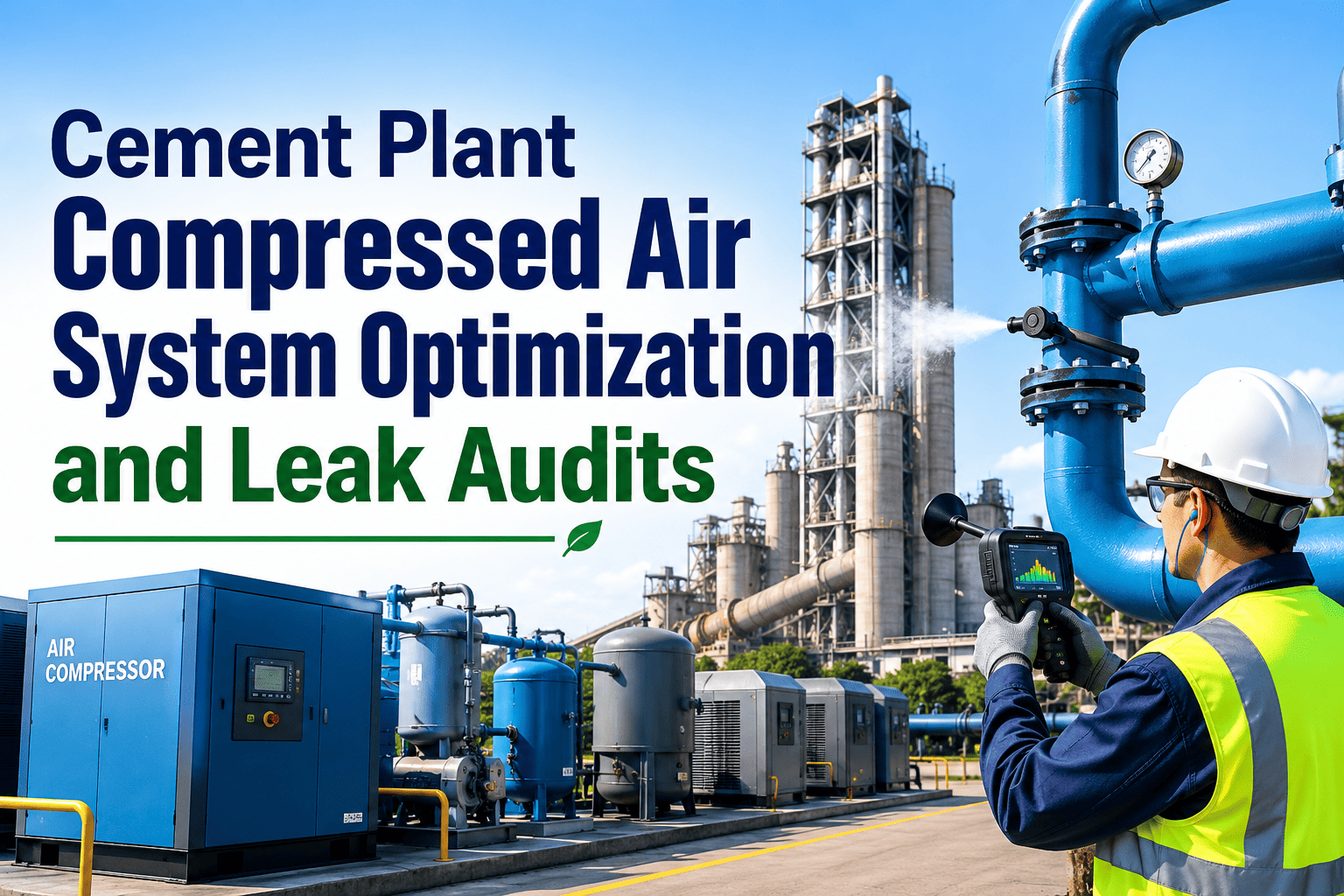
Compressed air and nitrogen are the two utility gases a cement plant cannot run safely or reliably without — yet both are treated as invisible background services until something fails. A refrigerant dryer silently drifting from a +3°C pressure dew point up to +15°C will not trip an alarm, but it will corrode pneumatic actuators on the kiln inlet, ruin baghouse pulse-jet cleaning, and contaminate instrument air readings within weeks. A PSA nitrogen generator producing 97% purity instead of its rated 99.5% looks operational on the skid HMI, but it will no longer reduce coal mill bag filter oxygen below the 12% limiting oxygen concentration required to prevent an explosion during an emergency inerting event. The gap between rated performance and actual performance is bridged by maintenance — filter element changes, desiccant replacement, carbon molecular sieve protection from oil carryover, drain trap verification, dew point sensor calibration, O2 analyser calibration, and valve cycle counting. Book a demo to see how OxMaint turns compressed air dryer and nitrogen generator PM into a tracked, audit-ready safety-critical workflow instead of an assumed background service.
Utility Systems · Cement CMMS · Air & Nitrogen
Compressed Air Dryer and Nitrogen Generator Maintenance in Cement
Pneumatic actuators, baghouse cleaning, instrument air, and coal mill inerting all depend on two utility systems that run for years without anyone looking at them — until something breaks. A structured CMMS workflow around dew point, PSA purity, filter pressure drop, and drain performance keeps both systems within spec continuously and converts silent drift into a tracked maintenance event.
75%
share of a compressed air system's lifetime cost that is energy — efficiency loss is expensive, not just operational
−40°C
typical desiccant dryer pressure dew point target for instrument and process air
99.5%+
typical PSA nitrogen generator purity for coal mill and silo inerting applications
12%
oxygen concentration ceiling for inerting — N2 purity must stay high enough to reach this below-LOC target
Two Systems, One Utility Loop
Compressed Air and Nitrogen — What Each System Actually Does in a Cement Plant
Most cement plants treat compressed air and nitrogen generation as separate black-box utilities from separate suppliers. In operational reality they share the same feed — atmospheric air — and the same failure modes: contamination, moisture ingress, and silent efficiency drift. Understanding what each one does, and where they overlap, is the starting point for building a maintenance programme that catches drift before it becomes downtime.
System 1
Compressed Air & Dryer
Typical types:Refrigerant (+3°C) & desiccant (−40°C)
Typical pressure:7 bar service, 10 bar process
Primary quality standard:ISO 8573-1 Class — particulate, water, oil
Key KPI:Pressure dew point (PDP) within spec
Baghouse pulse-jet cleaning, pneumatic conveying of raw meal and cement, air cannons on silos and preheater, instrument air for pneumatic valves and actuators, packing line, workshop tools.
System 2
Nitrogen Generator (PSA)
Typical technology:Pressure Swing Adsorption with CMS
Typical flow range:40–500 Nm³/hr for cement inerting
Primary quality standard:Purity 99–99.999%, dew point −40 to −80°C
Key KPI:Purity & O2 analyser accuracy
Coal mill and pulverised-fuel silo inerting, fine-coal bag filter blanketing, emergency inerting trigger to drop O2 below 12% LOC, alternative-fuel silo inerting, bright-atmosphere ancillary processes.
The Shared Failure Surface
Both Systems Start with Dirty, Wet, Warm Atmospheric Air — and Both Fail in the Same Three Ways
Oil carryover from the compressor, moisture breaking through the dryer, and particulates damaging the carbon molecular sieve are the three failure paths that connect compressed air quality directly to nitrogen generator health. Maintenance that treats these as one integrated workflow — not two separate skids — prevents the expensive second-order failure: a nitrogen system that produces lower purity because its feed air was contaminated months before anyone noticed.
The Seven Silent Failure Modes
Where Compressed Air Dryers and Nitrogen Generators Actually Fail — and What They Look Like
Every cement plant reliability engineer has a version of this list, but most of them live in the heads of the people who commissioned the system. When those people retire or move on, the list goes with them. The seven modes below cover the vast majority of documented utility-gas failures in the published cement and industrial gas literature.
01
Compressor Oil Carryover
Signal — Coalescing filter Δp climbing, oil traces downstream
Destroys desiccant beds and CMS prematurely. A contaminated CMS bed cannot be cleaned — it must be replaced. Can shorten 10-year sieve life to under 2 years.
02
Desiccant Exhaustion / Channelling
Signal — Outlet dew point rising against stable inlet conditions
Moisture breakthrough corrodes actuators, freezes pilot valves in winter, and washes lubricant from pneumatic cylinders. Instrument air out-of-spec invalidates DCS readings.
03
Condensate Drain Trap Failure
Signal — Continuous air loss or water slugging downstream
Stuck-open trap wastes 5–15% of compressor output continuously; stuck-closed trap floods the dryer and sends liquid water into the distribution header.
04
Coalescing & Particulate Filter Loading
Signal — Δp across element above 0.8 bar target
Pressure loss forces the compressor to run above setpoint, adding 7% energy per extra bar. Eventually media failure releases contaminants downstream.
05
CMS Bed Contamination (Nitrogen Generator)
Signal — Declining nitrogen purity at fixed flow and pressure
Inerting capacity drops silently; operators assume the skid is fine until an emergency inerting event fails to bring O2 below the 12% LOC target.
06
PSA Switching Valve Wear
Signal — Cycle time creep, purity swings, valve cycle count high
Cross-contamination between adsorption and regeneration beds. Purity becomes unstable; skid can pass steady-state tests but fail under transient demand.
07
Oxygen Analyser Drift
Signal — Missed calibration cycle; field-verify vs bottle standard
The skid's safety interlock depends on the O2 analyser. Uncalibrated drift means the protective shutdown is silently inactive — a critical undetected safety gap.
Maintenance Frequency Matrix
What to Check, How Often, Which Parameter, and What CMMS Does With It
A structured maintenance schedule turns the above failure modes into scheduled work orders with defined acceptance criteria. The table below shows a baseline cadence for a typical cement plant compressed air and nitrogen generation circuit — OxMaint calibrates the final intervals against OEM recommendations, operating hours, and observed trend data.
The Pneumatic Dependency Map
Six Cement Plant Systems That Fail When Utility Air and Nitrogen Fail
The cost of a compressed air or nitrogen generator issue is rarely paid by the utility department. It is paid downstream — in baghouse differential pressure, in pneumatic actuator failure on the kiln main burner, in coal mill safety interlocks that cannot do their job. Mapping the dependency explicitly turns utility maintenance from a back-office cost centre into a front-line reliability function.
01
Baghouse Pulse-Jet Cleaning
Filter bag cleaning cycles require consistent high-pressure, dry, oil-free air. Wet air blinds filter media; contaminated air produces pressure drop and emission excursions.
02
Kiln Main Burner & Dampers
Instrument air operates the actuators that modulate kiln burner positioning and damper control. Dew-point excursions freeze or seize these critical control paths.
03
Pneumatic Conveying (Raw & Cement)
Moisture in conveying air causes cement bridging in silos and pipe blockages. Off-spec air halts material transfer between raw mill, kiln feed, and cement storage.
04
Coal Mill & Bag Filter Inerting
Emergency inerting requires N2 at rated purity to drive oxygen below 12% in the target volume within a defined window. Purity drift makes this window miss.
05
Silo & Fine Coal Bin Blanketing
Fine coal and alt-fuel silos are continuously blanketed with N2 to suppress spontaneous combustion risk. Flow-rate loss or purity loss reintroduces the hazard silently.
06
Instrument & Control Air
Every pneumatic DCS loop depends on instrument-grade air. Moisture, oil, or particulate contamination produces phantom readings, stuck positioners, and false trips.
Expert Perspective
What Cement Plant Utility and Reliability Engineers Say
★★★★★
Our plant runs two desiccant dryers on the instrument air header and we used to change the dew point sensor battery once a year and assume the rest was fine. OxMaint made us honest. The first month of structured CMMS tracking showed one dryer was running with dew point climbing 2°C every week and nobody had raised a flag because it was still technically in spec. Two months later the desiccant was fully saturated. With the automated threshold work order, we caught the second dryer at exactly the same point and replaced the desiccant on schedule rather than during an instrument-air emergency.
LM
Lena Meyer, Dipl.-Ing.
Utilities Reliability Engineer, Central European Cement Group · 15 yrs compressed air system management
★★★★★
The nitrogen generator sat in a corner of the utility building for eight years before we realised the O2 analyser had drifted nearly two percentage points. The skid HMI was reading fine; the analyser itself was reading the same wrong number every day. Coal mill inerting had been nominally operational but our actual inerting capacity was below what safety depended on. Every quarterly calibration is now a CMMS-locked work order that will not close without a bottle-standard reading attached. For a safety-critical skid, this is the difference between a system and a decoration.
RM
Ravi Mahapatra, CMRP
Plant Maintenance Lead, South Asian Integrated Cement Producer · 20 yrs rotating equipment and utilities
★★★★☆
The insight that changed us was the dependency map. When utility air is framed as a cost centre, nobody fights for it. When the PM schedule shows that baghouse emissions, kiln damper response, and coal mill inerting all have a single shared upstream failure mode, suddenly the PM budget becomes a reliability conversation. Our compressor maintenance spend went up 12% in the first year and total plant downtime fell by a much bigger number. It is the clearest utility ROI conversation I have had in two decades.
EO
Elizabeth Oyebanjo, IEng MIMechE
Plant Reliability Manager, West African Cement Operations · 22 yrs utilities and process reliability
Frequently Asked Questions
Compressed Air Dryer and Nitrogen Generator Maintenance — Common Questions
Can OxMaint integrate with existing dew point sensors, PSA controllers, and oil analysis lab feeds?
Yes. OxMaint pulls dew point, purity, Δp, and oil analysis results over OPC-UA, REST API, Modbus, and file-based exchange. Readings become live inputs to the PM and alert engine.
Book a demo to map your specific sensor and lab workflow.
How does the system prevent a PSA nitrogen skid from running with a drifted O2 analyser?
Calibration is a calendar-locked PM. When the calibration interval lapses, the skid's safety-interlock status is flagged in the CMMS and downstream safety reports show the instrument as uncertified until calibration is logged — removing the silent-drift failure mode entirely.
Does OxMaint track compressor energy waste from pressure-band creep and leaks?
Yes. Compressor kWh data plus setpoint history feeds a trend report that flags pressure-band drift and probable leak load. Ultrasonic leak-detection inspection findings are logged as WOs with quantified savings.
Start a free trial to see the energy trend view.
How are annual inerting functional tests documented for safety audits?
Functional tests are scheduled as permit-gated WOs with required attachments: O2 reading before and after, elapsed time to below-12% O2, signed witness record. The complete evidence set is exportable for insurance and regulatory audits without additional paperwork.
Is OxMaint suitable for plants with mixed OEM equipment — different compressor, dryer, and PSA brands?
Yes. The workflow engine is OEM-agnostic. Atlas Copco, Ingersoll Rand, Pneumatech, Gaztron, and other suppliers are all supported through standard protocols, and asset-specific PM templates are configurable per skid without code changes.
Compressed Air Dryer & Nitrogen Generator Maintenance · OxMaint Cement CMMS
Two Skids Your Plant Runs Forever on Assumed Performance. Stop Assuming.
Compressed air and nitrogen generation systems are where unnoticed drift turns into unplanned downtime, failed inerting, and audit findings. OxMaint converts dew point, purity, filter Δp, drain performance, and analyser calibration into structured PM work orders, energy trend reports, and audit-ready evidence — so your utility gas systems are actually performing at the spec they were commissioned to, not just nominally running.