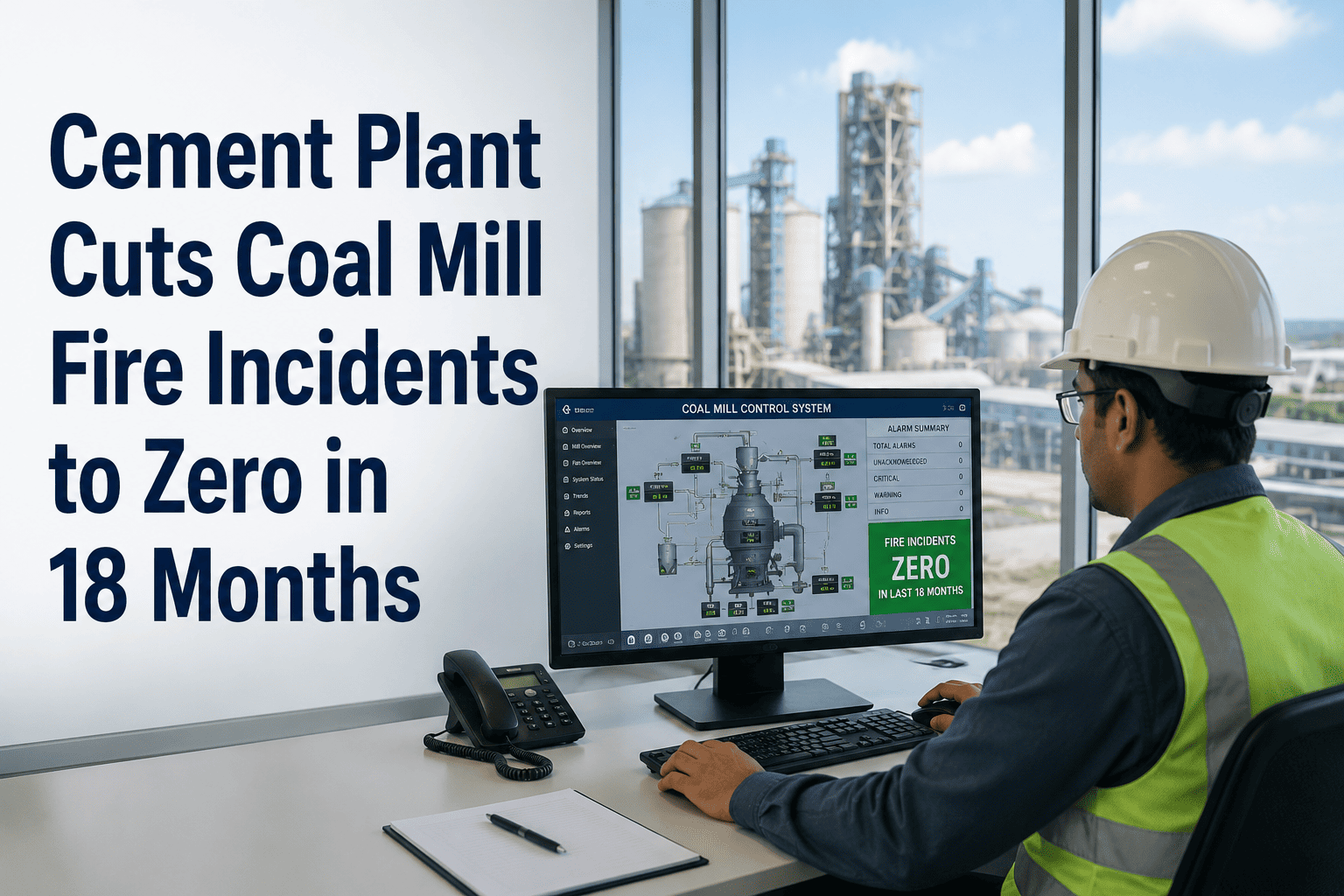
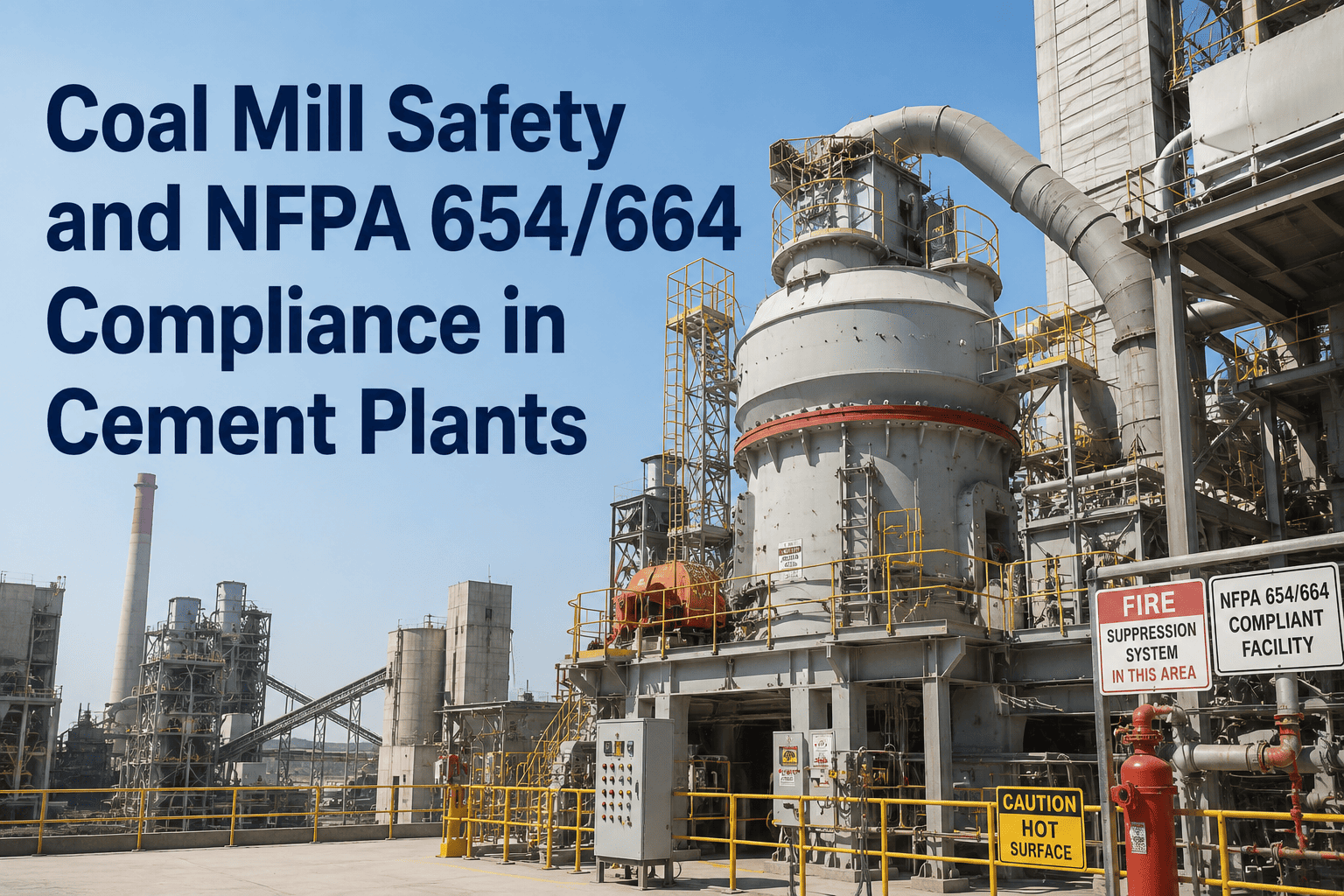
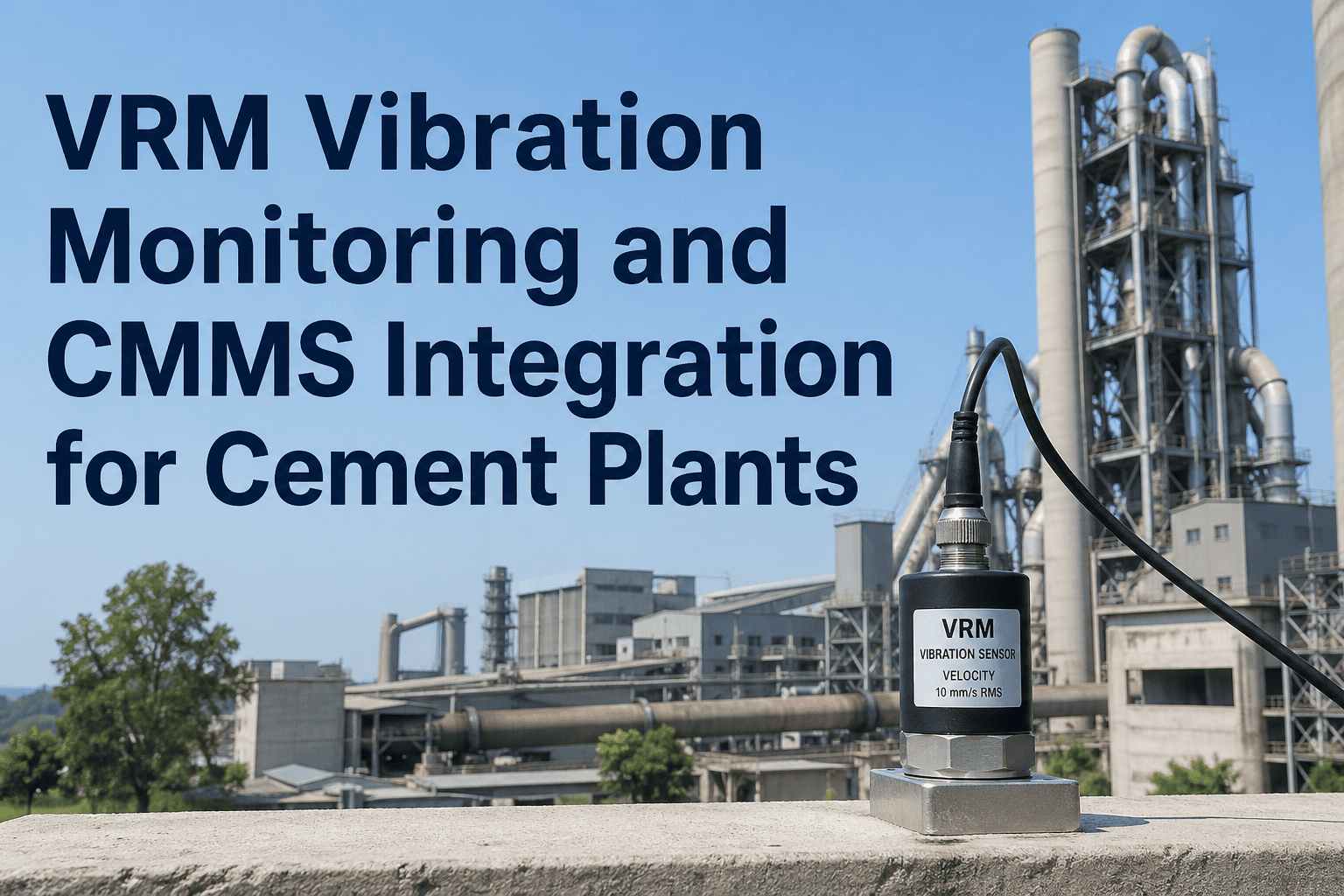
Coal dust is classified as one of the most dangerous combustible materials in industrial manufacturing, and inside a cement plant coal mill — where raw coal is pulverised to the 70-micron particle size needed for kiln firing — all three legs of the fire triangle sit permanently within arm's reach of each other. MSHA incident records and the cement industry's own explosion catalogues document dozens of coal mill fires and explosions over the last three decades, and the pattern in nearly every case is the same: the catastrophe was not a single fault but a cascade of early-warning signals nobody acted on. A CO reading rising above baseline. A mill outlet temperature drifting past 90°C. An O2 concentration climbing toward the 13% limiting oxygen concentration for bituminous coal. Each of those signals is measurable in real time. Each of them can trigger an automatic CMMS emergency work order, a forced lockout, or an inerting sequence — but only if the plant has actually connected those readings to an action system. Book a demo to see how OxMaint converts coal mill sensor data into automatic emergency work orders, lockout procedures, and safety-audit trails before ignition occurs.
Case Study · Coal Mill Safety · Cement CMMS
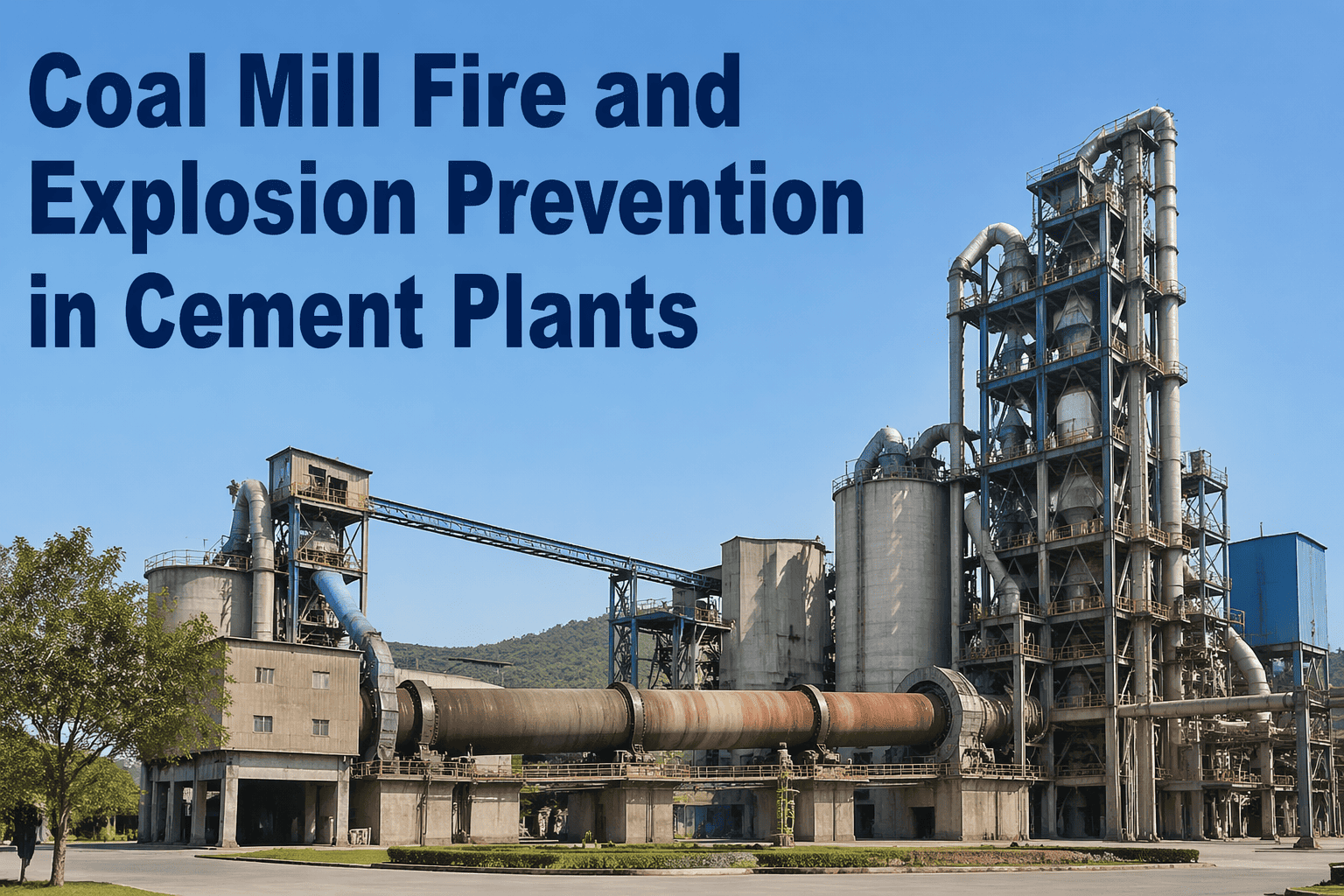
Coal Mill Fire and Explosion Prevention in Cement Plants
Coal mill fires and explosions are the most catastrophic safety event in cement manufacturing — yet CO trending, outlet temperature monitoring, and O2-in-mill tracking provide clear, measurable early warning signs. A CMMS that converts those signals into automatic emergency work orders, lockout tagout procedures, and inerting triggers turns a life-threatening incident window into a routine preventive intervention.
45 g/m³
Lower explosion limit of coal dust suspended in air — the upper limit can reach 2000 g/m³
13%
Maximum O2 concentration that still permits bituminous coal dust ignition under strong spark
90°C
Standard coal mill outlet gas temperature ceiling; exceedance indicates fire risk
2000 psi/s
Rate of pressure rise once ignition occurs — max pressure reached in 45 milliseconds
Case Study — The Anatomy of a Coal Mill Incident
How an Explosion Actually Develops — and Where CMMS Interrupts the Chain
Reviewing incident reports from MSHA's cement industry dataset and the European cement safety literature, coal mill explosions almost never begin at the moment of detonation. They begin 4 to 8 hours earlier in the coal yard or feed system, and every stage in between produces a measurable signal the plant could have captured. The timeline below traces a representative incident pattern — what was happening physically, what the instruments were showing, and the point at which a connected CMMS would have generated an automatic emergency work order.
T−6 hrs
Coal Yard — Spontaneous Oxidation
Humid, sun-exposed stockpile begins self-heating. Temperature in a pile core passes 80°C. Oxidation releases CO and low levels of CH4.
Yard pile thermocouple reading drifts above baseline. CMMS threshold rule would have triggered a "relocate/cool pile" work order.
T−2 hrs
Mill Feed — Self-Heated Coal Enters Circuit
Already-oxidising coal reaches the feed belt and enters the mill. Mill outlet CO begins to rise above its normal 30–50 ppm steady-state baseline.
CO analyser exceeds 100 ppm for the first time in the shift. CMMS issues a Level 1 alert work order to the control room.
T−30 min
Smouldering Starts in Filter / Cyclone
Localised hot spot develops in a dust accumulation inside the baghouse or cyclone. CO climbs above 200 ppm. Outlet temperature lifts 5–8°C from normal.
CMMS auto-raises a Level 2 emergency WO, assigns a safety technician, and starts the pre-shutdown checklist.
T−10 min
Critical — CO > 500 ppm, Active Hot Spot
Intensified oxidation in a confined pocket. Without intervention, a shutdown or mill restart will introduce O2 to smouldering material. Explosion probability rising sharply.
CMMS automatic Level 3 trigger: forced controlled shutdown sequence, inerting system armed, maintenance entry locked out.
T−0
Ignition Window
Typical ignition path: operator opens an inspection door, or mill restarts after an unplanned trip. Fresh air meets smouldering coal. Pressure rises at 2000 psi/sec, peak in 45 ms.
The CMMS path is designed so this row never occurs — every earlier stage has an automated mitigation action.
The Fire Triangle Inside a Coal Mill
Three Legs, Three Hard Thresholds — Miss Any One and the Triangle Breaks
Fire and explosion protection in a coal grinding circuit reduces to controlling three variables with known numeric thresholds. The cement industry predominantly uses indirect firing systems that operate with intentionally low oxygen atmospheres (often 3–8% O2 from preheater tail gas), but excursions above the limiting oxygen concentration are the condition that turns a fire hazard into an explosion hazard. These are the numbers every coal mill sensor package is measured against.
Leg 1 · Oxygen
< 13%
O2 by volume — bituminous coal
Below 13% O2 under strong ignition conditions, bituminous coal dust cannot ignite. MAOC target is typically 2–3% below LOC. Lignite LOC is around 12% with N2 inerting and 14% with CO2 inerting.
Leg 2 · Fuel
45 g/m³
Minimum dust concentration in air
Coal dust explosion lower limit is 45 g/m³; the upper limit reaches 2000 g/m³. Particle size below 74 microns dramatically increases ignition sensitivity. Housekeeping and dust accumulation tracking are direct levers.
Leg 3 · Ignition
90°C
Mill outlet gas temperature ceiling
Above 90°C at the mill outlet, smouldering risk is active. Inlet air generally capped at 400°C. Spontaneous combustion in pile cores starts at 80°C; ignition possible from 800°C coal surface temperature, tramp iron sparks, or bearing failures.
From Sensor Reading to Safety Action
Every Coal Mill Already Has the Sensors — What's Usually Missing Is the Automatic Response Chain
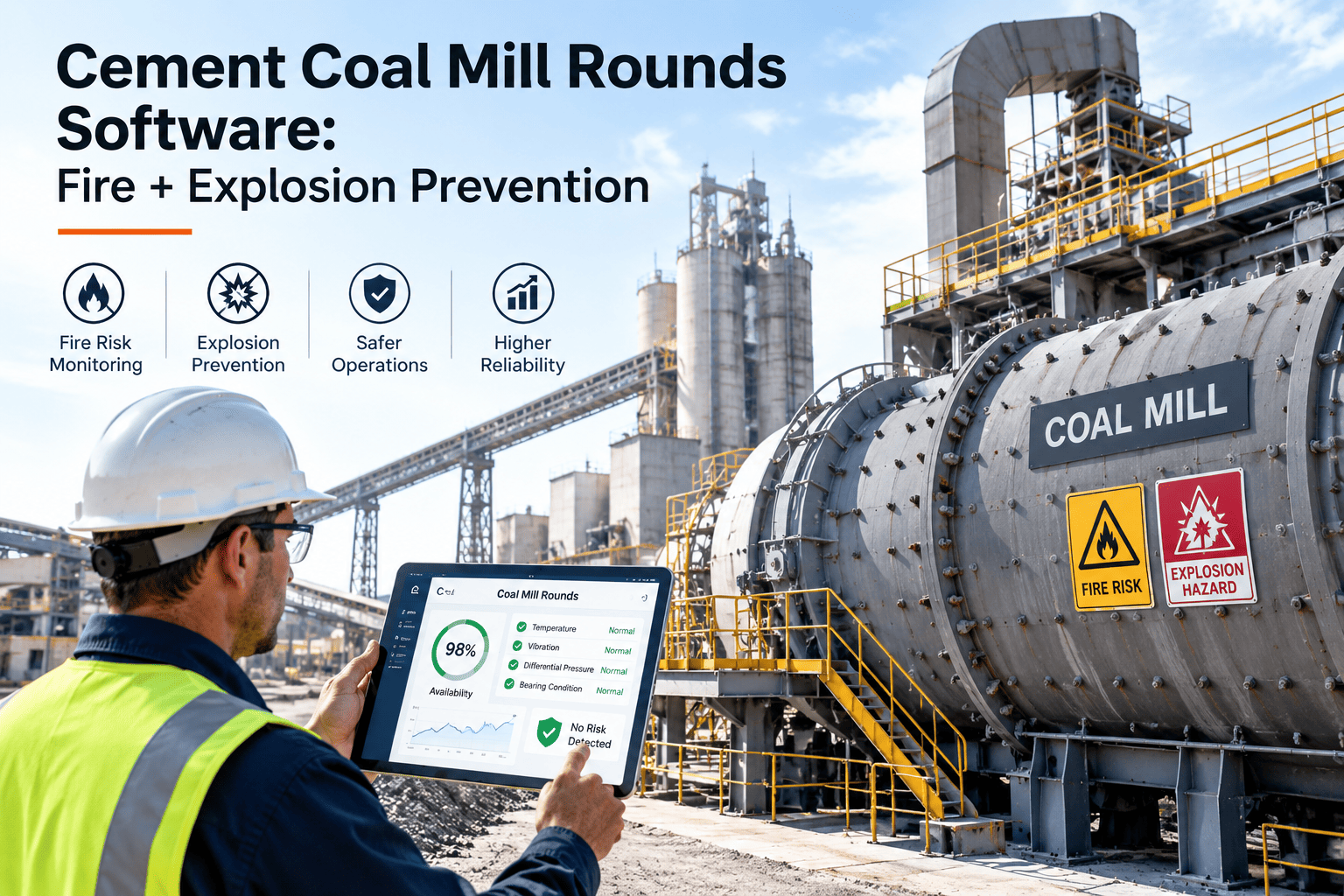
CO analysers, mill outlet temperature probes, and O2 sensors are installed on virtually every cement coal grinding system. The gap is not the data — it is the chain that converts a 400 ppm CO reading at 2 a.m. into a Level 3 work order, a forced shutdown permit, and an audit trail the regulator can review after the fact. OxMaint wires that chain end-to-end.
The Four Sentinel Signals
The Measurements a Coal Mill CMMS Must Never Stop Watching
Every documented coal mill explosion that had instrumentation in place showed a deviation on at least one of these four signals in the hours preceding the event. A CMMS linked to the mill control system translates each threshold crossing into a defined action level — alert, emergency WO, or forced shutdown — removing operator judgement from the part of the chain where human error is most expensive.
01
Carbon Monoxide (CO) Concentration
Baseline · Alert · Critical
30–50 ppm · 100 ppm · 500 ppm+
CO build-up is the single earliest indicator of intensified coal oxidation inside the mill circuit. A rising CO trend against a stable production rate means combustion is starting somewhere you cannot see.
02
Mill Outlet Gas Temperature
Normal · Alert · Shutdown
< 75°C · 80–90°C · > 90°C
Mill outlet temperature is the thermal fingerprint of what is happening in the grinding zone and downstream cyclone. A sustained rise, decoupled from inlet temperature changes, signals a heat source that is not the drying air.
03
Oxygen Concentration (O2 in Mill)
Inert · MAOC · Explosive
3–8% · 10% · > 13%
Indirect-fired cement coal mills run with tail-gas dilution to keep O2 well below the LOC. A drift upward during a trip, restart, or false-air ingress creates the exact condition for ignition at the moment inerting is most needed.
04
Vibration, Dust Build-up & Tramp Metal
Mechanical · Housekeeping · Foreign Object
RMS trend · Daily inspection · Magnet/detector log
Bearing failure sparks, broken damper plates, and tramp iron are primary ignition sources identified in MSHA investigations. Vibration trending plus magnetic separator inspection logs catch the physical precursors before a spark happens.
CMMS Automation Matrix
From Alarm to Automatic Response — What OxMaint Executes at Each Threshold
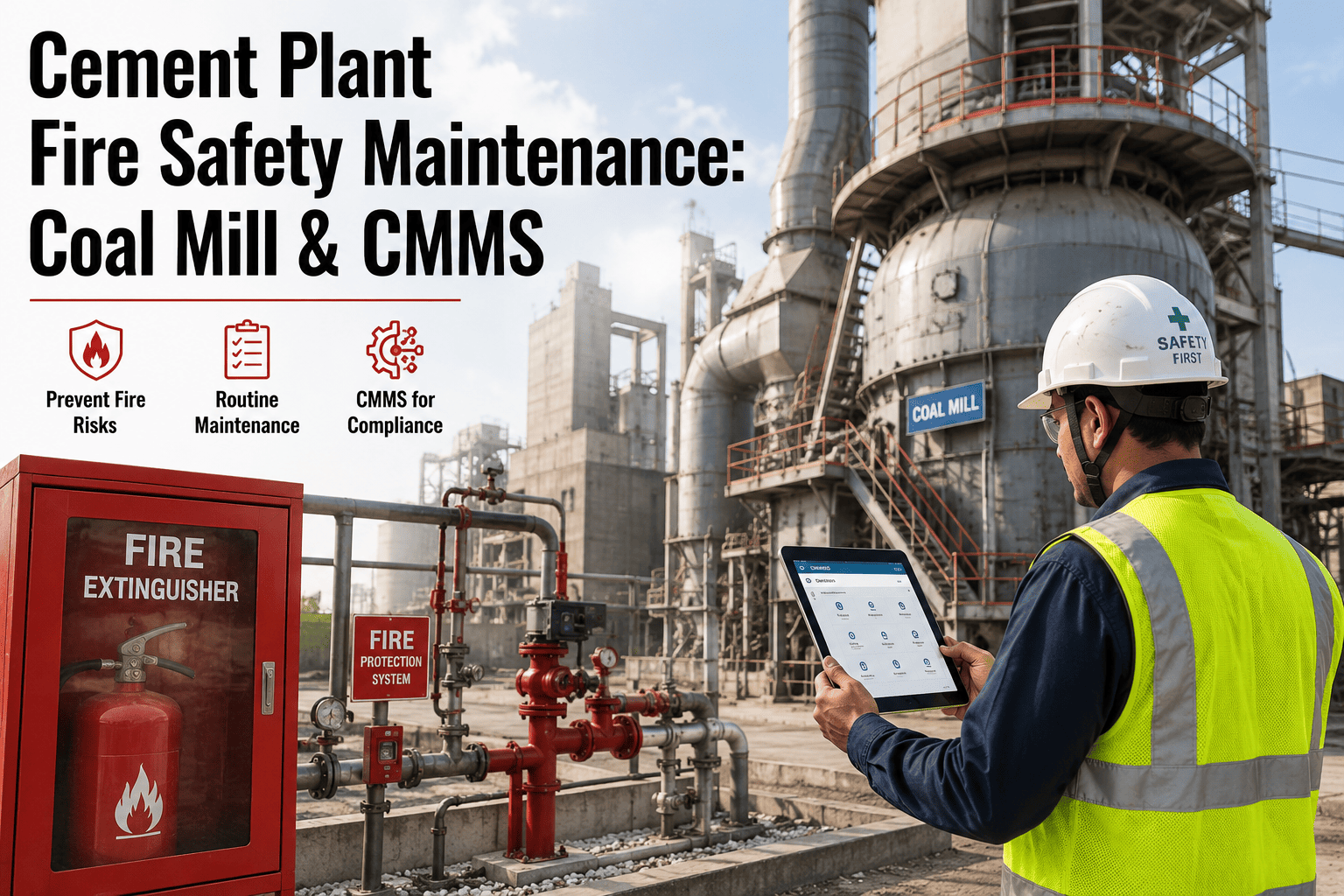
A monitoring system without an automated response is a log file after the fact. OxMaint's coal mill safety workflow maps each sensor threshold to a defined automatic action, an assigned responder role, and a verification checklist the system will not close without. The table below shows the action matrix that runs out of the box and calibrates against plant-specific setpoints in commissioning.
Layered Defense Roadmap
Five Prevention Layers — Each One a CMMS-Managed Workflow
Coal mill safety engineering follows a layered defense principle: no single control is relied upon to prevent a fire or explosion. Each layer reduces the probability of the next layer being tested. OxMaint operationalises all five as managed workflows with assigned responsibility, scheduled verification, and auditable closure — so the "layered defense" on paper exists in practice, not only in the safety manual.
01
Yard & Feed Management
Pile rotation schedules, thermocouple checks, moisture monitoring, and FIFO consumption rules — enforced through scheduled WOs so hot coal never reaches the mill feed.
02
Continuous Sensor Monitoring
CO, outlet temperature, O2, and vibration tracked in real time with automatic threshold escalation to alert, emergency, and shutdown work orders — operator judgement removed from the alarm path.
03
Preventive Maintenance Discipline
Bearing PM, magnetic separator inspection, baghouse filter integrity, explosion-vent condition checks — scheduled against operating hours and verified by photographic evidence in the WO record.
04
Emergency Inerting Readiness
N2 or CO2 inerting system linked to automatic trigger rules, inventory level tracking, injection line integrity checks, and annual functional test records — ready to fire within seconds of a Level 3 trigger.
05
Permit to Work & Lockout Discipline
Inspection-door entry, hot work, and restart-after-trip all require electronic permits that will not issue unless cold-state, inerting, and housekeeping checks are verified — the exact control that prevents the MSHA-documented inspection-door ignition pattern.
Expert Perspective
What Cement Plant Safety and Reliability Leads Say
★★★★★
Our pulveriser fire incident in 2021 was the reason we rebuilt the entire coal mill safety workflow around the CMMS rather than around PDF SOPs. The investigation report showed our CO analyser had been drifting above 200 ppm for almost 40 minutes before the fire, and nobody had escalated it. With OxMaint, that exact threshold now raises an emergency work order automatically and logs the operator response time. Twelve months in, we have had three Level 2 events, all resolved before Level 3, and zero fires.
BS
Björn Svensson, IOSH Managing Safely
Head of Process Safety, Nordic Cement Operations · 22 yrs cement pyroprocess safety and incident investigation
★★★★★
The honest problem in most plants is not lack of sensors — it is that the sensors are wired to a control room screen and nothing else. The operator sees CO rising, notes it, and carries on because there is no workflow that says stop. Having the CMMS issue the work order, assign the responder, and block restart without verification changes the culture in six months. Our post-trip restarts used to average eleven minutes; now they average forty-five, because the cooldown checklist has to be closed. That is exactly the time window the MSHA incident reports say we were missing.
AN
Aisha Ndlovu, CMIOSH NEBOSH
Plant Safety Manager, Southern African Cement Producer · 17 yrs coal mill and kiln safety
★★★★☆
For our reliability team, the biggest shift was linking vibration trending on the mill main bearing and the primary air fan directly to the fire-safety workflow. A bearing failure that produces sparking is a classic ignition source in the MSHA case log. When the CMMS elevates a vibration trend warning into the coal mill safety register automatically, it stops being a condition-monitoring finding and becomes a tracked safety control — which is the only reason it gets the attention it deserves.
HC
Hector Carvalho, CMRP
Reliability and Condition Monitoring Lead, LATAM Cement Group · 18 yrs rotating equipment reliability
Frequently Asked Questions
Coal Mill Fire and Explosion Prevention — Common Questions
Does OxMaint integrate with existing CO analysers, O2 sensors, and DCS/SCADA systems?
Yes. OxMaint integrates over OPC-UA, REST API, and Modbus with common DCS, SCADA, and field instrumentation. CO, temperature, O2, and vibration readings become live inputs to the safety workflow engine.
Book a demo to map your specific sensor and DCS topology.
Can automatic shutdown actions trigger inerting systems directly?
Yes, where the inerting system supports an external trigger. OxMaint arms the inerting logic on Level 3 events, records the trigger time, and prevents restart until O2 recovers below the MAOC setpoint with a verified cold-state inspection on file.
How are restart-after-trip scenarios controlled?
Restart-after-trip is a checklist-gated permit in OxMaint. Cooldown verification, inerting status, and housekeeping inspection must be signed off before a restart permit issues — closing the MSHA-documented inspection-door and restart ignition pattern.
Start a free trial to configure the workflow.
Does the system keep audit-ready records for regulators and insurance?
Every alarm, work order, permit, inspection, and shutdown event is timestamped, user-stamped, and exportable. OSHA, ATEX, NFPA, and plant insurance audit trails draw from the same evidence set — no parallel paperwork, no reconstructed reports after the fact.
Is OxMaint appropriate for plants still running paper-based LOTO and permits?
Yes — plants migrating from paper LOTO typically see the fastest risk reduction. Electronic permit-to-work and digital LOTO remove the loophole where entry occurs during a hot-coal state, which is the single most common path to coal mill inspection-door explosions in historical case data.
Coal Mill Fire and Explosion Prevention · OxMaint CMMS · Cement Safety
The Signals Are Already There. Connect Them to Action Before the Next Shift.
Every cement plant coal mill fire in the published case record had early warning signals in the hours preceding it. The difference between plants where those signals stop an incident and plants where they become investigation evidence is whether the CMMS converts sensor data into automatic emergency work orders, forced lockouts, and audit-ready records. OxMaint builds that chain on top of the sensors and DCS you already have — so the next CO rise in your coal mill raises a work order, not a forensic report.