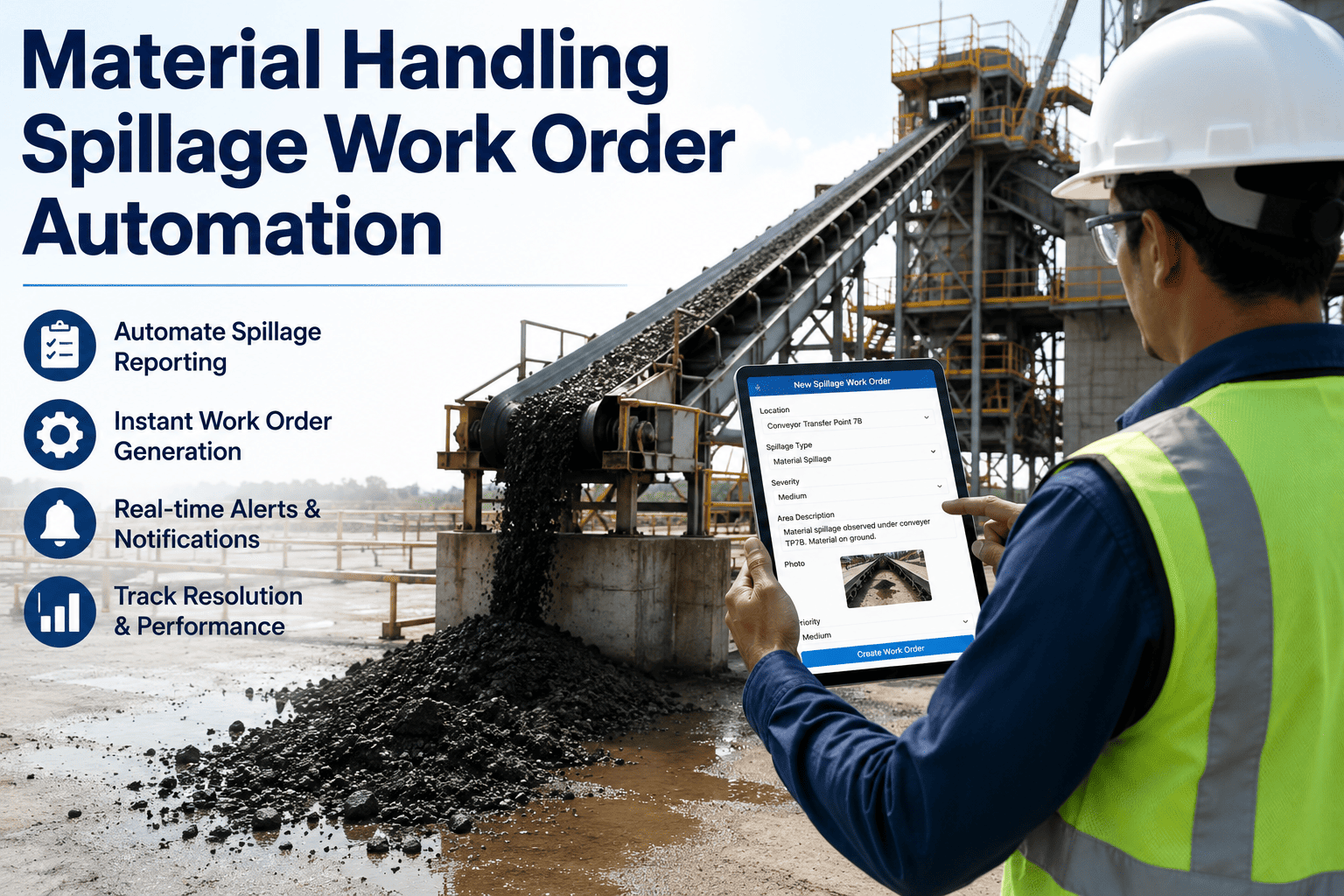
Belt carryback and conveyor spillage are among the most accepted forms of avoidable waste in cement plant operations — accepted because the fix seems routine, the individual incidents seem minor, and nobody has added up what they actually cost. A conveyor carrying 800 tonnes per hour with 0.5% carryback is losing 4 tonnes per hour to spillage accumulation under the belt return. Over a 20-day production run, that is 1,920 tonnes of material that required crushing, grinding, and conveying energy to produce but never reached the intended destination. Behind that material loss is a more expensive problem: the abrasion, misalignment, and structural damage caused by accumulated spillage under the belt that your housekeeping team is constantly cleaning but your maintenance team is not systematically addressing. OxMaint Preventive Maintenance builds a structured belt cleaner and skirt rubber PM program that reduces carryback, protects your conveyor structure, and eliminates the repetitive housekeeping cycle that everyone knows is a symptom but nobody has time to fix at the root.
The Full Cost of Neglected Belt Cleaners and Skirt Rubber
Most cement plant cost analyses track belt cleaner replacement as a maintenance expense. The actual cost of neglecting belt cleaners and skirt rubber runs across five categories that rarely appear in the same ledger — which is why the true ROI of a structured PM program is almost always underestimated.
Belt Cleaner and Skirt Rubber PM Checklist
This checklist covers the full conveyor spillage control system — primary and secondary belt cleaners, skirt rubber, and the support structures that determine how effective the cleaning components can be. All tasks are structured for OxMaint mobile execution with photo documentation.
Deploy This Checklist Across All Conveyors in OxMaint
OxMaint schedules belt cleaner and skirt rubber inspections automatically, tracks blade wear measurements per asset, and creates corrective work orders when wear limits are reached — replacing informal walkdowns with a systematic program that runs on every conveyor, every shift cycle.
Replacement Timing: PM Cost vs. Reactive Cost Comparison
| Component | PM Replacement Trigger | PM Replacement Cost | Run-to-Fail Cost | Interval Without OxMaint Tracking |
|---|---|---|---|---|
| Primary cleaner blade | Tip wear below 20mm minimum | $180–$450 (planned) | $4,200–$8,500 (belt damage + labor) | Replaced on complaint — often 4–8 wks late |
| Secondary cleaner segment | Segment wear to 15mm minimum | $60–$150 per segment (planned) | Belt marking and cover delamination — $2,000–$6,000 | Replaced after carryback visible — 2–6 wks late |
| Skirt rubber section | Thickness below 20mm or gap > 8mm | $90–$280 per section (planned) | $1,800–$4,500 spillage cleanup + structural inspection | Replaced after spillage housekeeping complaint — weeks to months late |
| Tensioner spring or cartridge | Calibrated force below 80% of specification | $120–$380 (planned) | $2,400–$6,800 accelerated blade wear through entire service period | Rarely replaced proactively — replaced only with blade |
| Skirt backing plate | Deformation > 5mm or fastener looseness | $200–$500 (planned at scheduled stop) | Repeated skirt gap adjustments — $800–$2,400 in labor over one year | Almost never replaced proactively — root cause missed repeatedly |
Build Your Conveyor PM Program in OxMaint
OxMaint works for any number of conveyor assets — from a single transfer point to a 60-conveyor plant network. Standardize your belt cleaner and skirt rubber PM across every asset and every shift team from one platform.
Frequently Asked Questions
How often should belt cleaner blades be inspected in a cement plant environment?
Belt cleaner blades at cement plant conveyor discharge points should receive a daily visual contact check and a weekly measurement inspection that records actual blade tip thickness against the minimum serviceable specification. The daily check catches tensioner loss or blade damage that develops rapidly, while the weekly measurement builds the wear rate trend that predicts replacement timing weeks in advance. In high-throughput applications — conveyors carrying cement clinker at more than 600 tonnes per hour — weekly measurement intervals may need to be reduced to three-day intervals during initial service life tracking, because wear rates vary significantly between applications and the first measurement series establishes the per-conveyor wear rate that calibrates all subsequent replacement planning. OxMaint PM scheduling allows different inspection frequencies per conveyor asset, so high-throughput conveyors can be tracked at higher frequency while lower-intensity assets follow the standard weekly schedule.
What is the correct tensioner setting for a primary belt cleaner, and how do we verify it?
The correct contact force for a primary belt cleaner blade is specified by the cleaner manufacturer as a force per unit width of belt — typically expressed in Newtons per meter (N/m) or pounds per foot (lb/ft) of belt width. This specification varies by blade material (polyurethane, tungsten carbide tipped, or ceramic) and by application (fine powder vs. wet material). Verification requires either a dedicated cleaner tensioner calibration gauge — available from most major belt cleaner suppliers — or a calibrated pull scale attached to the blade assembly to measure contact force directly. Do not rely on visual inspection alone for tensioner verification: a spring tensioner can appear correctly positioned while delivering significantly lower contact force than specified due to spring fatigue or incorrect installation. Record the verified force value in OxMaint at each weekly inspection to track tensioner calibration stability over time.
How does OxMaint track blade wear measurements and predict replacement dates?
OxMaint stores each blade thickness measurement against the specific asset (conveyor + cleaner position) and work order date, creating a time-series wear record for every blade in service. Using the recorded measurements, OxMaint calculates the current wear rate in millimeters per operating hour or per week and projects the date on which the blade will reach the minimum serviceable thickness. The maintenance planner sees a replacement due date for every belt cleaner blade in the plant — updated automatically with each new measurement — and can create a planned replacement work order weeks before the blade is actually worn out. This eliminates both premature replacement (discarding blade life based on a calendar interval) and late replacement (discovering wear after carryback has already increased). The spare blade inventory module in OxMaint connects replacement due dates to parts stock levels, generating a reorder trigger when inventory drops below the minimum required for the upcoming replacement schedule.
What is the difference between primary and secondary belt cleaners, and do we need both?
A primary belt cleaner is installed at the discharge pulley and contacts the belt on the carrying side at the point where the belt leaves the head pulley — it removes the bulk of the carryback material that would otherwise adhere to the return belt. A secondary cleaner is installed on the return belt after the primary cleaner position and operates at lower contact force to remove residual fine material that the primary cleaner missed. For most cement conveyor applications — particularly those handling clinker, raw meal, or finished cement — both cleaners are necessary because the fine particle size and adhesive properties of cement-industry materials mean the primary cleaner alone cannot achieve acceptable carryback levels. The combination of primary and secondary cleaning typically achieves 85–95% carryback reduction compared to the uncleaned condition. Plants relying on primary cleaners alone in fine cement conveying applications typically observe residual carryback levels 3–5x higher than a two-stage cleaning installation. The incremental cost of the secondary cleaner and its PM program is recovered within weeks in reduced spillage cleanup labor and material loss at most applications.
Can we use OxMaint to manage belt cleaner PM across all conveyors plant-wide, not just critical ones?
Yes, and this is one of the most significant advantages of a CMMS-based belt cleaner program over the typical approach of manually scheduling inspections on high-priority conveyors only. OxMaint allows you to register every conveyor in the plant as an asset, assign belt cleaner and skirt rubber PM schedules at the appropriate frequency for each one, and manage all inspection work orders from a single plant-level dashboard. Conveyors that are currently below the threshold for structured PM attention — because they carry lower throughput or are less visible — are frequently the source of chronic spillage problems that accumulate undetected because nobody is systematically inspecting them. OxMaint's asset management makes it practical to extend structured PM to the full conveyor population without proportionally increasing the maintenance planning burden, because work order generation and scheduling are automated once the asset and PM template are configured.