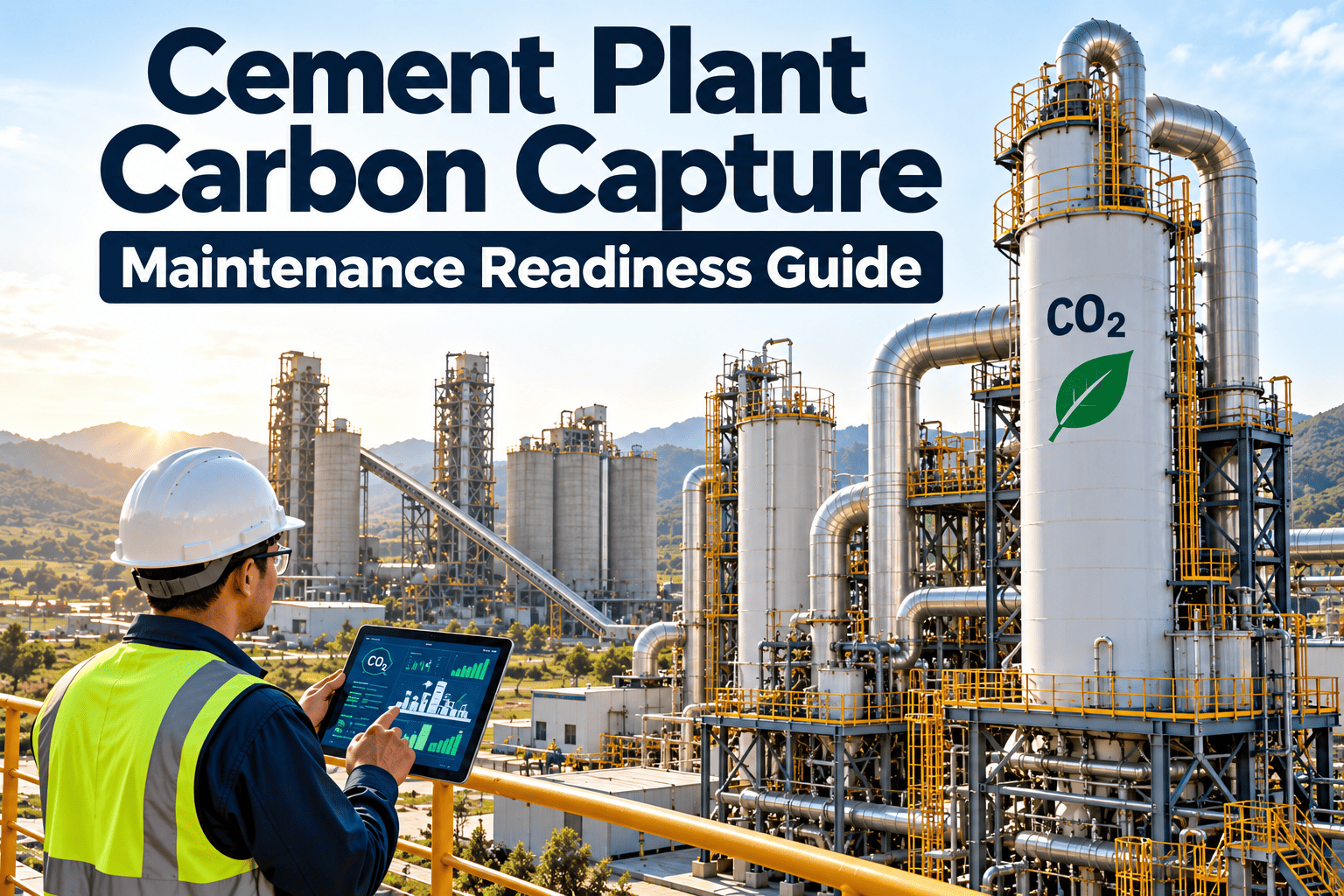
Carbon capture is moving from pilot projects to real investment decisions in the cement sector, driven by process emissions from limestone that efficiency alone cannot remove. A capture unit adds absorbers, solvent systems, compressors, heat exchangers and dense instrumentation to a plant that already runs hard on its kiln. Maintenance teams who prepare early avoid learning on live equipment under commercial pressure. This guide sets out what readiness means, which assets and records matter, and how a CMMS built for cement plants supports the transition.
Cement Plant Carbon Capture Maintenance Readiness Guide
Prepare asset registers, inspection plans, spares, skills and compliance records before a CCUS unit is connected to your kiln.
- Phase 1ScreeningDefine asset baseline
- Phase 2DesignMaintainability review
- Phase 3ConstructionRegister new assets
- Phase 4CommissioningTest and hand over
- Phase 5OperationRun, inspect, improve
Why Maintenance Readiness Cannot Wait for Commissioning
Capture is not a bolt-on that the existing team can absorb without preparation. It changes the plant's equipment mix, safety profile and reliability dependencies.
Without early preparation
- Asset data arrives late and incomplete from contractors
- Spares are discovered missing after the first failure
- Operators and technicians learn unfamiliar equipment during start-up
- Inspection and test records are scattered across vendors
- Kiln and capture unit schedules conflict
With a readiness plan
- Assets are registered with the right hierarchy at handover
- Critical spares are identified during design
- Training is completed before first operation
- Records and certificates sit against each asset
- Maintenance windows are planned across both systems
What a Capture Unit Adds to Your Asset Base
Technology choices differ, but post-combustion systems using chemical solvents are among the most discussed for cement. The list below is a general guide. Your vendor design will define the final scope.
| System area | Typical equipment | Main maintenance concern |
|---|---|---|
| Flue gas preparation | Gas conditioning, quench or cooling, blowers, filters | Fouling, dust carryover, fan reliability, corrosion |
| Absorption | Absorber columns, packing, distributors, pumps | Packing fouling, flow distribution, corrosion, solvent degradation |
| Solvent regeneration | Stripper, reboiler, heat exchangers, steam supply | Thermal stress, scaling, fouling, steam availability |
| Solvent management | Storage, filtration, reclaiming, dosing | Contamination, chemical handling, sampling discipline |
| CO2 conditioning | Compressors, coolers, dehydration, knockout vessels | Rotating equipment health, moisture control, seal condition |
| Utilities | Cooling water, steam, power distribution, instrument air | Supply reliability and shared dependencies with the plant |
| Instrumentation and analyzers | Gas analyzers, flow meters, safety instrumented systems | Calibration, proof testing, data integrity |
The Kiln and Capture Interface
The capture unit depends on the kiln for flue gas and often on the plant for steam, power and water. A problem on one side can propagate to the other.
Kiln and preheater
Flue gas flow, temperature and dust load change with kiln operation.
Capture unit
Needs stable gas quality, steam and power to hold capture rate.
Utilities and WHR
Steam and power sharing creates new dependencies and trade-offs.
Questions to settle before design freezes
- What happens to the kiln if the capture unit trips?
- Can the capture unit be bypassed safely, and who authorizes it?
- Which planned stops can be aligned between kiln and capture?
- Where does steam come from, and what is the effect on other users?
Start Building Your Readiness Records Today
Set up your current asset base, inspection routines and spares now, so adding new systems later is an extension rather than a restart.
Readiness Scorecard by Phase
- 1
Screening and concept
- Current asset register is accurate for kiln, filters and fans
- Failure history for flue gas path equipment is documented
- Maintenance resource constraints are understood
- 2
Design and engineering
- Maintainability reviewed for access, isolation and lifting
- Critical spares list requested from vendors
- Inspection and test requirements captured in design documents
- 3
Construction and handover
- Asset tags and data sheets follow your naming convention
- Manuals, certificates and test records are collected and stored
- Preventive tasks drafted from vendor recommendations
- 4
Commissioning
- Teams trained on safety, isolation and basic troubleshooting
- Baseline readings recorded for rotating and static equipment
- Punch list items tracked as work orders
- 5
Operation
- Inspection routines running with clear ownership
- Failure and solvent data reviewed regularly
- Intervals adjusted from real condition history
Capture Routes and What They Mean for Maintenance
Several routes are being developed for cement. Each shifts the maintenance burden to different equipment.
| Route | Basic idea | Maintenance implication |
|---|---|---|
| Post-combustion solvent capture | Flue gas is treated downstream of the kiln system to absorb CO2 into a solvent | Strong focus on solvent quality, corrosion, heat exchangers and steam supply |
| Oxyfuel combustion | Kiln burns fuel with oxygen-rich gas so exhaust is richer in CO2 | Oxygen supply, air separation, kiln sealing, gas recirculation and burner systems |
| Calcium looping | Solid sorbent cycles between capture and regeneration stages | Solids handling, cyclones, abrasion, high-temperature refractory and fans |
| Direct separation designs | Process modifications separate process CO2 from combustion gases | Modified kiln equipment, tighter process control and new sealing needs |
Stay vendor-neutral early
Technology selection belongs to engineering and project teams. Maintenance should ask for the same readiness information whichever route is chosen: equipment lists, wear points, test requirements and spares.
Solvent Quality Workflow
For solvent-based systems, chemistry is a maintenance topic. Poor solvent condition damages equipment and reduces performance.
- 1
Sample on schedule
Take samples at defined points and times, with clear labels and chain of custody for results.
- 2
Compare with limits
Check degradation products, contaminants and strength against vendor and site limits.
- 3
Raise an action
Create a work order for filtration, reclaiming, dosing adjustments or inspection when limits are crossed.
- 4
Inspect the effect
Check packing, exchangers and pumps for fouling or corrosion linked to the chemistry change.
- 5
Record and learn
Store results and actions against the equipment so patterns across months become visible.
Compressor and Rotating Equipment Readiness
Baseline and monitoring
- Record vibration, bearing temperature and seal condition at commissioning
- Define alarm limits with the vendor
- Decide which signals are monitored online and which on routes
- Link abnormal readings to a standard work order
Support systems
- Lube oil quality and filter changes
- Cooling water quality and flow
- Instrument air supply and dryers
- Protection system testing and records
Plan vendor support in advance
Specialist compression and rotating machinery service often has long lead times. Agree response commitments, spare part support and overhaul timing early, and store the agreements where planners can find them.
Coordinating Shutdowns Across Kiln and Capture
A kiln stop affects the capture unit, and a capture trip can affect kiln operation. Shared planning prevents duplicate downtime.
- Align the calendarPlace capture inspection and overhaul tasks inside kiln stops wherever safe and practical.
- Sequence isolationAgree who isolates what, in which order, and how gas and steam are made safe before entry.
- Prepare long-lead itemsOrder packing, tubes, seals and other items early so the stop is not extended by waiting for parts.
- Review after the stopRecord what was found, what was repaired and which tasks should move to a different interval.
Documentation That Auditors and Insurers Ask For
Equipment dossiers
Data sheets, drawings, material certificates and manuals stored with each asset.
Inspection history
Dates, findings, measurements and the name of the person who carried out each check.
Change records
Any modification to design, settings or materials, with approvals and updated drawings.
Calibration evidence
Certificates and as-found results for analyzers, flow meters and safety instruments.
Incident and repair records
Failures, root causes and corrective actions linked to the affected equipment.
Training and competency
Records showing who is authorized to work on each system.
Reliability Risks to Plan Around
Solvent degradation
Impurities and heat can degrade solvent and raise corrosion and fouling risk. Sampling routines and clear action limits are essential.
Corrosion
Material choice, temperature and solvent condition all affect wall thinning. Plan thickness measurement at known susceptible points.
Heat exchanger fouling
Reduced heat transfer raises steam demand. Track approach temperatures and cleaning performance.
Compressor reliability
Compression trains are critical and specialized. Monitor vibration, seals, lubrication and surge protection with discipline.
Instrument drift
Capture performance and emissions reporting depend on analyzers and flow meters that need a strict calibration plan.
Chemical safety
Handling solvent and its degradation products requires controlled procedures, protective equipment and clean records.
Why Emissions Records Now Matter to Maintenance
Carbon accounting and border carbon rules are turning emissions data into a commercial and compliance topic, not only an environmental one.
- Border carbon pricingThe EU Carbon Border Adjustment Mechanism moved beyond its transitional reporting period, and cement is one of the covered sectors. Importers need credible embedded emissions data from producers.
- Verification expectationsMeasurement systems must be calibrated, documented and defensible. Maintenance owns much of that evidence.
- Capture performance claimsStored or captured volumes depend on reliable flow and composition measurement, with traceable calibration records.
- Audit readinessInspection dates, test results, repairs and approvals should be retrievable by asset without a manual search.
Check current rules for your market
Requirements differ by country and change over time. Confirm the current regulations that apply to your plant and exported products with your compliance team.
Skills and Training Plan
Mechanical and process
- Column, packing and distributor inspection
- Heat exchanger cleaning and tube testing
- Pump and compressor maintenance basics
- Pressure equipment inspection awareness
Electrical and instrumentation
- Analyzer calibration and sample system care
- Safety instrumented function proof testing
- Variable speed drive troubleshooting
- Control valve and transmitter maintenance
Safety and operations
Cover chemical handling, confined space entry, emergency response and isolation. Record each person's competency so task assignment matches qualification.
KPIs to Define Before Start-Up
Capture unit availability
Time the unit is available to treat flue gas, split by planned and forced outage.
Kiln impact hours
Kiln time lost or constrained because of capture unit faults.
Planned work share
Proportion of maintenance hours on planned rather than emergency work.
Calibration compliance
Analyzers and meters calibrated within their due dates.
Critical spare coverage
Share of critical items with spares on site or agreed supply.
How Oxmaint Supports CCUS Readiness
Oxmaint is a maintenance management system. It does not control the capture process, but it organizes the work, records and assets around it.
Asset register and hierarchy
Add new capture assets under clear parent systems, with documents and tags linked to each one.
Preventive maintenance
Convert vendor recommendations into recurring tasks with checklists and assigned owners.
Inspections and calibration
Schedule analyzer calibration, thickness checks and safety tests, and keep the results with the asset.
Work orders and punch lists
Track commissioning defects and later faults through to closure with full history.
Inventory
Manage critical spares, solvent-related consumables and minimum stock levels.
Reporting and dashboards
Review backlog, downtime causes and compliance status in one place.
A 90-Day Preparation Plan
Days 1 to 30
Clean up the current asset register, review failure history for flue gas path equipment and set naming standards for new assets.
Days 31 to 60
Draft inspection templates, spares criteria and competency requirements. Ask vendors for data and maintenance requirements in a usable format.
Days 61 to 90
Pilot the templates on existing similar equipment such as large fans, pumps and heat exchangers, and refine them from technician feedback.
Common Readiness Gaps
- Receiving contractor documents as unstructured files with no asset link
- Leaving the maintenance team out of design reviews
- Assuming existing kiln spares policies will fit new equipment
- Delaying training until commissioning pressure peaks
- Ignoring calibration and proof test requirements in early plans
- Overlooking how steam and power sharing affects other plant users
Questions for your steering group
- Who owns maintenance planning for the capture unit once it is handed over?
- How many additional technicians and specialists will the new equipment need?
- Which spares must be purchased before first operation rather than after?
- Are existing permit, isolation and contractor procedures suitable for solvent and high-pressure CO2 systems?
- How will performance and maintenance data be shared between operations, quality and sustainability teams?
Answering these early exposes resourcing and procedure gaps while there is still time and budget to close them, rather than during start-up when every delay carries a commercial cost.
Treat readiness as a project, not a document
Assign an owner, set milestones and review progress with project and operations leaders. Maintenance readiness is a deliverable, just like civil works. Review it at every project gate, report gaps openly, and make sure the people who will inherit the equipment are involved in decisions about access, spares, instrumentation and inspection points while changes are still inexpensive to make.
Frequently Asked Questions
What does maintenance readiness mean for carbon capture?
It means asset data, inspection plans, spares, skills and records are ready before the unit starts operating.
Which capture equipment is most critical to maintain?
Compressors, absorption and regeneration equipment, heat exchangers and analyzers usually deserve the closest attention.
Can Oxmaint run the capture process?
No. It manages maintenance work and records. Book a demo to see the workflows.
When should we start preparing?
As early as design. Sign up for Oxmaint to organize your current assets first.
How does CBAM relate to maintenance?
Credible emissions data relies on calibrated, well-maintained measurement equipment and clear records.
Be Maintenance-Ready Before the First Tonne Is Captured
Build the asset records, routines and compliance evidence your team will need when carbon capture joins the plant.