Cement plants are among the most capital-intensive and equipment-dependent operations in heavy industry. A single unplanned kiln stoppage can cost $50,000–$150,000 per day in lost production. Yet most plants still operate in a reactive maintenance culture — fixing breakdowns as they happen rather than systematically eliminating the root causes of equipment failure.
Total Productive Maintenance (TPM) offers a proven, structured methodology to transform cement plant reliability from firefighting to world-class. This guide maps the 8 TPM pillars directly to cement plant operations, with practical implementation steps and digital CMMS integration. Launch your TPM program today.
Total Productive Maintenance (TPM) in Cement Plants
Achieving world-class OEE through the 8 pillars of TPM — mapped to kiln lines, mills, and clinker systems with digital CMMS tracking
The cement industry faces a unique convergence of pressures: aging equipment, rising energy costs, tighter emission standards, and the demand for higher throughput. Traditional maintenance strategies — run-to-failure and calendar-based PM — leave enormous value on the table. TPM closes the gap by engaging every level of the organization in eliminating the "Six Big Losses" that destroy equipment effectiveness. Assess your plant's TPM readiness.
55%
Avg Cement OEE
Industry average — world-class target is 85%+
$8M
Annual Loss / Plant
From unplanned downtime in a typical 5,000 TPD plant
40%
Maintenance Reactive
Percentage of work orders that are unplanned/emergency
85%+
TPM OEE Target
Achievable within 2–3 years of disciplined TPM execution
The TPM Promise: TPM isn't just a maintenance program — it's a production system. By engaging operators in daily equipment care (Autonomous Maintenance), systematically attacking chronic losses (Focused Improvement), and building a culture of zero breakdowns, zero defects, and zero accidents, cement plants routinely achieve 20–30 point OEE improvements within 24 months.
Each TPM pillar addresses a specific dimension of equipment and organizational effectiveness. Below is how each pillar applies specifically to cement plant operations, with measurable KPIs for tracking progress. See TPM pillar tracking in OxMaint.
Cement Application
Kiln operators perform daily inspections: checking refractory condition indicators, shell temperatures, tire alignment, and bearing lubrication. Mill operators clean classifier vanes and monitor vibration readings. Operators own basic equipment care.
KPI: % of AM checklists completed on time | Target: 95%+
Cement Application
Cross-functional teams attack chronic losses — kiln coating buildup, cyclone blockages, mill bearing failures, cooler grate plate wear. Uses root cause analysis (5 Why, fishbone) to eliminate recurring breakdowns permanently.
KPI: # of Kaizen projects completed / quarter | OEE lift per project
Cement Application
Shift from time-based PM to condition-based: vibration monitoring on mill bearings, thermography on electrical panels, oil analysis on gearboxes. Schedule shutdowns based on data, not calendars. Optimize refractory replacement timing.
KPI: Planned vs. Unplanned ratio | Target: 85:15 or better
Cement Application
Link equipment conditions to product quality: kiln temperature profiles affect clinker free lime, mill fineness affects cement strength. Set equipment condition standards that prevent quality defects at the source.
KPI: Quality defect rate linked to equipment | Free lime variance
Cement Application
Feed maintenance learnings into new equipment design and procurement. When specifying a new cooler or VRM, incorporate lessons from predecessor failures — accessibility for maintenance, wear part life, sensor mounting points.
KPI: Time-to-stable-operation for new equipment | Warranty claim rate
Cement Application
Build multi-skilled operators who understand process AND equipment. Train kiln operators on refractory basics, mill operators on bearing lubrication theory, electricians on VFD diagnostics. Close the skill gap created by workforce aging.
KPI: Skill matrix coverage % | Training hours per employee/year
Cement Application
Zero accidents through equipment safety standards: guarding on conveyors, lockout/tagout procedures for mills, dust exposure controls at transfer points, confined space protocols for silos and preheater cyclones.
KPI: Zero lost-time injuries | Near-miss reporting rate
Cement Application
Extend TPM principles to support functions: streamline spare parts procurement, eliminate waste in work order processing, reduce stores lead times. Digitize maintenance workflows to cut administrative overhead by 50%+.
KPI: Work order cycle time | Spare parts availability rate
Track all 8 TPM pillars digitally. OxMaint CMMS provides built-in TPM dashboards with pillar-level KPI tracking, AM checklist management, and Kaizen project workflows — purpose-built for cement plant operations.
TPM targets the elimination of Six Big Losses that erode OEE. In cement plants, these losses have specific, identifiable causes tied to kiln lines, grinding circuits, and material handling systems. Start tracking your losses with OxMaint.
Availability Loss
Unplanned stops due to component failure — kiln drive trips, mill bearing seizures, conveyor belt tears, fan motor burnouts.
Cement Impact: Kiln breakdown = $50K–$150K/day. Raw mill failure can starve kiln feed within 4 hours, forcing a costly kiln cool-down.
Availability Loss
Time lost during changeovers, planned shutdowns, and restarts — refractory replacement, grinding media charging, separator adjustments.
Cement Impact: Annual kiln shutdown for refractory typically takes 15–25 days. Each day saved = $100K+ in additional production.
Performance Loss
Brief interruptions under 10 minutes — cyclone blockages, conveyor tripping, feeder jams, air slide stoppages. Often unreported but cumulatively massive.
Cement Impact: 15–20 minor stops/day × 5 min each = 1.5+ hours of hidden production loss daily, invisible without digital tracking.
Performance Loss
Running equipment below rated capacity — kiln feed rate reduction due to coating buildup, mill derating due to worn liners, cooler speed reduction due to grate damage.
Cement Impact: A 10% kiln feed reduction on a 5,000 TPD line = 500 tonnes/day lost output = $15K–$25K/day revenue loss.
Quality Loss
Off-spec production requiring rework — high free lime clinker, cement with wrong fineness, incorrect setting time. Must be blended or reground.
Cement Impact: Off-spec clinker requires blending at 3:1 ratio with good clinker, reducing effective capacity by 25% until the batch is consumed.
Quality Loss
Reduced yield during startup — kiln warm-up produces sub-standard clinker, mill start-up produces coarse product until stable state is reached.
Cement Impact: Kiln startup produces 8–12 hours of off-spec clinker. Each unplanned restart multiplies this loss. Stable continuous operation is the goal.
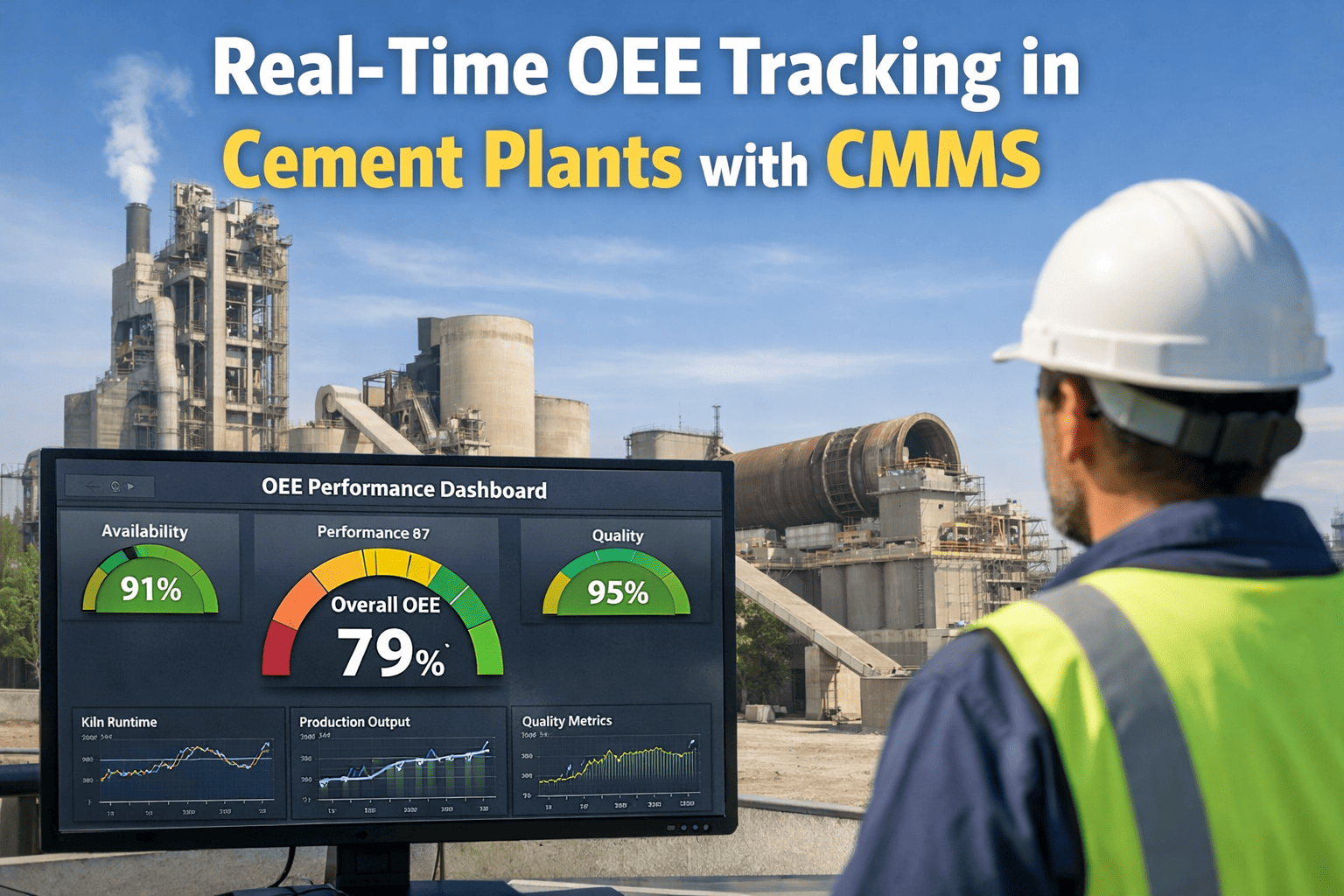
Overall Equipment Effectiveness (OEE) is the single most important metric in TPM. It combines availability, performance, and quality into one number that reveals the true productive capacity of your equipment. Automate your OEE calculations with OxMaint.
Availability (Target: 90%+)
Formula: (Planned Production Time – Downtime) / Planned Production Time
Cement Drivers: Kiln uptime is the master constraint. Track planned stops (refractory, media charge) separately from unplanned stops (breakdowns, blockages). Goal: minimize unplanned stops to <3% of available time.
Performance (Target: 95%+)
Formula: (Actual Output / Theoretical Max Output) during running time
Cement Drivers: Kiln feed rate vs. design rate. Mill throughput vs. rated capacity. Measure against nameplate — not the "comfortable" operating rate. Captures speed losses and minor stops.
Quality (Target: 99%+)
Formula: (Good Product / Total Product) produced
Cement Drivers: % of clinker meeting free lime spec. % of cement meeting fineness & strength standards. Includes startup waste and off-spec production requiring rework or blending.
OEE Benchmarks: Where Does Your Plant Stand?
World-Class Cement Plant
Availability: 92% × Performance: 96% × Quality: 99.2%
OEE: 87.5% — Benchmark Leader
Industry Average Plant
Availability: 78% × Performance: 82% × Quality: 96%
OEE: 61.4% — Significant Improvement Potential
Reactive Maintenance Plant
Availability: 65% × Performance: 75% × Quality: 92%
OEE: 44.9% — Urgent TPM Intervention Needed
Autonomous Maintenance (AM) is the foundation of TPM. It transfers basic equipment care from maintenance technicians to machine operators — the people who see, hear, and feel the equipment every shift. In cement plants, this means operators become the first line of defense against deterioration. Digitize your AM checklists with OxMaint.
Cement-specific AM checklists ready to deploy. OxMaint includes pre-built Autonomous Maintenance templates for kiln lines, grinding circuits, packing plants, and material handling — customizable to your equipment fleet.
The transformation from a reactive maintenance culture to a mature TPM operation is dramatic — and measurable. Below is a typical comparison for a 5,000 TPD integrated cement plant over 24 months of TPM implementation. Get your plant's transformation roadmap.
OEE
52–60%. Frequent breakdowns mask true capacity. No systematic tracking of losses.
OEE
78–85%+. All six losses tracked and systematically reduced. Real-time dashboards.
Maintenance Culture
"Fix when it breaks." Operators call maintenance for everything. Blame culture between departments.
Maintenance Culture
Operators own basic care. Cross-functional Kaizen teams. Shared OEE targets. Zero-breakdown mindset.
Kiln Reliability
3–5 unplanned stops/month. Average 280 run days/year. Refractory life unpredictable.
Kiln Reliability
0–1 unplanned stop/month. 330+ run days/year. Refractory life extended 15–20% through monitoring.
Maintenance Spend
High emergency repair costs. Excessive spare parts inventory "just in case." Overtime-heavy.
Maintenance Spend
30–40% reduction in total maintenance cost. Optimized spare parts. Planned work during shifts.
Annual Production Loss (5,000 TPD):
$8M+
+ Safety incidents + Quality rework
→
TPM Value Recovery:
$5.5M/yr
Recovered capacity + Reduced costs + Fewer incidents
TPM without digital tracking is TPM without accountability. A CMMS transforms TPM from wall charts and paper checklists into a live, auditable system with real-time KPIs. Here's how OxMaint integrates with each TPM activity. See the TPM-CMMS integration in action.
Function: Operators complete shift-start AM checklists on mobile devices with photo evidence and abnormality flagging.
CMMS Capabilities:
□ Equipment-specific checklists with visual standards (photos of "good" vs. "bad")
□ Abnormality detection auto-generates work orders routed to maintenance
□ Completion rates tracked by shift, area, and operator — dashboard visibility
□ Historical trend analysis reveals deterioration patterns before failure
Function: Automatic OEE calculation from downtime logs, production data, and quality records with drill-down into loss categories.
CMMS Capabilities:
□ Real-time OEE dashboard by equipment, line, and plant level
□ Pareto analysis of top losses — automatically identifies biggest improvement opportunities
□ Trend tracking: weekly/monthly OEE progression with target overlays
□ Breakdown classification by failure mode for focused improvement targeting
Function: Manage focused improvement projects from problem identification through root cause analysis to countermeasure verification.
CMMS Capabilities:
□ Kaizen project register with team assignments, timelines, and status tracking
□ Root cause analysis tools (5 Why templates) linked to work order history
□ Before/after OEE comparison for each completed Kaizen
□ Best practice library: successful countermeasures shared across plant areas
TPM is a 3–5 year journey to maturity, but measurable results begin within months. Start with a model area, prove results, then expand. Get your customized TPM roadmap.
Launch: Management commitment declaration. TPM coordinator appointed. Select model area (typically kiln line or cement mill). Baseline OEE measurement. Deploy CMMS. Initial 5S and deep cleaning event.
Deliverable: Baseline OEE + First AM checklists deployed
Success Metric: Model area OEE baseline established, 100% AM compliance
Expand: Activate AM, Focused Improvement, and Planned Maintenance pillars in model area. Launch first Kaizen teams targeting top 3 losses. Transition from time-based to condition-based PM. Operator skill training begins.
Deliverable: First Kaizen results + Planned/unplanned ratio improvement
Success Metric: Model area OEE +10 points, unplanned downtime –30%
Scale: Replicate model area success across all production areas. Activate all 8 pillars. Integrate quality maintenance with process control. Launch TPM awards and recognition program. Target autonomous team maturity.
Deliverable: Full TPM ecosystem across plant
Success Metric: Plant OEE 80%+, zero breakdowns culture.
Begin your TPM journey
Sustain & Innovate: Pursue TPM Excellence Award standards. Implement predictive maintenance AI. Benchmark against global leaders. Integrate TPM with lean manufacturing and Six Sigma. Continuous improvement embedded in culture.
Deliverable: Sustained world-class performance
Success Metric: OEE 85%+, zero lost-time injuries, industry benchmark leader
Executive Challenge
Plant OEE averaged 54% with 8–10 unplanned kiln stops per month. Maintenance was 70% reactive. The raw mill suffered chronic bearing failures (6 per year at $120K each). Operator-maintenance relations were adversarial — operators did zero equipment care beyond pushing buttons. Annual production was 15% below nameplate capacity.
TPM Solution Implemented
Deployed OxMaint CMMS with TPM module across all production areas • Established kiln line as model area with dedicated TPM coordinator • Launched Autonomous Maintenance with digital checklists for 85 operators • Formed 6 Kaizen teams targeting top chronic losses • Implemented condition monitoring (vibration, thermography, oil analysis) on 45 critical assets • Installed real-time OEE dashboards visible on plant floor screens • Created multi-skill training program with operator certification levels
Results (24 Months)
Plant OEE:
54% → 82%
28-point improvement
Kiln Stops:
10 → 1/mo
90% unplanned stop reduction
Maintenance Cost:
-38%
$14M → $8.7M annually
Additional Output:
+420K TPY
$12.6M additional revenue
"Two years ago, our operators wouldn't touch a grease gun. Today, they're catching bearing defects before our vibration analysts do. The shift from 'your machine' to 'my machine' is the real TPM transformation. The OEE numbers followed naturally. OxMaint gave us the digital backbone to make it stick — without the system, we'd still be doing TPM on paper and losing momentum." — Plant Manager
TPM in cement plants isn't a maintenance initiative — it's a production strategy. The plants that achieve world-class OEE don't have magic equipment; they have disciplined systems, engaged operators, and relentless focus on eliminating losses. Every percentage point of OEE improvement translates directly to tonnes produced, costs reduced, and margins protected.
The journey starts with a single model area, a committed team, and a digital platform to track progress. Don't let reactive maintenance culture consume your capacity and your budget. Schedule your TPM readiness assessment or launch your digital TPM program today.
OxMaint CMMS delivers the complete digital TPM platform — Autonomous Maintenance checklists, real-time OEE dashboards, Kaizen project tracking, and predictive analytics — built for the demands of cement plant operations.
38%
Maint. Cost Reduction
For Plant Managers & Reliability Leaders: Free OEE baseline assessment + TPM implementation roadmap included with briefing
-in-cement-plants.png)