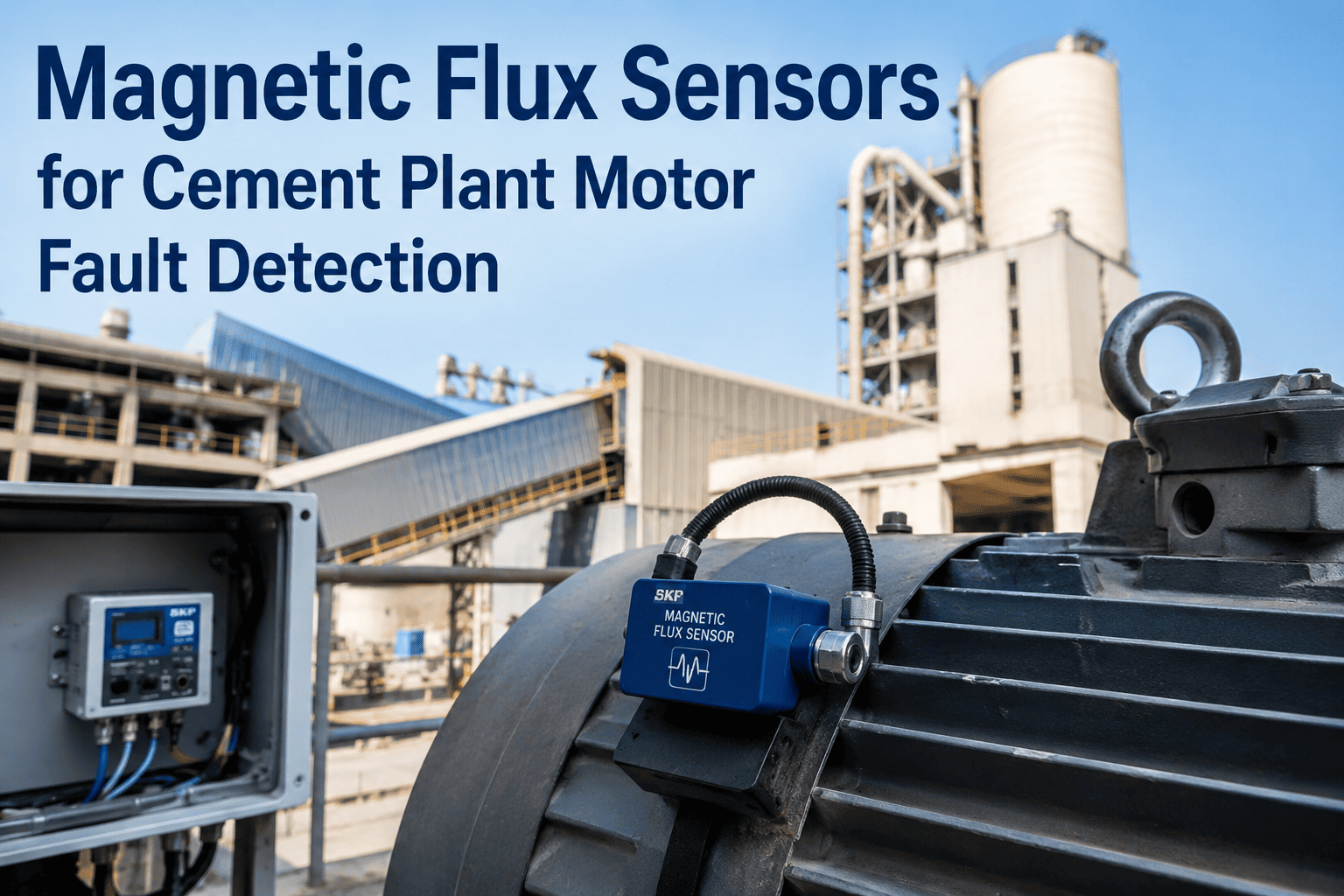
Electric motors drive every critical process in a cement plant — the kiln rotation, the mill grinding circuits, the preheater fans, the clinker conveyors — and motor failure in any of these systems triggers costly unplanned stops that ripple across the entire production chain. Traditionally, predictive motor health has required vibration sensors mounted on individual motor housings, making full-fleet coverage economically impractical for a plant operating 1,000 or more motors. Motor Current Signature Analysis changes this entirely: by analysing the electrical current already flowing through your Motor Control Centre, MCSA-integrated CMMS platforms detect broken rotor bars, bearing degradation, air-gap eccentricity, and shaft misalignment weeks before failure — without touching a single motor. AI models trained on cement-specific failure libraries classify fault type, severity, and degradation rate, then auto-generate work orders in OxMaint's maintenance workflow with repair procedures, parts requirements, and optimal scheduling windows already populated. The result is predictive motor coverage across your entire fleet at a fraction of the cost and deployment complexity of sensor-based approaches.
82% of Cement Plant Motor Failures Are Detected Only After the Motor Has Already Stopped. MCSA Changes That.
Every induction motor in your cement plant — from the 2,500 kW kiln drive to the 15 kW conveyor motor — generates a continuous electrical current signature that encodes the mechanical health of the machine in real time. Broken rotor bars produce specific sideband frequencies. Bearing races generate defect frequency patterns. Air-gap eccentricity creates characteristic harmonic signatures. This diagnostic data is already present in your MCC — it just requires AI-powered Motor Current Signature Analysis to decode it into actionable maintenance intelligence. OxMaint integrates AI-MCSA diagnostics directly into CMMS workflows — so a fault detected in your kiln's ID fan motor at Stage 1 severity automatically becomes a scheduled work order with the right technician, right parts, and right repair window assigned before the fault progresses to a production-stopping failure.
What Is Motor Current Signature Analysis (MCSA)?
MCSA is a non-invasive diagnostic technique that analyses the electrical current drawn by an induction motor to detect developing mechanical and electrical faults — without stopping the machine, without adding sensors, and without disrupting production.
Every mechanical fault in a motor — a cracked rotor bar, a spalling bearing race, shaft misalignment — disturbs the air gap flux between rotor and stator. This disturbance appears as specific frequency components in the motor's stator current. MCSA captures the current waveform from the Motor Control Centre (MCC), applies FFT frequency analysis, and identifies the fault-specific frequencies that indicate developing problems — weeks or months before the motor would fail.
AI-powered MCSA platforms go further: machine learning models trained on cement-plant-specific motor failure signatures classify fault severity, track degradation rate, and predict remaining useful life — delivering a maintenance decision, not just a data point.
What MCSA Detects in Cement Plant Motors — and How Early
Each fault type produces a distinct frequency signature in the motor's current spectrum. AI models trained on cement-specific failure libraries identify these signatures at Stage 1 severity — when the fault is weeks or months from causing a production stop.
See Every Motor Fault Before It Stops Your Kiln
OxMaint integrates AI-powered MCSA diagnostics directly into your CMMS workflow — fault detected, work order created, repair scheduled, all in one system.
MCSA vs. Vibration Monitoring: Why Cement Plants Need Both — and Can Start with MCSA
Vibration monitoring is proven and effective for accessible motors. But in a cement plant, the economics and accessibility constraints of 1,000+ motor fleets make vibration sensor coverage impractical at scale. MCSA closes the gap.
| Comparison Factor | Vibration Monitoring | MCSA (AI-Powered) |
|---|---|---|
| Sensing Cost Per Motor | $200–$800 per sensor + installation | Near-zero — uses existing MCC current data |
| Fleet Coverage (1,000 motors) | $200,000–$800,000 sensor investment | Full fleet coverage from MCC integration |
| Installation Access Required | Physical sensor mounting on motor housing — production stop sometimes required | Current transducer at MCC — no machine access |
| Performance Under Variable Load | Variable load creates false vibration signals in cement mill circuits | Load-compensated analysis — accurate under variable conditions |
| Broken Rotor Bar Detection | Limited — vibration signature appears only at late stage | Direct electrical signature — detects weeks earlier |
| Winding & Electrical Fault Detection | Cannot detect electrical faults | Direct electrical fault visibility |
| Best For | Critical motors — kiln main drive, primary fans | Fleet-wide coverage — all 1,000+ motors |
MCSA + OxMaint CMMS: From Fault Signal to Completed Repair
AI-powered MCSA delivers its full value only when fault detections connect automatically to maintenance workflows. OxMaint closes the loop from detection to documented repair in one system.
What Cement Plants Achieve with AI-MCSA + CMMS Integration
Priority MCSA Targets in a Cement Plant
Not all motors carry equal production risk. MCSA deployment in cement plants should be staged by consequence — highest downtime cost first, full fleet second.
| Motor / System | Typical Motor Size | Downtime Consequence | Primary MCSA Faults | MCSA Priority |
|---|---|---|---|---|
| Kiln Drive Motor | 400–2,500 kW | Full plant stop — $18,000–$45,000/hr | Rotor bar, eccentricity, bearing | P1 — Immediate |
| VRM/Ball Mill Drive | 1,000–5,000 kW | Mill circuit stop — 8–24 hrs recovery | Bearing degradation, rotor bar, misalignment | P1 — Immediate |
| Preheater & Kiln ID Fan | 200–1,500 kW | Kiln stop triggered — refractory thermal cycling | Bearing, eccentricity, phase imbalance | P2 — Month 1–3 |
| Raw Mill & Coal Mill Fan | 75–400 kW | Circuit stop — 4–12 hrs | Bearing degradation, misalignment | P2 — Month 1–3 |
| Clinker Conveyor Drives | 15–150 kW | Clinker backup — 2–6 hrs | Bearing, rotor bar, misalignment | P3 — Fleet Coverage |
| Compressed Air & Auxiliary | 5–75 kW | Partial system impact — redundancy available | Bearing degradation, phase imbalance | P3 — Fleet Coverage |
Start Monitoring Your Kiln Drive Motor This Week
OxMaint's MCSA integration deploys from MCC data — no machine access, no sensor installation, no production interruption. First motor health reports available within days of connection.
Frequently Asked Questions
Your Motor Fleet Is Already Generating the Diagnostic Data. You Just Need the AI to Read It.
OxMaint's MCSA integration gives cement plant maintenance teams full-fleet predictive motor health — from MCC current data already available in your plant — with work orders auto-generated and repair history permanently recorded.