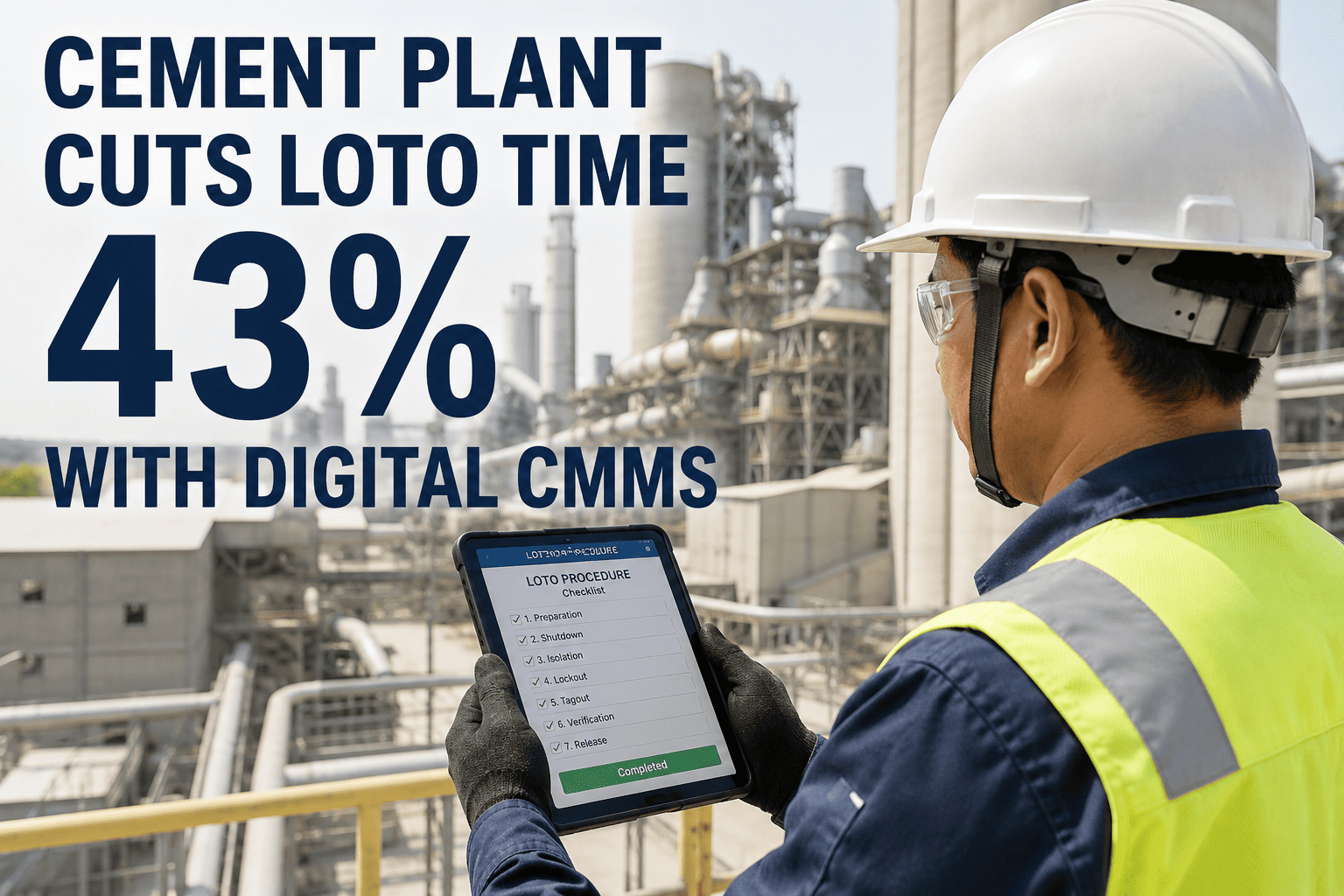
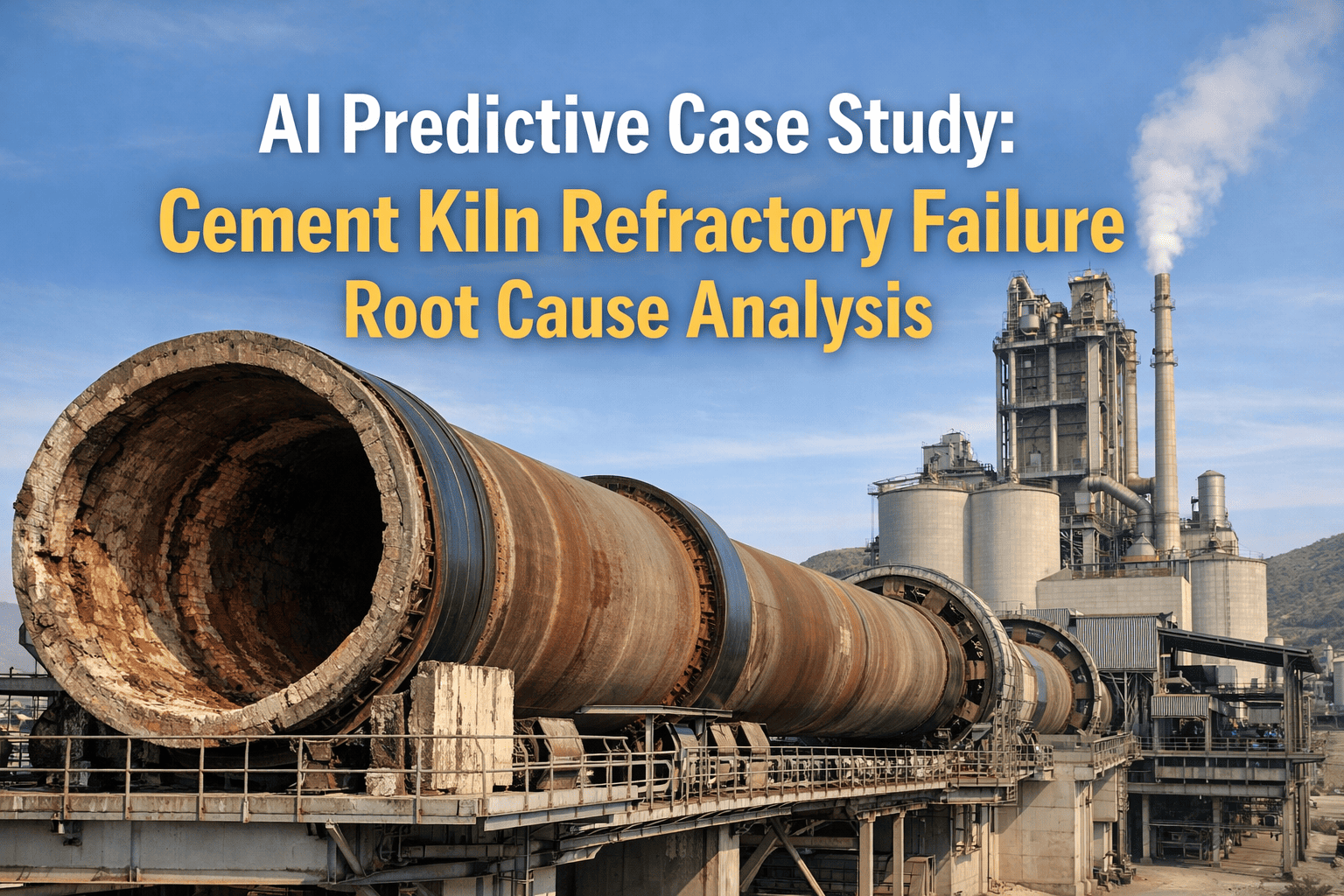
A top-10 Indian cement producer running three kilns across two plants was spending ₹2.4 crore per unplanned kiln stop — parts at spot pricing, overtime labor, and clinker shortfall penalties combined. With six unplanned stops in the 18 months before deployment, the maintenance leadership case for predictive maintenance was already built. The question was execution: connect existing vibration and temperature sensors to a CMMS that could convert readings into work orders before failures occurred. Book a demo to see how Oxmaint connects IoT sensor data to predictive work orders for your plant assets.
ProducerTop-10 Indian cement group, 3 kilns, 2 plants
Problem6 unplanned kiln stops in 18 months — ₹14.4 crore in direct costs
SolutionIoT sensor integration + Oxmaint predictive work order engine
Result₹8 crore saved in Year 1 — zero unplanned kiln stops in 11 months
₹8 Cr
saved in Year 1 across both plants
11 mo
zero unplanned kiln stops after go-live
3.1x
MTBF improvement on trunnion bearing assets within 8 months
5 wks
from deployment start to first predictive work order fired
The Problem: Sensors Installed, Data Going Nowhere
Both plants had vibration sensors on kiln trunnion bearings and girth gear pinion housings — installed two years prior as part of a capital improvement project. The sensors were collecting data. The data was sitting in a standalone vibration analysis software package reviewed by a condition monitoring contractor on a monthly basis. When the contractor's monthly report flagged an anomaly, the plant maintenance team would raise a work order manually — typically 3 to 4 weeks after the sensor first recorded the deviation.
Three of the six unplanned stops in the 18-month baseline period were on assets with active sensor coverage. The data existed. The response loop was too slow. A trunnion bearing that shows elevated RMS velocity in week one of a developing fault and is not actioned until week four is already past the optimal intervention window in high-alkali kiln exhaust conditions. The maintenance manager's assessment was direct: the monitoring program was generating reports, not preventing failures.
Root Cause
Sensor data was reviewed monthly by an external contractor. Average time from anomaly detection to work order creation was 22 days. Three of the six unplanned stops in the baseline period occurred on assets with active sensor coverage — failures that a sub-24-hour response loop would have caught in the correctable window.
Why Oxmaint Was Deployed
The plant evaluated two options: expand the existing vibration software to include work order generation, or deploy a CMMS with native IoT integration that could absorb sensor data and trigger work orders automatically. The existing vibration platform offered a work order module — but it was limited to that platform's own sensor network and could not incorporate the plant's temperature and oil analysis data into a unified asset condition record. Oxmaint was selected because OPC-UA integration, multi-sensor condition record consolidation, and automatic work order creation on threshold breach were all standard at deployment — not additional modules requiring separate configuration.
OPC-UA Integration
Existing vibration sensors connected to Oxmaint via OPC-UA in week two — no new hardware, no replacement of existing monitoring equipment.
Sub-1-Hour Response Loop
Threshold breach on any sensor fires a condition work order automatically — technician receives the assignment with full asset history before the shift ends.
Unified Asset Record
Vibration, temperature, and oil analysis data consolidated against the same asset record — cross-sensor patterns visible to any technician, not locked in separate software.
RUL and CapEx Forecasting
Remaining Useful Life calculations from MTBF history and condition trend — refurbish-versus-replace recommendations feeding directly into the plant's annual capital planning cycle.
Implementation: Five Weeks to First Predictive Work Order
Week 1–2
Asset Registry and Historical Import
All kiln, mill, and auxiliary assets registered via QR scanning across both plants. Three years of maintenance history imported from the existing CMMS to establish MTBF baselines per component. Vibration sensor thresholds configured against ISO 10816-3 limits and adjusted for each kiln's documented baseline condition.
Week 3–4
OPC-UA Connection and PM Schedule Activation
Existing vibration sensors connected to Oxmaint via OPC-UA. Temperature sensors on trunnion bearing housings and girth gear added via REST API. Full PM schedule — shift, weekly, monthly — activated across both plants. Technicians trained on mobile work order access via QR scan at asset location.
Week 5 — First Predictive Intervention
Kiln No. 2 Trunnion Bearing — Caught Before Failure
Day 34 after go-live: vibration RMS on the inlet trunnion bearing at Kiln No. 2 crossed the alert threshold at 3.1 mm/s. Oxmaint fired a condition work order within 40 minutes. Bearing inspection found early-stage brinelling on the inner race — a fault that the prior monthly contractor review cycle would not have caught for another 11 days. Bearing replaced in a planned 6-hour window. Estimated cost of the failure avoided: ₹2.4 crore.
Month 3–11
Zero Unplanned Stops — Program Maturation
Eleven consecutive months of zero unplanned kiln stops across all three kilns. Four additional condition-triggered interventions in months two through eight — girth gear backlash deviation, oil particle count exceedance, preheater ID fan bearing, and cooler drive gearbox oil temperature. All caught and resolved in planned windows.
Results: Year 1 Outcomes
Year 1 Saving
₹8 Crore
₹5.8Cr avoided downtime cost + ₹2.2Cr reduction in emergency repair spend
Unplanned Kiln Stops
0 in 11 months
vs 4 in the same 11-month period of the prior year baseline
MTBF — Trunnion Bearings
3.1x improvement
From 1,240 hours to 3,840 hours average between unplanned bearing events
5
Predictive interventions completed in planned windows — all five would have been reactive failures under the prior program
89%
PM compliance rate at 11 months — up from 61% baseline calculated from the prior system's records
22 days → 40 min
Average time from anomaly detection to work order creation — the single most consequential change in the program
₹2.4 Cr
Cost of the first prevented failure alone — the Kiln No. 2 trunnion bearing caught on Day 34 post go-live
Before and After
| Metric |
Before |
After (11 months) |
| Unplanned kiln stops |
4 in 11 months — ₹9.6 crore direct cost |
0 in 11 months |
| Anomaly to work order |
22 days — monthly contractor report cycle |
Under 40 minutes — automatic on threshold breach |
| Trunnion bearing MTBF |
1,240 hours average |
3,840 hours average — 3.1x improvement |
| PM compliance rate |
61% across both plants |
89% — risk-weighted, critical assets at 94% |
| Condition data silos |
Vibration in standalone software, temperature in SCADA, oil in lab spreadsheets |
All three in one asset record — visible to any technician |
| Annual maintenance cost |
Baseline year average |
₹8 crore total saving — Year 1 |
What the Maintenance Manager Said
We had sensors on the kiln trunnions for two years before Oxmaint. We still had four unplanned stops in that period. The data was there — we just were not acting on it fast enough. When the inlet trunnion on Kiln No. 2 came up on a condition work order 34 days after go-live and we pulled the bearing and found early brinelling, that was the moment the team understood what we had deployed. That single intervention covered more than the cost of the system for the year.
Head of Maintenance
Top-10 Indian Cement Producer, two-plant operation
Frequently Asked Questions
QDid the plant need to replace existing sensors or monitoring hardware to connect to Oxmaint?
QHow were vibration thresholds set — ISO standard or asset-specific baselines?
Initial thresholds were set from ISO 10816-3 for rotating machinery of each asset's power class, then adjusted against the 90-day baseline condition readings captured during the first two months on Oxmaint. Asset-specific baselines improve detection accuracy and reduce false alarms — particularly important on older kilns where "normal" operating vibration may sit above the ISO standard starting point.
QHow is the ₹8 crore saving calculated?
The figure comprises two components: ₹5.8 crore in avoided unplanned downtime cost (four prevented stops at ₹2.4 crore per event average, offset against two planned intervention costs) and ₹2.2 crore in reduced emergency repair spend as the planned maintenance ratio improved from 58% to 81% over the 11-month period. Both figures use the plant's own cost accounting baseline from the prior year.
QDoes Oxmaint satisfy BIS and CPCB maintenance documentation requirements for Indian cement operations?
Continue Reading
₹8 Crore Saved. Zero Unplanned Stops. Your Sensors Already Exist.
Connect your existing vibration, temperature, and oil analysis infrastructure to Oxmaint. Predictive work orders fire automatically on threshold breach — no new hardware, no monthly contractor reports, no 22-day response lag.
OPC-UA Integration
Predictive Work Orders
5-Week Deployment
No New Hardware