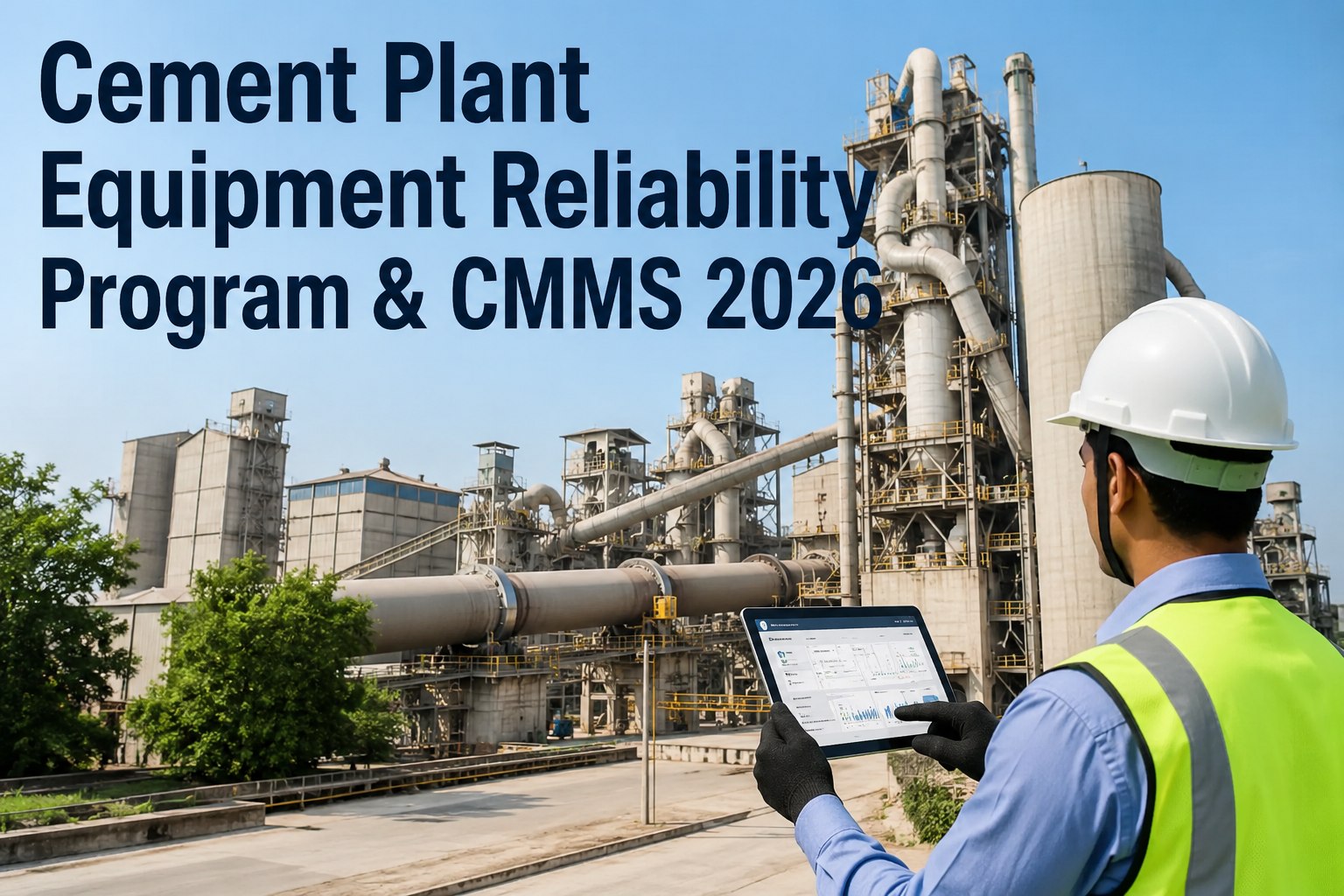
A technician who has spent twenty-eight years on the same kiln line does not just know the procedure — they know the listening check that flags a bearing problem before any sensor fires, the exact torque sequence that avoids a recurring gasket failure, and the one workaround that keeps a finicky feeder running through a hot summer. None of that lives in a manual. When that technician retires, it walks out the door with them, permanently.
Capture Your Veteran Technicians' Knowledge Before It Retires
Cement plant maintenance is facing the steepest retirement wave in its history, and most of what keeps kilns, mills, and preheaters running has never been written down. OxMaint turns everyday work orders and inspections into searchable standard work that survives the people who created it.
The Retirement Wave Cement Plants Cannot Hire Their Way Out Of
The maintenance workforce in heavy industry is older than at almost any point in its history, and a large share of that workforce has spent the majority of a career on one plant, one kiln line, one set of equipment quirks.
Hiring can replace headcount. It cannot replace the accumulated pattern recognition a veteran technician built over a decade of shutdowns, near-misses, and one-off fixes, which is exactly why capturing that knowledge before it leaves matters more than filling the seat afterward.
How Knowledge Loss Compounds Once It Starts
The first departure rarely looks like a crisis. The damage builds quietly across each subsequent retirement, as the remaining team absorbs more responsibility with less institutional support.
Localized performance decline on the affected equipment class. Remaining staff compensate informally, which masks the true scope of the capability loss.
A second or third retirement removes the people who were covering the earlier gap. Repair times extend further and PM compliance on complex assets slips visibly.
Without documented diagnostic patterns, new technicians troubleshoot from first principles on every fault, extending unplanned downtime and inflating overtime costs.
Three Types of Knowledge Worth Capturing Before They Leave
Not all institutional knowledge carries the same weight. These three categories are the most expensive to lose and the hardest to rebuild.
Process Diagnostic Intuition
Correlating thermal, pressure, and chemistry signals into a single diagnosis, built over fifteen to twenty years of watching the same kiln behave under different conditions.
Shutdown Scope and Sequence Knowledge
Which assets need inspection, which repair sequences conflict with each other, and which contractor actually does the work correctly — judgment built from a decade of shutdowns.
Supplier and Contractor Context
Spare parts sources, specialist contractor contacts, and emergency vendor relationships that typically exist in one or two people's phone contacts, nowhere else.
Why Apprenticeship Programs Alone Are Not Enough
Many plants respond to the retirement wave by investing in apprenticeship pipelines, and structured training is genuinely valuable, but it addresses only half the problem. A new technician still needs somewhere to find the accumulated diagnostic patterns a veteran built over decades, not just a technical foundation.
Pairing formal training with a searchable, asset-linked knowledge base closes the gap that apprenticeships alone leave open. A technician who understands bearing theory in general still benefits enormously from a note that says which specific fan on which specific line has a history of running hot under a particular seasonal load pattern.
Plants combining both approaches consistently report faster time-to-proficiency for new hires, because the training gives them the framework and the documented history gives them the plant-specific context that no generic course can teach.
Signs Your Plant Is Already Losing Knowledge
Knowledge loss rarely announces itself. It shows up first as small, easy-to-dismiss patterns that compound quietly over several quarters.
- The same two or three names get called for every complex fault, regardless of who is scheduled that shift.
- New technicians solve recurring problems from scratch instead of finding a documented fix.
- Shutdown scope keeps changing mid-outage because nobody wrote down what was inspected last time.
- Repair times on a specific equipment class have quietly crept upward over the past year.
- Contractor and spare parts sourcing depends on one person's personal contacts rather than a shared record.
Any one of these on its own is manageable. Two or more appearing together is usually a sign that the knowledge transfer gap has already started widening.
Turn Tribal Knowledge Into Institutional Memory
OxMaint captures diagnostic notes, shutdown sequences, and workaround procedures directly inside the work order, so the next technician can search it instead of waiting for the one person who remembers.
Documented Standard Work vs. Tribal Knowledge
The gap between a plant that survives a retirement wave and one that struggles through it comes down to whether procedures live in a system or in someone's memory.
Building a Standard Work Program That Actually Gets Used
Knowledge capture programs fail when they ask technicians to write documentation as a separate task. The ones that work capture knowledge as a byproduct of work already being done.
- Require a diagnostic note on every work order that closes a recurring or unusual fault, not just a completion checkbox.
- Pair junior technicians with veterans on shutdown walk-downs and log the sequence and reasoning, not just the task list.
- Convert repeated verbal troubleshooting steps into a searchable procedure attached to the asset record.
- Review retirement timelines annually and flag high-risk knowledge gaps at least twelve months ahead.
- Audit procedure usage quarterly to confirm new technicians are actually finding and following documented steps.
How OxMaint Supports Knowledge Retention
OxMaint gives maintenance teams a structured place to capture what would otherwise stay in someone's head, tied directly to the equipment it applies to.
Work Order Diagnostic Notes
Technicians document root cause reasoning and fix steps directly inside the work order, building a searchable fault history over time.
Asset-Linked Procedures
Standard work procedures attach to the specific asset record, so the next technician finds the right steps without hunting through a shared drive.
Competency and Training Tracking
Skill gates and training records flag which procedures a technician has completed, preventing unqualified assignments on critical equipment.
Mobile Access on the Floor
Procedures and diagnostic history are available from a phone or tablet mid-shift, right where the equipment problem is happening.
Knowledge Capture: Frequently Asked Questions
What kind of knowledge is most at risk when a technician retires?
How do we capture knowledge without adding extra paperwork?
How far ahead should we plan for a known retirement?
Can OxMaint show which procedures still rely on one person?
How do we see this working for our plant's workforce plan?
Do Not Let Institutional Knowledge Walk Out With the Next Retirement
The technicians who keep your kiln line running have knowledge worth more than any single repair budget. OxMaint gives that knowledge a permanent, searchable home.