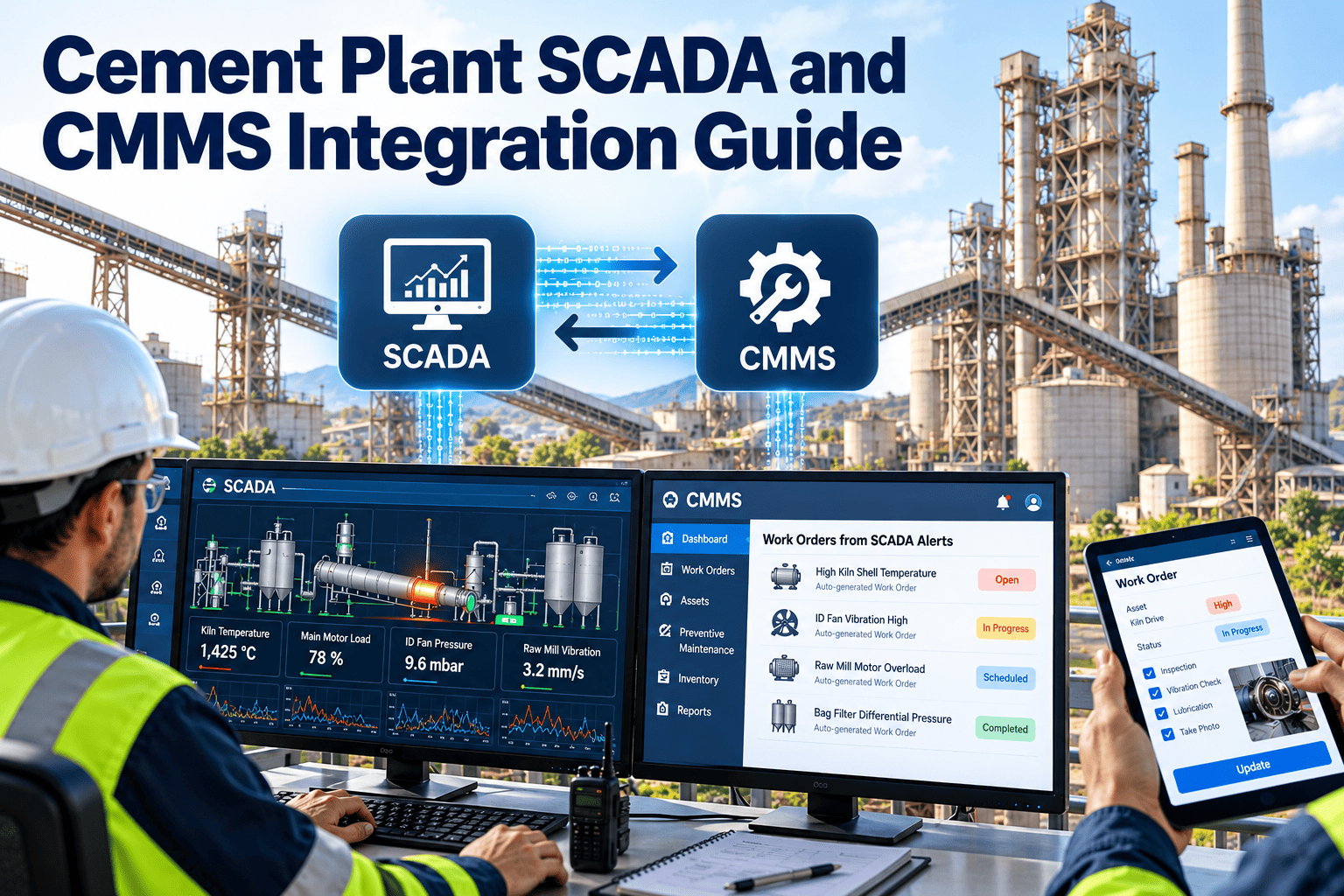
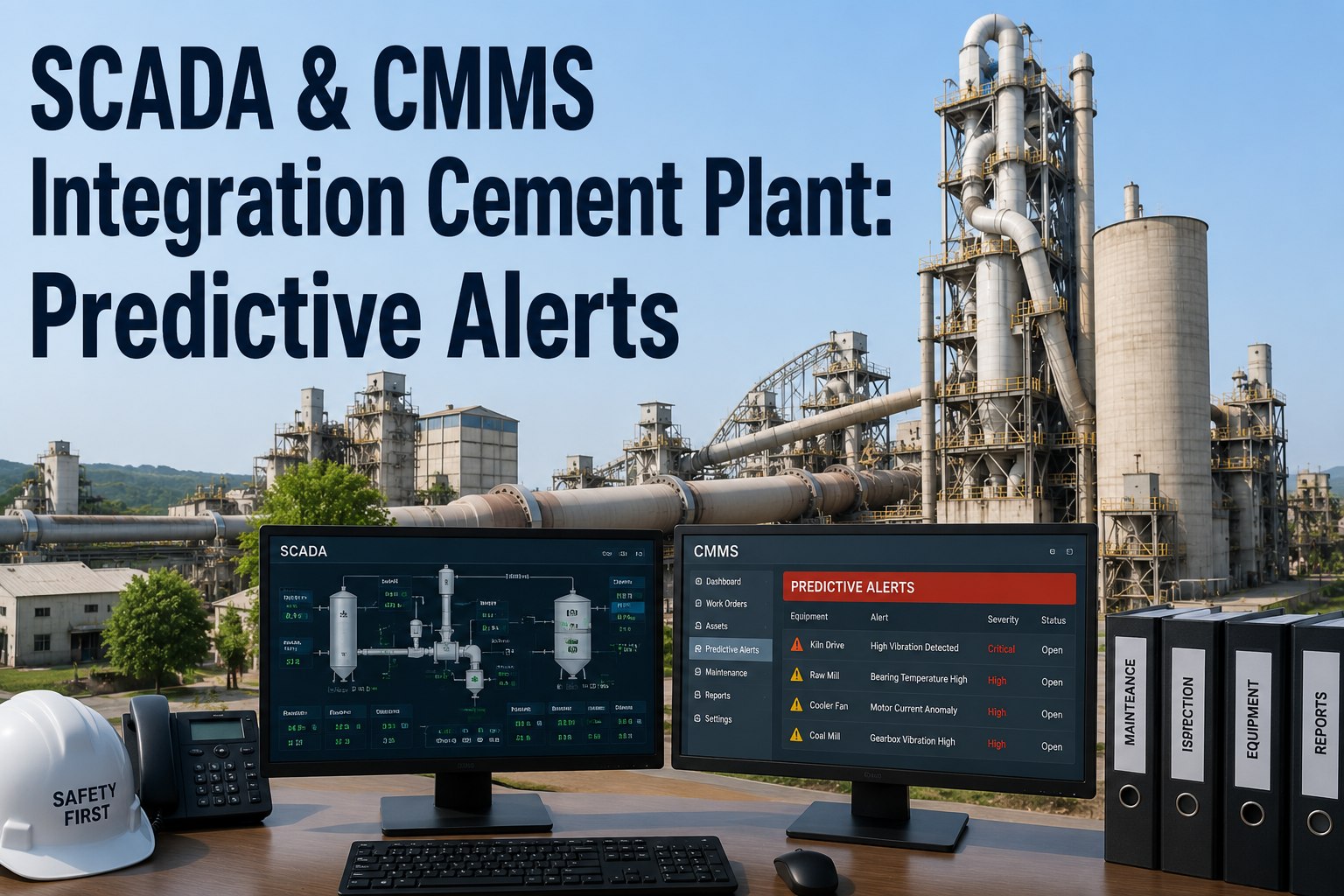
Every cement plant runs on equipment that wears down hour by hour — kiln bearings, mill gearboxes, fan rotors — and the difference between a planned replacement window and an unplanned shutdown is simply knowing how many hours of life each asset has left. Machine learning RUL (Remaining Useful Life) prediction trains on your plant's own sensor time-series data to give your maintenance team that number with precision, so the CMMS can schedule the perfect swap during a production gap, not during peak output. If you want to see how this works on your asset fleet, start a free trial with Oxmaint or book a 30-minute demo with our team.
68%
of cement plant failures are predictable with ML sensor models
4–6×
higher repair cost for reactive vs. condition-based replacement
320+ hrs
average advance warning window from trained RUL models
$190K
average annual savings per plant from avoided emergency shutdowns
The Challenge
Why Cement Plants Can't Afford to Guess on Asset Life
Cement production is continuous and capital-intensive. A kiln that runs 24/7 at 1,450°C, a raw mill gearbox absorbing constant impact loads, a clinker cooler fan spinning under abrasive dust — these assets don't fail on a schedule. Fixed-interval maintenance replaces parts that still have life left, while missing the components that are quietly degrading between service dates. The result: unexpected stoppages that cost more per hour than almost any other industrial process.
01
Fixed PM Intervals Miss Real Degradation Curves
Calendar-based schedules replace bearings every 3,000 hours regardless of actual wear. Some fail at 1,800 hours under heavy load; others run cleanly to 5,000. Interval maintenance is wrong in both directions simultaneously.
02
Vibration Alarms Fire Too Late
Threshold alarms on vibration sensors trigger when damage is already advanced. By the time an alarm fires on a kiln support roller bearing, the repair window has shrunk from weeks to hours — and the production schedule has no room left.
03
No Link Between Asset Health and Work Order Planning
Even plants with condition monitoring have a gap: sensor data lives in one system, work orders in another. The maintenance planner manually bridges that gap — or doesn't, and the equipment fails during a production run.
04
Long-Lead Spare Parts Ordered Too Late
A replacement kiln thrust bearing has a 10–14 week OEM lead time. Without an early RUL forecast, the part gets ordered when the bearing is already critical — and the plant waits months for a component that could have been on the shelf.
Know Exactly When Your Kiln Bearing Will Fail
Oxmaint's ML-powered RUL engine connects your sensor data to your CMMS work order and procurement workflow — so replacement happens before failure, not after. Deployments are live in 8–12 weeks.
How It Works
From Raw Sensor Data to a Precise Hours-Remaining Forecast
RUL prediction is not a black box. It follows a well-defined pipeline — from sensor ingestion through model training to CMMS-triggered work orders — and every step can be audited by your engineering team.
1
Sensor Time-Series Ingestion
Vibration (mm/s RMS), temperature (°C), current draw (A), oil pressure (bar), and acoustic emission data stream from existing plant sensors into the Oxmaint data layer at configurable intervals — typically 1-second to 5-minute resolution depending on asset criticality.
2
Feature Engineering on Degradation Signals
Raw sensor values are transformed into degradation-relevant features: RMS trend slope, kurtosis elevation, spectral density shift at fault frequencies (BPFO, BPFI, BSF for bearings), and multi-sensor correlation patterns. These features capture what simple threshold alarms miss.
3
Model Training on Plant-Specific Run-to-Failure History
LSTM and gradient-boosting models train on your plant's historical failure records paired with the sensor data that preceded each failure. Generic models improve with plant-specific retraining — the more operational history, the tighter the RUL confidence interval.
4
RUL Forecast Output with Confidence Bands
Each monitored asset receives a continuously updated RUL estimate: "This kiln support roller bearing has 340 ± 45 operating hours remaining." The estimate updates every shift as new sensor data arrives, narrowing the confidence band as the failure window approaches.
5
CMMS Work Order and Parts Reservation Triggered
When RUL drops below the configured planning horizon (e.g., 500 hours), Oxmaint automatically creates a work order, assigns it to the next scheduled production gap, reserves the replacement part in inventory, and triggers a purchase order if stock is insufficient.
Asset Coverage
Which Cement Plant Assets Benefit Most from RUL Prediction
Not every asset needs ML-based life prediction. RUL models deliver the highest ROI on high-criticality, high-repair-cost equipment where failure consequences are severe and lead times for parts are long.
Kiln Support Roller Bearings
Vibration, Temp, Shell Scanner
200–600 hrs
Very High
Raw Mill Gearbox
Vibration, Oil Particle Count, Temp
150–400 hrs
Very High
Clinker Cooler Fan Rotor
Vibration, Current Draw, Imbalance
100–300 hrs
High
Cement Mill Main Drive Motor
Current Signature, Winding Temp
300–700 hrs
High
Preheater Cyclone Fans
Vibration, Pressure Differential
120–350 hrs
Medium
Separator Bearings
Vibration, Acoustic Emission
80–250 hrs
Medium
CMMS Integration
How RUL Forecasts Close the Loop in Your Maintenance Workflow
A RUL forecast that lives only in a condition monitoring dashboard is only half the solution. The value comes when that forecast automatically triggers the right maintenance action at the right time in your CMMS.
Planning
Work Order Pre-Scheduled to Production Gap
When RUL crosses the planning horizon, Oxmaint identifies the nearest upcoming production changeover or scheduled stop and creates the work order within that window — so replacement never interrupts active production.
Procurement
Spare Parts Reserved or Auto-Ordered
Inventory is checked against work order requirements at time of creation. If stock is insufficient and lead time exceeds the RUL window, a purchase order is auto-generated immediately — no manual parts chase required.
Execution
Technician Briefed Before Job Start
Work order details include the RUL trend chart, failure mode probability, required tools, and parts location — so the technician arrives prepared, not discovering requirements at job start.
Learning
Actual Condition Feeds Back to Retrain Model
When the technician records actual component condition at replacement, that data closes the training loop. Each replacement event makes the next RUL forecast more accurate for that asset class.
Performance Benchmarks
Before and After: What ML-Based RUL Prediction Changes in Practice
These figures are drawn from cement and heavy industrial plants that deployed CMMS-integrated RUL prediction over a 12–18 month period, compared against their prior condition monitoring or fixed-interval PM baseline.
| Metric |
Threshold / Fixed-PM |
With ML RUL Prediction |
| Unplanned kiln stoppages / year |
6–10 events |
1–2 events |
| Average warning lead time before failure |
2–8 hours (alarm-based) |
200–500 hours |
| Emergency spare parts procurement events |
14–22 per year |
2–4 per year |
| Preventive replacement with remaining life > 20% |
38–55% of replacements |
Under 12% |
| Work orders completed within planned window |
61% on-schedule |
91% on-schedule |
| Annual maintenance cost per critical asset |
Baseline |
22–31% reduction |
$190K
Average annual savings from avoided emergency shutdowns per plant
91%
Work orders completed within planned production window post-deployment
8 wks
Typical time from deployment to first RUL forecast on live plant assets
Frequently Asked Questions
ML RUL Prediction for Cement Plants: Common Questions
How much historical failure data is needed to train an accurate RUL model?
Does RUL prediction require adding new sensors to our equipment?
How does the system handle cement plant operating variability — different feed rates, fuel mixes, seasonal loads?
RUL models are conditioned on operating state. The system normalizes sensor readings against load and production rate parameters, so degradation signals are compared against similar operating conditions — not a single average baseline. This prevents false alarms during high-load campaigns and missed detections during low-load periods.
Book a demo to see how operating-state conditioning works for rotary kilns.
How long does full deployment take for a cement plant with 50+ monitored assets?
Most plants reach live RUL forecasting on priority assets within 8–12 weeks — covering sensor integration, model initialization, CMMS workflow configuration, and team onboarding. The full asset fleet is typically onboarded in phases over 16–20 weeks.
Book a demo to build a deployment timeline for your plant.
Can the RUL model output be explained to plant engineers — or is it a black box?
Every RUL forecast in Oxmaint includes a contributing factors breakdown: which sensor channels are driving the degradation signal, what the trend trajectory looks like, and what historical cases the model is drawing on. Engineers can review and override forecasts with their own field observations, keeping the model grounded in operational reality.
Start a free trial to explore the forecast explanation interface.
Schedule Every Replacement Before Your Next Kiln Bearing Fails
Oxmaint connects ML-based RUL forecasting directly to your CMMS work orders, spare parts inventory, and procurement workflow — so your maintenance team acts on hours-accurate predictions, not hindsight. No new infrastructure required. Live in under 12 weeks.