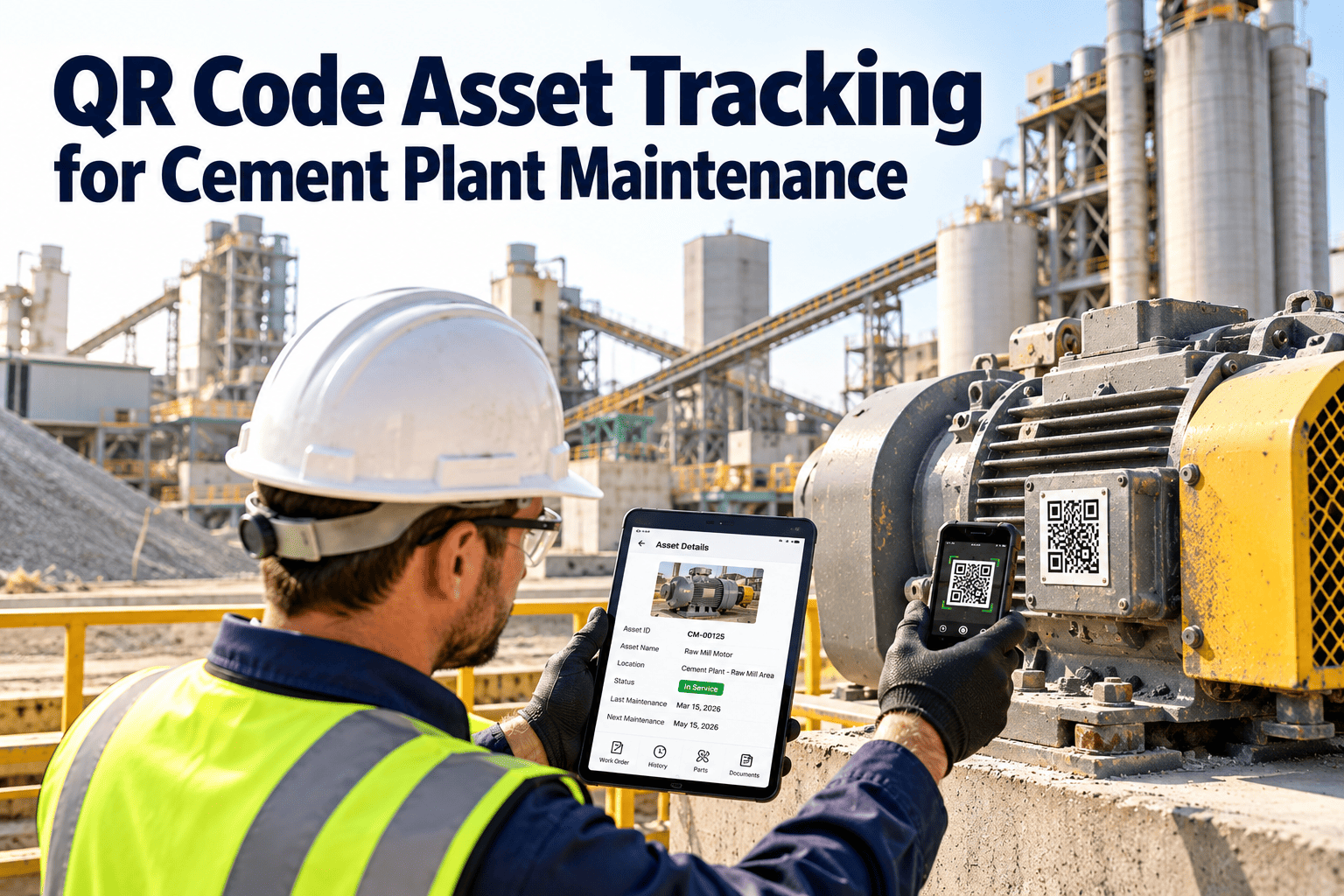
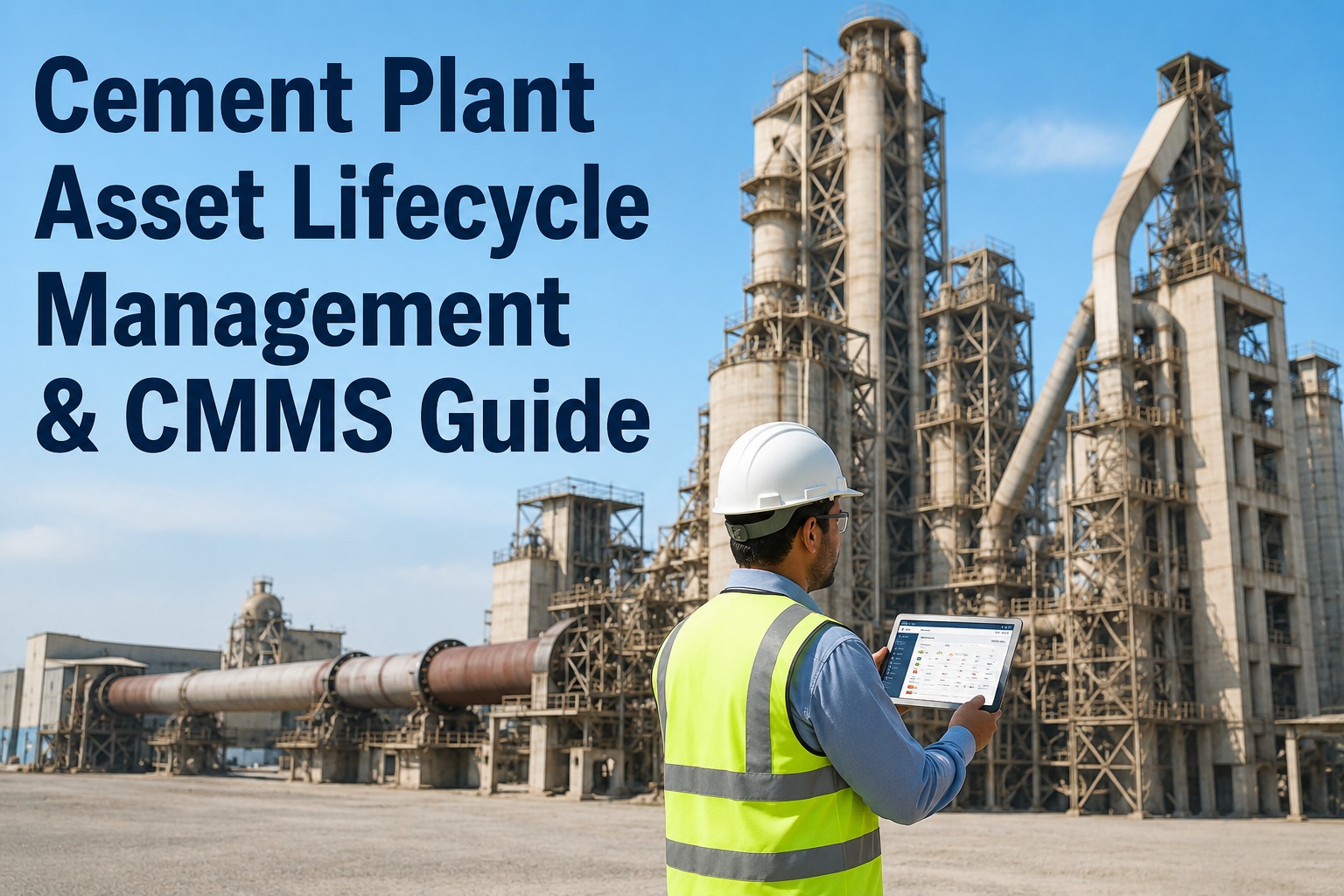
Cement plants retire 23% of major rotating equipment prematurely because maintenance teams lack total cost of ownership data at the moment capital decisions are made. A rotary kiln shell with 8 years of remaining useful life gets replaced at year 18 because no one tracked refractory campaign history against revolution counts. A ball mill bearing fails catastrophically because liner wear data lived in a technician's notebook rather than a condition-scored asset record. Asset lifecycle management in cement manufacturing closes the gap between what equipment costs over its operational life and what finance teams budget for capital replacement. Book a demo to see how Oxmaint tracks every cement plant asset from commissioning through end-of-life replacement with full cost visibility at every stage.
See How Oxmaint Tracks Asset Lifecycle Across Your Entire Cement Plant
From rotary kiln commissioning data to clinker cooler end-of-life forecasting, Oxmaint gives maintenance and capital teams a single source of truth for every asset's condition, cost history, and replacement timeline. Book a 30-minute demo with your plant's equipment profile and see rolling CapEx forecasts built from your actual asset records.
Asset Lifecycle Compliance Coverage by Region
Cement plant asset management programmes must align with regional maintenance documentation, equipment inspection, and capital reporting frameworks. Oxmaint automates the records, schedules, and audit trails that keep programmes compliant across every operating region.
| Region | Key Frameworks | Oxmaint Coverage |
|---|---|---|
| USA | OSHA 29 CFR 1910, MSHA 30 CFR Part 56, EPA Title V, NFPA 652 | Asset inspection records, PM audit trails, equipment health dashboards, compliance exports |
| UAE | OSHAD-SF, Civil Defence codes, SASO standards, Ministry of Industry directives | Multi-site asset registers, inspection work orders, lifecycle documentation, regulatory reports |
| India | Factories Act 1948, BIS IS 14489, CPCB emission norms, DGMS kiln directives | Statutory inspection scheduling, maintenance registers, condition archiving, certificate tracking |
| Germany | BetrSichV, DIN EN 13306, TUV inspection requirements, EU ETS carbon reporting | Inspection record archiving, maintenance documentation, asset condition records per unit |
| UK | PSSR 2000, PUWER 1998, HSE cement plant guidance, Building Safety Act | Work order scheduling, compliance record exports, full maintenance history archiving |
| Canada | CSA Z1000, Provincial OHS Acts, ACGIH guidelines, CCOHS standards | Multi-site dashboards, inspection audit trails, worker and equipment compliance records |
Oxmaint delivers asset inspection scheduling, lifecycle documentation, and compliance audit trail generation for cement plants across every region above. Your maintenance team has accurate records at every regulatory visit without manual administration or last-minute record assembly.
What Is Asset Lifecycle Management in Cement Manufacturing?
Asset lifecycle management in cement plants tracks every maintainable asset from first commissioning through final decommissioning, capturing condition data, maintenance cost history, and remaining useful life calculations that feed capital replacement decisions. It is not simply an asset register. Book a demo to see how Oxmaint's lifecycle tracking engine handles the full cement plant asset hierarchy from preheater inlet to packing line drive.
Asset Registry and Hierarchy
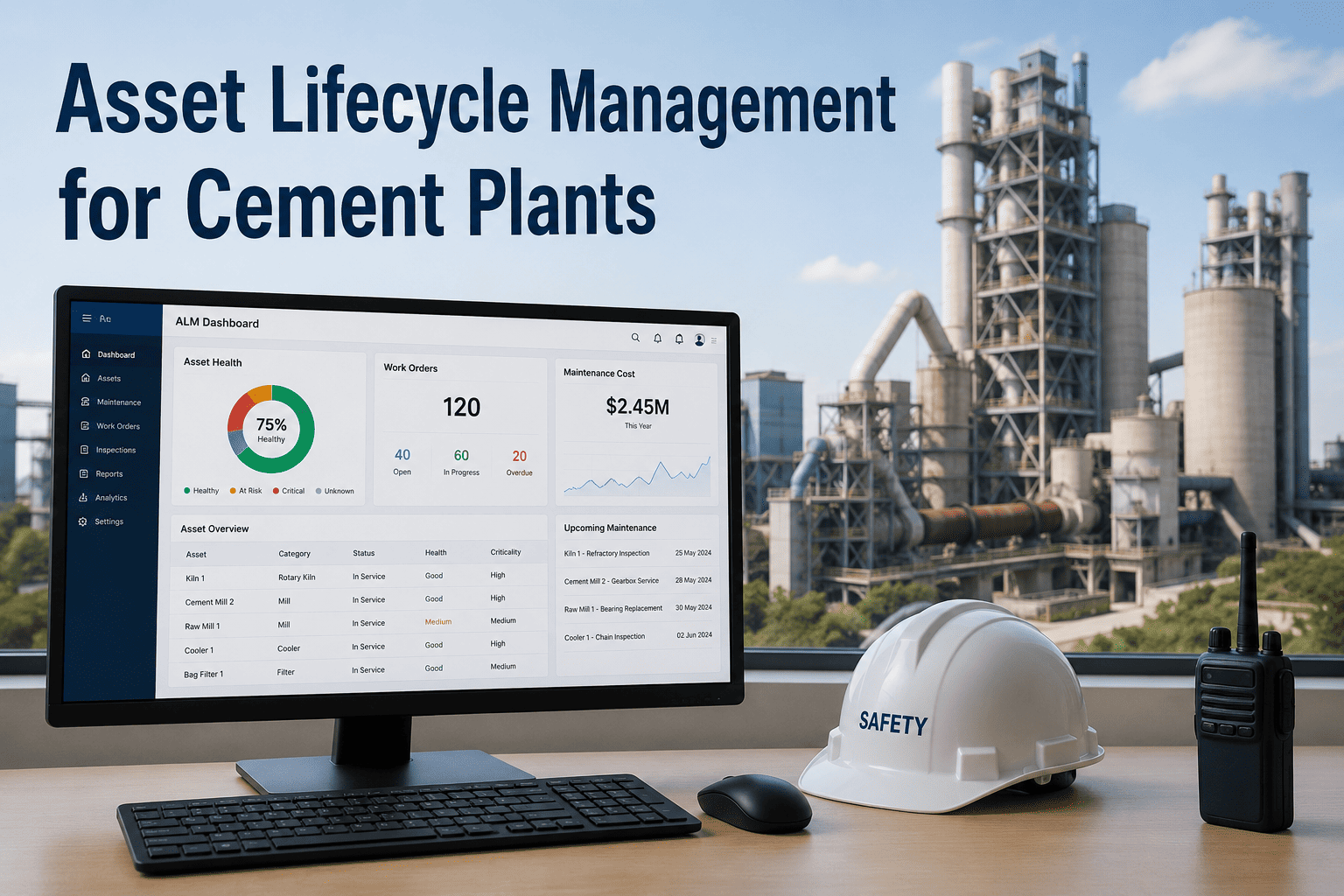
Every cement plant asset registered across five tiers: Portfolio, Plant, System, Equipment, and Component. Kiln shells, girth gears, refractory zones, mill liners, cooler grate sections, and all auxiliary drives captured with nameplate data, installation date, condition score, and operating parameters from day one of commissioning.
Condition and Cost History
Every repair, inspection, liner change, and overhaul recorded against the specific asset record with technician, parts consumed, and total cost. MTBF and MTTR calculated automatically per equipment class. Condition score updated at each maintenance event so the asset record always reflects current health, not installation age alone.
Remaining Useful Life Calculation
RUL calculated from degradation rate, maintenance frequency trend, and condition score trajectory. Kiln refractory RUL calculated against revolution counts and hot zone temperature history. Mill liner RUL calculated against throughput tonnage since last change. Each asset class uses its own wear-rate model, not a simple age formula.
Capital Planning and CapEx Forecasting
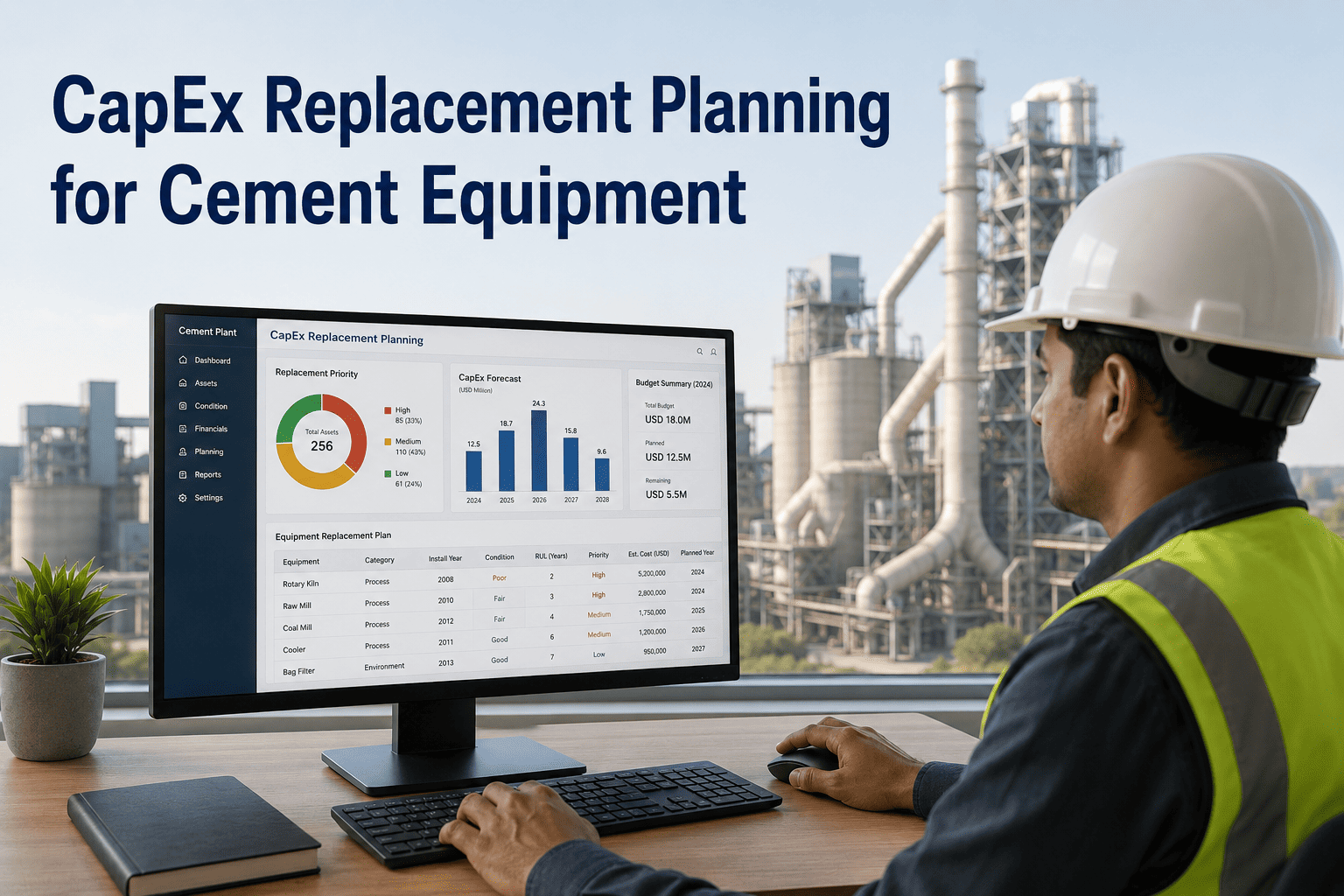
RUL outputs feed directly into rolling 5 to 10 year CapEx forecasts. Refurbish versus replace analysis for every major equipment class with full total cost of ownership breakdown. Capital reports formatted for board-level project approval without requiring finance team translation of maintenance data into investment language.
Four Asset Management Failures Costing Cement Plants Every Year
No Single Asset Record Across the Production Chain
Most cement plants manage equipment records across disconnected systems: ERP for some assets, spreadsheets for others, paper files for quarry and raw mill equipment. No single source of truth means planners cannot assess total plant replacement risk, identify repeat failure patterns, or generate accurate shutdown scope before a major kiln or mill outage begins. Capital decisions get made on age alone.
Capital Replacement Based on Age Not Condition
When a clinker cooler grate section or ball mill shell approaches end of design life, the replacement decision is made on equipment age alone rather than total cost of ownership, repair frequency trend, and remaining useful life projection. Premature replacement wastes capital. Delayed replacement triggers failure events costing 4 to 5 times more than planned intervention. Book a demo to see how Oxmaint's RUL engine changes capital replacement decisions in cement plants.
Shutdown Scope Built Without Complete Equipment History
Without a full asset record, kiln and mill shutdowns routinely expand beyond planned scope when technicians discover deterioration not captured in maintenance records. Scope changes during a shutdown cost 3 to 4 times more than the same work planned in advance. Unplanned parts orders extend shutdown duration by an average of 2.4 days per major outage event.
CapEx Forecasts That Miss the Real Replacement Window
Finance teams receive capital budgets built from equipment age estimates rather than condition data. A kiln tyre showing accelerated wear at year 12 does not appear in a 5-year CapEx forecast built from a 20-year design life figure. The result is unbudgeted emergency replacements costing 4 to 5 times more than planned capital interventions and budget variance of 40 to 65% versus actual spend.
How Oxmaint Structures Cement Plant Asset Lifecycle Management
Oxmaint connects commissioning records, condition scoring, preventive maintenance history, and capital forecasting into a single platform built for cement manufacturing. Book a demo to walk through the full asset lifecycle framework with your plant's equipment inventory and existing capital planning structure.
Ready to Replace Age-Based Capital Decisions with Condition-Driven Forecasting?
Oxmaint deploys across a cement plant's full asset base in 60 to 90 days. Asset registry, condition scoring, and CapEx forecasting reach full operational function within the first deployment phase with no shutdown required. Book a 30-minute demo with your maintenance and capital planning teams and see lifecycle forecasts built from your actual plant equipment data.
Oxmaint Platform: Asset Lifecycle Modules for Cement Plants
Each module addresses a specific gap in cement plant asset lifecycle capability. Together they form a complete platform connecting commissioning data directly to capital decisions. Book a demo to walk through each module with real cement plant equipment data.
Reactive Asset Management vs. Oxmaint: The Performance Gap in Cement Plants
The gap between reactive asset management and structured lifecycle tracking in cement manufacturing is measurable in capital budget accuracy, kiln availability, and emergency replacement premium. Read the full cement plant CMMS software comparison to see how lifecycle management capability varies across leading platforms.
| Performance Factor | With Oxmaint Lifecycle Management | Without Lifecycle Management |
|---|---|---|
| Kiln Tyre Replacement Timing | Tyre migration and roller wear tracked at every PM cycle against displacement thresholds. RUL calculated from measured wear rate. Replacement scheduled 6 to 12 weeks ahead at planned cost with no production loss. | Replacement driven by visible failure or age estimate. Emergency replacement costs 4 to 5 times more than planned. Unplanned kiln stop averaging 3.2 days adds $57,600 to $144,000 in lost production. |
| Ball Mill Liner Planning | Liner wear tracked against throughput tonnage since last change. Replacement at optimal wear point, not calendar date. Liner life extended by average 12 to 18% through condition-driven scheduling. | Calendar-based replacement regardless of actual wear. Over-replacement at 70% wear wastes liner cost. Under-replacement risks shell damage costing $280,000 to $1.4 million per overhaul event. |
| Capital Budget Accuracy | CapEx forecasts built from RUL calculations and live condition scores. Capital budget variance reduced to under 13%. Replacement cycles planned 3 to 5 years ahead with full refurbish versus replace analysis per equipment class. | Replacement decisions based on equipment age alone. Budget variance of 40 to 65% versus actual spend. Unplanned failure-driven replacements create recurring budget overruns each capital year. |
| Refractory Lining Management | Refractory condition scored per kiln zone at every campaign inspection. Campaign length optimised against condition score, extending average refractory life by 8 to 15% across kiln zones. | Fixed campaign lengths regardless of zone condition. Early replacement wastes refractory material cost of $85,000 to $420,000 per full reline. Late replacement risks brick loss and shell damage. |
| Shutdown Scope Accuracy | Shutdown scope compiled from accumulated equipment condition records and maintenance backlog. Scope accuracy within 12% of initial estimate. Parts ordered at standard lead time, no air freight premium. | Scope discovered after kiln cools down. Average 35 to 60% scope overrun from undetected deterioration. Emergency parts orders at 2.8 to 4.2 times standard cost. Shutdown extended by 2.4 days on average. |
| Girth Gear Service Life | Girth gear backlash, root clearance, and surface condition measured and recorded at every PM cycle. Gear set replacement planned 12 to 18 months ahead, aligned with major shutdown window. | Gear condition assessed visually with no quantified wear rate. Catastrophic gear failure costs $1.2 million to $4.8 million including emergency gear set, installation labour, and production loss. |
Asset Lifecycle Performance Benchmarks: Cement Plants on Oxmaint
These benchmarks represent average performance improvements measured across cement plants that transitioned from reactive asset management to structured Oxmaint lifecycle programmes within 18 months of full platform deployment.
Cement Plant Asset Lifecycle Profiles: Configuration by Equipment Class
Understanding the lifecycle profile of each major cement plant equipment class defines CMMS configuration requirements, RUL calculation parameters, and critical spare stocking levels needed to support proactive capital planning. Book a demo to see how Oxmaint configures lifecycle profiles for your specific equipment inventory and campaign schedule.
Rotary Kiln Shell and Girth Gear
Refractory lining condition scored per kiln zone at each campaign inspection with hot zone records updated from shell temperature scans. Girth gear backlash and tyre migration measured quarterly against wear thresholds. Bearing temperature trend stored against revolution count for RUL calculation per kiln section.
Ball Mill and Vertical Roller Mill
Liner wear progression tracked against throughput tonnage since last change event. Separator and classifier bearing condition recorded at each scheduled mill inspection. Drive gearbox oil analysis results stored against the asset record. Shutdown work packs for liner change compiled automatically from accumulated inspection findings.
Clinker Cooler and Grate System
Grate plate wear condition assessed per cooler section at each outage and scored against replacement threshold. Drive chain elongation measured at each PM cycle and recorded against the chain asset record. Grate section replacement history linked to kiln campaign records to identify wear acceleration during high-throughput periods.
Preheater Cyclone Tower Assembly
Cyclone stage refractory condition scored at each outage inspection with photo documentation stored against the specific stage asset record. Dip tube wear measured and recorded per stage against replacement threshold. Shell temperature hot spot records linked to refractory condition scores to predict lining failure before breakthrough events cause uncontrolled kiln shutdown.
Asset Lifecycle ROI in Cement Manufacturing
Your Cement Plant Capital Planning Starts With Accurate Asset Data
Oxmaint deploys asset lifecycle management across your full cement plant equipment base in 60 to 90 days. Asset registry, condition scoring, and rolling CapEx forecasts reach full function within the first deployment phase. Book a 30-minute demo with your maintenance and capital planning teams to see RUL forecasts and capital reports built from your actual equipment data from session one.
Frequently Asked Questions: Asset Lifecycle Management in Cement Plants
QWhat is the difference between an asset register and asset lifecycle management in a cement plant?
QHow does Oxmaint calculate remaining useful life for kiln and mill equipment?
QWhich global compliance frameworks require documented asset lifecycle records for cement plants?
QHow long does it take to deploy Oxmaint asset lifecycle management at an operating cement plant?
QCan Oxmaint integrate asset lifecycle data with existing ERP or finance systems?
QWhat is the payback period for asset lifecycle management investment at a mid-size cement plant?
Continue Reading: Cement Plant CMMS and Asset Management Resources
Explore these resources to build a complete picture of cement plant maintenance management, capital planning, and CMMS platform selection across your operations.
Start Building Your Cement Plant Asset Lifecycle Programme Today
Oxmaint deploys across your cement plant's full asset base in 60 to 90 days. No heavy implementation fees, no extended onboarding programme, no shutdown required at any deployment stage. Book a 30-minute demo with your maintenance team and see the platform running against your actual kiln, mill, and crusher equipment data from your first session.