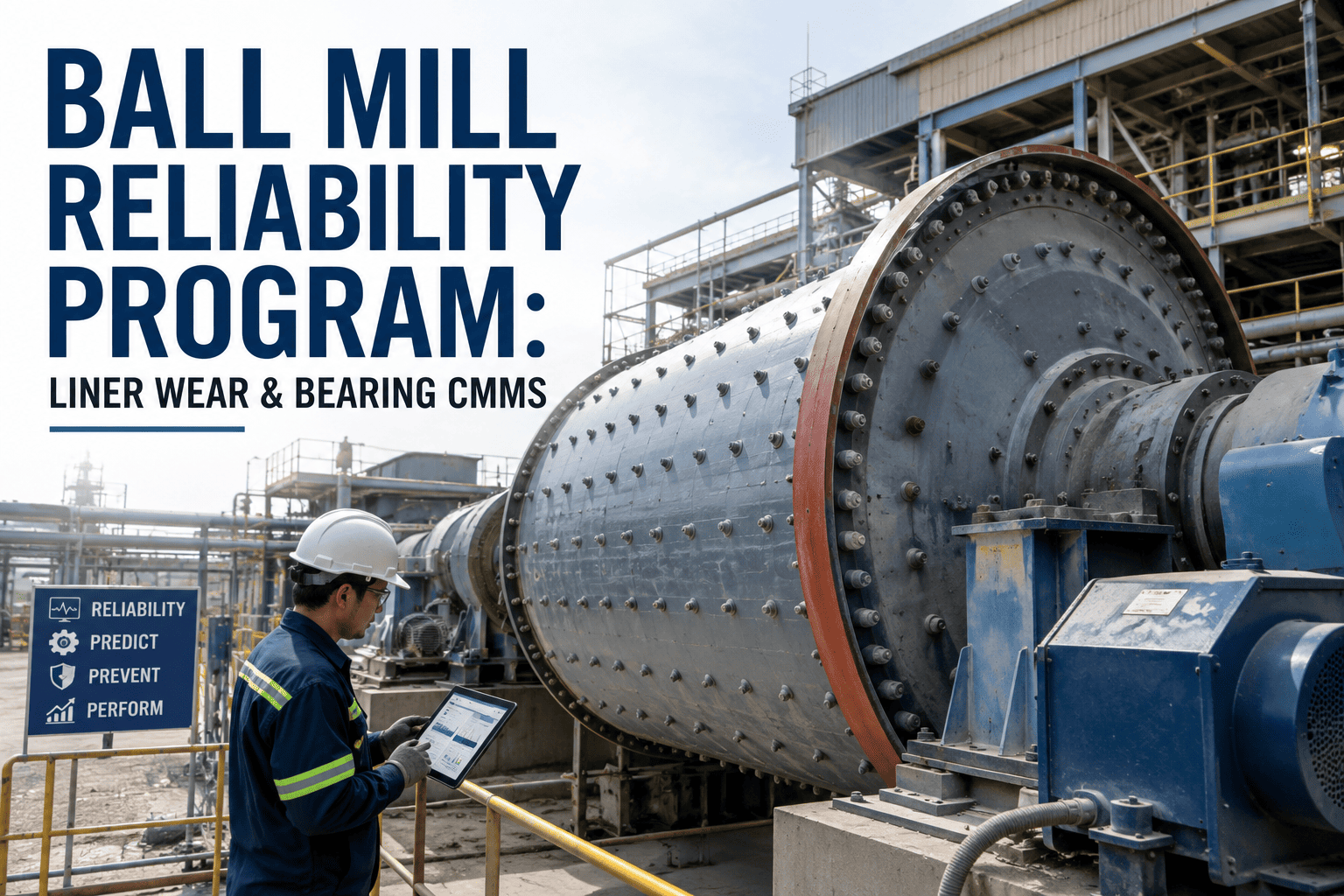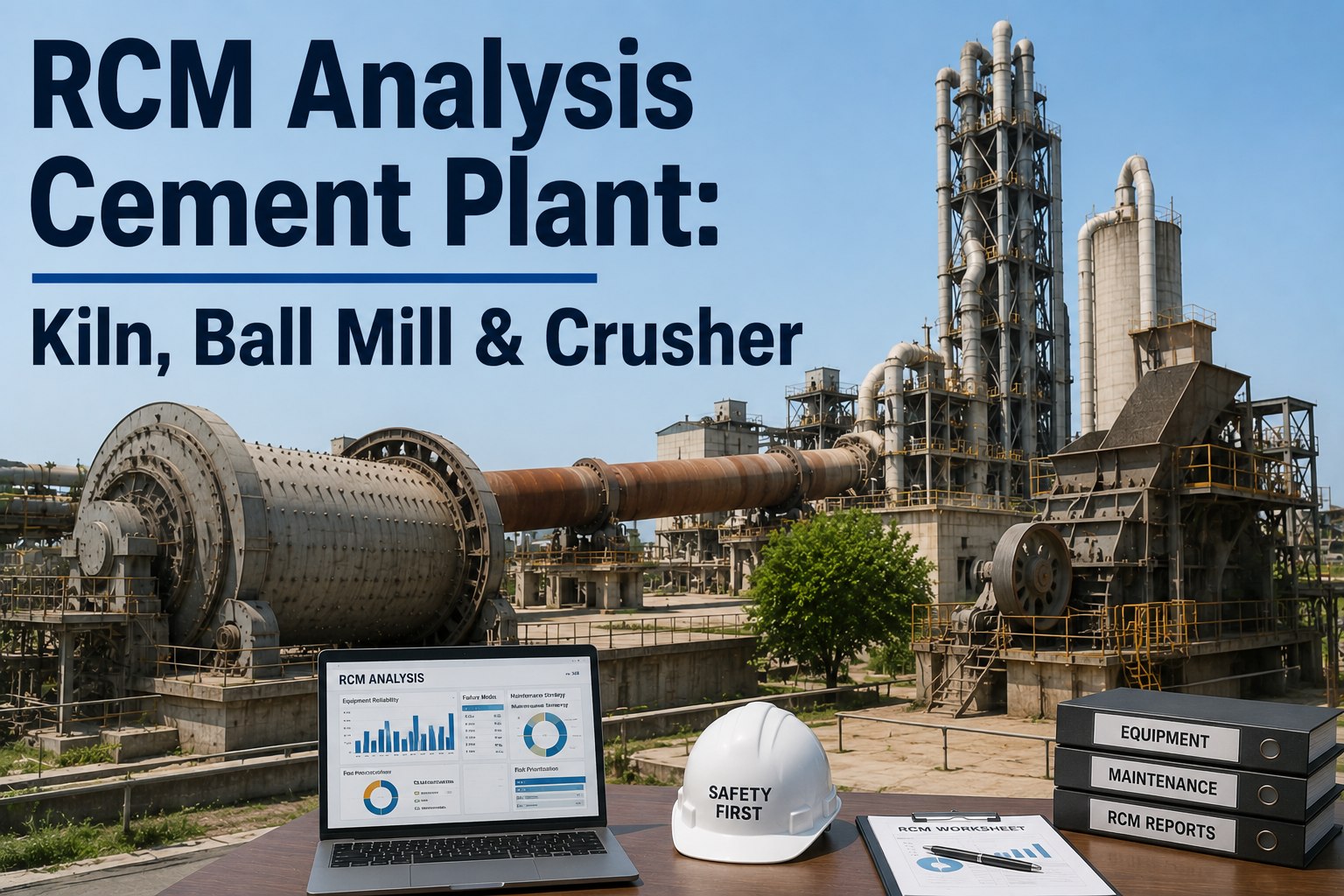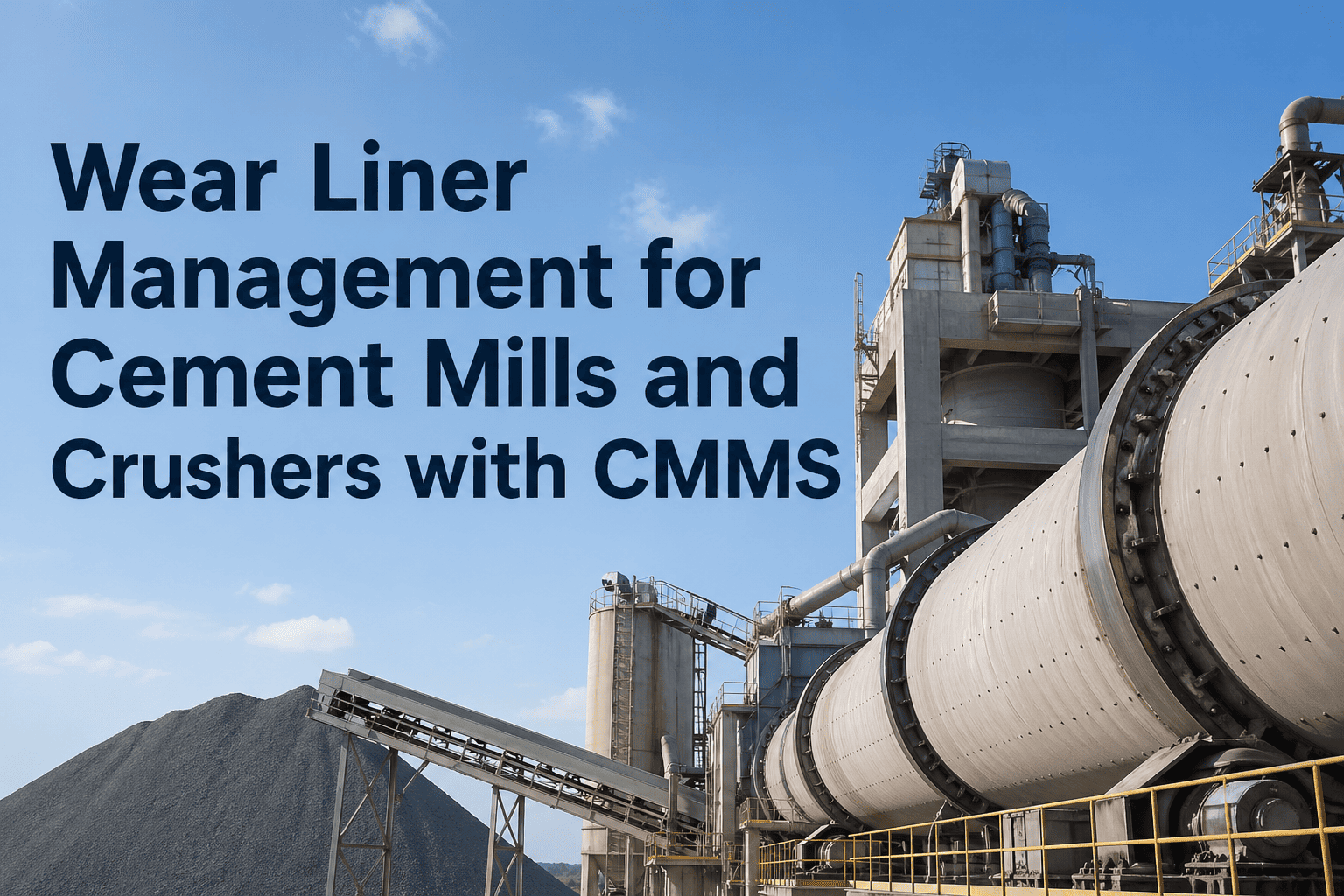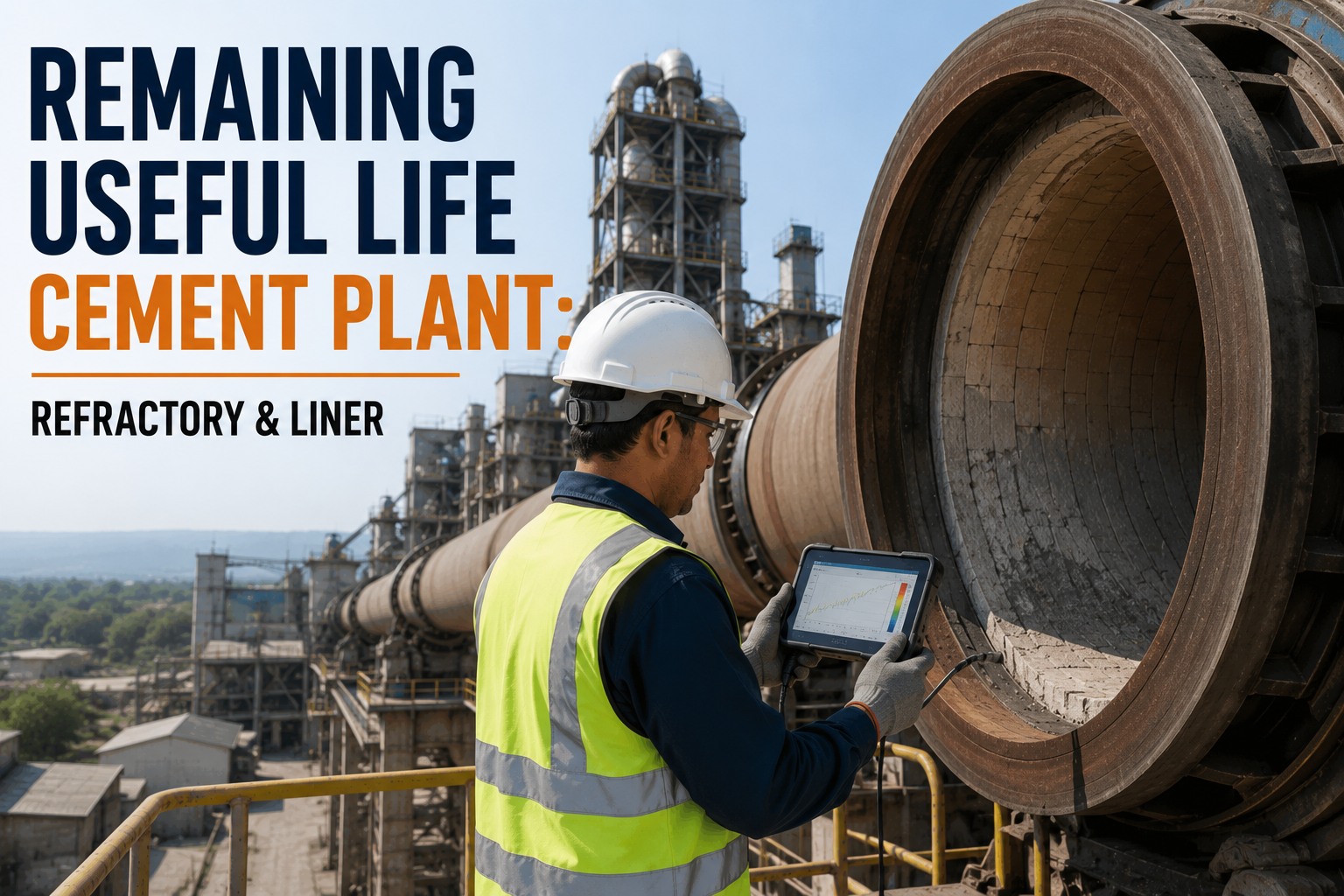
Remaining useful life prediction for refractory and mill liners is one of the highest-value predictive maintenance outputs in a cement plant, where every additional tonne of clinker per campaign converts directly into operating margin. Kiln refractory, ball mill liners, crusher wear parts, and girth gears each degrade on measurable trajectories that, when modeled correctly, extend campaign length and prevent unplanned outages. This guide covers the measurement techniques, RUL modeling approaches, and CMMS-driven campaign integration that turn refractory and liner life prediction into a structured margin-capture program. You can deploy the full RUL module inside OxMaint today when you Start Free Trial.
How many more tonnes of clinker before the next refractory campaign?
Every extra campaign day on a 5,000 TPD kiln is roughly 5,000 tonnes of clinker — and at $45/tonne margin, a 7-day extension is worth $1.6M per kiln per year. RUL modeling turns refractory wear data into a number your planning team can actually schedule around.
extended with RUL-modeled refractory scheduling vs. fixed 270-day cycles
Where RUL prediction pays off most in a cement plant
Not every asset deserves a RUL model. The four asset families below account for 70–80% of unplanned cement-plant downtime cost and consume the largest share of refractory, wear-part, and gear-replacement budget. They are also the assets where a 10–15% life extension changes campaign economics.
Kiln refractory
$2.4M
Typical refractory cost per 2-pier kiln reline
Magnesia-spinel and doloma brick in the burning zone degrade through thermal spalling, alkali infiltration, and mechanical flex. A 1% improvement in campaign length saves $24K–$36K per kiln per year.
Ball mill liners
14%
Throughput loss in final 20% of liner life
Worn lifter profiles reduce lifting angle and increase specific energy consumption. Liner changeouts cost $180K–$320K including downtime; premature changeout wastes 8–12% of useful life.
Crusher wear parts
3–6 weeks
Typical jaw / hammer life range
Manganese steel crusher mantles and hammers wear according to feed hardness, moisture, and throughput. RUL modeling prevents both premature changes and the $40K–$70K cost of a catastrophic failure.
Girth gear
12–18 yrs
Design life of a properly lubricated girth gear
Backlash, tooth pitch error, and pitting progression determine whether a gear reaches 18 years or fails at 9. A new girth gear install runs $380K–$620K plus 10–14 days of kiln downtime.
How refractory and liner RUL is actually calculated
RUL prediction is not a single algorithm — it is a stack of three modeling approaches, each suited to a different data regime. Cement plants typically run all three in parallel and let the CMMS reconcile their outputs against inspection findings.
Degradation curve fit
Used for refractory brick wear and liner thickness. W(t) is the measured wear at time t, Wfail is the failure threshold (e.g. 50mm residual brick), and λ(t) is the time-varying wear rate derived from kiln shell temperature, coating stability, and clinker chemistry. Best when you have 3+ campaigns of measurement history.
Survival / Weibull
Used for girth gear teeth and crusher hammers where the failure mechanism is stochastic. β (shape) captures whether wear-in or wear-out dominates; η (scale) is the characteristic life. The CMMS updates η each time an asset of the same class is replaced, so the survival curve sharpens with operating data.
Hybrid / condition-weighted
Combines the degradation curve with live condition signals — shell scan temperature, pinion vibration, and hood draft pressure. When the adjustment factor f() drops below 0.85, the CMMS auto-triggers a campaign review. This is the model used for kiln refractory on lines running alternative fuels, where wear rate is volatile.
Worked example: a 4,800 TPD kiln running a hybrid RUL model on its burning-zone refractory extended its campaign from a fixed 280 days to 412 days over three cycles — an additional 632,000 tonnes of clinker per campaign, or roughly $2.8M in margin captured before the planned reline window.
The measurement chain that feeds refractory and liner RUL
A RUL number is only as defensible as the data behind it. The table below maps each asset class to the primary signals the CMMS ingests, the inspection cadence that grounds the model, and the threshold that typically triggers a campaign-planning review.
| Asset class | Primary signals | Inspection cadence | Review trigger |
|---|---|---|---|
| Kiln refractory (burning zone) | Shell scan temp, kiln shell ovality, coating thickness ultrasonic, alkali sampling | Continuous shell scan + weekly ultrasonic | Shell temp > 370°C or 60mm residual brick |
| Kiln refractory (transition / upper) | Shell scan temp, red-kiln visual, thermography | Continuous shell scan + shift walkdown | Sustained hot spot > 15 min |
| Ball mill liners | Lifter profile laser scan, mill motor kW/T, acoustic emission | Monthly profile scan + continuous power | < 40% lifter height or kW/T up 8% |
| Crusher wear parts | Throughput TPH, product gradation, motor load, gap setting | Daily gap check + weekly gradation | P80 drift > 12% or gap maxed |
| Girth gear | Pinion vibration, backlash, tooth contact pattern, lubricant ferrography | Monthly vibration + quarterly ferrography | ISO 10816 velocity > 7.1 mm/s |
From RUL number to scheduled campaign window
The real value of RUL prediction is not the number itself — it is how that number flows into the campaign plan. A CMMS-driven RUL workflow converts each asset's remaining-life estimate into a ranked, cost-optimized outage schedule across the kiln, mill, and crusher lines.
RUL forecast refresh
CMMS re-runs the degradation model for every tracked asset and publishes a 120-day, 90-day, and 60-day RUL window. Assets crossing the 90-day threshold are flagged for campaign inclusion.
Campaign grouping
Refractory, liner, and gear RUL windows within 21 days of each other are grouped into a single kiln outage. This avoids two short outages and captures shared scaffolding and crane cost — typically $120K–$180K per avoided duplicate mobilization.
Spare & contractor lock
Refractory brick order, liner castings, and gear specialists are committed against the modeled RUL window. The CMMS auto-generates purchase requisitions linked to each asset's RUL record, so procurement matches the engineering plan.
Final model reconciliation
A final inspection sweep confirms the RUL estimate. If the hybrid model shows accelerated wear, the outage is pulled forward; if wear has slowed, the window is pushed 7–14 days to capture additional production.
Planned outage execution
The outage runs against the RUL-informed scope. Post-outage, the CMMS logs actual refractory thickness, liner weight, and gear tooth data to recalibrate the degradation curves for the next cycle.
What a CMMS-driven RUL program returns to the plant
Plants that operationalize RUL prediction inside their CMMS see three measurable shifts: longer campaigns, fewer emergency outages, and tighter spare spend. The figures below are drawn from cement-plant deployments running RUL models across kiln, mill, and crusher lines.
+18%
Average campaign extension
Refractory campaigns lengthened from a fixed-cycle baseline of 280–310 days to a modeled 330–365 days, with no increase in red-kiln incidents.
−42%
Unplanned outage hours
Emergency refractory and liner failures dropped as the hybrid model caught accelerated wear 30–60 days before failure.
$1.9M
Annual margin per kiln line
Combined value of extended campaigns, avoided emergency relines, and optimized spare ordering across a single 5,000 TPD kiln.
“
We moved from a fixed 300-day refractory cycle to a RUL-driven schedule and gained 47 production days in the first year. The CMMS now tells us when to stop — not the calendar.
— Maintenance Manager, 2-line cement plant, Southeast Asia
Turn refractory and liner RUL into longer, safer campaigns
Deploy the OxMaint RUL module across your kiln, mill, and crusher lines and see your first modeled campaign window within 30 days.
Cement plant RUL — questions plant teams ask
How much historical data do we need before RUL prediction is usable?
For degradation-curve models on refractory and liners, you need at least one full campaign of thickness or profile measurements — roughly 9–12 months. For survival models on gears and crushers, three to five failure events on the same asset class give a usable Weibull fit. If you have less history, the CMMS starts with a manufacturer-baseline curve and sharpens it as inspection data accumulates.
Can RUL modeling work with alternative fuels that change wear rates?
Yes — and this is exactly where the hybrid condition-weighted model outperforms a fixed schedule. Because the wear rate λ(t) is adjusted by live shell temperature, alkali load, and hood draft, the RUL estimate absorbs fuel-driven volatility. Plants co-firing 30–60% alternative fuel see the biggest accuracy gain from hybrid modeling versus calendar-based replacement.
How does the CMMS reconcile conflicting RUL estimates across models?
When the degradation-curve and survival models disagree by more than 15%, the CMMS flags the asset for a physical inspection and uses the more conservative estimate for campaign planning until the inspection reconciles the gap. You can review the conflict resolution log inside the RUL dashboard — see it for yourself when you Start Free Trial or book a walkthrough via Book a Demo.
What is the typical payback period for a RUL program in a cement plant?
Most single-kiln plants recover the CMMS and instrumentation cost within 8–14 months. The payback is driven by one or two avoided emergency refractory relines ($400K–$700K each in lost margin and repair) plus the margin from extended campaigns. Multi-kiln plants with shared contractor mobilization see payback closer to 6 months.
Does RUL prediction replace visual refractory inspection?
No — it prioritizes it. RUL tells you which kiln section, which liner, and which gear tooth to inspect first, and when. Visual inspection, ultrasonic thickness, and thermography remain the ground-truth that calibrates the model. The CMMS schedules inspections based on RUL confidence intervals rather than a fixed calendar.
Model your next campaign on data, not on the calendar
Deploy OxMaint RUL across refractory, liners, crusher wear, and girth gears — and capture the tonnes your fixed schedule is leaving behind.
Free 14-day trial · No credit card