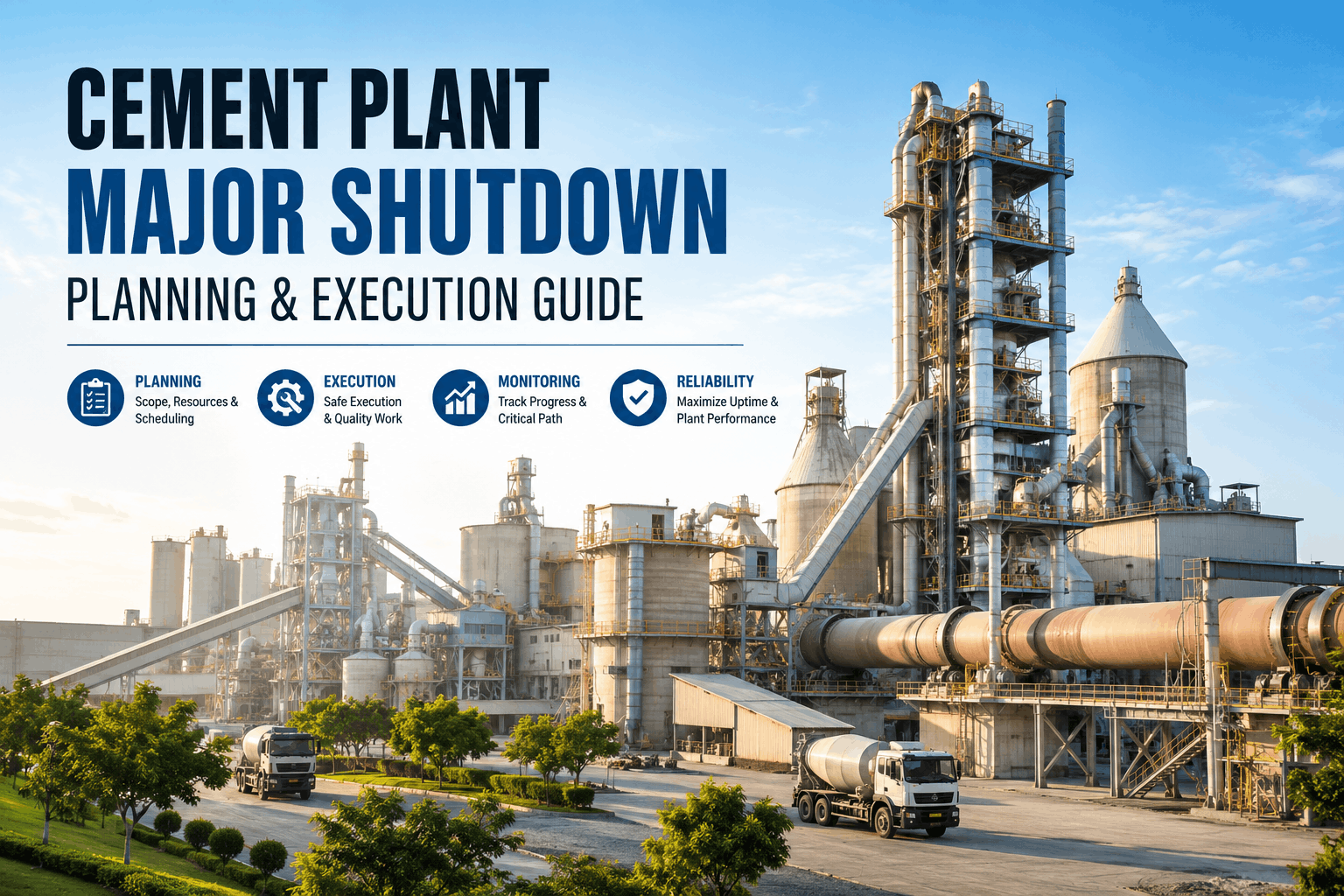
Cement Plant Major Shutdown Planning & Execution Guide
By Alex Jordan on July 3, 2026
A cement plant major shutdown is not a maintenance event — it is a coordinated intervention across mechanical, structural, refractory, electrical, and environmental systems compressed into a 12–20 day window where $1.5M–$3M of contractor labour, parts, and lost production value are at stake. A single day of unplanned extension costs $180K–$340K in lost clinker production at a 5,000 tonne-per-day facility. The economic pressure to "catch up on schedule" by cutting inspection corners or skipping preventive startup procedures is enormous — and the cost of rushing can be even larger than the overrun, as incomplete commissioning triggers equipment failures within days of restart. The difference between a cement plant that plans shutdowns with discipline and one that scrambles with crisis management is not talent — it is system design. A structured CMMS shutdown program compiles work scope from asset condition data 90 days ahead, sequences tasks on the critical path with dependency links, coordinates 100–300 contractors with qualification gates and digital permits, and executes with real-time progress tracking that surfaces critical path risks hours before they impact the schedule. Cement plants deploying AI-assisted shutdown planning combined with CMMS execution report 32% average shutdown duration reduction, cost variance improved from 40–65% to under 15%, and measurable reduction in post-shutdown trip failures that indicate commissioning shortcuts.
Cement Industry · Shutdown Planning · Execution
Cement Plant Major Shutdown Planning & Execution Guide
Complete framework for planning and executing cement plant annual shutdowns: kiln reline scope, raw mill overhaul, clinker cooler rebuild, critical path management, contractor coordination, and post-shutdown verification — with proven timelines and cost benchmarks from 50+ major shutdowns.
−32%Average shutdown duration reduction with AI planning and CMMS execution
−45%Cost variance improvement — from 50% overrun to 15% with structured CMMS programs
90 DaysAdvanced planning window — scope definition to critical path baseline before shutdown window opens
$2.3MAdditional annual production value recovered from 9 days saved — real case study at Turkey cement plant
The Shutdown Planning Crisis: From Clipboard to Chaos
A typical cement plant annual shutdown planning process starts four to six months before the outage window opens — but without structured data integration, those four months of planning effort do not reduce the chaos of the first shutdown day. Equipment inspectors generate PDFs of kiln shell scans and refractory thickness readings that sit in individual engineer folders. Production planning has a 12-week demand forecast that nobody in maintenance has seen — so a kiln reline scheduled against a fixed calendar date clashes with a peak demand week that nobody knew about. The first day the kiln cools, inspectors find refractory damage in zones that nobody tracked systematically because condition data was stored in spreadsheets that were last updated two months ago. Parts are on 8-week lead time and are not in-country. The shutdown extends four days beyond plan. That four-day extension alone costs $1.4M–$2.0M in lost production at a mid-size facility — completely preventable through structured data integration connecting asset condition records, demand forecasts, and supplier lead times into a single source of truth. A CMMS-driven shutdown program eliminates the data silos that create the chaos: condition scores for every major asset feed automatically into scope definition, production planning synchronizes with maintenance scheduling to avoid timing conflicts, and long-lead parts are ordered 90 days in advance when scope is locked, not discovered on day one when they are unobtainable.
Six-Phase Shutdown Planning & Execution Sequence
Phase 1
Scope Definition (6–4 Months Out)
Asset condition scores compiled from last 12 months of PM inspection data. Deferred maintenance backlog identified. Refractory burn-through history and campaign progression tracked. Equipment age and RUL projections reviewed. CMMS automatically generates work scope per asset with cost estimates and labour hour allocations.
Work tasks sequenced on critical path with dependency links — kiln reline (always critical), girth gear inspection, mill liner replacement, cooler grate repair sequenced with lead times and crew skills accounted for. Resource load plan created showing labour allocation per day against available technician and contractor capacity.
Critical
Phase 3
Contractor & Parts Procurement (2 Months Out)
Refractory bricks, spare liners, gearbox components, and mechanical parts ordered with 8–12 week lead times confirmed through supplier. Contractors qualified and mobilization dates locked. Pre-shutdown work — scaffolding, staging areas, temporary utilities — scheduled and resource allocated.
Essential
Phase 4
Execution & Real-Time Tracking (Live Shutdown)
Work orders loaded in CMMS for all contractor packages. Daily crew allocation adjusted from actual progress data. Coordinator dashboard shows critical path status, labour utilisation, and scope changes in real time. Hold-point inspections triggered per schedule. Permits issued and managed digitally. Delays surfaced within hours of onset.
Critical
Phase 5
Commissioning & Startup (Final 24–48 Hours)
Systematic startup checklist executed via CMMS. Every system tested, lubricated, and documented before kiln light-up. Cold-start temperature ramping verified per OEM requirements. Control systems calibrated and verified. No pressure to "catch up on schedule" by cutting corners — startup is methodical and documented.
Critical
Phase 6
Post-Shutdown Learning (Weeks 1–2 After Restart)
Actual vs. planned analysis generated automatically from CMMS work order data. Duration, cost, scope, and contractor performance scorecards reviewed within 48 hours of restart. Lessons learned documented and linked to next shutdown planning cycle. Asset condition scores updated based on shutdown inspection findings.
Essential
Shutdown Duration Benchmarks: Where Your Plant Stands
A kiln refractory reline on a 5,000 TPD facility typically runs 12–18 days depending on kiln size and scope complexity. Industry average for top-quartile performers is 12–14 days. Mid-tier plants average 15–18 days. Bottom-quartile plants often exceed 20 days. The difference is rarely technical — it is execution discipline: starting work on non-critical tasks only after critical path work is confirmed on schedule, deploying crews from non-critical jobs to support critical-path bottlenecks, and eliminating the first-day discovery surprises that destroy the carefully planned schedule. A CMMS system that recalculates critical path every shift from actual work order completion data allows coordinators to reallocate crews within hours of a delay appearing — recovering the schedule through smart resource management rather than overtime-driven heroics.
Shutdown Duration Benchmarks · By Plant Performance Tier (Days)
5,000 TPD facility · 12–18 day kiln reline turnaround
5
World-Class Performance (12–14 Days)
CMMS-managed with AI-assisted planning. Scope defined 90 days ahead from condition data. Critical path tracked hourly. Contractor performance monitored in real time. Pre-work completed before kiln cooldown. Zero day-one surprises. Crew redeployment from non-critical to critical path prevents schedule slip.
Characteristics: Planned ratio 80%+. PM compliance 85%+. Cost variance under 15%. Equipment failures after startup minimal. Repeatable performance across shutdowns.
4
Disciplined Execution (14–16 Days)
Structured shutdown program with defined milestones and critical path awareness. Contractor management partially digitized. Most scope defined in advance but some day-one discoveries occur. Crew scheduling reactive rather than proactive — delays extend shutdown rather than trigger resource redeployment.
Characteristics: Planned ratio 65–75%. Cost variance 20–30%. Equipment trips within first week of startup. Repeated delays on similar tasks across shutdowns indicate learning gaps.
3
Reactive Management (16–18 Days)
Minimal advanced planning. Scope discovered as kiln cools. Contractor coordination through daily meetings and radio calls. Limited visibility into critical path or resource allocation. Scope changes common because baseline scope was incomplete. Crew availability often discovered too late.
Characteristics: Planned ratio 50–60%. Cost variance 35–50%. Significant post-startup rework and equipment failures. Shutdown duration highly variable from year to year.
2
Crisis Management (18–22 Days)
Paper-based planning and contractor coordination. Extensive first-day surprises requiring scope changes. Contractor delays invisible until they cascade across multiple job sequences. Parts shortages discovered after design phases begin. Crew coordination chaotic with frequent idle time alternating with overtime crises.
Characteristics: Planned ratio under 50%. Cost variance 50–70%. Multiple equipment failures in first month post-startup. Shutdown costs often 80%+ above budget baseline.
1
Persistent Overrun (22+ Days)
No documented planning process. Shutdown unfolds reactively with management by crisis. Equipment conditions discovered post-cooldown add scope that was never anticipated. Contractors mobilized without pre-qualification. Parts unavailable. Crews idle waiting for work to be defined. Startup cut short to minimize extension — resulting in immediate failures.
Characteristics: Cost variance 70%+. Planned ratio under 40%. High post-startup trip frequency. Shutdown extends by 5–10 days unpredictably. Fire-fighting culture drives technician burnout.
The most advanced cement plants deploying shutdown planning in 2026 combine CMMS data with AI prediction to move from reactive crisis management to predictive optimization. AI models trained on historical shutdown data identify work sequencing patterns that correlate with schedule overruns — and flag them before planning is locked. Thermal robots enter kilns at 300°C (while cooldown is still in progress) and inspect refractory condition — eliminating the 4–6 day period where humans cannot enter but kiln data is unknown. This alone has compressed shutdown durations by 3–4 days at plants that deployed robotic inspection. Machine learning models on contractor performance data predict which vendors will likely slip schedule based on resource allocation and similar task history — allowing coordinators to pre-deploy contingency crews before problems emerge. These technologies are no longer exotic — they are operational at leading cement facilities and have become standard competitive practice for plants targeting world-class 12–14 day shutdown performance.
Scope Planning
90 Days
Advanced definition
Asset condition data compiled automatically into work scope per equipment class. Estimated labour hours, parts requirements, and budget allocation generated from CMMS asset templates. Scope locked 90 days before shutdown — no surprises on day one.
Critical Path
Hourly Update
Live recalculation
Critical path recalculated every shift from actual work order completion data. Buffer visibility per dependency chain. Coordinator can redeploy crews from non-critical to critical-path bottlenecks within hours of a delay appearing.
Contractor Coordination
300+ Contractors
Manageable dashboard
Each contractor work package visible with status, hold-point position, and permit status. Delays flagged automatically when milestones fall behind schedule. Reduces coordination radio traffic by 60% compared to manual methods.
AI Prediction
−3–4 Days
Duration reduction
Thermal robots inspect refractory condition at 300°C while cooldown in progress — locking scope days before human entry is safe. ML models predict contractor performance and flag resource risks before schedule impact occurs.
Frequently Asked Questions About Shutdown Planning with CMMS
How far in advance should shutdown planning begin?
6 months for major annual shutdowns, 8–12 weeks for mid-year maintenance shutdowns. CMMS scope definition should be locked 90 days before the outage window to allow long-lead parts ordering and contractor mobilization without expedite premiums.
What is a realistic time to add new scope after the shutdown plan is locked?
4 weeks before shutdown — after which scope additions require plant manager approval with automatic cost and schedule impact calculation visible in CMMS. This prevents the 3–7 day scope creep that destroys carefully planned schedules.
How do we know if a shutdown is on track before it becomes a crisis?
CMMS critical path dashboard updated hourly from work order completion data. Delays surface within hours of occurrence — allowing crew redeployment to corrective path before delays cascade. Without CMMS visibility, delays are often invisible until they compress the schedule irrecoverably.
What is the typical ROI of AI-assisted shutdown planning for a mid-size cement plant?
2–4 days of shutdown duration recovery per shutdown cycle × $180K–$340K per day value = $360K–$1.36M per shutdown. ROI achieved in first shutdown event. Additional improvements on shutdowns 2–3 as processes mature are pure gain.
How do we prevent schedule pressure from causing equipment startup shortcuts?
Systematic startup checklist built into CMMS with every system requiring digital sign-off before kiln light-up. Startup is methodical and documented — no pressure to "catch up" by cutting corners. Post-startup failures that indicate commissioning shortcuts are prevented before they occur.
Can we apply lessons from one shutdown to improve the next shutdown?
Yes — CMMS captures post-shutdown analysis automatically: variance analysis by work order, contractor performance scorecards, duration vs. planned, and cost vs. budget. Lessons learned are documented and linked to the next shutdown planning cycle for process improvement.
How does CMMS integrate with production planning to avoid scheduling conflicts?
Bidirectional integration with production planning systems syncs demand forecasts with maintenance schedules. A kiln reline scheduled against a calendar date vs. a low-demand window makes 3–5x difference in lost sales cost — CMMS ensures timing alignment, preventing $200K–$500K conflicts.
"
Our plant used to run shutdowns like a fire drill. We'd plan for 18 days, discover scope on day two, contractors would slip schedule, and we'd finish in 23–24 days — costing nearly $3M in lost production and overrun expenses annually. We implemented CMMS shutdown planning with critical path tracking. Our last shutdown came in at 14 days, 4 days early, with cost variance under 8%. That single improvement covered the CMMS annual cost 10+ times over. The second shutdown was even better as the team became familiar with the system.
Plant Operations Director, 5,000 TPD Integrated Cement Facility, USA
Getting Started: Your Shutdown Planning Roadmap
A typical shutdown planning program deployment starts 4–6 months before the first major shutdown you plan to manage with CMMS. Phase 1 (weeks 1–4) captures historical shutdown data, baseline performance metrics, and establishes asset condition baselines. Phase 2 (weeks 5–8) builds shutdown templates with kiln reline, mill overhaul, and cooler rebuild scope. Phase 3 (weeks 9–12) configures critical path dependencies, contractor work packages, and resource allocation rules. Phase 4 is your first live shutdown execution — where the system proves its value. Most cement plants report measurable improvements on shutdown #1, with significant gains on shutdowns #2–3 as the team optimizes processes and contractors internalize the CMMS workflow requirements. The long-term competitive advantage is not the first shutdown duration recovery — it is the knowledge capture and continuous improvement cycle that makes every subsequent shutdown more efficient and predictable.
Start Your Shutdown Planning Program This Quarter.
OxMaint shutdown planning reduces duration by 2–4 days and cost variance from 50% to under 15%. First shutdown plan live in 12 weeks. Book a demo to scope your next major turnaround.