A confined space entry at a preheater cyclone tower — without a current gas test, without a posted rescue team, and without a signed permit — costs a US cement plant an average OSHA citation of $156,000 per violation, plus the human consequence that no fine can address. In 2023, 74 percent of OSHA inspections at cement and mineral processing facilities found at least one permit-required confined space documentation failure. The permits existed on paper. The gas tests were performed. The rescue plans were written. The failure was in the connection — between what happened in the field and what was documented in a retrievable, auditable record. That gap is exactly what Oxmaint closes. Book a demo to see how Oxmaint digitizes cement plant safety permits, LOTO records, and confined space management across your full operation.
Cement plant safety management requires documented control of four high-consequence hazard categories: permit-required confined space entry (kiln shell, preheater tower, mill interiors), lockout/tagout energy isolation for rotating equipment, fall protection for elevated work on kiln platforms and conveyor structures, and respirable silica and cement dust exposure monitoring. Oxmaint digitizes every permit, isolation record, and hazard inspection — connecting field execution to auditable documentation automatically, without paper and without manual transfer.
The Four Safety Systems Where Cement Plants Carry the Highest Risk
Each system has its own regulatory requirement, its own documentation obligation, and its own failure mode when that documentation is managed on paper. Book a demo to see how Oxmaint structures all four into a unified digital safety management program.
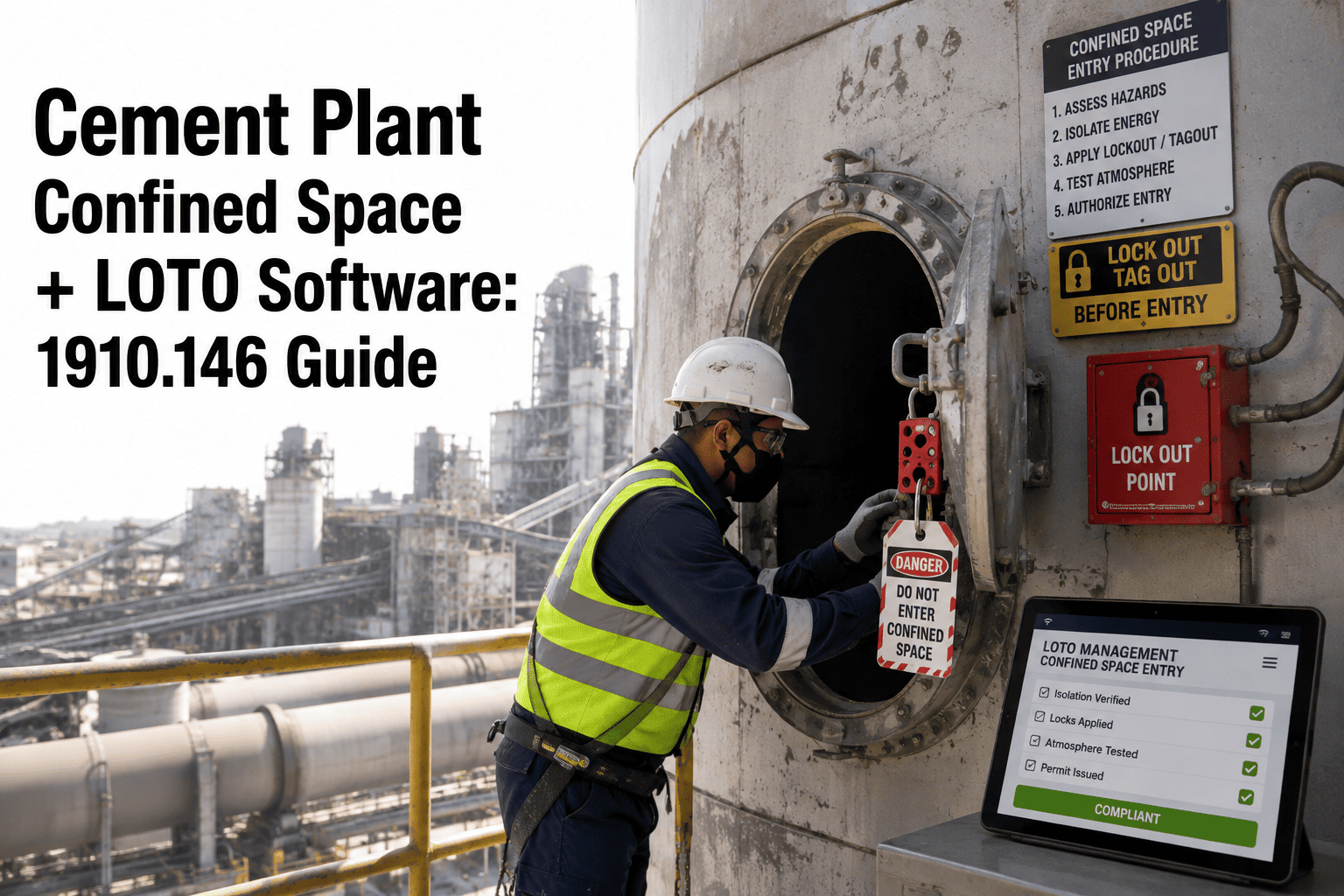
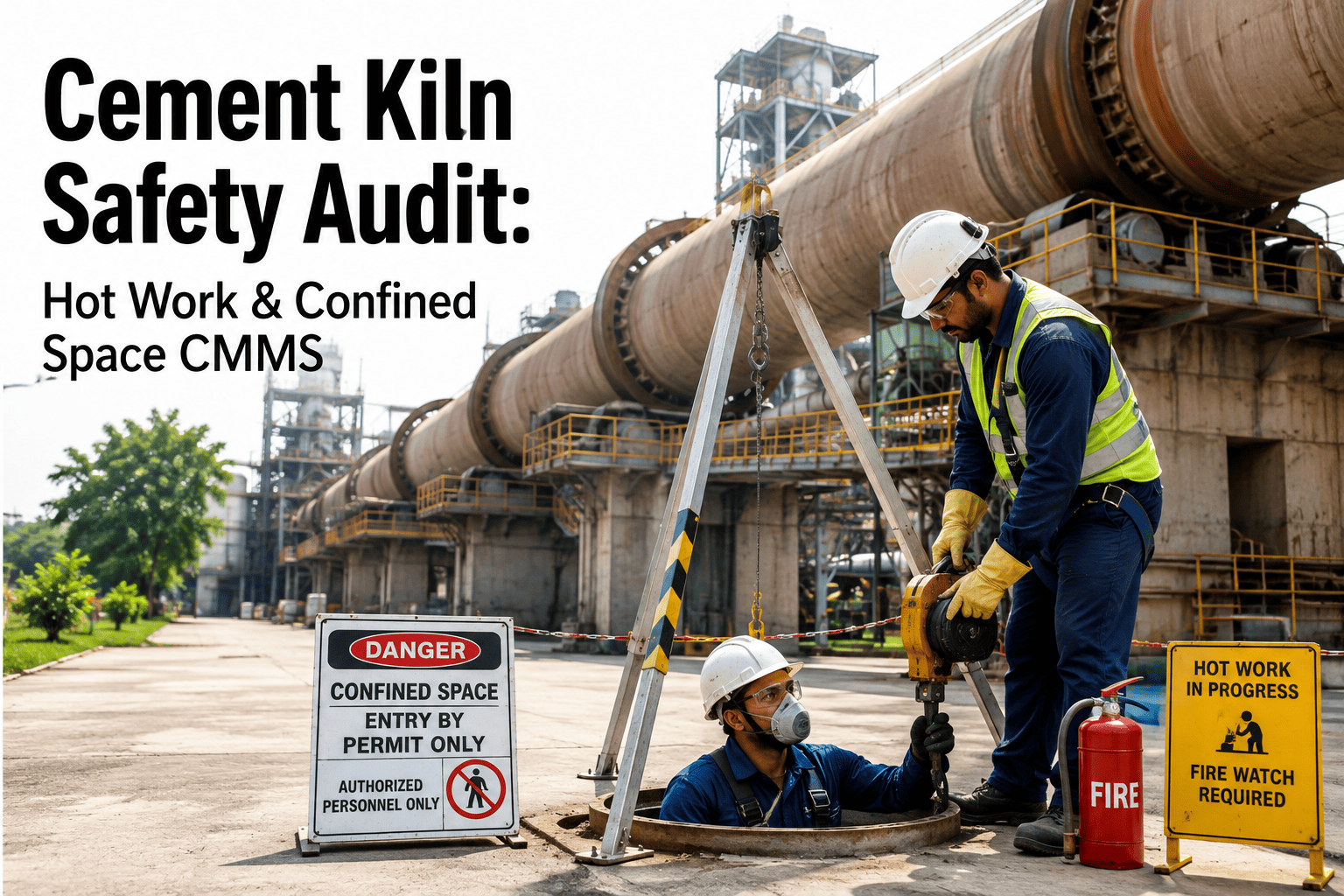
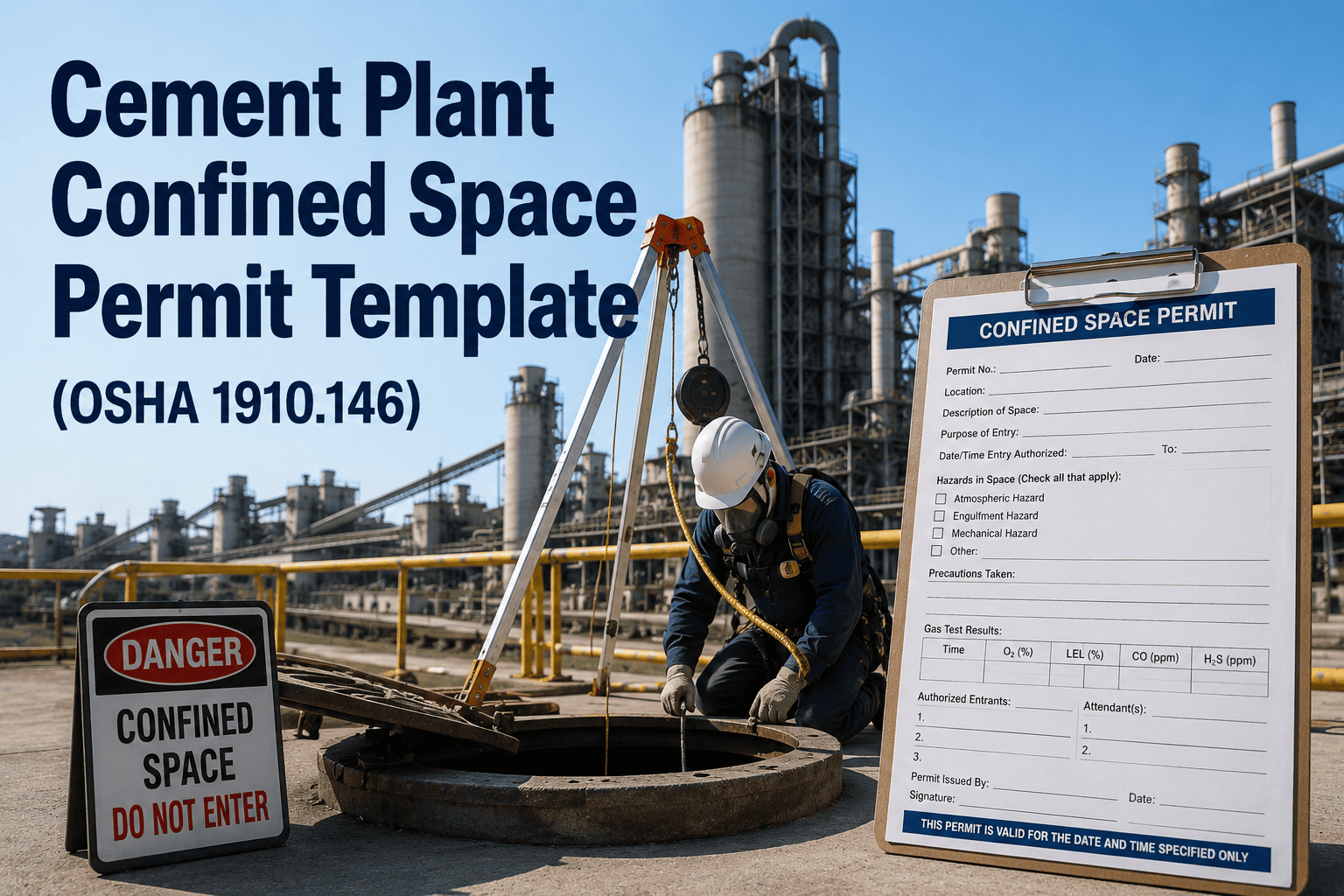
Rotary kiln shell, preheater cyclones, raw meal silos, clinker silos, ball mill interiors, and cement storage domes are all permit-required confined spaces. Each entry requires an atmospheric test record, an entry supervisor sign-off, a rescue team on standby, and a posted permit visible at the entry point. Oxmaint generates and routes the permit digitally, captures gas test readings at the point of entry, and archives the complete record against the asset automatically.
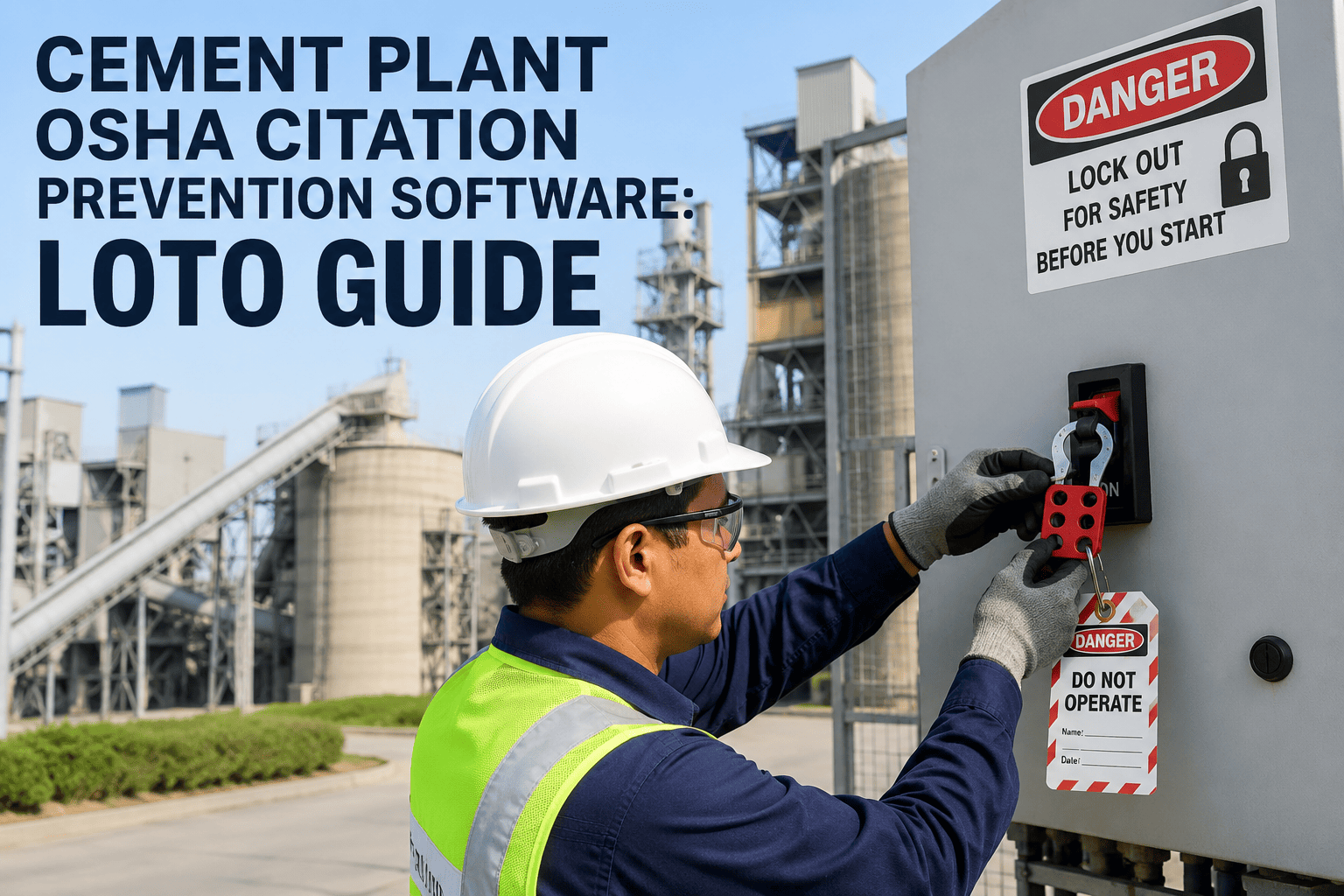
Kiln drive systems, raw mill drives, clinker cooler fans, and conveyor belt drives all require documented energy isolation before any maintenance activity. LOTO without a verified isolation checklist and individual technician lock records is a willful OSHA violation. Oxmaint generates LOTO work orders with equipment-specific isolation point checklists, captures each lock application with technician identity and timestamp, and prevents the work order from closing until all locks are documented removed.
Kiln platforms, preheater towers reaching 70 to 120 meters, conveyor walkways, and raw mill rooftops all require documented fall protection planning, harness inspection records, and anchor point certifications. At kiln shutdown, access by refractory crews to shell zones and internal platforms creates concentrated fall risk. Oxmaint links fall protection equipment inspection records to every confined space entry and elevated work permit — ensuring gear is current before work proceeds.
Respirable crystalline silica in raw meal grinding and cement clinker handling creates a documented occupational health obligation under OSHA's 2016 silica rule. Personal monitoring records, exposure assessments, and medical surveillance documentation must be maintained for 30 years per technician. Oxmaint manages the monitoring schedule, captures exposure reading records, and triggers automated alerts when exposure thresholds approach the OSHA action level of 25 micrograms per cubic meter.
Every Permit. Every Lock. Every Gas Test. Captured at the Point of Work — Not After.
Oxmaint generates confined space permits, LOTO checklists, and fall protection inspection records on mobile — completing documentation in the field, not reconstructed from memory at the end of the shift. Book a demo to see the safety permit workflow for your kiln and mill equipment.
Oxmaint Safety Management — Implementation Workflow and Roadmap
A structured deployment moves your cement plant from paper-based safety permits to a fully operational digital safety management system — without disrupting ongoing plant operations or existing safety protocols.
Every confined space, every energy isolation point, every elevated work location, and every silica-exposure workstation registered in Oxmaint's asset hierarchy with its safety category, regulatory code reference, and permit type. LOTO isolation point checklists built per equipment from existing plant isolation registers. Confined space classifications validated against OSHA 29 CFR 1910.146 definitions.
Confined space entry permits, LOTO isolation checklists, fall protection pre-work inspections, and dust exposure monitoring records configured as mobile-first digital forms in Oxmaint. Field technicians access permits via QR-scanned equipment tags — no paper, no manual form retrieval, no missing signatures. Gas test readings entered at the equipment, not transcribed later. Book a demo to see mobile permit completion for kiln confined space entry.
Oxmaint safety dashboard activated showing permit compliance rates, overdue monitoring tasks, outstanding corrective actions, LOTO log currency, and ISO 45001 hazard register status. Safety supervisor and plant manager views configured with role-appropriate data scope. Automated escalation alerts when permit frequencies are overdue or when silica exposure readings approach action thresholds.
All safety permit records, LOTO logs, incident reports, and corrective action closure evidence exportable in formats required for OSHA inspection responses, ISO 45001 surveillance audits, and insurance carrier safety reviews. ISO 45001 Clause 9.1 monitoring and measurement data produced automatically from Oxmaint records — no manual assembly before the auditor arrives.
Regional Safety Compliance Coverage
Cement producers operating across multiple jurisdictions face different safety regulatory obligations per market. Oxmaint's safety templates are pre-configured for each primary regulatory framework.
| Region | Primary Safety Frameworks | Key Cement Safety Requirements | Oxmaint Safety Coverage |
|---|---|---|---|
| USA / Canada | OSHA 29 CFR 1910 General Industry, OSHA 1910.146 Confined Space, OSHA 1910.147 LOTO, OSHA 1910.1053 Silica, MSHA Part 56/57, CSA Z1000 (Canada) | Permit-required confined space documentation, LOTO isolation registers, respirable silica monitoring records (30-year retention), MSHA surface mining safety for quarry operations | OSHA-aligned permit templates, LOTO isolation point checklists, silica exposure monitoring schedules, MSHA inspection record management, 30-year documentation retention in Oxmaint |
| Germany / EU | BetrSichV Machinery Safety, DGUV Rules for Cement Industry, EU Directive 2019/1152, DIN EN ISO 45001, TRGS 559 Mineral Dust | BetrSichV machine guarding and safety device inspections, DGUV cement-specific confined space requirements, TRGS 559 mineral dust exposure monitoring | BetrSichV inspection scheduling, DGUV-aligned permit forms, TRGS 559 exposure monitoring records, DIN EN ISO 45001 hazard register and corrective action management |
| UK | Confined Spaces Regulations 1997, COSHH Regulations 2002, PUWER 1998, LOLER 1998, Health and Safety at Work Act 1974, CDM Regulations 2015 | Confined space risk assessment and rescue plan documentation, COSHH dust exposure assessment records, PUWER equipment inspection registers, LOLER lifting equipment inspection records | UK Confined Spaces Regulations permit templates, COSHH exposure monitoring management, PUWER and LOLER inspection scheduling with certificate tracking, CDM construction phase safety records |
| Australia | Safe Work Australia Model WHS Regulations, Confined Spaces Code of Practice, Hazardous Chemicals regulations, State WorkSafe requirements (SafeWork NSW, WorkSafe VIC, etc.) | Confined space entry permits per AS 2865, hazardous chemical registers and SDS management, plant and equipment inspection registration, dust exposure monitoring under WHS regulations | AS 2865-aligned confined space permit templates, hazardous chemical register in Oxmaint, registered plant inspection scheduling, state-specific WorkSafe inspection records |
| Saudi Arabia / UAE | SASO Technical Regulations for Workplace Safety, Saudi MOMRA Safety Standards, UAE OSHAD-SF (Abu Dhabi OHS Framework), Civil Defence requirements, GCC unified safety standards | Civil Defence hot work and confined space permit requirements, OSHAD-SF hazard identification documentation, SASO machine safety inspection records, contractor safety management for large plant workforces | OSHAD-SF and SASO-aligned safety permit templates, Civil Defence hot work permit management, contractor safety induction tracking, multilingual mobile forms for diverse site workforces |
OSHA, ISO 45001, and Regional Safety Frameworks — One Digital System
Whether your cement operation runs under OSHA in North America, BetrSichV in Germany, or OSHAD-SF in the UAE — Oxmaint pre-configures the correct permit templates, monitoring schedules, and audit exports for your jurisdiction. Book a demo to see multi-region safety compliance configuration for your cement group.
Oxmaint vs Competing CMMS Platforms — Cement Safety Management
Most general-purpose CMMS platforms handle work orders — they do not handle permit-required confined space documentation, LOTO isolation registers, or ISO 45001 corrective action management configured for cement plant operations.
| Safety Capability | Oxmaint | MaintainX | UpKeep | Fiix | Limble | IBM Maximo | Hippo CMMS | Infor EAM |
|---|---|---|---|---|---|---|---|---|
| Cement-specific confined space permits | Yes | Generic | No | No | No | Custom | No | Custom |
| LOTO isolation point checklists per asset | Yes | Generic | Generic | Partial | Generic | Yes | Generic | Yes |
| Silica exposure monitoring schedule | Yes | No | No | No | No | Custom | No | Custom |
| ISO 45001 hazard register and CAPA | Yes | No | No | Partial | No | Yes | No | Partial |
| Gas test readings captured at entry point | Yes | Generic | No | No | No | Custom | No | Custom |
| OSHA audit export — ready in under 2 hours | Yes | Partial | Partial | Partial | Partial | Yes | Partial | Yes |
| Fall protection equipment inspection tracking | Yes | Generic | Generic | Generic | Generic | Yes | Generic | Yes |
| Multilingual mobile forms for site crews | Yes | Yes | Partial | Partial | Partial | Yes | Partial | Yes |
| Deployment in weeks without consultant | Yes | Yes | Yes | Varies | Yes | No | Yes | No |
| Contractor safety induction tracking | Yes | Generic | No | No | No | Yes | No | Partial |
Safety Management KPI Benchmarks — Cement Industry
Client Results — Cement Plants Using Oxmaint Safety Management
These outcomes are drawn from cement plant deployments where Oxmaint's digital safety permit system replaced paper-based confined space, LOTO, and monitoring programs within the first year of operation.
From 62% to 98% Permit Compliance — in 90 Days
Cement plants that move from paper permits to Oxmaint's digital safety management system close the documentation gap before the next OSHA inspection — not after. Book a demo to see your current permit compliance gap identified in the first deployment session.
Oxmaint Safety Platform Features for Cement Plants
Confined space, hot work, and elevated work permits generated and signed on mobile — gas test readings captured at the equipment, rescue team confirmation logged before entry authorized.
Equipment-specific lockout isolation point checklists — each lock application captured with technician identity, timestamp, and photo. Work order cannot close until all locks are documented removed.
OSHA 1910.1053-aligned monitoring schedules per worker and workstation — automated alerts when sampling intervals are due, readings logged against employee record for 30-year retention.
Hazard identification, risk assessment records, and corrective action closure tracked against ISO 45001 Clause 10.2 requirements — with automated escalation when CAPA deadlines are missed.
Every harness, lanyard, anchor point, and safety net registered in Oxmaint with inspection due date — inspection records linked to confined space entry and elevated work permits requiring gear currency verification.
Every contractor's site induction, competency verification, and safety certification tracked in Oxmaint — gate access integration available to block site entry until induction is confirmed current in the system.
Safety Documentation: Before and After Oxmaint
| Safety Documentation Area | Before Oxmaint | After Oxmaint |
|---|---|---|
| Confined space permit retrieval for OSHA | 3 to 5 days searching physical files | Under 10 minutes from Oxmaint search |
| LOTO isolation point documentation | Handwritten log books — illegible and incomplete | Digital record per lock, per technician, per timestamp |
| Silica monitoring record retention | Spreadsheets at plant level — no centralized 30-year archive | Centralized per-employee record with automatic 30-year retention |
| ISO 45001 audit preparation time | 3 weeks of manual record assembly | 2-hour automated export from Oxmaint |
| Overdue permit identification | Not identified until OSHA inspection | Automatic alert at 7-day and 1-day intervals before due date |
| CAPA closure tracking | Average 47 days to close, no escalation visibility | Average 12 days to close with automated escalation at day 20 |
| Contractor induction currency at site entry | Paper registers at gatehouse — not verified at time of entry | Real-time induction status verified in Oxmaint before site access granted |
Frequently Asked Questions
Continue Reading
Connected resources in the cement plant safety, environmental, and compliance cluster
Close the Safety Documentation Gap Before the Next OSHA Inspection
Digital confined space permits, LOTO isolation tracking, silica exposure monitoring, and ISO 45001 CAPA management — all live in Oxmaint within 4 to 6 weeks, no IT project required. Book a demo with your plant safety manager and see the full permit workflow configured for your kiln, mill, and conveyor equipment.