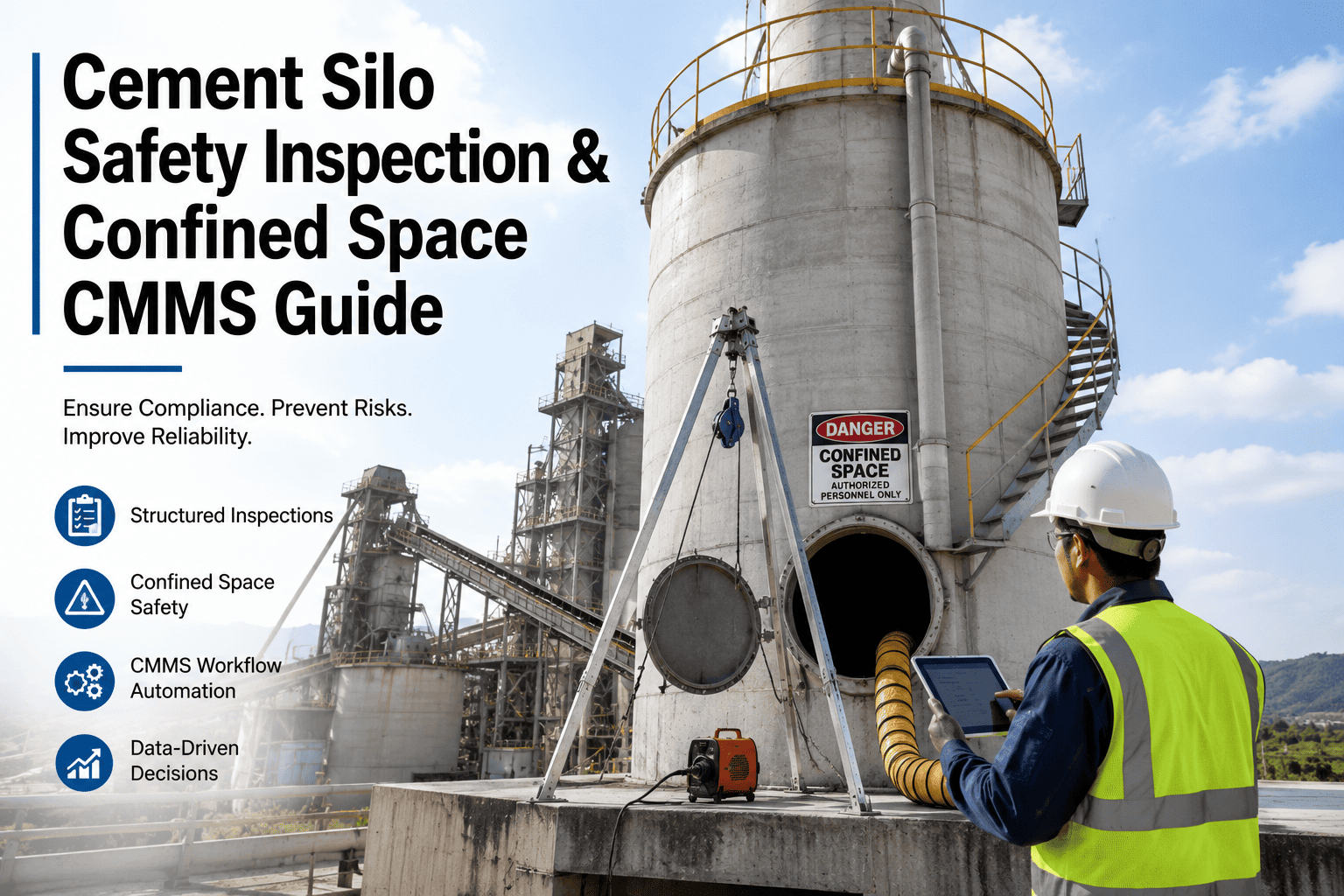
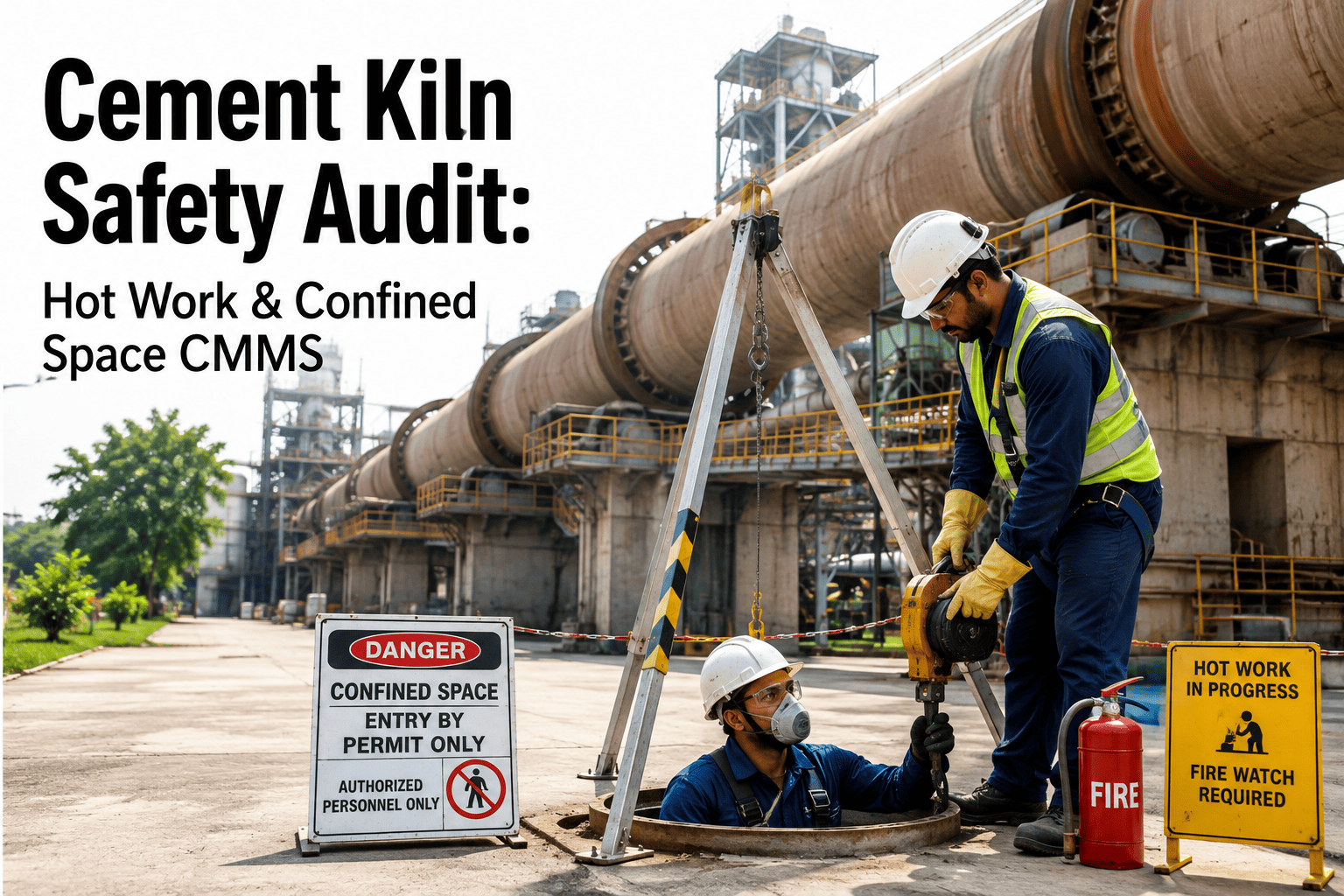
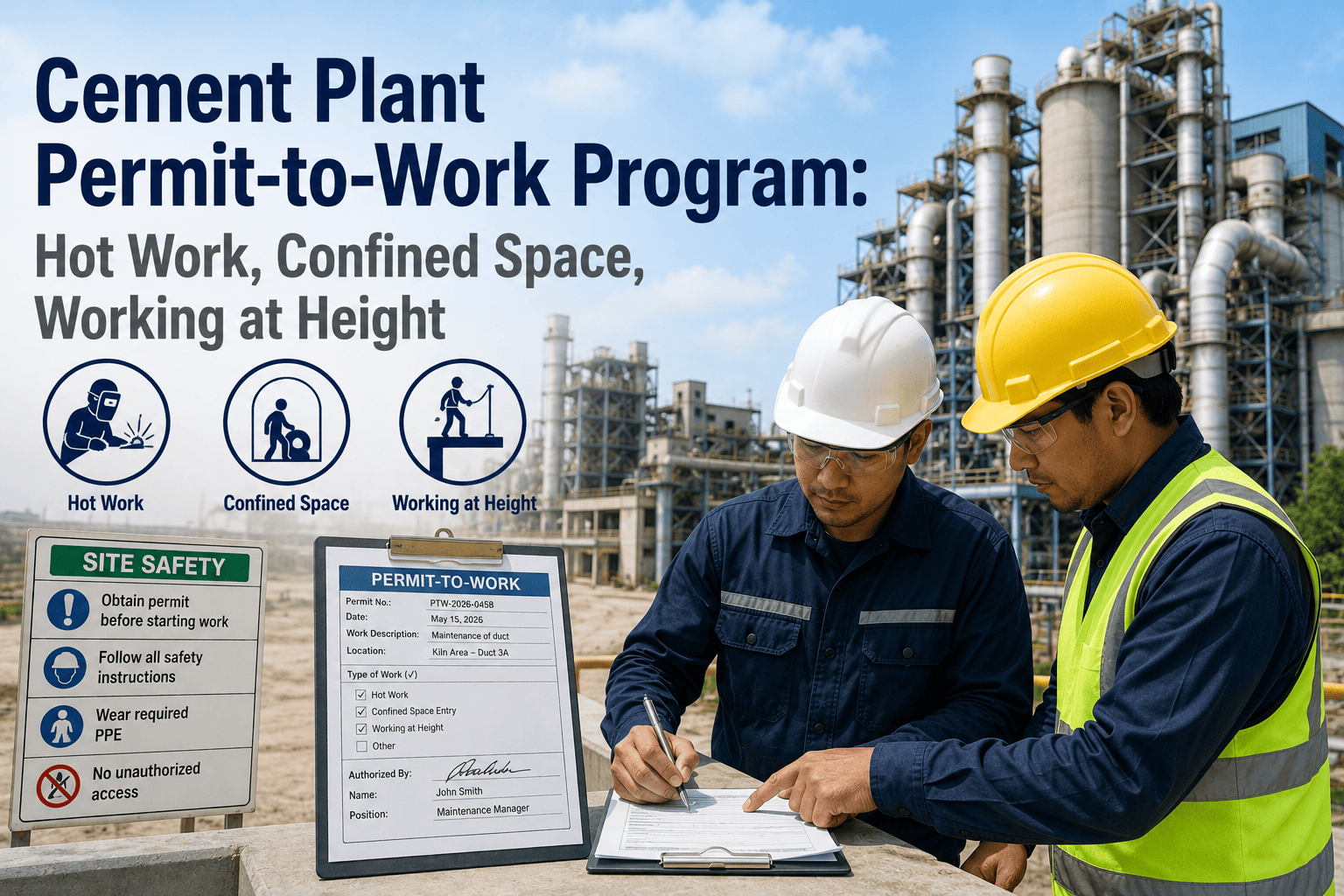
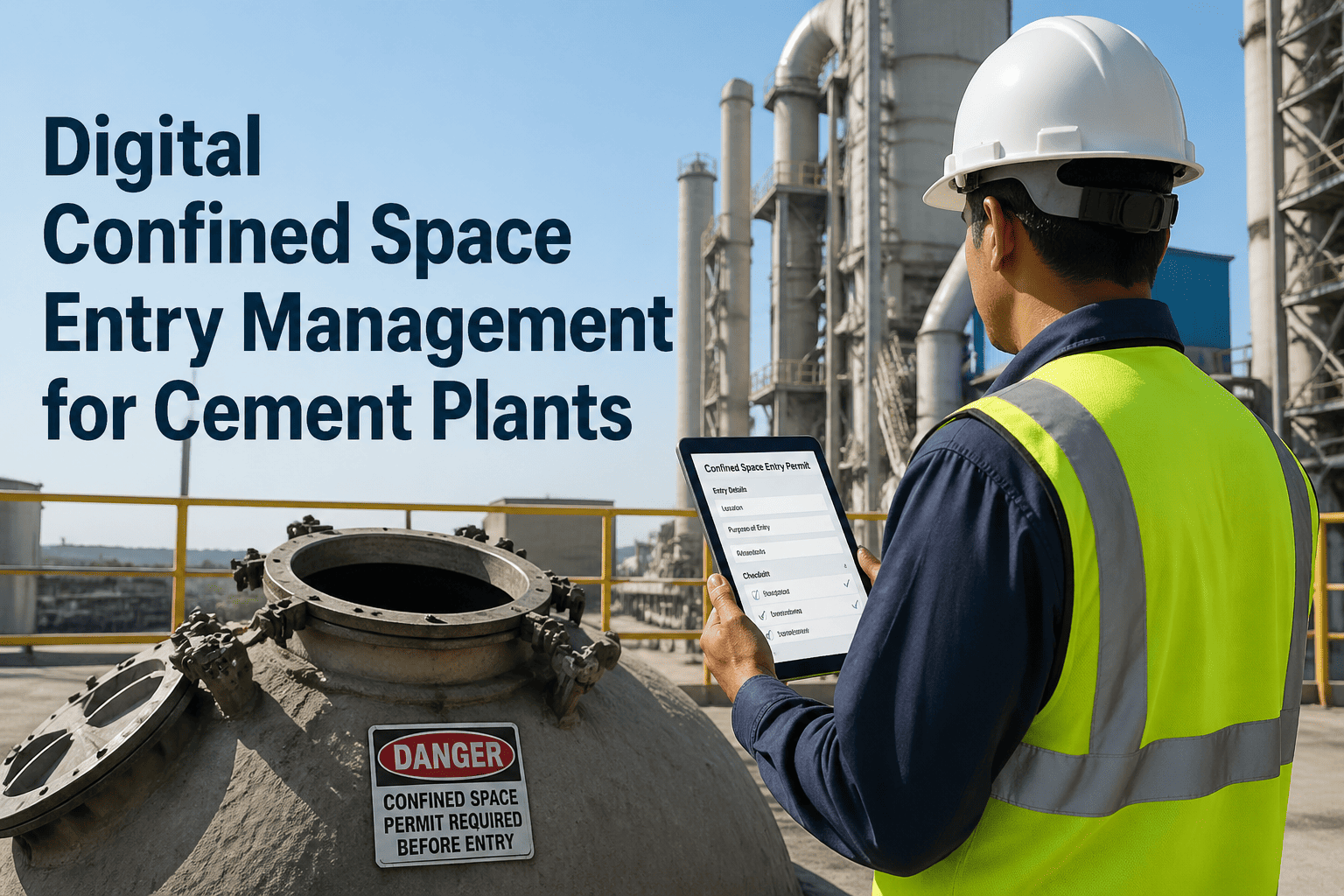
A cement plant contains more confined spaces per square meter than almost any other industrial facility. Preheater cyclones, raw meal silos, clinker silos, cement silos, ball mills, the kiln shell, cooler compartments, coal hoppers, bag filter housings, process vessels, and underground tunnels — every one capable of killing a worker in minutes. Confined space fatalities follow a tragically predictable pattern: insufficient atmospheric testing, expired or missing permits, untrained would-be rescuers who become additional victims. In the cement industry, confined space incidents account for approximately 15% of all workplace fatalities, with a horrifying statistic: for every worker who dies in a confined space, 1.5 additional workers die attempting rescue without proper equipment or training. Every single one of these deaths is preventable with proper digital permit enforcement, continuous atmospheric monitoring, and CMMS-integrated entry tracking.
15%
Of cement fatalities are confined space
60%
Of confined space deaths are failed rescuers
90%
Of incidents involve inadequate atmospheric testing
100%
Preventable with proper digital enforcement
Identifying Confined Spaces: The Cement Plant Inventory
The first step in any confined space program is a complete inventory. Cement plants typically contain 40–80+ classified confined spaces, each with different hazards and entry requirements. Missing even one from your register is a regulatory violation — and potentially a death sentence.
Raw Meal / Cement Silos
Engulfment from material collapse, O₂ depletion from material off-gassing, fall from height (15–40m internal), dust explosion potential. Material can bridge and collapse without warning — standing on a "solid" surface that is actually a thin crust over a void.
O₂ Depletion
Engulfment
Fall (15–40m)
Dust Explosion
Entry frequency: 2–4x per year (inspection, cleaning, maintenance)
Kiln Shell (during shutdown)
Residual heat (>60°C for 24–48 hrs after shutdown), refractory brick fall hazard, CO/CO₂ accumulation, restricted access through kiln hood or cooler end. Kiln rotation must be absolutely prevented — accidental rotation while workers are inside is immediately fatal.
CO/CO₂
Extreme Heat
Falling Brick
Rotation Risk
Entry frequency: 1–3x per year (refractory relining, inspection)
Preheater Cyclones & Risers
CO gas accumulation (combustion gases persist after kiln shutdown), extreme heat in upper stages, material fall from cyclone walls and buildup, height exposure (60–120m). Access often requires rope work or confined space within confined space (manhole into cyclone from platform).
CO Accumulation
High Heat
Material Fall
Height (120m)
Entry frequency: 2–6x per year (buildup removal, inspection)
Ball Mills (Raw / Cement)
Rotation hazard (mill must be locked, de-energized, and mechanically blocked), noise exposure during entry even when stopped (metal structure), respirable dust, restricted egress through small manhole openings. Mill internals (liners, grinding media) present crush and impact hazards.
Rotation Risk
Restricted Egress
Dust Exposure
Crush/Impact
Entry frequency: 4–8x per year (liner change, media charge, inspection)
Clinker Cooler Compartments
Residual heat from clinker (can exceed 100°C for hours after shutdown), mechanical hazards from grate drive mechanisms, dust exposure, restricted space between grate plates and housing. Hot clinker "red rivers" can persist in dead zones.
Residual Heat
Grate Drives
Dust
Entry frequency: 2–4x per year (grate plate replacement, inspection)
Bag Filters / ESP Housings
Fine particulate dust (respirable fraction), limited visibility, restricted access and egress, potential energy stored in rapper mechanisms. Accumulated dust on surfaces can become mobile (engulfment risk) if disturbed during cleaning operations.
Respirable Dust
Restricted Egress
Stored Energy
Entry frequency: 4–12x per year (bag replacement, cleaning, inspection)
Atmospheric Monitoring: The Life-or-Death Parameters
Atmospheric hazards kill faster than any other confined space danger — oxygen depletion can cause unconsciousness in 15 seconds and death in minutes. Continuous monitoring isn't optional; it's the difference between a safe entry and a body recovery.
Oxygen (O₂)
Most common confined space killer in cement. Material off-gassing and chemical reactions consume O₂.
DANGER <16%
SAFE 19.5–23.5%
>23.5%
0%16%19.5%23.5%25%+
Below 19.5%: DO NOT ENTER. Ventilate and re-test. If below 16%, treat as IDLH — evacuate immediately if already inside.
Carbon Monoxide (CO)
Accumulates in preheater, kiln, and any space connected to combustion gas paths. Odorless and lethal.
SAFE <25 ppm
CAUTION 25–50
DANGER >50 ppm → EVACUATE
0 ppm25502001,200+ (IDLH)
Above 25 ppm: Enhanced ventilation required. Above 50 ppm: Exit immediately, increase ventilation, re-test before re-entry.
Carbon Dioxide (CO₂)
Heavier than air — pools in pits, tunnels, and lower levels of vessels. Cement raw materials release CO₂ during storage.
SAFE <0.5%
CAUTION 0.5–1.5%
DANGER >1.5% → EVACUATE
0%0.5%1.5%3%4%+ (IDLH)
Above 0.5%: Investigate source, increase ventilation. Above 1.5%: Exit space. At 3%+: headache, dizziness. At 4%+: IDLH — rapid incapacitation.
Lower Explosive Limit (LEL)
Coal dust, fuel oil vapors, and alternative fuel residues create explosion risk in mill, burner, and fuel system spaces.
SAFE <10% LEL
CAUTION 10–25%
DANGER >25% LEL → EVACUATE
0%10%25%50%100% LEL
Above 10% LEL: No hot work, eliminate ignition sources, increase ventilation. Above 25%: Evacuate immediately — explosion imminent at 100% LEL.
Critical rule: Pre-entry testing alone is NOT sufficient. Atmospheric conditions change during work — ventilation can fail, disturbed material releases gases, welding consumes oxygen. Continuous 4-gas monitoring for the entire duration of entry is mandatory. Digital CMMS systems can auto-expire permits if gas monitor readings breach thresholds.
Automate Atmospheric Monitoring Compliance
OXmaint links gas monitor readings to digital permits — if thresholds breach, the permit auto-suspends and alerts the entry supervisor, attendant, and plant safety team simultaneously.
The 8-Step Digital Confined Space Entry Workflow
Paper permits fail because they can't enforce sequencing — nothing stops someone from skipping the atmospheric test or entering before the attendant is confirmed. A digital workflow enforces every step in order, with no bypass possible.
1
Work Order Initiation
Entry request originates from a CMMS work order. The system identifies the asset as a classified confined space and auto-attaches the confined space entry permit template. The correct permit type (entry, hot work, combined) is selected based on the work scope.
GATE: Work order must exist before permit can be created
2
Hazard Assessment & Isolation
Digital checklist of all energy sources requiring isolation: electrical, mechanical (rotation, conveyors), pneumatic (air slides), hydraulic, gravity (material above), thermal, and chemical. Each isolation point must be confirmed with a LOTO tag number linked to the CMMS.
GATE: All listed isolation points must be verified before proceeding
3
Atmospheric Testing (Pre-Entry)
4-gas monitor readings recorded: O₂, CO, CO₂, LEL. Testing must be done at top, middle, and bottom of the space (gases stratify by density). Results logged digitally with timestamp. System auto-checks readings against permit thresholds — if any reading is out of range, the permit cannot advance.
GATE: All 4 gas readings must be within safe limits at all 3 levels
4
Personnel Verification
System verifies: entrant has current confined space training certification, medical fitness certificate is valid, entry supervisor is qualified and present, attendant is assigned (1:1 ratio for extreme risk spaces), rescue team is standing by with equipment. Digital sign-on creates a real-time headcount.
GATE: All personnel certifications must be current — expired = entry blocked
5
Rescue Plan Confirmation
Rescue method confirmed and documented: self-rescue, non-entry rescue (retrieval system), or entry rescue. Retrieval system rigged and tested. Rescue team briefed on entry point, number of entrants, and space layout. Communication method confirmed (radio, lifeline signals, visual).
GATE: Rescue plan must be documented and rescue team confirmed as ready
6
Permit Approval & Entry
Entry supervisor reviews all completed gates, signs digitally, and activates the permit. Permit is now LIVE with a countdown timer (max 8-hour validity for standard entry, 4 hours for extreme-risk spaces). All entrants digitally sign in at the entry point — their names appear on the live entry register visible to the control room.
GATE: Supervisor digital signature required — permit timer starts
7
Continuous Monitoring During Entry
Continuous 4-gas monitoring throughout the entry. Attendant maintains visual or voice contact with all entrants. Digital permit displays real-time gas readings if linked monitors are used. System sends periodic check-in prompts (every 30 min) — if attendant doesn't confirm, auto-escalation is triggered.
GATE: Any gas reading breach → permit auto-suspends → evacuation alert
8
Exit, Close-Out & De-Isolation
All entrants digitally sign out. Attendant confirms all personnel have exited. Entry supervisor inspects space and confirms tools/materials removed. Permit closed digitally. LOTO removal authorized only after permit closure. Post-entry debrief captures any observations for future risk assessments — fed back into the CMMS confined space register.
GATE: All entrants must sign out before LOTO can be removed
Rescue Planning: The Three-Tier System
The #1 rule of confined space rescue: never enter a confined space to rescue someone unless you are trained, equipped, and authorized. Untrained rescue attempts are the leading cause of multiple-fatality confined space incidents. Every entry must have a pre-determined rescue tier assigned.
When: Entrant is conscious, mobile, and can exit under own power. Early warning from gas monitor or attendant signal.
How: Entrant exits through entry point or emergency exit immediately upon alarm or attendant instruction. No intervention required from outside.
Requirements: Clear egress path, entrant physically capable, communication system working, atmospheric conditions allow safe exit.
When: Entrant is incapacitated but connected to retrieval system. Space geometry allows extraction through entry point without rescuer entry.
How: Attendant activates mechanical retrieval system (tripod + winch) to extract entrant through entry opening. No one enters the space.
Requirements: Full-body harness with D-ring, retrieval line connected to mechanical device (tripod/davit arm), line of sight to entrant, entry opening aligned with extraction path.
When: Non-entry rescue is not possible (complex geometry, entrant not connected to retrieval, horizontal entry). Only trained rescue team members may enter.
How: Rescue team enters with SCBA/airline, secondary retrieval line, medical kit. Minimum 2 rescuers enter while attendant + backup maintain external support. External emergency services on standby.
Requirements: Trained confined space rescue team (annual drill certification), SCBA rated for atmosphere, rescue stretcher/basket, communication equipment, standby EMS notification.
Target: <15 minutes (on-site team) / <30 min (external)
Track Every Permit, Every Entry, Every Rescue Drill
OXmaint manages your complete confined space program — from space classification to permit enforcement to rescue drill scheduling and compliance tracking.
Confined Space Entry Equipment Checklist
No entry should proceed without every item on this list verified and documented in the digital permit. Missing or malfunctioning equipment is a permit rejection — no exceptions.
☐ 4-gas detector (O₂, CO, CO₂/H₂S, LEL) — calibrated within 24 hrs
☐ Spare sensor cartridges available on site
☐ Sampling pump + extension tubing for pre-entry remote testing
☐ Full-body harness with dorsal D-ring (inspected, in-date)
☐ Hard hat with chin strap
☐ Safety boots (steel toe, chemical resistant where required)
☐ RPE (P3 minimum for dusty environments; SCBA for IDLH potential)
☐ Gloves appropriate to task and environment
☐ ATEX-rated headlamp / intrinsically safe torch
☐ Tripod + mechanical winch (rated for heaviest entrant + 25%)
☐ Retrieval line attached to entrant harness D-ring
☐ SCBA sets for rescue team (2 minimum, tested and charged)
☐ Rescue stretcher / basket (fits through entry opening)
☐ First aid kit with resuscitation equipment at entry point
☐ Two-way radio (intrinsically safe rated) or lifeline signal system
☐ Forced-air ventilation fan (explosion-proof for LEL risk spaces)
☐ Flexible ducting to deliver air to lowest point of space
☐ Warning signs and barriers at entry point
Anatomy of a Confined Space Fatality: What Goes Wrong
Investigations of confined space fatalities in cement plants reveal a frighteningly consistent failure chain. Understanding this sequence is critical because digital systems can break the chain at every link.
T - Days
Root Cause: Maintenance Demand
A buildup develops in a preheater cyclone, or a silo level sensor fails requiring manual inspection, or a ball mill liner needs replacement. A work order is created — but in paper systems, the confined space permit requirement may not auto-attach.
Digital break: CMMS auto-classifies the asset as confined space and requires permit attachment before work order scheduling.
T - Hours
Failure 1: Inadequate Pre-Planning
Permit issued based on generic hazard assessment rather than current conditions. Atmospheric testing scheduled but not yet completed. Isolation list copied from last entry without verifying current connections. Rescue plan is "call the fire brigade" with no on-site capability.
Digital break: System blocks permit approval until all pre-conditions are completed with timestamped evidence, including fresh atmospheric readings.
T - Minutes
Failure 2: Entry Without Valid Conditions
Worker enters space with expired or incomplete permit. Atmospheric test was done at top of space but not at bottom where CO₂ accumulates. Attendant is "covering" two entries simultaneously. Retrieval system not rigged because "it's just a quick look."
Digital break: Permit timer expires → entry blocked. Incomplete gas readings → permit cannot be activated. Worker digital sign-in enforces 1:1 attendant ratio.
T = 0
Failure 3: Atmospheric Change During Entry
Material shift releases trapped CO₂. Ventilation fails or was inadequate. Welding consumes O₂ in an already marginal atmosphere. Worker collapses without warning — in oxygen-depleted environments, there is no sensation of suffocation; the victim simply loses consciousness.
Digital break: Continuous gas monitoring with auto-alarm. Permit auto-suspends on threshold breach. Immediate evacuation notification to all stakeholders.
T + Minutes
The Cascade: Failed Rescue Attempts
Co-worker sees victim collapsed and enters without respiratory protection — becomes second victim within 30 seconds. Third person enters — third victim. This cascade is responsible for 60% of all confined space deaths. The untrained impulse to help is the deadliest response.
Digital break: Emergency protocol auto-activated at T=0, with explicit "DO NOT ENTER" alert to all site personnel. Only trained rescue team with SCBA authorized to enter. Rescue team pre-positioned and pre-briefed as part of the digital permit.
Break the Fatal Chain at Every Link
OXmaint's digital confined space system enforces every gate — from permit creation to atmospheric verification to rescue plan confirmation. No shortcuts. No expired permits. No unauthorized entries.
Frequently Asked Questions
What qualifies as a confined space in a cement plant?
A confined space is any area that is large enough for a worker to enter and perform work, has limited or restricted entry/exit points, and is not designed for continuous human occupancy. In cement plants, this includes silos, ball mills, kilns, cyclones, hoppers, bins, bag filter housings, cooler compartments, tanks, pits, tunnels, and ducts. A permit-required confined space additionally has one or more of: hazardous atmosphere potential, engulfment risk, converging walls/floors, or any other recognized serious safety hazard.
How often should atmospheric testing be done during a confined space entry?
Atmospheric testing must be done before initial entry (at multiple levels within the space) and then continuously during the entire duration of occupancy. "Before entry" means within 30 minutes of the first person entering — not hours or shifts earlier. If continuous monitoring is interrupted for any reason (monitor failure, worker exits and re-enters), the space must be re-tested before re-entry. Best practice is personal 4-gas monitors on every entrant plus a fixed monitor at the entry point.
What is the role of the confined space attendant?
The attendant is the critical safety link. Their responsibilities include: maintaining continuous contact with all entrants (visual or voice), monitoring atmospheric conditions, maintaining an accurate count of who is inside the space at all times, ordering evacuation if conditions change, preventing unauthorized entry, and initiating the emergency response plan if rescue is needed. The attendant must NEVER enter the confined space for any reason — including to attempt rescue. In extreme-risk spaces, a 1:1 attendant-to-entrant ratio is required.
What is the maximum duration for a confined space entry permit?
There is no universal regulatory maximum, but best practice in cement plants is 8 hours maximum for standard confined spaces and 4 hours for extreme-risk spaces (kilns, silos with engulfment potential). If work extends beyond the permit duration, a new permit must be issued with fresh atmospheric testing and all pre-entry checks repeated. Digital permit systems enforce this automatically through countdown timers that cannot be extended without full re-authorization.
Why do so many people die trying to rescue confined space victims?
The instinct to rush in and help a fallen colleague is overwhelming — but in an atmosphere that has already incapacitated one person, an unprotected rescuer will be incapacitated just as quickly (often within 15–30 seconds in oxygen-depleted environments). The rescuer doesn't realize the danger because many lethal atmospheric hazards are invisible and odorless. This is why rescue planning is a mandatory part of every confined space entry: the plan must be in place before anyone enters, so that when an emergency occurs, the response follows protocol rather than instinct.
How does a CMMS improve confined space safety?
A CMMS improves confined space safety by: auto-classifying assets as confined spaces and requiring permits when work orders are created for these assets; enforcing the entry workflow (atmospheric testing, isolation verification, personnel certification, rescue plan) in a sequence that cannot be bypassed; tracking all entries with timestamps, gas readings, and personnel records for regulatory compliance; scheduling and tracking rescue equipment inspections, gas monitor calibrations, and rescue team training certifications; and building a historical database that identifies which spaces have the most entries, the most atmospheric issues, and the highest risk profiles for targeted improvement.