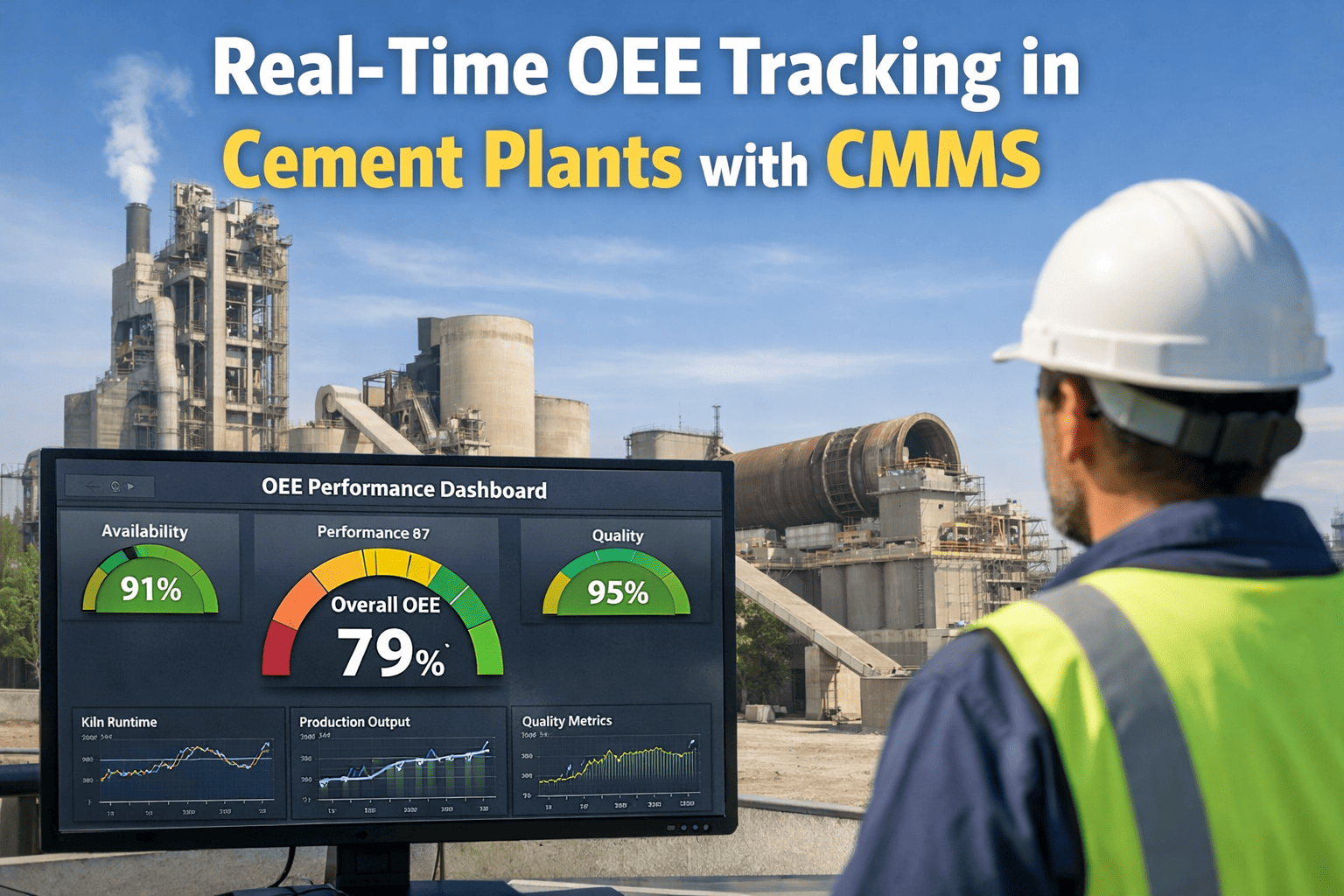
A 3,000 TPD cement kiln producing at 70% OEE against a world-class benchmark of 85% is quietly losing 450 tonnes of clinker every single day — but the plant manager will not see that number until the morning production meeting tomorrow. By then the shift is over, the operator who could have intervened has gone home, and the drift that caused it is already baked into the monthly report. This is the core failure of spreadsheet-based OEE tracking in cement: it is not a measurement problem, it is a latency problem. The gap between when OEE starts falling and when someone with authority to act finds out about it is where the money disappears. A CMMS-integrated real-time OEE dashboard closes that gap to seconds — feeding kiln availability, mill throughput, and lab quality data into a single live score that triggers maintenance work orders the moment a threshold is breached, so interventions happen before the shift ends, not after the quarter closes. To see how live OEE dashboards connect to maintenance execution in one platform, start a free OxMaint trial.
Real-Time OEE Tracking · Cement Plants · CMMS Dashboard Integration
Real-Time OEE Tracking in Cement Plants with CMMS
Stop calculating OEE in spreadsheets two days after the production loss happened. Connect kiln availability, performance, and quality into a live score that triggers maintenance interventions before OEE collapses.
65%
Typical cement plant OEE — vs 85% world-class benchmark
450 TPD
Clinker lost at 70% OEE vs world class on a 3,000 TPD line
$20K–$85K
Cost per hour of unplanned kiln downtime
14 days
Average lag from fault detection to work order in manual systems
The Real Problem Is Not OEE. It's the Time Between When OEE Drops and When Anyone Knows.
Every cement plant calculates OEE. Most calculate it in a spreadsheet at the end of the shift, the end of the day, or worse, the end of the month. The calculation is correct. The timing makes it useless for operational decisions. By the time the production team sees that yesterday's availability ran at 78%, the kiln refractory hot spot that caused the morning trip is already the plant's problem, the cooler grate that was throttling performance has already fed out-of-spec clinker into the mill, and the opportunity to intervene while the loss was still small is gone.
The Latency Ladder — Where Your OEE Data Actually Lives
Each rung shows how long it takes before a production loss becomes visible to someone with authority to intervene. Every hour added to the ladder is an hour of unrecoverable loss.
28–48 hrs
Monthly Excel rollup
Loss is discovered at month-end review. Root cause is already cold. Intervention impossible.
12–24 hrs
Daily shift logbook + spreadsheet
Yesterday's OEE discussed in morning meeting. The shift that could have fixed it has already ended.
2–6 hrs
SCADA historian with manual pull
Supervisor queries SCADA at shift change. Loss is visible but not linked to a work order.
30–60 sec
CMMS-integrated live OEE dashboard
Operator sees drift the moment it begins. Threshold breach auto-generates a work order. Intervention happens in-shift.
What a Real-Time Cement Plant OEE Dashboard Actually Watches
A real-time dashboard is not a single number. It is the three OEE components feeding into one score, with every input wired to the physical asset that produces it. For a cement plant, that means the kiln, the raw mill, the cement mill, and the clinker cooler each contribute to a live calculation that updates every 30–60 seconds — with drill-down into the specific signal causing any drop.
Availability
Target: 90%+
Data source
DCS stop/start signals, kiln run-time from PLC, planned vs unplanned downtime codes
What the dashboard watches
Kiln shell temperature differential trending, girth gear lubrication pressure, bag filter differential pressure, motor current on main drive, trunnion bearing temperature
Auto-triggers a CMMS work order when
Any monitored parameter breaches its condition-based threshold, or availability falls below shift target for three consecutive intervals
Performance
Target: 95%+
Data source
Kiln feed rate TPH, clinker output from weighbridge, mill throughput, specific heat consumption per kg of clinker
What the dashboard watches
Actual TPH against rated design capacity, minor stops and micro-outages on cooler and conveyors, mill fineness drift, burning zone temperature deviation
Auto-triggers a CMMS work order when
Throughput drops below 92% of design rate for more than 20 minutes, or specific heat consumption exceeds benchmark by 3% sustained
Quality
Target: 99.9%+
Data source
LIMS results for free lime, Blaine fineness, SO3 content, compressive strength, clinker-to-cement ratio
What the dashboard watches
Off-spec batch count, cement mill separator efficiency, clinker factor by product, rejection rate trending by shift and by raw material source
Auto-triggers a CMMS work order when
Two consecutive batches breach free lime specification, or Blaine fineness drifts outside tolerance on cement mill output
CMMS + Real-Time OEE — OxMaint
Connect the Score That Measures Losses to the System That Fixes Them.
OxMaint pulls availability, performance, and quality data directly from your DCS, SCADA, and LIMS, calculates live OEE per asset every 30–60 seconds, and auto-generates maintenance work orders the moment any threshold is breached — so interventions happen in-shift, not in the following week's report.
How a CMMS-Integrated Dashboard Converts a Dropping OEE Into an Open Work Order
The difference between a reporting dashboard and an operational dashboard is what happens the moment OEE starts dropping. A reporting dashboard shows you the drop. An operational dashboard — one connected to the CMMS — converts the drop into action. Below is the five-step signal chain that runs inside OxMaint every time a cement plant OEE component crosses a threshold. The complete sequence executes in under 90 seconds from signal to scheduled technician response. For deeper detail on how signal-to-work-order chains work on a shared CMMS platform, book a 30-minute walkthrough.
01
Signal
DCS / SCADA emits live parameter
Kiln inlet temperature, mill motor current, cooler fan vibration, bag filter pressure — read every 2–5 seconds via OPC-UA.
→
02
Calculate
OEE engine recalculates score
Availability × Performance × Quality recomputed per asset every 30–60 seconds. Score compared against shift target.
→
03
Classify
AI downtime coding runs
The drop is classified into a root-cause bucket — mechanical, electrical, process upset, raw material, quality — with a confidence score.
→
04
Trigger
Work order auto-drafted in CMMS
Asset, fault code, priority, required skills, and parts are populated automatically. Planner receives notification on mobile.
→
05
Intervene
Technician dispatched in-shift
Response happens on the same shift where the drop occurred. OEE recovers before the issue compounds into a kiln stop.
The Financial Gap Between 70% and 85% OEE on a Cement Line
OEE improvement in cement is not a percentage point conversation, it is a tonnes-per-day conversation. Every percentage point of OEE on a clinker line converts directly into additional sellable product with no new capital equipment, no additional fuel consumption beyond the marginal cost, and no additional headcount. The table below shows the incremental output and annual revenue recovered for a reference 3,000 TPD kiln at $85/tonne clinker margin — the opportunity that live OEE tracking exists to capture.
| OEE Level |
Daily Clinker Output |
Annual Production |
vs 70% Baseline |
Incremental Annual Revenue |
| 65% — below average |
1,950 TPD |
676,500 T |
–150 TPD |
–$4.66 M (loss vs baseline) |
| 70% — industry average |
2,100 TPD |
728,700 T |
Baseline |
Baseline |
| 75% — focused improvement |
2,250 TPD |
780,750 T |
+150 TPD |
+$4.43 M |
| 80% — strong operation |
2,400 TPD |
832,800 T |
+300 TPD |
+$8.85 M |
| 85% — world class |
2,550 TPD |
884,850 T |
+450 TPD |
+$13.28 M |
Reference: 3,000 TPD design kiln, 347 run days per year, $85/T clinker margin. Actual figures vary by market, fuel mix, and product portfolio — this table illustrates scale of opportunity, not guaranteed outcomes.
The Six Dashboard Views That Matter in a Cement Plant
A live OEE dashboard in a cement plant is not one screen. The same underlying data stream needs to surface six different views because an operator, a shift supervisor, a maintenance planner, a plant manager, a quality lead, and a CFO all need to see different slices of the same truth at the same time.
Operator View
Live kiln state, current mill TPH vs target, active alarms, open work orders for my area
Refresh: 2–5 seconds
Shift Supervisor
Shift-to-date OEE by line, active downtime events ranked by tonnes lost, reason-code distribution
Refresh: 30–60 seconds
Maintenance Planner
Auto-generated work orders from OEE drops, parts availability, technician workload, predictive alerts
Refresh: 30–60 seconds
Plant Manager
Plant-wide OEE vs plan, top three losses by tonnes, shift-over-shift trend, MTBF degradation flags
Refresh: 5 minutes
Quality Lead
Live free lime and Blaine trends, clinker factor by product, batch rejection Pareto, LIMS integration feed
Refresh: per batch completion
CFO / Operations Director
Monthly OEE trend, revenue impact of downtime, cost per tonne of clinker, maintenance ratio vs production
Refresh: hourly rollup
What Changes in the First 90 Days of Live OEE Deployment
Cement plants deploying a CMMS-integrated OEE dashboard typically follow a 90-day ramp. The first 30 days establish data accuracy and baseline OEE. The middle 30 days activate live alerting and auto-generated work orders. The final 30 days close the loop — showing recovered OEE, recovered production tonnes, and the first documented interventions that prevented a kiln stop.
Days 1–30
Connect and Baseline
Integrate DCS, SCADA, and LIMS via OPC-UA read-only. Validate signal mapping against floor observation. Import 3–6 months of historical downtime codes. Establish baseline OEE per asset — kiln, raw mill, cement mill, cooler. No alerts yet; the 30 days are pure data accuracy.
Deliverable: Baseline OEE per asset with validated data accuracy
Days 31–60
Activate and Alert
Configure thresholds for each OEE component per asset. Enable AI downtime coding. Turn on auto-generation of work orders when thresholds breach. Deploy operator, shift supervisor, and maintenance planner dashboard views on the floor. First documented in-shift interventions begin.
Deliverable: Live dashboards + first work orders generated from OEE drops
Days 61–90
Close the Loop
Deploy plant manager and CFO rollup views. Activate trend detection for MTBF degradation on critical rotating equipment. First documented avoided kiln stop — typically a bearing, refractory, or girth gear event caught 3–6 weeks before failure. OEE improvement becomes visible in the month-end report.
Deliverable: Documented OEE lift + first avoided unplanned shutdown
"
The reason cement plants stay stuck at 65–75% OEE is not because the operators and maintenance teams lack skill. It is because the information loop between a developing loss and a dispatched intervention runs on a 24-hour delay, and by the time the loss is visible to someone with authority to act, the shift is over and the fault is cold. Live OEE tracking inside a CMMS platform collapses that loop from 24 hours to 60 seconds. That single change — not a new sensor, not a new algorithm, just reduced latency — is what separates plants that sustain improvement from plants that chase the same three percentage points every year and never catch them.
Marcus Eidenschink, B.Eng, CRL
Certified Reliability Leader (SMRP) · 21 years in cement plant reliability engineering and OEE programme deployment · Specialist in DCS-to-CMMS signal integration and real-time production loss accounting for continuous-process industries
Frequently Asked Questions
How fast does a real-time OEE dashboard actually need to refresh for a cement plant?
Machine state signals (running, stopped, idle) should update every 2–5 seconds so operators see the moment anything changes. OEE scores — which are averages — can refresh every 30–60 seconds without losing intervention value. Historical rollups for managers and CFOs can refresh every 5 minutes to hourly.
Start the free trial to see refresh rates configured for kiln, mill, and cooler.
Does OxMaint replace our existing SCADA or DCS system?
No. OxMaint reads from SCADA and DCS via OPC-UA in read-only mode. Your existing control systems keep running exactly as they are. OxMaint adds the OEE calculation layer, the CMMS work order automation, and the dashboard views that your SCADA system was never designed to produce.
Book a demo to see integration mapped to your specific control architecture.
We have historical downtime data in spreadsheets — can that feed the new system?
Yes. OxMaint imports historical downtime logs during onboarding to establish a baseline OEE and train the AI downtime coding models on your plant's actual failure modes. Most cement plants load 3–6 months of prior data in the first 30 days, which means the AI is already classifying events accurately when live operation begins.
How does the dashboard handle quality data from the lab?
OxMaint integrates with LIMS systems to ingest free lime, Blaine fineness, SO3, and compressive strength results the moment each batch completes analysis. Quality data feeds directly into the Quality component of OEE and flags any drift that should trigger a maintenance or process work order — for example, separator wear causing fineness drift.
What is the typical OEE lift a cement plant should expect in year one?
Cement plants moving from spreadsheet-based OEE to live CMMS-integrated tracking typically see 5–10 percentage point OEE improvement in the first 12 months, with unplanned stop reduction of 40–60% on the same timeline. Most of the lift comes from faster intervention, not new equipment.
Book a demo to model the lift for your specific plant.
Real-Time OEE · CMMS Integration · OxMaint
Every Hour Your OEE Lives in a Spreadsheet Is an Hour of Lost Clinker You Cannot Recover.
OxMaint connects kiln availability, mill performance, and lab quality into a live OEE score that updates every 30–60 seconds — and auto-generates the maintenance work orders that turn a dropping score into a completed intervention in the same shift.