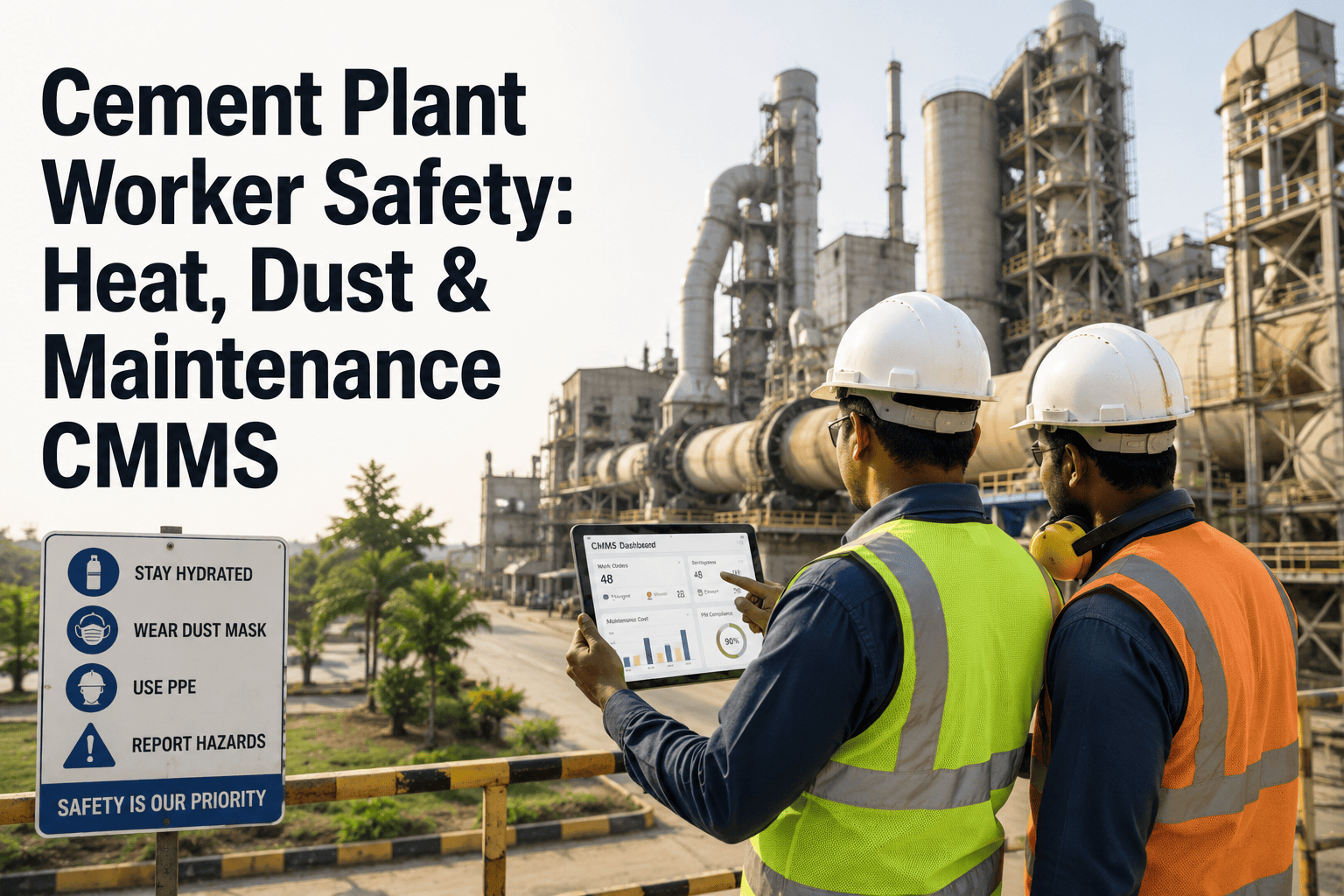
Cement manufacturing is one of the most physically demanding industrial environments in the world — workers routinely operate near kiln surfaces exceeding 1,400°C, breathe air laden with respirable crystalline silica, and enter confined preheater cyclones where a single misstep can be fatal. Across the global cement industry, roughly 3 to 4 recordable injuries per 200,000 hours still occur at most integrated plants, and heat-related illness alone accounts for a measurable share of summertime lost-time incidents near clinker coolers and grinding mills. A modern safety program can no longer rely on clipboards and tribal knowledge — it needs engineered controls, rigorous PPE protocols, and a CMMS that ties every permit, inspection, and training record to the asset and the worker. Start Free Trial and see how OxMaint brings maintenance-driven safety under one auditable system.
Cement Worker Safety · CMMS Guide
Are your kiln-side technicians protected from heat, dust, and confined-space hazards — or just hoping they are?
Heat illness near clinker coolers, silica-laden dust in raw mills, and non-permitted entry into preheater cyclones are the three failure modes that quietly drive recordable injuries and fatalities at cement plants. A CMMS-anchored safety program closes the gap between policy and the floor — every permit, PPE check, and training record tied to the asset and the worker.
Heat Stress Prevention
Engineering out heat illness near kilns, coolers, and grinding mills
Wet-bulb globe temperatures around an operating clinker cooler can exceed 35°C even in winter — and OSHA's heat stress thresholds trigger mandatory work-rest cycles long before most supervisors notice. Without a documented schedule, hydration protocol, and acclimatization ramp, the first sign of trouble is a worker on the floor.
New crew and returning workers (≥1 week absence) must rebuild heat tolerance. Skipping this step accounts for the majority of serious heat illness cases in industrial settings.
For moderate exertion near kiln shells. At ≥32°C WBGT with heavy work (refractory tear-out), shift to 30:30. Rest area must be shaded, ventilated, and within 2 minutes of travel.
A worker losing 2% body mass in sweat sees measurable cognitive decline — exactly when mistakes near rotating equipment become fatal. Supply points every 50 m in hot zones.
A 180-asset integrated plant in the GCC region tracked 11 heat-related near-misses across two summer turnaround seasons using paper-based logs. After deploying CMMS-enforced work-rest cycles, mandatory pre-shift hydration check-ins, and WBGT-triggered task rescheduling, near-misses dropped to 2 over the following 12 months — and zero recordable heat illnesses during the next turnaround.
Dust & Respiratory Protection
Silica is the quiet killer — PPE choice and fit determine whether workers come home
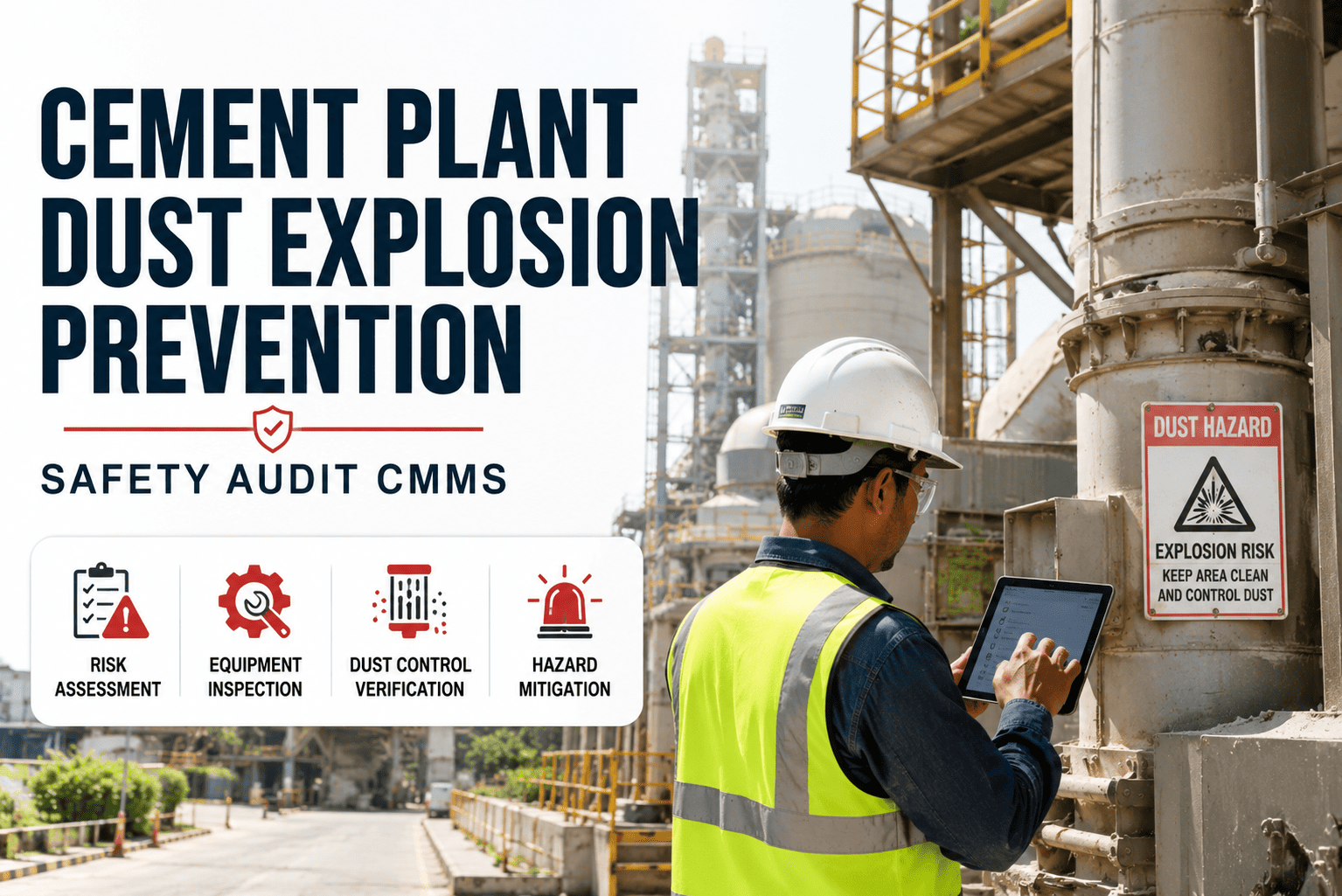
Cement dust carries respirable crystalline silica at concentrations that, without controls, can exceed 0.05 mg/m³ — the OSHA PEL — within minutes of baghouse maintenance or conveyor cleanup. Chronic exposure leads to silicosis, COPD, and lung cancer, and the latency means today's exposure is next decade's compensation claim.
Confined Space & Working at Height
Permit-to-work discipline that stops the three killers: entry, atmosphere, and rescue
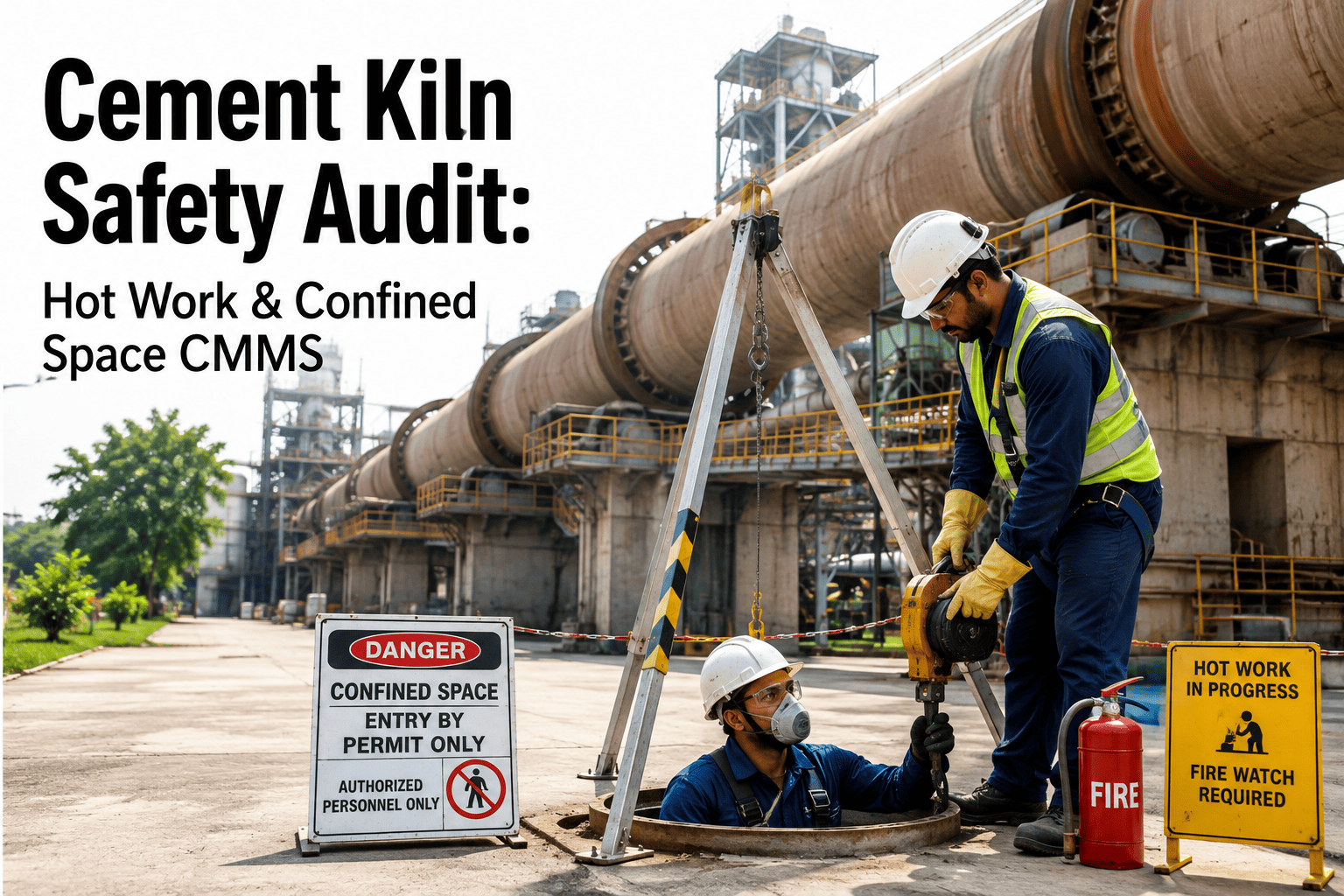
Preheater cyclones, silos, and kiln hood interiors are permit-required confined spaces — and the cement industry's confined-space fatalities cluster in the same three failures: untrained entrants, unchecked atmospheres, and no rescue plan. A CMMS that locks the permit to live gas-test results and training currency is the difference between a routine cleanout and a line-of-duty death.
- Oxygen 19.5–23.5%
- LEL below 10%
- CO below 25 ppm
- H2S below 10 ppm
- Continuous monitoring, not just pre-entry grab sample
- Entrant confined-space training current (≤12 mo)
- Attendant present, dedicated, no other duties
- Supervisor signed permit, on site, reachable
- Rescue team on standby with retrieval line rigged
- Communication device tested, not just carried
- Fall arrest anchored to engineered point, not handrail
- Harness inspected pre-use, logged in CMMS
- MEWP ground conditions checked, outriggers set
- Tool tethering — no loose hammers above lower crews
- Rescue plan for suspended harness trauma (≤10 min)
The CMMS Safety Loop
How a CMMS turns a safety binder into a live, enforced system
Paper safety programs fail at the moment of execution — the permit is signed but the gas test wasn't done, the harness was inspected but not logged, the training expired and nobody flagged it. A CMMS closes that loop by making each safety control a precondition for the work order to proceed.
Asset and location metadata in the CMMS automatically applies the correct hazard profile — heat zone, silica area, confined space, height — to every generated work order, no supervisor memory required.
Technician training currency, medical clearance, fit-test validity, and PPE inventory are verified. A lapsed confined-space certification blocks assignment and reroutes the task to a qualified worker automatically.
Gas test results, LOTO verification, and isolation confirmations feed directly into the digital permit. The permit cannot reach "approved" status until every field is satisfied by a named, signed entry.
Every checklist item, near-miss, and actual work-rest interval is timestamped and tied to both the asset record and the technician profile — creating a defensible audit trail for OSHA, MSHA, or corporate EHS review.
Near-misses, permit deviations, and PPE shortages roll up into a live dashboard — giving the safety manager leading indicators (permits with deviations, overdue fit tests) instead of lagging ones (recordable rate only).
Ergonomics & Manual Handling
The body mechanics of refractory, bagging, and conveyor maintenance
Refractory brick installation, bag stacking, and idler replacement generate the musculoskeletal injuries that never make headlines but account for a large share of lost-time days at cement plants. NIOSH's lifting equation puts a recommended weight limit of about 23 kg under ideal conditions — conditions that almost never exist on a kiln floor.
Stop managing cement safety on paper — enforce it where the work happens
Permits, PPE, training, and inspections tied to every asset and every technician. See it live in 30 minutes.
Frequently Asked Questions
Cement plant worker safety — what maintenance leaders ask most
Baseline PPE includes hard hat, safety glasses with side shields, steel-toe boots, cut-resistant gloves, and high-visibility coveralls. Task-specific layers add hearing protection (≥85 dB zones), PAPR with P100 cartridges for silica tasks, aluminized proximity suits for radiant-heat work near kiln shells, and fall arrest harnesses above 1.8 m. The CMMS assigns the correct PPE kit per task type and blocks issue if inventory is short or fit-test is expired.
A CMMS enforces work-rest cycles by locking the active work order to a timer tied to the WBGT reading for that zone, sends hydration check-in prompts at set intervals, and reschedules non-critical outdoor tasks when the heat index crosses configured thresholds. It also tracks each worker's acclimatization status and blocks assignment of heat-zone work to unacclimatized crew. You can Book a Demo to see the heat-stress module configured for a cement operation.
OSHA's PEL for respirable crystalline silica is 50 µg/m³ (0.05 mg/m³) as an 8-hour time-weighted average. For general Portland cement dust without silica fraction, ACGIH recommends 10 mg/m³ for inhalable particulate. Real exposures during baghouse cleanout or conveyor spillage can exceed these limits within minutes, which is why engineering controls and respiratory protection are required, not optional.
Confined-space entry training should be refreshed annually at minimum, with additional task-specific briefings before each entry into a preheater cyclone, silo, or kiln hood. Rescue drill practice should occur at least every 12 months and whenever a new rescue team member joins. The CMMS stores training currency per worker and automatically flags expiring certifications 30 days before they lapse.
Yes — modern CMMS platforms accept gas-test results via API or manual entry with tamper-evident timestamps, and link them directly to the digital permit-to-work. Permits cannot reach approved status until every atmosphere field, LOTO step, and isolation confirmation is satisfied by a named user. Start a Start Free Trial to test the integration with your existing gas detectors and permit templates.
Protect every shift
Give your cement maintenance crew a safety system that actually runs the floor
Permits enforced, PPE verified, training current, heat cycles timed, dust exposure tracked — all in one CMMS built for heavy industry.
Free 14-day trial · No credit card