Every tonne of clinker a cement plant produces starts with a blast, a bucket, and a haul truck bed several kilometers before it ever reaches a kiln. Quarry equipment — drills, excavators, haul trucks, apron feeders, and the primary crusher that ties the pit to the plant — runs in the harshest conditions on site, and when it fails, the entire production chain behind it slows or stops. This guide walks through the failure modes specific to quarry operations, the early signals that predict them, and how a structured predictive maintenance program keeps raw material moving without surprises. For a closer look at connecting drill, crusher, and haul truck data on one maintenance platform, the sections below cover exactly what that looks like in practice.
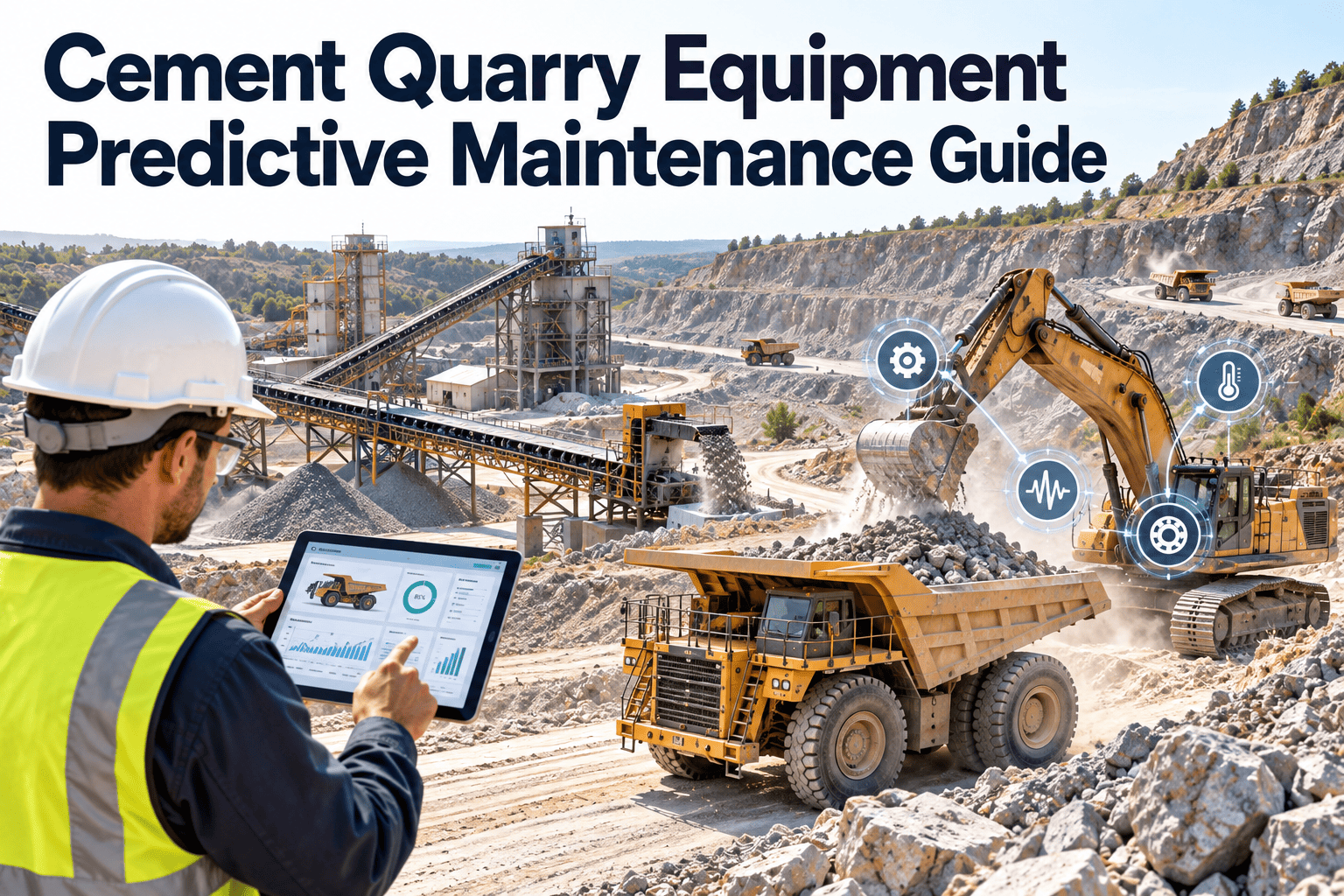
Cement Quarry Equipment Predictive Maintenance Guide
Blast hole drills, excavators, haul trucks, and the primary crusher generate failure signals weeks ahead of breakdown — this guide shows where to look and how to act on them before the kiln feed runs dry.
Why quarry equipment failures hurt more than they should
A quarry is the widest, dirtiest, and most spread-out part of a cement operation, which is exactly why its equipment is the hardest to keep on a consistent inspection routine. A haul truck failure a kilometer from the shop does not just cost the repair — it cuts raw material delivery to the crusher, and if the plant's buffer stockpile runs down, the kiln itself has to slow.
The quarry-to-crusher equipment chain
Raw material moves through a fixed sequence of equipment before it ever reaches the plant, and a failure at any stage backs up everything behind it. Mapping the chain is the first step in deciding where monitoring effort pays off fastest.
Failure modes by equipment class
Quarry equipment fails in predictable, well-documented ways. The table below groups the failure modes maintenance teams see most often, along with the lead time available to act on them before they become unplanned downtime.
| Equipment | Common Failure Mode | Typical Lead Time | Detection Method |
|---|---|---|---|
| Blast hole drill rigs | Undercarriage wear, compressor and bit degradation | 2–5 weeks | Run-hour tracking, penetration rate trending |
| Excavators / loaders | Hydraulic pump wear, track/bucket wear, engine overheating | 2–4 weeks | Hydraulic pressure and temperature trending |
| Haul trucks | Tire wear, transmission and brake degradation | 1–3 weeks | Load cycle and telematics trending |
| Primary jaw crusher | Jaw plate wear, toggle plate stress, bearing heat | 3–8 weeks | Weekly thickness survey, vibration monitoring |
| Conveyor idlers | Seized bearings causing roller heat and belt damage | 1–2 weeks | Thermal imaging, vibration sensors |
A worn jaw plate doesn't announce itself — it just cracks mid-shift
Oxmaint tracks drill, excavator, haul truck, crusher, and conveyor condition on one asset registry, so a quarry equipment issue becomes a scheduled repair instead of a stalled kiln feed.
Jaw plate wear: a case study in predictable failure
Primary jaw crushers are one of the clearest examples of a genuinely predictable failure mode — the wear rate per tonne of limestone processed is essentially constant for a given rock hardness, and that rate is directly measurable through periodic thickness surveys.
The gap between an order-trigger thickness and the condemn limit typically spans three to four weeks of production at normal throughput, which is enough time to procure and schedule a plate change during a planned stop rather than an emergency one. A plant that measures weekly and logs the trend against tonnage captures that window every time; a plant that inspects only during a planned outage risks finding the plate already past condemn limit and running an unplanned changeout instead.
Building a quarry maintenance workflow that survives the distance
The biggest obstacle to consistent quarry maintenance is not technical — it's logistical. Equipment is spread across a wide, often remote site, which makes paper-based inspection rounds easy to skip and hard to verify.
- Step 1 Register every quarry asset — drills, excavators, haul trucks, crushers, feeders, and conveyors — in one hierarchy with full bill-of-materials and failure history.
- Step 2 Set meter-based preventive maintenance triggers tied to run hours or tonnage rather than calendar dates alone, since quarry equipment duty cycles vary widely by season and blast schedule.
- Step 3 Capture inspection data from a mobile device on the equipment itself, so a jaw plate reading or a hydraulic pressure check is logged the moment it's taken, not transcribed from a paper sheet hours later.
- Step 4 Route any threshold breach — a thickness below trigger, a vibration spike, a temperature rise — into a work order automatically, with the spare part requirement attached.
Reactive quarry maintenance versus a condition-based program
Long-lead spares are the hidden risk in quarry maintenance
Some of the most expensive components in the quarry-to-crusher chain — stacker-reclaimer slew rings, crusher main shafts, large gearboxes — carry procurement lead times measured in months, not weeks. A component sitting at 80% of its condemn limit for half a year with no measurement logged anywhere a procurement system can act on is a near-guaranteed emergency order at a steep cost premium once it finally crosses the line.
This is why quarterly or monthly measurement alone is not enough — the readings need to feed directly into inventory and procurement planning, so a part crossing a wear threshold triggers a purchase order automatically, well ahead of the date it will actually need replacing.
What a quarry-focused CMMS actually tracks
Oxmaint brings drill, excavator, haul truck, crusher, and conveyor data into one asset registry per quarry, connecting field inspections directly to work orders and spare part inventory.
What plants report after moving to condition-based quarry maintenance
Frequently Asked Questions
Keep the kiln feed moving from the first blast to the crusher discharge
Oxmaint connects drill, haul truck, crusher, and conveyor data into one predictive maintenance program, so a quarry equipment issue is a scheduled work order — not a stalled production line. Free trial, no credit card required.