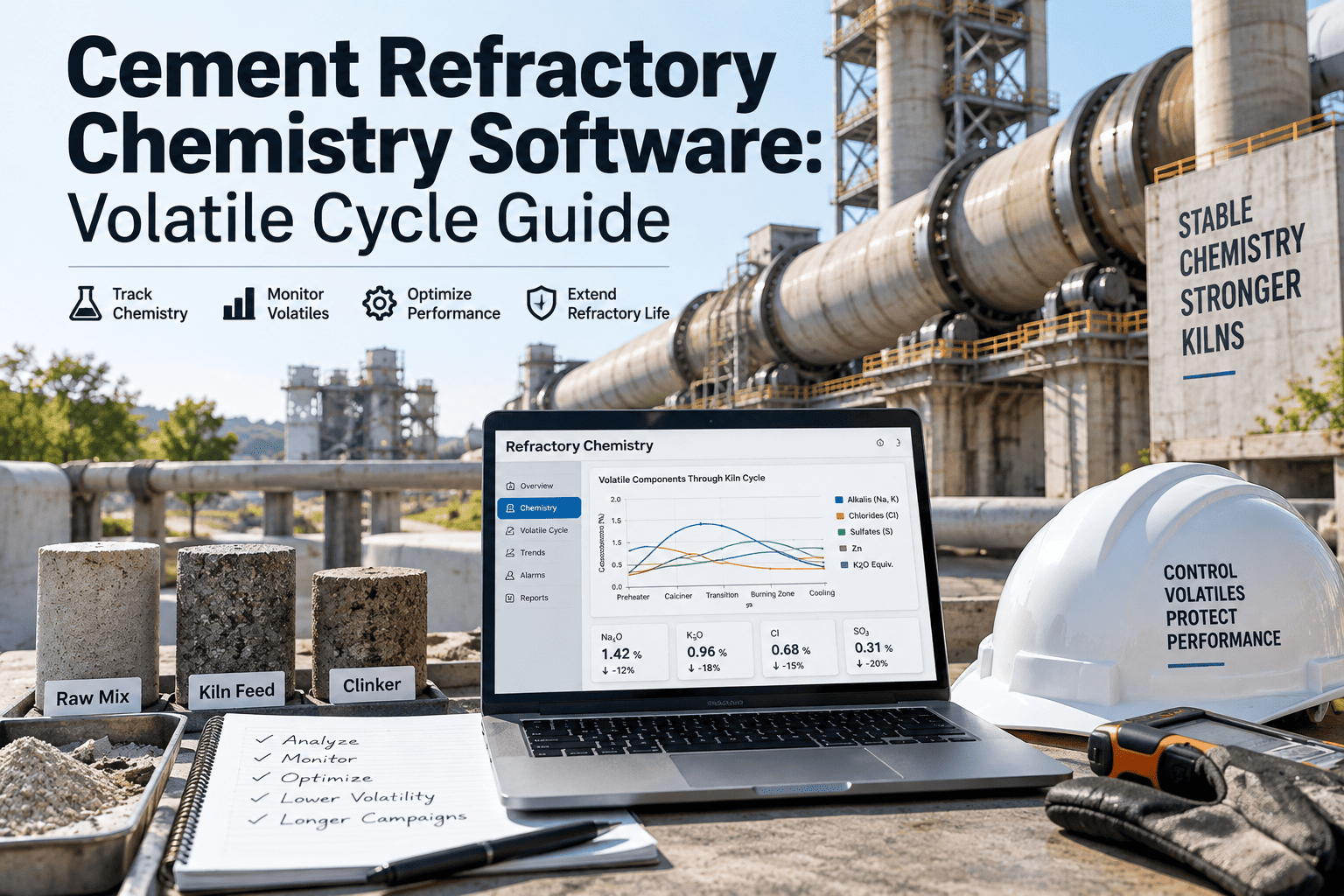
Every cement kiln runs on chemistry that most maintenance teams never see directly: chlorine, sulfur, potassium, and sodium compounds vaporize in the burning zone, travel backward with the kiln gases, and condense the moment they hit cooler refractory and raw meal surfaces in the preheater tower. That condensed layer gets carried right back into the kiln with the next batch of feed, re-evaporates, and repeats the loop again. Left untracked, this volatile cycle concentrates instead of washing out, and the salts it deposits work their way into the pore structure of refractory brick, crystallize, expand, and physically push the lining apart — a failure mode plants call brick jacking. It shows up as unexplained ring formation, cyclone blockages, and lining life that falls well short of design specification, and by the time a shutdown reveals the damage, the volatile load has usually been climbing for months. Tracking Cl, S, K, and Na concentration against refractory condition over time turns an invisible chemistry problem into a scheduled repair instead of an emergency one, and that is exactly the kind of pattern OxMaint AI is built to surface before a lining fails mid-campaign.
The Volatile Cycle Wearing Out Your Kiln Lining From the Inside
Chlorine, sulfur, potassium, and sodium don't leave the kiln system — they circulate, concentrate, and infiltrate refractory brick until the lining jacks apart from within. OxMaint tracks the chemistry so the failure never comes as a surprise.
How the Volatile Cycle Moves Through a Kiln System
The volatile cycle is not a single event — it is a loop that repeats with every rotation of raw feed through the kiln and preheater tower. Understanding each stage is what makes it possible to interrupt the loop before concentration levels reach the point of refractory damage.
Evaporation in the Burning Zone
At burning-zone temperatures near 1450 degrees Celsius, chlorine, sulfur, potassium, and sodium compounds vaporize out of the clinker and enter the kiln gas stream heading toward the preheater.
Condensation on Cooler Surfaces
As gas temperature drops moving up the preheater and calciner, the vaporized compounds condense onto raw meal particles and exposed refractory surfaces, forming a fine salt layer.
Return With the Raw Feed
Coated raw meal falls back down through the preheater cyclones and re-enters the kiln, carrying the condensed volatiles back toward the burning zone instead of leaving with the exhaust.
Re-Evaporation and Concentration
The cycle repeats each pass, and without a bypass or purge point, volatile concentration climbs with every rotation, increasing the chemical load pressing into refractory pore structure.
Four Elements Driving Refractory Chemical Attack
Not every volatile element behaves the same way once it reaches the refractory lining. Each of the four tracked elements attacks brick chemistry differently, and distinguishing between them changes which part of the system needs attention first.
Chlorine
Forms alkali chlorides that penetrate brick pores deeply and crystallize on cooling, generating the expansion pressure most directly linked to brick jacking near the kiln inlet.
Sulfur
Reacts with alkalis to form sulfate compounds that build coating rings inside the kiln and preheater, and excess sulfur is a leading cause of cyclone and downpipe blockages.
Potassium
Combines readily with chlorine and sulfur to form low-melting compounds that infiltrate brick joints, accelerating chemical wear faster than either element acting alone.
Sodium
Behaves similarly to potassium but tends to concentrate closer to the burning zone, contributing to coating instability and unpredictable ring formation near the kiln hood.
Normal Volatile Load vs High Volatile Load Operation
Raw material source, fuel mix, and bypass configuration all influence how much volatile load a kiln system carries. Recognizing which operating profile a plant is running determines how aggressively refractory condition needs to be monitored.
Volatile Monitoring Thresholds and Refractory Risk Reference
Use this reference alongside routine gas and raw meal sampling to judge whether current volatile levels are within a normal operating range or approaching the point where refractory risk increases significantly.
| Monitored Parameter | Typical Safe Range | Elevated Risk Indicator |
|---|---|---|
| Chlorine circulation (kiln feed basis) | Below 0.015 percent | Sustained levels above 0.03 percent |
| Sulfur to alkali molar ratio | Close to 1:1 balance | Ratio consistently above 1.2 |
| Preheater cyclone pressure drop trend | Stable between cleanings | Rising trend over consecutive weeks |
| Coating thickness at kiln inlet zone | Consistent between inspections | Recurrent thickening at the same location |
| Refractory lining wear rate | On pace with campaign design life | Accelerated loss noted at scheduled inspection |
| Bypass dust extraction rate | Matched to raw material volatile input | Extraction rate lagging behind rising input |
Track the Chemistry Before It Tracks Your Lining
OxMaint logs Cl, S, K, and Na readings against refractory inspection history in one place, so a rising volatile trend triggers a maintenance review before jacking or spalling forces an unplanned shutdown.
Three Warning Signs of Volatile-Driven Refractory Damage
Refractory failure caused by volatile chemistry rarely happens without warning. These three patterns typically appear weeks or months before a lining requires emergency replacement.
Brick Jacking Visible at Scheduled Inspection
Bricks that appear pushed outward or separated at the joints indicate salt crystallization inside the pore structure. Document the exact zone and cross-reference recent Cl and K readings from that section of the kiln.
Ring Formation Recurring at the Same Location
A coating ring that keeps rebuilding after cleaning at the same kiln zone points to a localized volatile concentration problem rather than a one-time process upset. Track the recurrence interval to judge urgency.
Cyclone Pressure Drop Climbing Between Cleanings
A steady rise in preheater cyclone pressure drop between scheduled cleanings usually means sulfate or chloride buildup is narrowing gas passages. Left unaddressed, this accelerates into a full blockage.
Refractory Chemistry and Volatile Cycles: Frequently Asked Questions
Can OxMaint track chlorine and sulfur readings alongside refractory inspections?
What causes brick jacking specifically, versus normal refractory wear?
Does switching to alternative fuels increase volatile cycle risk?
How often should refractory condition be inspected in a high-volatile kiln?
Can a bypass system fully eliminate volatile cycle problems?
How OxMaint Supports Refractory Chemistry Monitoring
OxMaint connects chemistry readings, coating trends, and refractory inspection records to the same kiln asset, turning a chemistry problem that used to live in separate lab reports into one continuous maintenance record.
Volatile Element Trend Logging
Cl, S, K, and Na readings log against a timeline for each kiln zone, making a slow upward trend visible months before it becomes a refractory emergency.
Digital Refractory Condition Records
Inspectors log jacking, spalling, and coating observations by zone with photos attached, building a searchable condition history across every campaign.
Threshold-Based Escalation
When volatile readings or pressure drop trends cross a defined threshold, reliability teams get an alert to schedule inspection before the next planned stop instead of waiting on the full campaign calendar.
Campaign Life Forecasting
Historical wear rate data combined with current volatile trends supports more accurate forecasting of remaining refractory life, helping plants plan relines around production schedules rather than surprises.
Case Study: Plant Extends Lining Life by Catching a Chlorine Trend Early
A mid-capacity cement plant had been replacing kiln inlet refractory roughly a year ahead of design campaign life without a clear explanation, treating each reline as an unavoidable cost of operation.
We had accepted early relines as just part of running this kiln. It wasn't until we started logging chlorine and sulfur readings against inspection notes in OxMaint that we noticed a slow but steady climb in circulating chlorine that lined up almost exactly with a raw material source change two years earlier. We adjusted our bypass extraction rate and increased inspection frequency at the inlet zone. Our last campaign ran nearly four months longer than the previous two, and we caught early jacking signs at a scheduled stop instead of finding out mid-campaign. It changed how our reliability team thinks about refractory life — it's not fixed, it's a function of the chemistry we're feeding it.
Reliability Engineer, Regional Cement Manufacturing Plant
See Refractory Wear Coming Before It Costs You a Campaign
OxMaint links volatile chemistry readings to refractory inspection history so jacking, spalling, and ring formation show up as a trend, not a surprise. Schedule a demo to see how it fits your kiln monitoring routine.