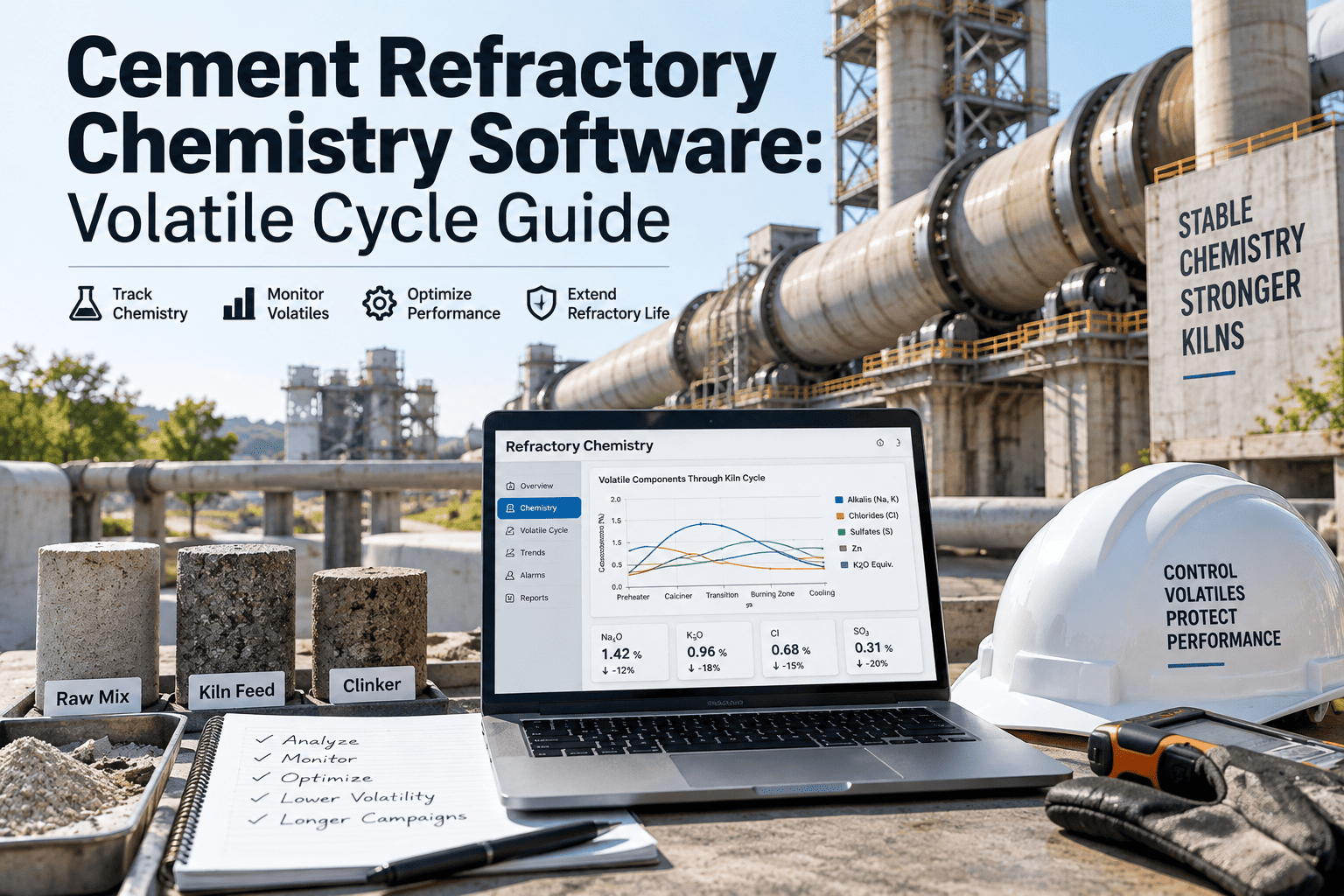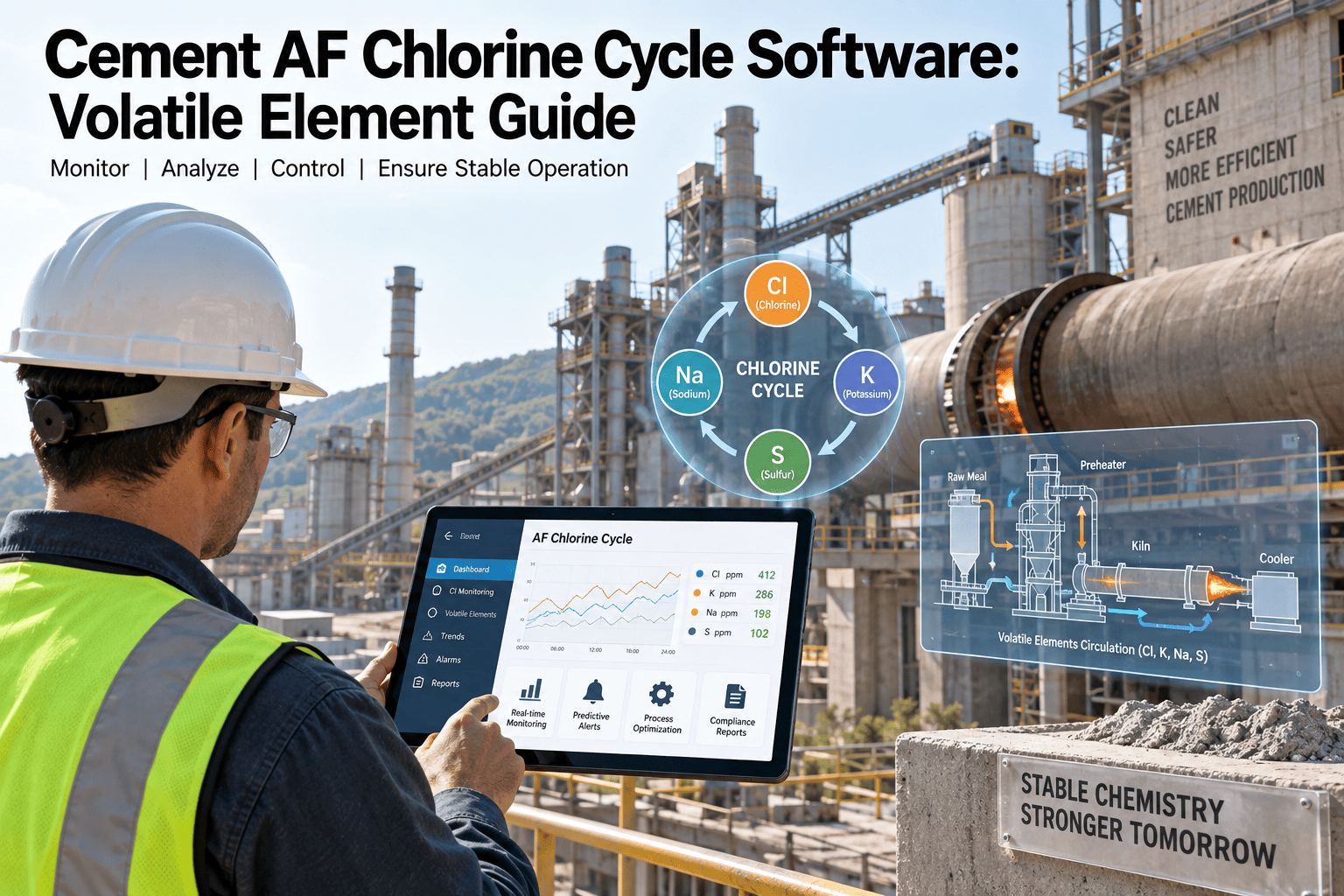
Every kiln that burns alternative fuel inherits a chemistry problem that never shows up on a single gauge: chlorine, sulfur, potassium and sodium vaporize in the burning zone, drift backward with the gas stream, condense on cooler surfaces in the preheater, and ride the next batch of raw meal straight back into the flame. Left unmeasured, that loop concentrates instead of washing out, and the salts it deposits crystallize inside refractory pore structure with enough force to jack bricks apart. Plants running high thermal substitution rates need a way to see the cycle building before it shows up as a shortened refractory campaign, and that visibility is what a cement AF chlorine cycle CMMS is built to provide.
Alternative fuel raises thermal substitution. It also raises the volatile load your refractory has to absorb.
Chlorine, sulfur, potassium and sodium from RDF, tires and other AF streams cycle through the kiln system, concentrate at the inlet and preheater, and drive tire jacking, coating rings and cyclone blockages. A CMMS built for cement plants turns fuel-batch chemistry, feed-rate trends and refractory inspections into one traceable record instead of three disconnected logs.
Why the volatile cycle behaves differently from ordinary refractory wear
Standard thermal cycling wears refractory evenly and predictably. Volatile-element attack does not — it concentrates at specific temperature zones, so two kilns burning identical AF blends can show wildly different failure timelines depending on bypass design, feed consistency and raw-meal alkali content.
Chlorine
Forms alkali chlorides with low volatilization temperatures. They penetrate brick pore structure at the kiln inlet, crystallize on cooling and generate the expansion pressure behind most tire-jacking incidents.
Sulfur
Combines with alkalis into sulfate compounds that build coating rings inside the riser ducts and calciner. Excess sulfur is a leading driver of cyclone and downpipe blockages on high-AF kilns.
Potassium
Reacts readily with both chlorine and sulfur to form low-melting compounds that infiltrate brick joints, accelerating chemical wear faster than any single element acting on its own.
Sodium
Behaves similarly to potassium but tends to concentrate lower in the kiln string, adding to burning-zone coating instability when raw materials already carry a high natural alkali load.
Five stages of one loop — and where it can be broken
A bypass, a purge point or a feed correction only helps if it is applied at the right stage of the cycle. Mapping the loop stage by stage is what turns a vague "chlorine problem" into a specific, actionable target.
Volatilization in the burning zone
Chlorine, sulfur and alkalis in the AF ash and raw meal vaporize at burning-zone temperatures and move backward with the kiln gas flow toward the cooler preheater tower.
Condensation on cooler surfaces
As gas temperature drops through the lower cyclone stages and kiln inlet, the vaporized compounds condense onto raw meal particles and exposed refractory brick.
Re-entry with the next feed batch
Coated raw meal falls back into the kiln with the next feed cycle, carrying the condensed salts forward into the burning zone again, where they re-volatilize.
Concentration without an exit point
Without a bypass or purge, each pass adds volatile mass to the loop rather than removing it. Concentration climbs rotation after rotation until it exceeds what the clinker and cement standard can absorb.
Bypass extraction and dust management
A kiln-inlet bypass draws off a controlled gas stream, cools and filters it, and removes the chlorine-rich dust from the system before it can complete another loop.
The operational impact when the cycle runs unmanaged
Under EN 197, total chlorine content across common cement types is capped near 0.1%, so a kiln pushing thermal substitution above roughly 50% without a bypass in place can hit that ceiling before it hits a production limit.
Sulfate and chloride coating buildup inside cyclones and downpipes narrows gas passages, raising pressure drop and forcing unplanned cleaning stops that were never on the maintenance calendar.
Crystallized alkali chlorides expand inside brick pores near the kiln inlet, physically pushing lining apart and shortening a refractory campaign that should have run for months longer.
Cement chlorine content that creeps toward the standard's limit forces a choice between throttling AF substitution rate or risking a quality hold on finished product.
Chlorine cycling is closely linked to PCDD/F formation pathways in kiln gas, making bypass operation a compliance issue as much as a refractory-protection one.
| Monitoring point | What to track | Typical trigger |
|---|---|---|
| AF fuel batch chlorine content | Chlorine and sulfur content per incoming AF load | Batch flagged before it reaches the feed bin |
| Kiln inlet gas temperature drop | Deviation from baseline condensation profile | Inspection scheduled at the next planned stop |
| Bypass dust extraction rate | Volume and chlorine concentration of extracted dust | Rate adjustment when concentration trends upward |
| Cyclone and downpipe pressure drop | Differential pressure trend across preheater stages | Cleaning work order raised ahead of a blockage |
| Refractory wall-thickness scan | Localized thinning near the kiln inlet transition zone | Brick replacement scoped before an unplanned failure |
See the chlorine cycle before it reaches the brick
Connect fuel-batch data, bypass performance and refractory inspections into one record with Oxmaint.
How a CMMS closes the gap between fuel data and refractory condition
Most plants already collect the data needed to see a chlorine cycle building — fuel certificates, bypass logs, inspection notes and lab results. The problem is that they sit in different systems and never get compared against each other in time to matter.
Oxmaint logs chlorine and sulfur content against each AF batch as an asset record, so a supplier's shredded-tire load or RDF delivery is tied to the kiln run it fed, not lost in a paper certificate.
Digital checklists standardize kiln-inlet, riser-duct and cyclone inspections, so wall-thickness readings and coating observations are captured on a consistent schedule instead of an inconsistent one.
Pressure-drop trends and bypass dust chlorine readings can trigger a cleaning or brick-inspection work order automatically, moving the response ahead of the failure rather than after it.
Bypass operating logs, emissions data and refractory campaign history stay together in one audit-ready record, useful for both EN 197 chlorine-limit tracking and environmental reporting.
- Fuel chemistry logged on paper, reviewed weeks after feeding
- Bypass dust rate adjusted reactively after a coating ring forms
- Refractory wear discovered at a planned shutdown, not before it
- Chlorine spec deviation found in final QC testing
- AF batch chemistry checked against limits before it is fed
- Bypass performance trended against dust chlorine concentration
- Inlet and riser-duct inspections scheduled on wear evidence
- Chlorine trend visible days before it approaches the cement limit
A short checklist for plants raising thermal substitution
Confirm bypass capacity matches your target substitution rate before increasing AF volume, not after chlorine content starts climbing.
Log chlorine and sulfur content on every AF delivery, not just periodic composite samples.
Track feed-rate stability — fluctuation beyond roughly 1% over a ten-minute window is a common early sign of feeder drift feeding the cycle.
Inspect the kiln-inlet transition zone on a schedule tied to substitution rate, not a fixed calendar interval alone.
Review bypass dust disposal or valorization options, since extracted dust still carries a chlorine load that needs a managed exit.
Cement AF chlorine cycle CMMS — frequently asked questions
What thermal substitution rate typically requires a chlorine bypass?
Many plants find the margin for flame control and refractory protection narrows once substitution passes roughly 50%, though the exact threshold depends on raw-meal alkali content and existing bypass capacity.
How does a CMMS actually reduce refractory failures from the volatile cycle?
By connecting fuel-batch chemistry, bypass performance and inspection history in one record, so wear evidence surfaces early enough to schedule a repair instead of reacting to a failure. Book a demo to see the workflow mapped to your kiln.
Is chlorine the only volatile element worth tracking?
No — sulfur, potassium and sodium interact with chlorine and with each other, and tracking all four together gives a more accurate picture of coating and refractory risk than chlorine alone.
Can bypass dust be reused instead of landfilled?
Some plants recover value from bypass dust through washing or valorization processes rather than disposal, though this depends on dust composition and local processing options.
Where should we start if we do not yet track AF chemistry?
Start by logging chlorine and sulfur content on incoming AF batches and comparing it against bypass dust concentration trends. Get started with a digital record for one kiln line first.
Give your refractory a warning system, not a post-mortem
Track fuel chemistry, bypass performance and refractory condition in one connected CMMS built for cement plants.
Free trial available · No credit card required