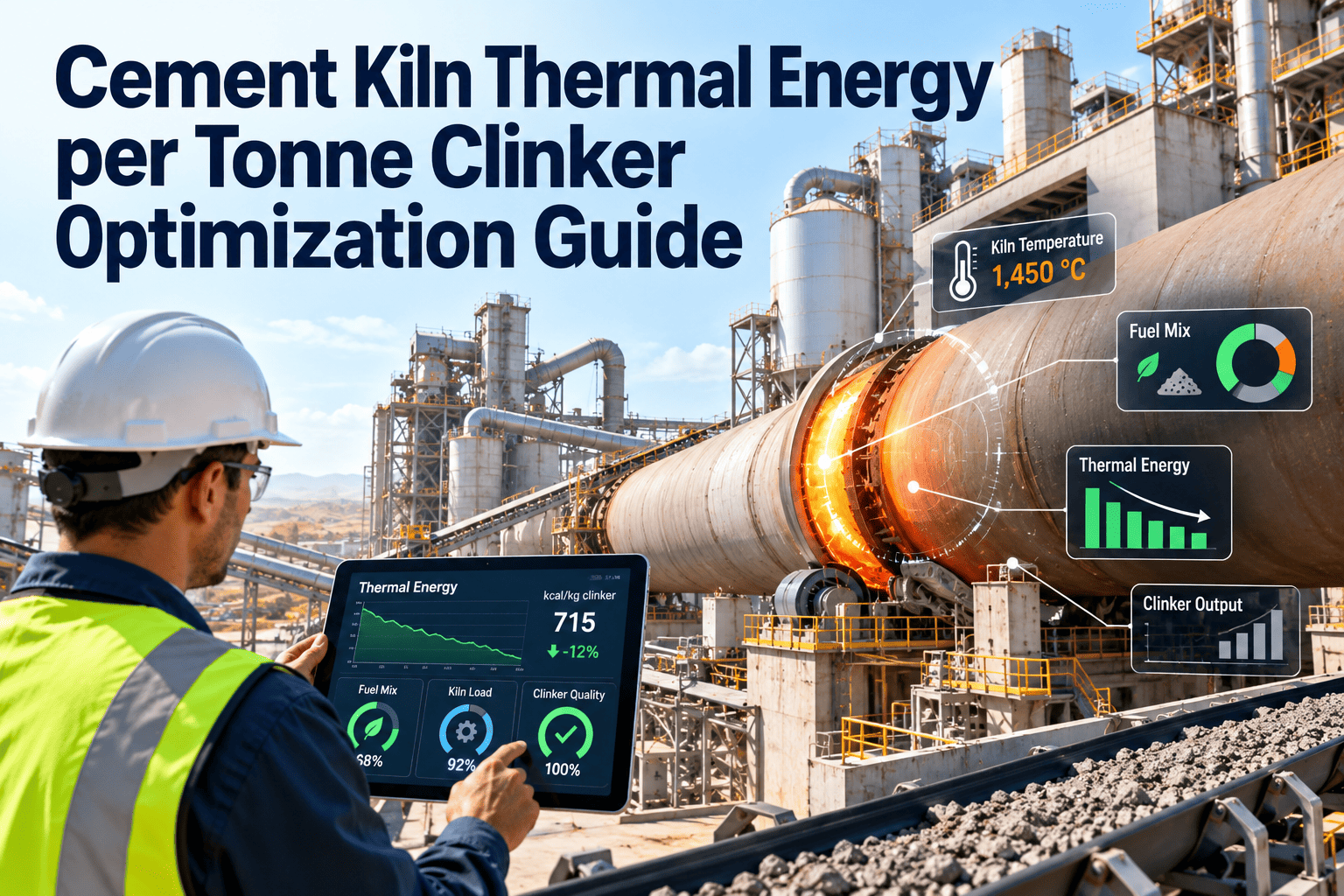
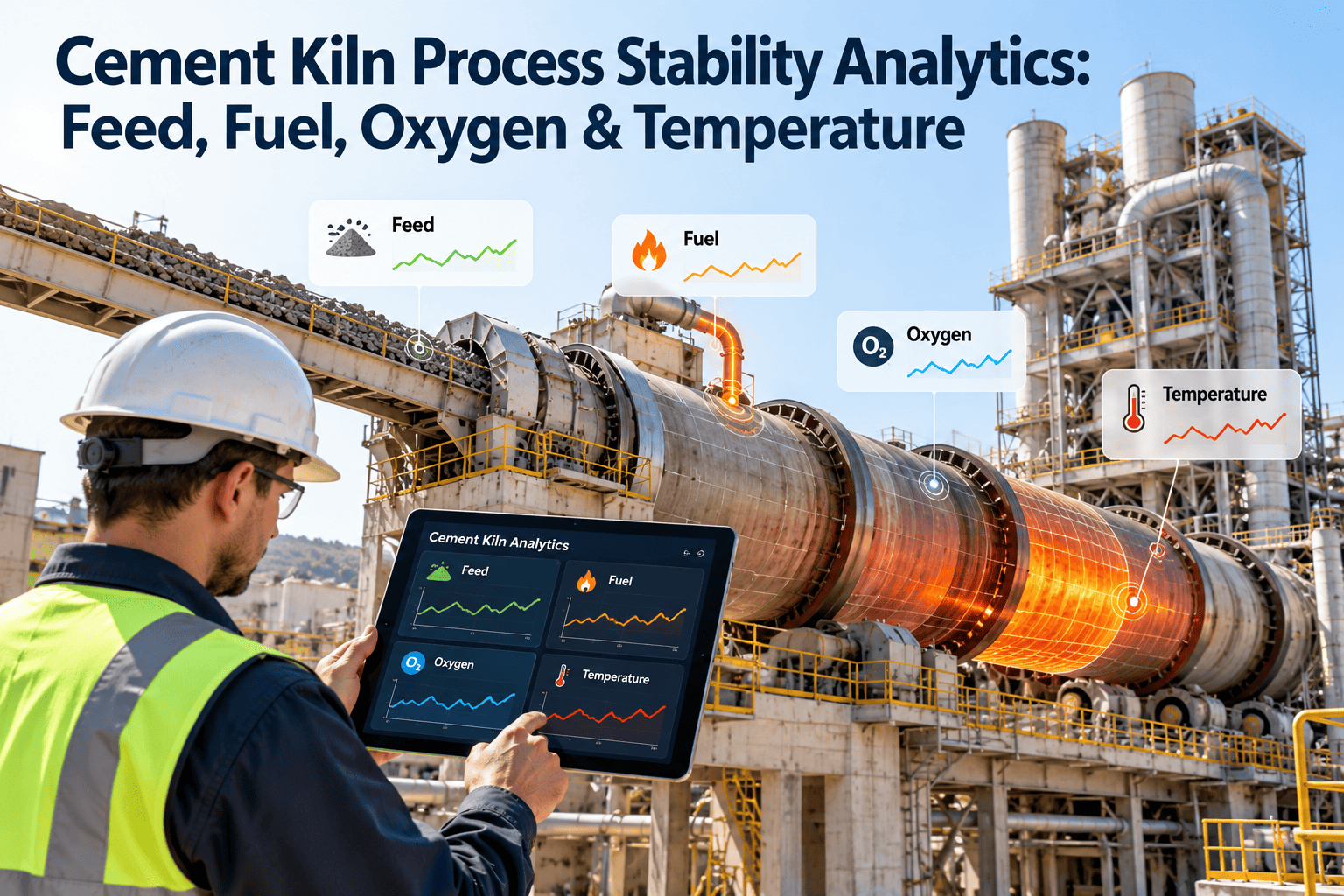
Cement production exceeds 4.1 billion tonnes annually, yet clinker quality remains the most unpredictable variable in the entire manufacturing chain. The gap between what the quarry delivers and what the kiln produces is governed by three chemical moduli — LSF, SM, and AM — that must be held within razor-thin tolerances while raw material chemistry drifts with every blast, fuel quality shifts between deliveries, and kiln conditions fluctuate minute to minute. Laboratory free-lime results arrive 2–4 hours after sampling, meaning several hundred tonnes of clinker have already left the burning zone before quality confirmation. Over-burning to compensate for this delay wastes 30–50 kcal/kg of clinker in unnecessary fuel consumption. Under-burning produces high free-lime clinker that fails strength targets and generates customer claims. The entire quality control chain — from raw mix proportioning through homogenization, preheater performance, burning zone stability, and cooler quench rate — must function as an integrated system, not a series of isolated control loops. Managing this system requires structured inspection workflows, condition-based equipment monitoring, and centralized process data tracking — exactly what Oxmaint's CMMS platform delivers for cement plant operations teams.
The Three Chemical Moduli That Control Everything
Every clinker quality outcome traces back to three ratios calculated from the raw mix oxide analysis. Getting these right is not just a quality exercise — it determines fuel consumption, coating stability, kiln operability, and ultimately cement strength. The raw mix design must balance these moduli against raw material availability, cost, and quarry constraints. When the quarry face shifts, these ratios drift — and if the drift is not detected and corrected before the material reaches the kiln, the consequences cascade through the entire process. Sign up for Oxmaint to track raw mix quality parameters alongside equipment condition in one integrated platform.
Lime Saturation Factor (LSF)
Silica Modulus (SM)
Alumina Modulus (AM)
Clinker Phase Composition: What You Are Actually Making
The chemical moduli control four mineralogical phases that form during sintering. Their relative proportions determine every performance property of the finished cement — setting time, heat of hydration, strength development, sulfate resistance, and durability. Traditional Bogue equations estimate these phases from oxide analysis but carry errors of 7–25% compared to XRD measurement. A 2025 Nature study demonstrated that machine learning models predict alite content with only 1.24% mean absolute error versus 7.79% for Bogue calculations — a transformational improvement in quality prediction accuracy.
C₃S (Alite)
Primary strength compound. Hydrates rapidly, providing early and ultimate strength. Higher C₃S means higher 1-day and 28-day strength. Requires proper burning zone temperature (1,400–1,450°C) and rapid cooler quench to stabilize.
C₂S (Belite)
Slow-reacting strength compound. Contributes to long-term strength (90+ days) but minimal early strength. Forms when burning zone temperature or residence time is insufficient for full C₃S conversion. High belite signals under-burning.
C₃A (Aluminate)
Most reactive phase. Controls initial set and flash set behavior. Requires sulfate regulation (gypsum) during grinding. High C₃A (>10%) increases heat of hydration and reduces sulfate resistance. Critical for Type V cement specification.
C₄AF (Ferrite)
Contributes to color (darker = more ferrite) and moderate sulfate resistance. Low reactivity. Acts as flux during sintering — reducing the temperature needed for liquid phase formation. AM ratio directly controls C₃A/C₄AF balance.
Connect Quality Data to Maintenance Actions
When clinker quality drifts, the root cause is almost always equipment-related — worn raw mill classifiers, failing kiln thermocouples, degraded fan performance, or blocked preheater cyclones. Oxmaint links process quality deviations to automated corrective maintenance work orders so nothing falls through the cracks.
Raw Mix Preparation: Where 80% of Quality Issues Originate
Most clinker quality problems are not kiln problems — they are raw mix problems that the kiln cannot compensate for. Coarse particles, inconsistent chemistry, poor homogenization, and excessive raw meal variability all force the kiln into reactive mode, burning hotter and longer to compensate for feed inconsistency. Controlling quality at the raw mix stage is always more energy-efficient and cost-effective than trying to fix it in the kiln.
Kiln Control Parameters: The Burning Zone Sweet Spot
The kiln burning zone must maintain a narrow temperature window — typically 1,400–1,450°C — where the liquid phase (20–25% of the mix) enables alite crystal formation through solid-state reaction. Too low and free-lime remains unconverted. Too high and the clinker becomes dense, hard to grind, and damages the refractory lining. Explore how Oxmaint tracks kiln condition parameters alongside maintenance schedules to keep your burning zone in the optimal range.
Quality Troubleshooting: Diagnostic Decision Map
When clinker quality deviates, systematic diagnosis is faster and more reliable than guesswork. Each quality symptom points to a limited set of root causes — most of which trace back to equipment condition or raw mix drift that structured maintenance and monitoring would have caught earlier.
LSF too high (check proportioning). Raw meal too coarse (>16% on 80μm). Poor homogenization (LSF σ > 2.0). Coarse silica particles creating unreacted SiO₂ nests.
Burning zone too cool. Insufficient residence time (kiln speed too fast). Reducing atmosphere (O₂ <1%). Coal quality shift — lower calorific value or higher moisture.
Raw mill classifier condition. Homogenization compressors and nozzles. Kiln pyrometer and thermocouples. Coal mill fineness. ID fan and damper condition.
Low C₃S content (under-burning or low LSF). Poor C₃S crystal structure from slow cooler quench. High belite content indicating thermal energy deficit in burning zone.
Clinker too hard to grind (over-burned, dense). Insufficient cement fineness. Incorrect gypsum dosage affecting sulfate balance and set time regulation.
Cooler Zone 1 fans and grate plates. Kiln shell scanner. Cement mill separator efficiency. Gypsum feeder calibration. Cement Blaine testing equipment.
SM too low (<2.0) creating excess liquid phase. High alkali content (K₂O + Na₂O >1.0%) condensing in transition zone. Chlorine >0.015% from raw materials or fuel creating volatile cycles.
Inconsistent burning zone temperature. Excessive reducing conditions creating FeO-rich melt. Poor flame shape from burner degradation. Kiln feed rate instability.
Main burner tip condition and primary air fan. Alkali bypass system efficiency. Kiln shell temperature scanner. Preheater cyclone condition and pressure drops.
SM too high (>2.8) with insufficient liquid phase for coating adhesion. Sudden LSF shifts disrupting thermal equilibrium. Raw mix chemistry change from quarry face shift.
Flame too aggressive impinging on coating. Kiln speed change without compensating fuel. Draft instability from fan or damper issues. Cooling air balance shift from cooler.
Kiln shell scanner (critical — bare shell >350°C demands immediate action). Burner alignment and nozzle condition. Refractory lining thickness. Draft control dampers.
Turn Quality Deviations into Automated Maintenance Actions
Oxmaint links kiln process data to equipment maintenance workflows — when quality drifts, the right corrective work order is generated automatically, assigned to the responsible technician, and tracked to completion. No more quality problems hiding behind missed inspections.
Frequently Asked Questions
What is the Lime Saturation Factor and why is it critical?
LSF is the ratio of CaO to the other major oxides (SiO₂, Al₂O₃, Fe₂O₃) in the raw mix. It determines how much of the available lime can be combined into calcium silicates during sintering. An LSF of 0.95 means 95% of the theoretically possible lime combination. Higher LSF produces more C₃S (stronger cement) but is harder to burn, requiring more fuel and risking high free-lime. Lower LSF is easier to burn but produces weaker clinker. Maintaining LSF within ±0.02 of target with standard deviation below 1.0 is the single most important raw mix control objective.
What causes high free lime in clinker?
High free lime (f-CaO >2.0%) indicates incomplete combination of CaO with SiO₂ to form C₃S. Causes include: LSF set too high for the kiln's thermal capacity, raw meal too coarse allowing unreacted silica nests, burning zone temperature too low, insufficient residence time (kiln speed too fast), reducing atmosphere from inadequate O₂, and poor homogenization causing LSF spikes in the kiln feed. Diagnosis requires checking both raw mix parameters and kiln operating conditions systematically — it is rarely a single cause.
How does raw meal fineness affect clinker quality?
Raw meal must pass through 80μm sieve with 84–88% (12–16% retained). Coarse raw meal contains large quartz and calcite particles that cannot fully react during the 20–30 minute residence time in the burning zone — producing unreacted nests that appear as free-lime clusters. Overly fine raw meal (specific surface >400 m²/kg) wastes grinding energy and can create localized high-viscosity liquid phase during sintering that impedes heat transfer and reaction kinetics. Optimal specific surface is 250–320 m²/kg.
What is the relationship between burning zone temperature and clinker quality?
The burning zone must maintain 1,400–1,450°C for proper clinker formation. Below 1,350°C, insufficient liquid phase forms and CaO remains uncombined (high free-lime). Above 1,500°C, clinker becomes over-densified — too hard to grind and potentially damaging to refractory. The target is the minimum temperature that achieves f-CaO below 1.5% — operating above this wastes fuel as "insurance over-burning." AI-driven kiln control can reduce this overburn by predicting f-CaO 15–30 minutes ahead, saving 30–50 kcal/kg.
Why does cooler performance matter for clinker quality?
Rapid quenching in the first cooler zone locks the C₃S crystal structure that provides cement strength. If clinker cools too slowly through the 1,250–1,100°C range, C₃S partially reverts to C₂S — permanently reducing cement reactivity. Target quench rate above 20°C/minute through this window. The cooler also generates secondary air (1,050°C) for kiln combustion and tertiary air (900°C) for the calciner — so cooler efficiency directly impacts both quality and energy consumption.
How does a CMMS improve clinker quality control?
A CMMS connects equipment maintenance to quality outcomes. When raw mill classifier wear causes raw meal to go coarse, the CMMS tracks wear measurements and triggers replacement before quality drifts. When kiln thermocouples drift and operators lose visibility into burning zone conditions, calibration PM ensures accurate readings. When cooler grate plates wear and quench efficiency drops, structured inspections detect the degradation early. Every quality deviation has an equipment root cause — a CMMS ensures the equipment that controls quality is maintained at the right intervals with proper documentation.
Can AI really improve clinker quality prediction?
Yes — demonstrably. A 2025 Nature Communications study showed machine learning models predict alite (C₃S) content with 1.24% mean absolute error versus 7.79% for traditional Bogue calculations. AI-driven kiln optimization using reinforcement learning can reduce free-lime standard deviation, predict f-CaO 15–30 minutes before lab confirmation, and automatically adjust fuel, speed, and draft to maintain burning zone stability. Plants using AI kiln control achieve higher alternative fuel substitution rates (20–40% higher than manual control) while maintaining quality consistency.