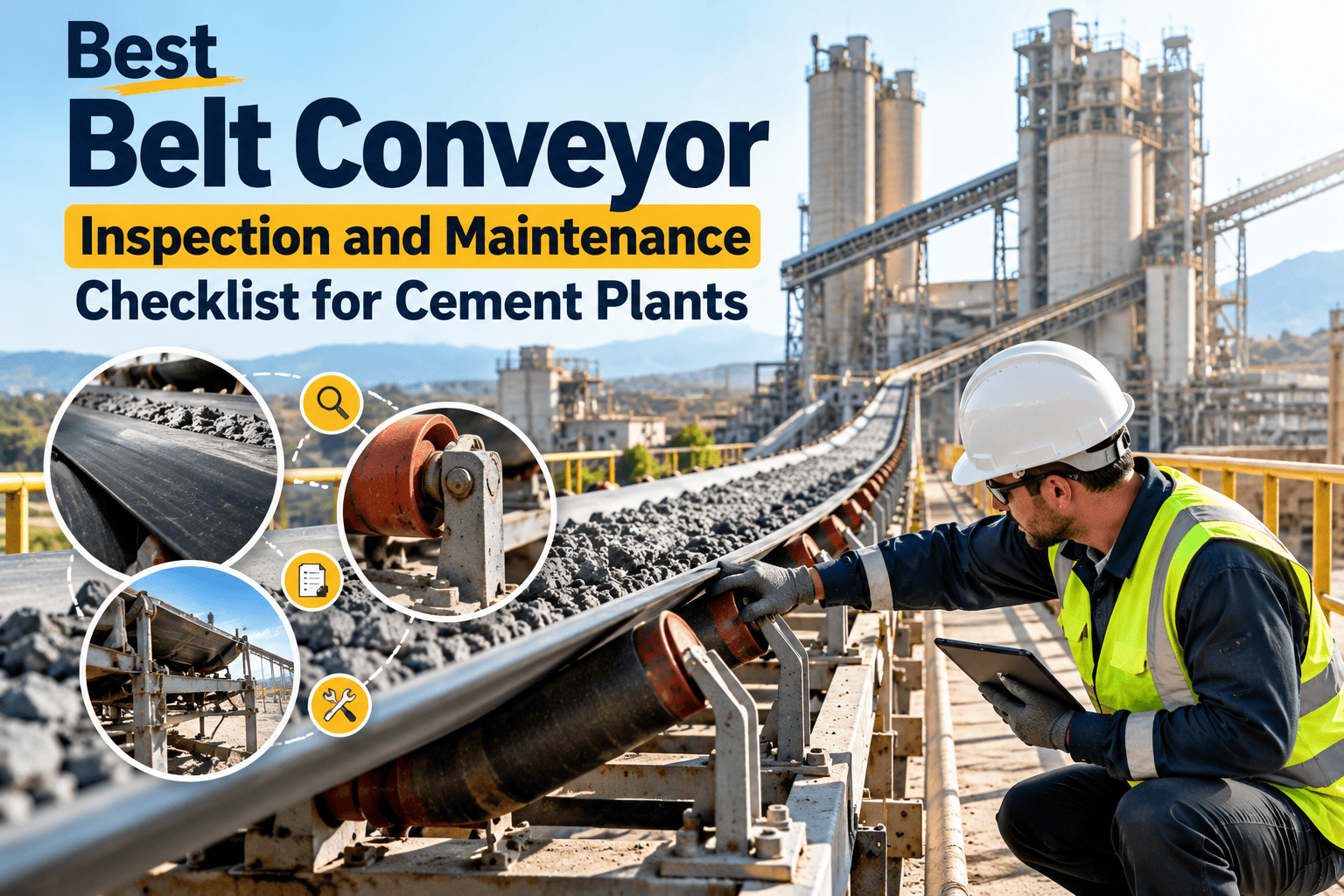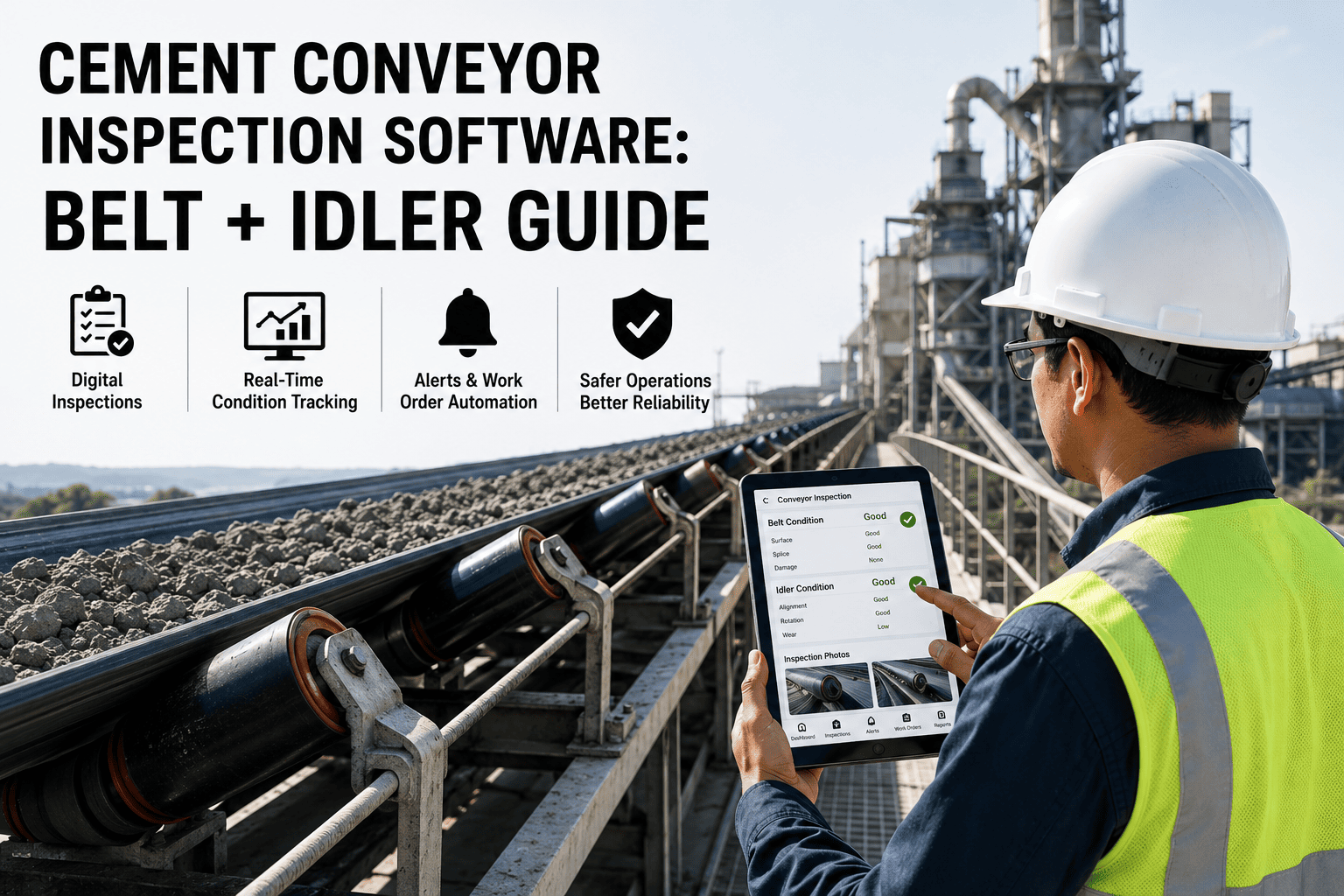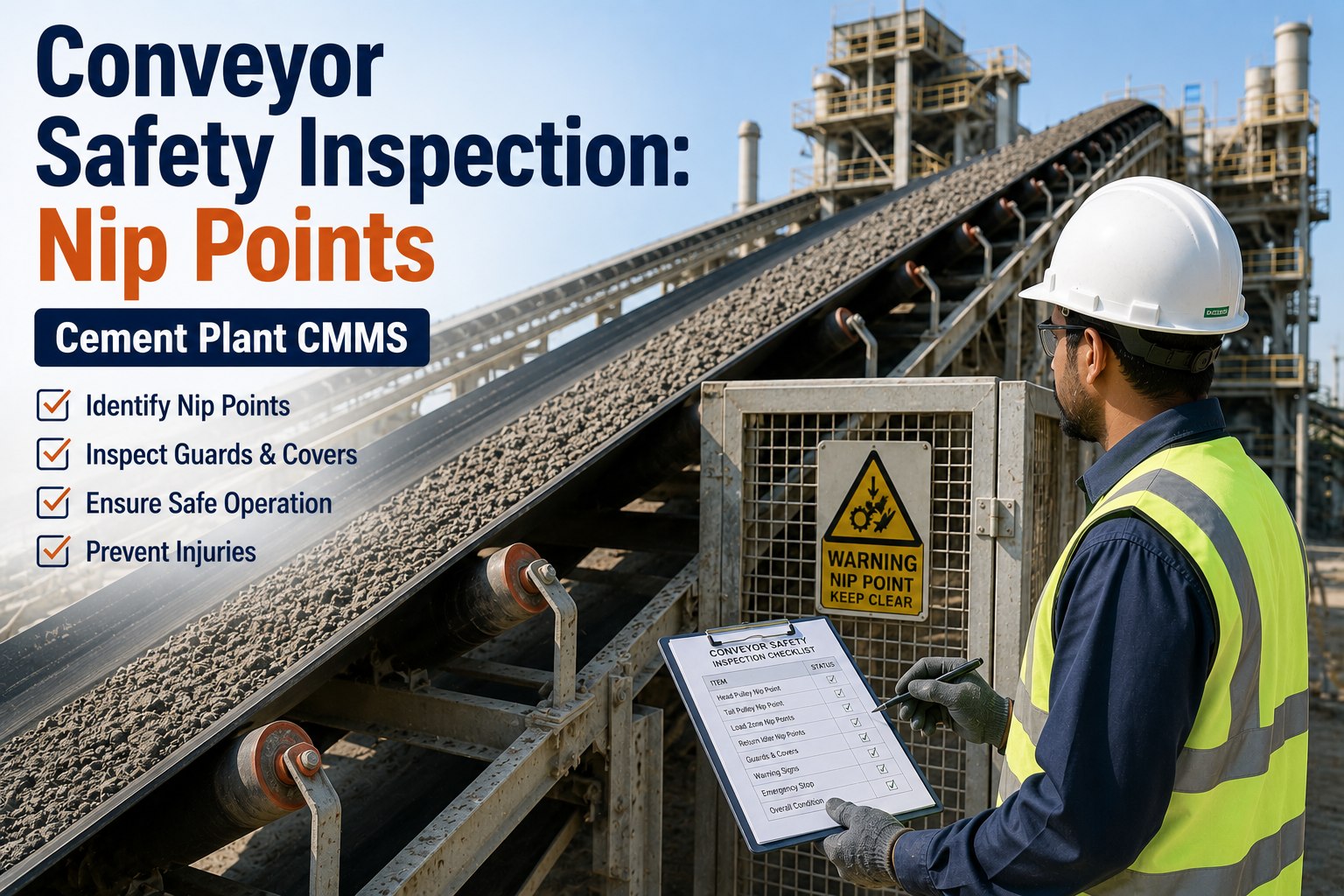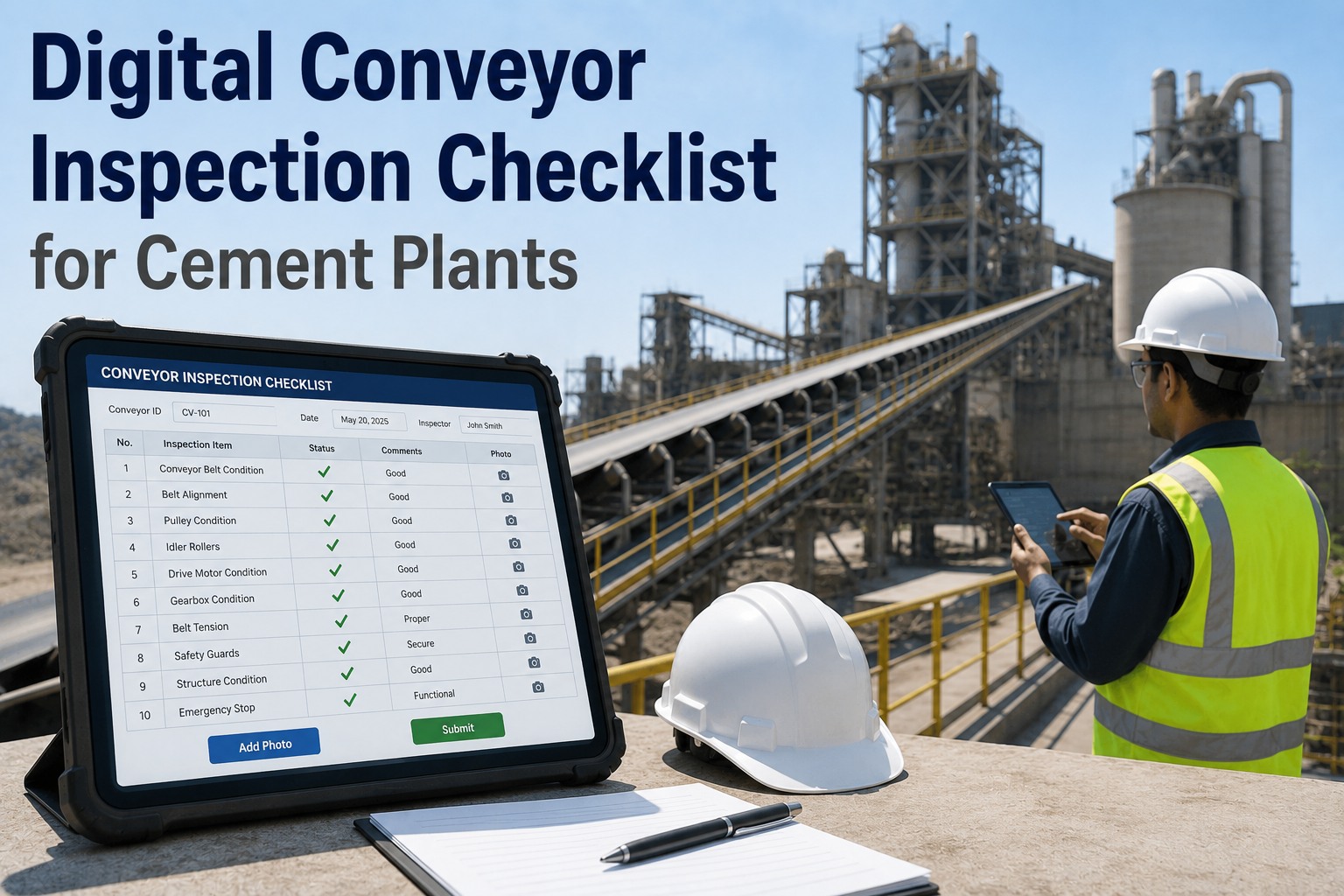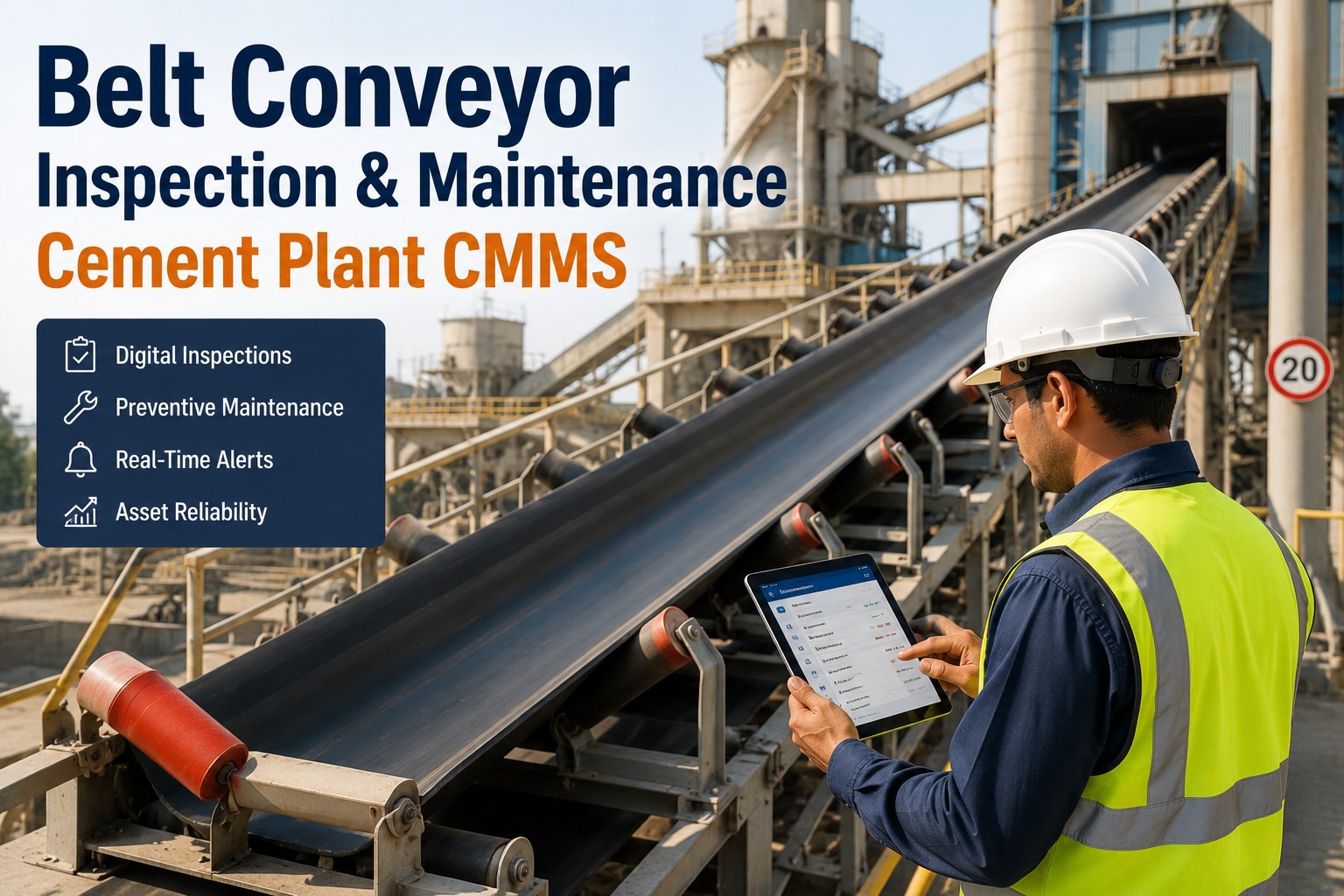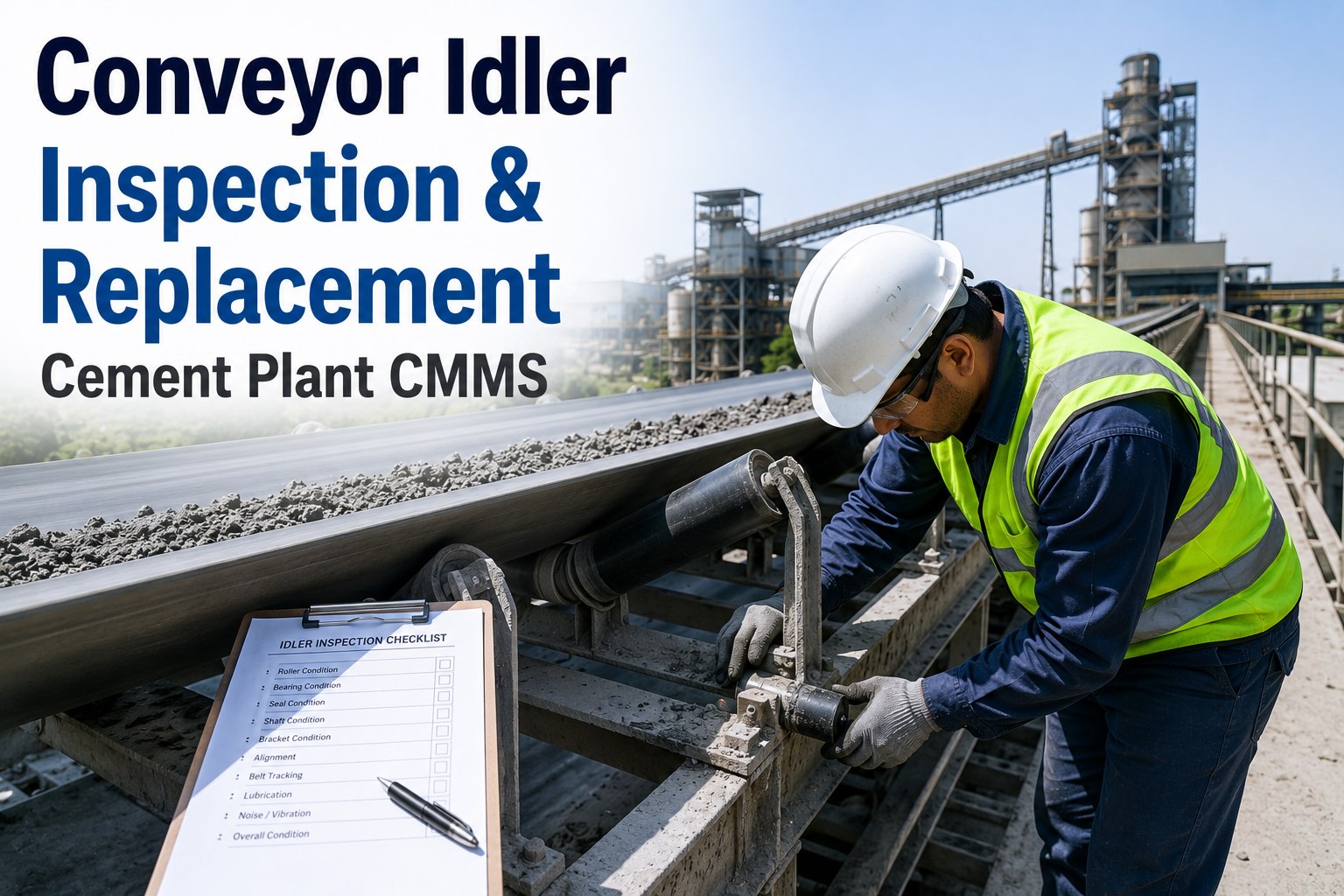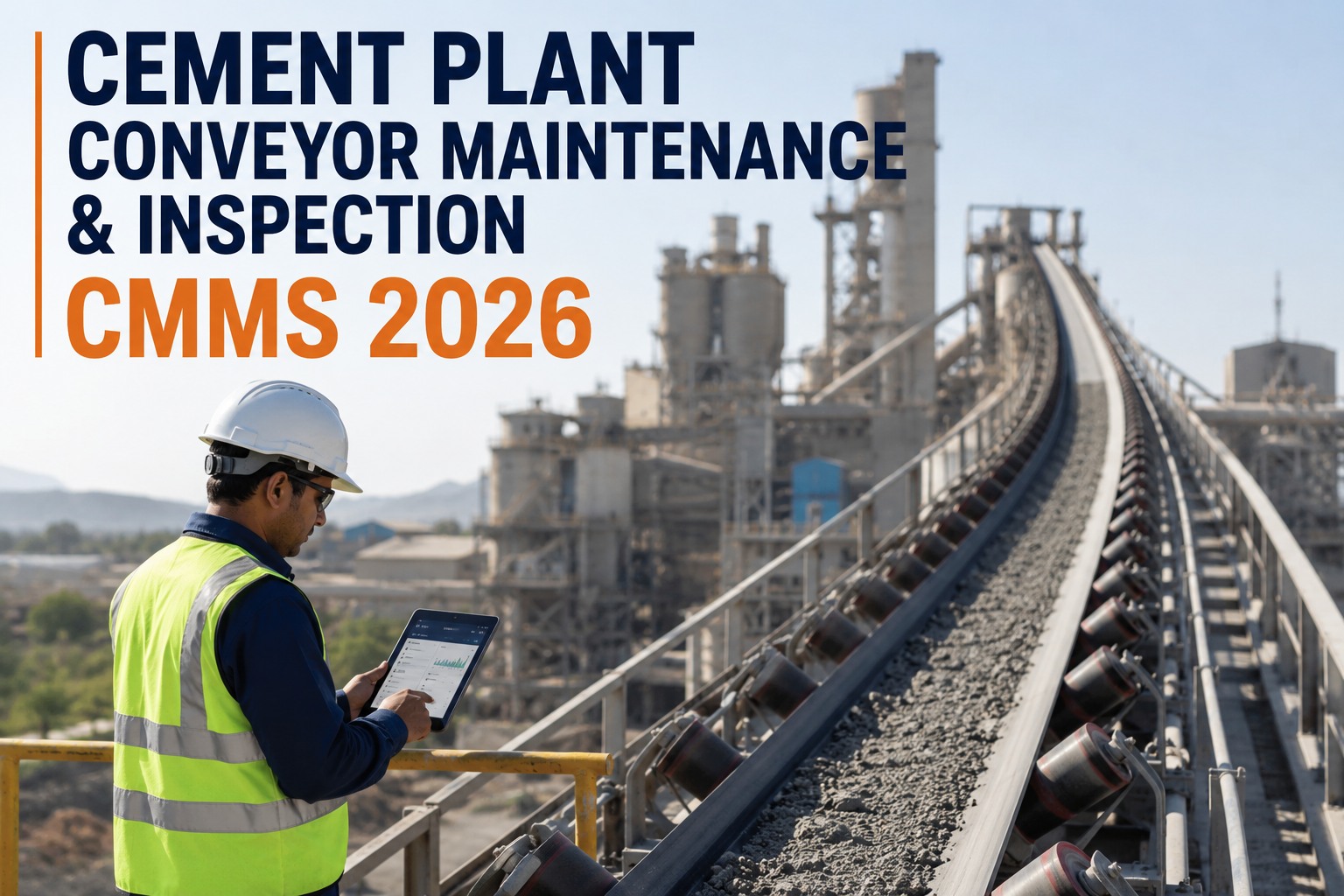
Cement plants run on conveyors — belt, screw, drag chain, and bucket elevator systems that together stretch for kilometers across a single facility. When one of those belts stops, the kiln keeps burning fuel, the clinker cooler backs up, and a single hour of unplanned downtime can cost $15,000 to $40,000 in lost throughput before you even count repair labor. This 2026 guide breaks down the preventive maintenance cadence, inspection routes, and CMMS configuration that keep material handling availability aligned with plant run-factor targets of 92% and above. If you want to skip straight to implementation, you can Start Free Trial and configure your conveyor PM templates today.
Cement Conveyor Reliability · 2026 CMMS Guide
Is one failed idler costing your plant more than your CMMS subscription?
Across cement operations, conveyor unplanned failure ranks among the top three causes of production loss — yet 68% of plants still inspect belt systems on paper checklists that never reach the maintenance office. A mobile-first CMMS closes that gap in under 30 days.
The Cost of Inaction
Why conveyor failure hits cement harder than any other industry
A cement plant operates as a single continuous flow — limestone in, clinker out, cement ground and dispatched. There is no buffer. When a 1,200 mm belt carrying 800 TPH of hot clinker drops a drive coupling at 2:00 AM, every upstream and downstream asset cascades into alarm within minutes.
Worked example
A 4,500 TPD clinker plant in Rajasthan operates 14 belt conveyors totaling 9.8 km. In 2025, it logged 23 unplanned conveyor stops averaging 2.4 hours each — 55 hours of lost run time, roughly 8,200 tonnes of clinker shortfall, and $42K in emergency spares. After deploying mobile inspection routes on a CMMS, unplanned stops dropped to 9 in the first six months of 2026, with mean-time-to-repair falling from 3.1 to 1.6 hours.
PM Cadence by Conveyor Type
Match the maintenance frequency to the conveyor, not the calendar
A 1,200 mm belt carrying hot clinker at 90°C does not wear like a screw conveyor moving cement powder at 60°C. The table below maps preventive maintenance cadence to conveyor type, driven by ISO 55000 asset criticality and TPM autonomous-maintenance principles.
| Conveyor Type | Daily Inspection | Weekly PM | Monthly PM | Quarterly PM | Critical Failure Mode |
|---|---|---|---|---|---|
| Belt Conveyor (clinker / raw meal) | Belt tracking, spillage, idler noise | Skirt board wear, chute liner thickness | Idler roll spin-test, belt tension gauging | Vulcanized splice ultrasonic check, drive alignment | Belt splice failure at high-tension section |
| Screw Conveyor (cement powder) | Seal leakage, motor amperage | Flight edge wear, hanger bearing play | Trough internal cleaning, gearbox oil sample | Flight replacement, shaft straightness | Hanger bearing seizure causing shaft twist |
| Drag Chain (hot clinker) | Chain tension, sprocket tooth wear | Chain elongation measurement | Flight replacement, return rail inspection | Sprocket reversal, full chain replacement | Chain breakage from elongation beyond 3% |
| Bucket Elevator (raw meal / cement) | Belt slip detection, discharge chute | Bucket bolt torque check, belt alignment | Boot section inspection, take-up travel | Belt splice inspection, bucket replacement cycle | Belt rupture at head pulley splice |
Mobile Inspection Workflow
From clipboard to closed-loop in five field-ready steps
A mobile CMMS does not replace the technician walking the belt — it removes the 40-minute lag between the walk and the work order. Here is the inspection-to-action loop that top-quartile cement plants deploy.
Route assignment on tablet
Inspector receives a QR-scanned route of 18 idler stations with conditional prompts — spin test, decibel reading, temperature — triggered by asset criticality tier.
Threshold-triggered work order
An idler registering 82 dB against a 75 dB baseline auto-generates a priority-2 work order with photo, GPS tag, and spares BOM pre-attached — no manual data entry.
Supervisor triage within 15 minutes
Shift supervisor reviews queued work orders on dashboard, adjusts priority, and assigns labor — all before the inspector finishes the route.
Repair execution with digital checklist
Technician scans the asset QR, follows the step-by-step repair procedure, logs spares consumed, and closes the work order with a post-repair photo.
Trend update and PM recalibration
The CMMS updates the idler's failure trend curve. If three idlers on the same stringer fail within 60 days, the system flags a PM-frequency review for that section.
Spillage Control & Idler Health
The two PM areas that separate 90% availability from 96%
Spillage and idler failure account for 61% of cement conveyor unplanned downtime. Here is what a modern inspection checklist targets — and what each check prevents downstream.
Transfer point inspection
- Skirt board rubber seal gap — verify 3 mm tolerance along full length
- Chute liner wear — ultrasonic thickness at four quadrants, log if below 8 mm
- Belt cleaner blade contact — visual + audible check, replace at 6 mm wear
- Impact bed deflection — measure at loading zone, flag beyond 4 mm
- Material build-up at chute throat — clear if accumulation exceeds 15% cross-section
Roll-by inspection route
- Idler spin test — free-spinning under hand pressure, no grinding noise
- Decibel reading — baseline 70 dB, flag at +5 dB above baseline
- Surface temperature — infrared at bearing housing, flag above 60°C ambient
- Frame alignment — string-line check, tolerance 2 mm per meter
- Grease seal integrity — visual for purge or contamination ingress
Motor and gearbox PM
- Gearbox oil sample — monthly ferrography, total iron flag above 120 ppm
- Coupling alignment — laser alignment quarterly, angular tolerance 0.05 mm
- Vibration analysis — ISO 10816 velocity, alarm at 4.5 mm/s RMS
- Motor bearing temperature — infrared, flag above 80°C at full load
- Drive pulley lagging — visual wear check, replace at 40% groove loss
Splice and cover monitoring
- Splice visual — weekly walk-down for lifting edges or step separation
- Cover wear — gauge thickness quarterly, flag at 40% top-cover reduction
- Belt tracking — confirm within 25 mm of centerline at head pulley
- Tension measurement — sonic tension meter, verify against spec
- Rip detection sensor — functional test monthly on equipped belts
CMMS Setup for Conveyors
Configure once, inspect for years — the asset hierarchy that scales
A cement plant CMMS fails when every idler is treated as a standalone asset. The hierarchy below — modeled on ISO 14224 reliability data collection — keeps inspection routes scannable while preserving failure history at the component level.
Availability formula
Availability (%) = (Scheduled Hours − Unplanned Downtime Hours) ÷ Scheduled Hours × 100
A plant running 8,000 scheduled hours with 320 hours of unplanned conveyor downtime sits at 96.0% availability. Driving that to 98.5% recovers roughly 200 hours of throughput — worth $300K–$800K at typical clinker margins.
Inspection routes
QR-scan a stringer once, auto-populate all 12 idlers on that section into the route checklist — 40% faster field rounds.
Failure trending
MTBF calculated per component group, not per conveyor — spots the stringer with chronic idler failure before it spreads.
Spares linkage
Each idler roll tied to a stocked part number with min/max — work order auto-reserves inventory on generation.
Run-factor alignment
Conveyor availability rolls up to line run-factor KPI — maintenance and production see the same number daily.
Ready to stop firefighting conveyor failures?
Deploy mobile inspection routes, auto-triggered work orders, and conveyor-specific PM templates in under 30 days — no migration, no consultants, no credit card.
Frequently Asked Questions
Cement conveyor CMMS — what plant teams ask first
How long does it take to deploy a CMMS for conveyor maintenance in a cement plant?
A typical mid-size cement plant with 20–30 conveyor systems goes live in 3–4 weeks. The fastest path is uploading your existing asset register, configuring PM templates by conveyor type, and QR-tagging the top 200 critical idler rolls. Field inspectors start using mobile routes on day one of go-live. You can Start Free Trial and import your asset list this week.
Can the CMMS handle all four conveyor types — belt, screw, drag chain, and bucket elevator?
Yes. Each conveyor type gets its own PM template library with failure-mode-specific checklists. Belt conveyors carry tracking and splice inspections, screw conveyors carry flight-wear and hanger-bearing checks, drag chains track elongation, and bucket elevators monitor belt slip and take-up travel — all within one system.
What does conveyor inspection look like for a technician on the floor?
The technician opens the mobile app, scans a QR code on the conveyor stringer or drive, and follows a conditional checklist — spin test, decibel reading, temperature, visual wear. Any reading outside threshold auto-generates a work order with photo, GPS location, and the correct spares BOM pre-attached.
How does the system improve plant run-factor, not just maintenance metrics?
Conveyor availability rolls up to the process-line run-factor KPI that production tracks daily. When the CMMS shifts 60% of unplanned stops to planned PM windows, the kiln runs longer between stoppages. A plant moving from 90% to 95% conveyor availability typically gains 300–400 hours of additional annual throughput.
Is there a way to see the system configured for a cement plant before committing?
Absolutely — book a 30-minute walkthrough and we will show you a cement-plant demo environment with belt, screw, and bucket elevator assets pre-loaded, mobile inspection routes active, and PM templates mapped to ISO 55000 criticality tiers. Visit Book a Demo to pick a time.
Start in 2026
Your conveyors run 24/7. Your maintenance system should too.
Join cement plants that cut unplanned conveyor downtime by 60% in the first six months — with mobile inspection routes, threshold-triggered work orders, and PM templates built for belt, screw, drag chain, and bucket elevator systems.
Free 14-day trial · No credit card