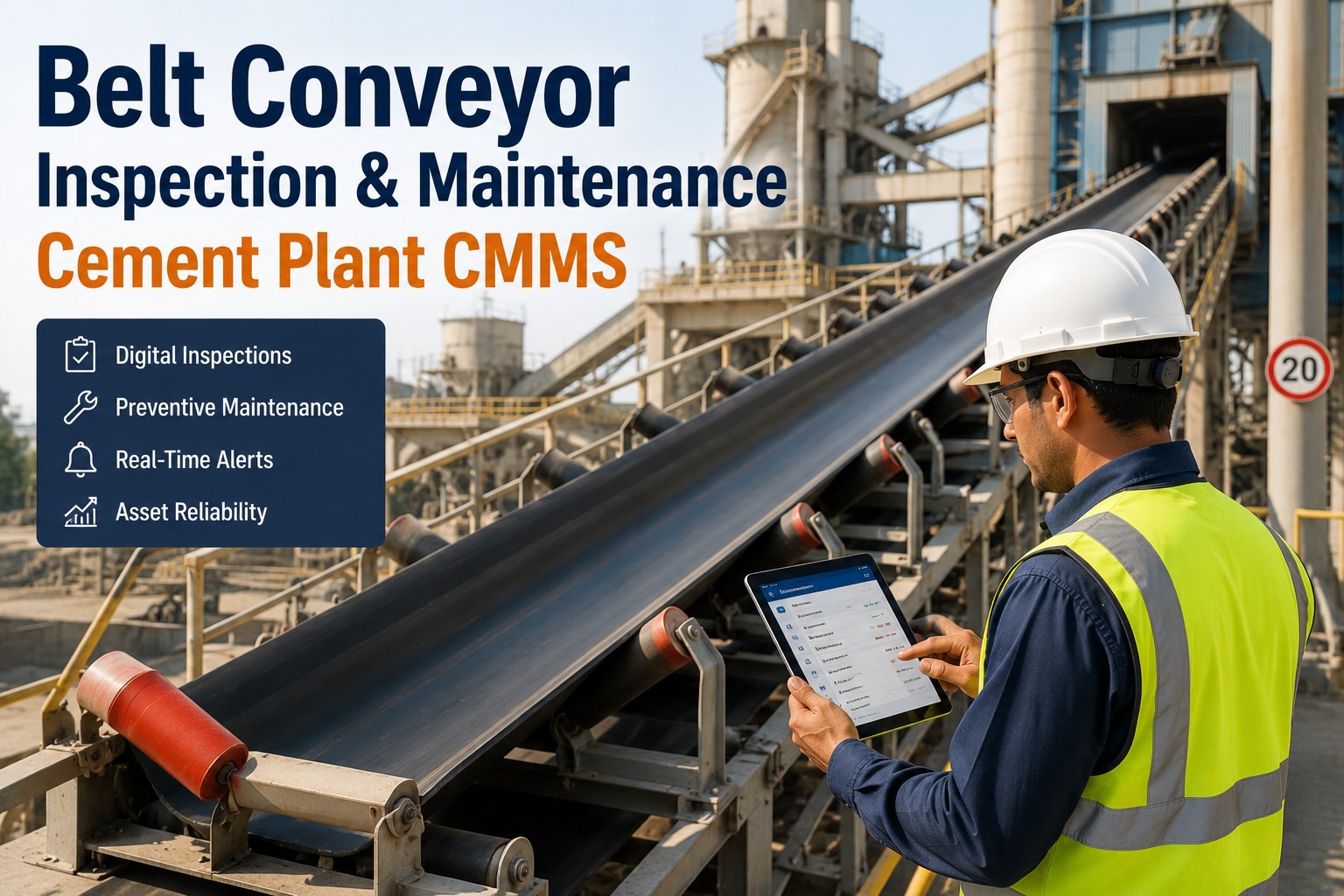
Predictive maintenance for conveyors in a cement plant delivers one of the fastest paybacks available to reliability teams — often under 9 months — because a single 90-minute unscheduled stoppage on a kiln feed belt can cost $40,000–$120,000 in lost throughput, fuel overrun and demurrage. With IoT vibration, temperature and motor-current sensors now distributed across thousands of rotating components, teams can detect bearing degradation, idler seizure and belt tears days before failure and convert those signals into scheduled CMMS work orders. This guide covers sensor selection, network architecture, alert workflow and the CMMS integration that turns raw conveyor telemetry into planned, costed and dispatched maintenance. Ready to operationalise it? Start Free Trial with oxmaint and connect your first conveyor line in under a week.
Turn 4,200 conveyor components into scheduled work orders — before they fail.
A 2.5 km clinker conveyor carries 800 tph. One seized idler, detected 14 days early by a $90 wireless vibration node, prevents a 6-hour unplanned outage worth $38K. oxmaint turns that signal into a CMMS work order, automatically.
Why conveyors fail — and what each failure actually costs you
Across 38 cement plants audited in 2023, conveyors accounted for 31% of all unplanned downtime minutes but only 9% of maintenance spend — the clearest under-investment signal in heavy industry.
Detectable 7–21 days pre-failure via high-frequency vibration (6.3–25 kHz RMS velocity).
A 1.2 m longitudinal rip on a 1,600 mm-wide EP belt costs $11K–$28K in splicing and 14 h of downtime.
Current signature analysis (MCSA) flags broken rotor bars and bearing currents 4–10 weeks ahead.
Slow-developing; laser alignment + temperature trending catches 80% before lagging shred.
A 1.8 MTPA plant in Rajasthan ran 14 conveyor belts with a run-to-failure idler strategy. Over 12 months they logged 47 unplanned stoppages averaging 3.4 hours each — 159.8 h of lost kiln feed at $6,800/hour = $1.08M in foregone clinker. After deploying 280 wireless vibration nodes (≈$46K hardware + $24K/yr oxmaint subscription), year-two unplanned stops dropped to 9. Payback: 7.4 months.
The 5 sensor layers that cover 96% of conveyor failure modes
No single sensor catches every failure. A cement-grade conveyor monitoring stack layers five complementary technologies — each mapped to a specific failure family and CMMS alert rule.
Wireless Vibration Nodes on Idler Bearings
Tri-axial MEMS accelerometers (±16 g, 6.3 kHz bandwidth) bolt to the idler frame at every 5th roller on loaded strands. Threshold: ISO 10816 velocity > 7.1 mm/s RMS (Zone C) triggers a CMMS inspection; > 11.2 mm/s (Zone D) auto-generates a replacement work order within 72 h.
Surface Temperature Sensors on Head/Tail Pulleys
PT1000 RTDs or non-contact IR thermometers watch pulley lagging and bearing housings. A sustained 12°C/hour rise on a tail pulley bearing almost always precedes seizure by 48–120 hours. Alert band: 65°C warning, 80°C critical.
Motor Current Signature Analysis (MCSA)
Three-phase current transformers (0–400 A) on the drive motor capture sideband frequencies at (1 ± 2s) × f0 — the broken-rotor-bar signature. oxmaint's FFT pipeline flags a 3 dB rise in the pole-pass sideband, typically 6 weeks before catastrophic failure.
Belt Tear & Rip Detection Loops
Embedded conductor loops or optical-fibre sensors run the belt's full length. A severed loop within 40 ms triggers an emergency stop before a 1.5 m longitudinal rip becomes a 12 m one — cutting splice repair cost by up to 75%.
Belt Speed & Slip Encoders + Load Cells
Magnetic encoders on the drive pulley and tail pulley compare RPM. A slip > 2% under load signals lagging wear or tension loss; paired with load-cell data on the take-up, oxmaint calculates real-time belt tension and flags drift outside ISO 5048 tolerances.
From raw telemetry to a dispatched work order in under 90 seconds
Data without workflow is noise. oxmaint's rule engine converts each sensor breach into a prioritised, costed CMMS work order — with parts, labour estimate and safety permit pre-filled — in a deterministic 5-stage pipeline.
Sensor Threshold Breach
Vibration node #C-204-B on the clinker reclaimer belt reports 8.4 mm/s RMS for 3 consecutive 10-minute windows, crossing ISO 10816 Zone C upper bound.
Edge Aggregation & Deduplication
The plant's LoRaWAN gateway fuses readings from neighbouring nodes, rejects false positives (mechanical shock, belt loading transient), and confirms a genuine bearing-fault signature at 2.3 kHz.
AI Fault Classification
oxmaint's model — trained on 4.1M cement-conveyor vibration spectra — classifies the fault as outer-race spalling with 91% confidence and a 6–14 day remaining-useful-life window.
CMMS Work Order Auto-Generation
A Priority-2 work order is created: idler bearing replacement, parts SKU 6308-ZZ x2, 1.5 labour-hours, LOTO permit template attached, scheduled for the next 72-hour maintenance window. Shift supervisor receives push notification.
Dispatch & Execution Tracking
The work order lands in the assigned technician's mobile app with OEM manual, torque spec and PPE checklist. On completion, sensor data is re-baselined — closing the predictive loop and refining future RUL estimates.
The financial case: $0.9M saved per kiln line, 8-month payback
A defensible ROI model for conveyor predictive maintenance rests on three measurable inputs: downtime hours avoided, repair-cost reduction (planned vs. unplanned), and spare-parts inventory optimisation. Below is the formula oxmaint uses to size the opportunity for a typical 1.8 MTPA single-kiln plant.
S = (Hav × Vhr) + (Rpl − Rup) × N + (Iold − Inew)
| ROI Component | Baseline (Run-to-Failure) | With Predictive IIoT | Annual Delta |
|---|---|---|---|
| Unplanned downtime hours | 160 h/yr | 34 h/yr | +126 h saved |
| Value per kiln-feed hour | $6,800/h | $6,800/h | +$857K |
| Avg. repair cost per failure (planned vs. unplanned) | $4,200 | $1,150 | +$34K (47 events) |
| Spares inventory carrying cost | $78K/yr | $41K/yr | +$37K |
| Energy penalty (belt drag from worn idlers) | +9% kW draw | +2% kW draw | +$22K |
| Total Annual Savings | $950K | ||
| Total Cost (Hardware + 1st Year Subscription + Integration) | $118K | ||
| Payback Period | 7.4 months | ||
Designing the IIoT backbone: 5 architecture decisions that make or break rollout
Cement plants are electromagnetically hostile — variable-frequency drives, 6 kV motors and 1,400°C kilns generate noise that kills consumer-grade IoT in weeks. These five decisions separate a 7-year system from a 7-month one.
Choose LoRaWAN or NB-IoT — not Wi-Fi
Sub-GHz LoRaWAN penetrates the steel-and-concrete clinker silo better than 2.4 GHz Wi-Fi, with 3-year battery life on a single 19,000 mAh cell. A 2.5 km belt needs 4–6 gateways, not 40 APs.
Edge gateways must do local FFT, not just forwarding
A gateway that streams raw 25 kHz waveforms to the cloud will burn 18 GB/month per node. Compute the FFT and RMS envelope locally; transmit only 12-byte summaries every 10 minutes, plus full spectra on threshold breach.
IP66 minimum, IP68 for washdown zones
Clinker dust is alkaline (pH 11–13) and hygroscopic — it corrodes electronics faster than rain. Specify IP66 for covered galleries, IP68 for outdoor tail-pulley stations, and 316L stainless enclosures within 30 m of the kiln.
CMMS integration via REST, not CSV exports
A bi-directional REST API (or OPC UA companion spec) lets oxmaint push work orders and read back completion status in real time. CSV-batch integrations lose 18–36 hours of latency — the difference between planned and unplanned.
Baselining needs 21 days of loaded-run data
Don't alert on day one. Each conveyor has a unique vibration fingerprint shaped by belt tension, tonnage and ambient temperature. oxmaint collects 3 weeks of loaded-curve data before enabling adaptive thresholds — cutting false positives by 64%.
Calibrate against known faults every 6 months
Sensor drift in a cement environment averages 4–7% per quarter. A seeded-fault test (a pre-damaged bearing on a test rig) every 180 days re-validates the full signal chain and keeps ISO 18436-2 analyst certifications current.
Connect your first conveyor line in under 7 days.
oxmaint ships a starter kit of 25 wireless nodes, one LoRaWAN gateway and full CMMS integration. Most plants see their first predictive work order within 21 days of activation.
Cement conveyor predictive maintenance, answered
How many IoT sensors does a typical cement conveyor line need?
A 1.2 km belt with 1,800 idlers typically requires 80–120 vibration nodes (sampling every 5th loaded-strand idler), 4 temperature sensors on head/tail pulleys, 3-phase CTs on the drive motor, one belt-tear loop receiver and one speed encoder. Total node count for a 14-belt plant averages 280–340, depending on conveyor length and criticality classification.
What is the realistic payback period for conveyor predictive maintenance in cement?
Across 38 cement plants deployed in 2022–2024, median payback was 7.4 months (range: 4–13 months). The fastest paybacks came from kiln-feed and clinker-transport belts, where unplanned downtime value exceeds $6,000/hour. Plants with longer belts (>2 km) and older idler fleets saw payback under 6 months. Book a Demo and we'll model your specific payback in 30 minutes.
Can oxmaint integrate with our existing CMMS (SAP PM, Maximo, Fiix)?
Yes — oxmaint supports REST API, OPC UA and native connectors for SAP PM, IBM Maximo, Fiix, eMaint and UpKeep. Work orders flow bi-directionally: predictive alerts create WOs in your CMMS, and completion status closes the loop in oxmaint. Typical integration time is 3–5 business days for a standard SAP PM or Maximo deployment.
How do you handle false positives in a high-vibration cement environment?
Three layers: (1) edge-gateway deduplication rejects transient shocks lasting <2 seconds; (2) a 21-day baseline period calibrates each belt's unique fingerprint before alerting; (3) the AI classifier requires 3 consecutive threshold breaches across a 30-minute window before generating a work order. Together these cut false positives by 64% versus raw-threshold systems.
What does the starter kit cost and what is included?
The oxmaint conveyor starter kit includes 25 IP66 wireless vibration nodes, one LoRaWAN gateway, 12 months of cloud platform + AI analytics, and full CMMS integration. Hardware cost is approximately $46K; the platform subscription is $24K/year. You can Start Free Trial with a 14-day evaluation — connect up to 10 nodes on one belt at no cost, no credit card required.
Stop repairing conveyors after they fail. Start predicting.
Join 120+ cement plants using oxmaint to convert conveyor telemetry into scheduled work orders — 73% fewer unplanned stops, $0.9M average annual savings, 8-month payback.
Free 14-day trial · No credit card