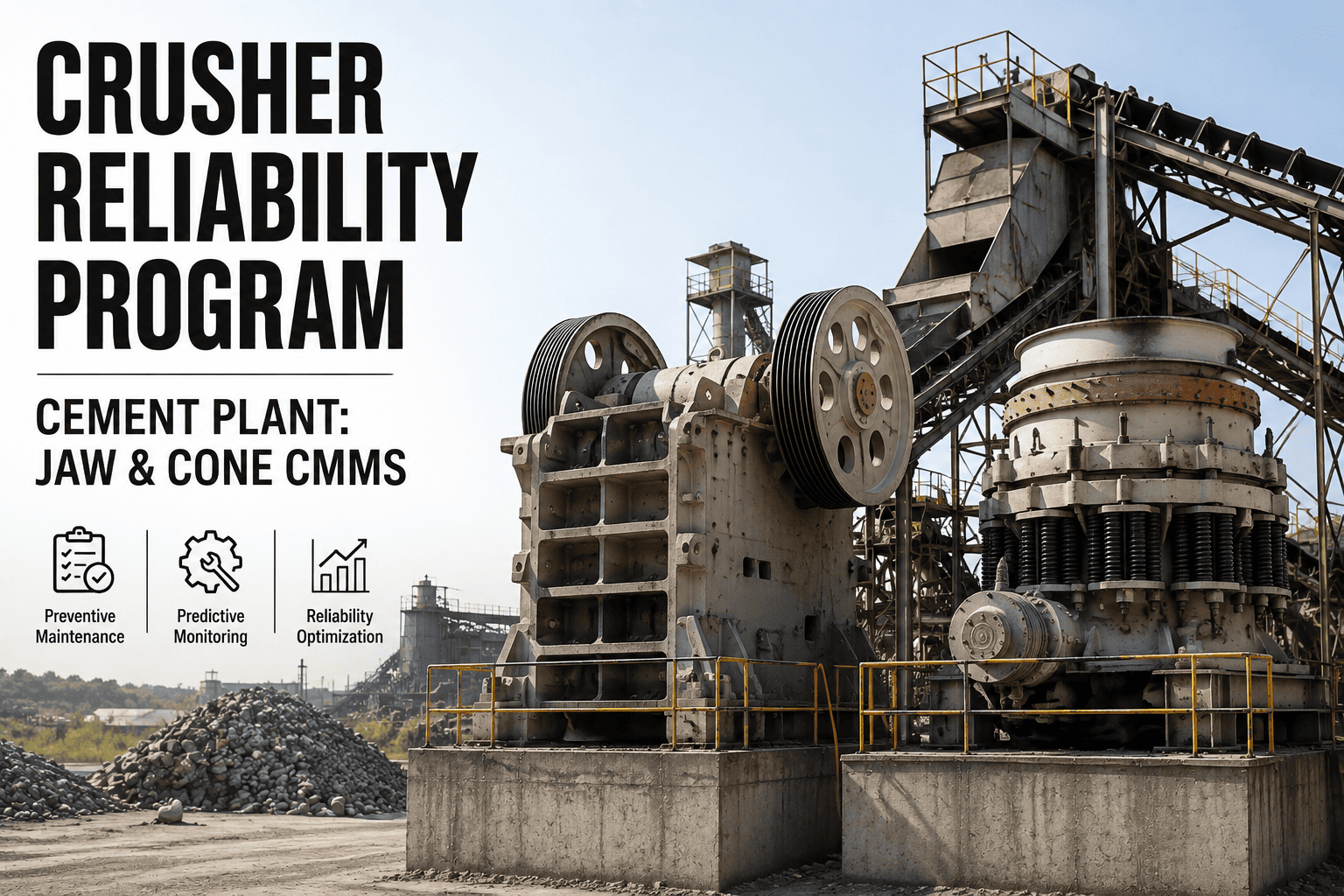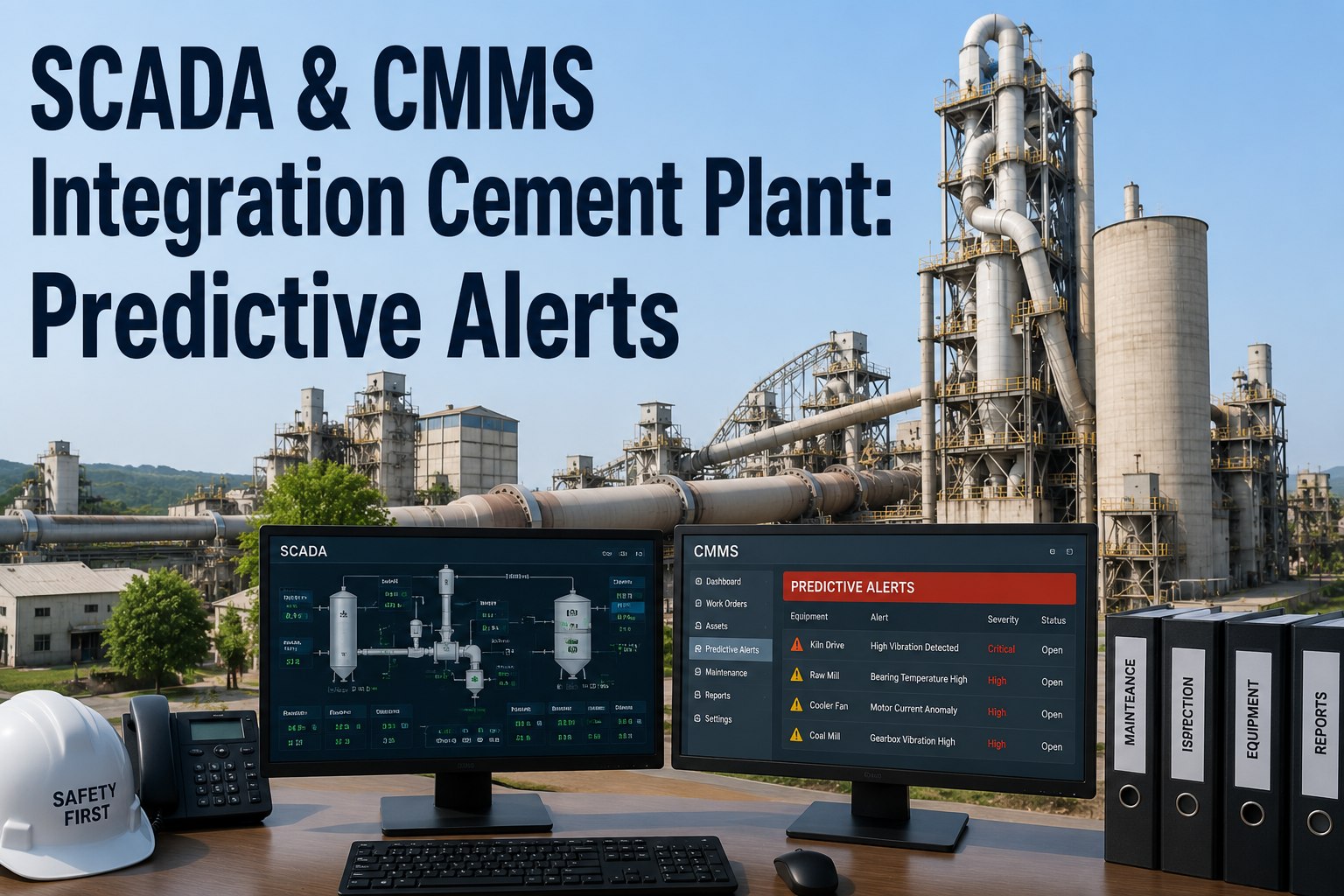
Crusher predictive maintenance is the difference between a cement plant that hits its clinker-to-finish targets and one that bleeds availability through unplanned downtime. A single jaw, cone, or impact crusher sitting at the head of the line can halt the entire upstream flow within minutes of a bearing seizure or mantle breach. This guide walks through vibration-based condition monitoring, wear tracking, and the CMMS-driven crusher PdM program that keeps limestone and clinker crushers running at plant-required OEE. Ready to move from reactive firefighting to data-driven reliability? Start Free Trial and configure your crusher assets today.
Is your crusher quietly failing between scheduled shutdowns?
Up to 70% of crusher failures in cement plants are bearing- or wear-related and develop detectable vibration signatures weeks before collapse. A CMMS-driven predictive program catches the trend early — protecting throughput, mill feed, and downstream kiln continuity.
Why crusher availability drives cement plant economics
A cement plant running 1.5M tonnes/year loses roughly $8,200 per hour of unscheduled crusher downtime when the primary limestone crusher trips. Here is where that money goes — and where predictive maintenance intercepts it.
The four-pillar crusher condition monitoring framework
A defensible crusher PdM program in cement is built on four numbered pillars — each feeding the CMMS so work orders are generated by exception, not by calendar. ISO 10816 vibration severity bands anchor every threshold.
Continuous tri-axial accelerometer monitoring
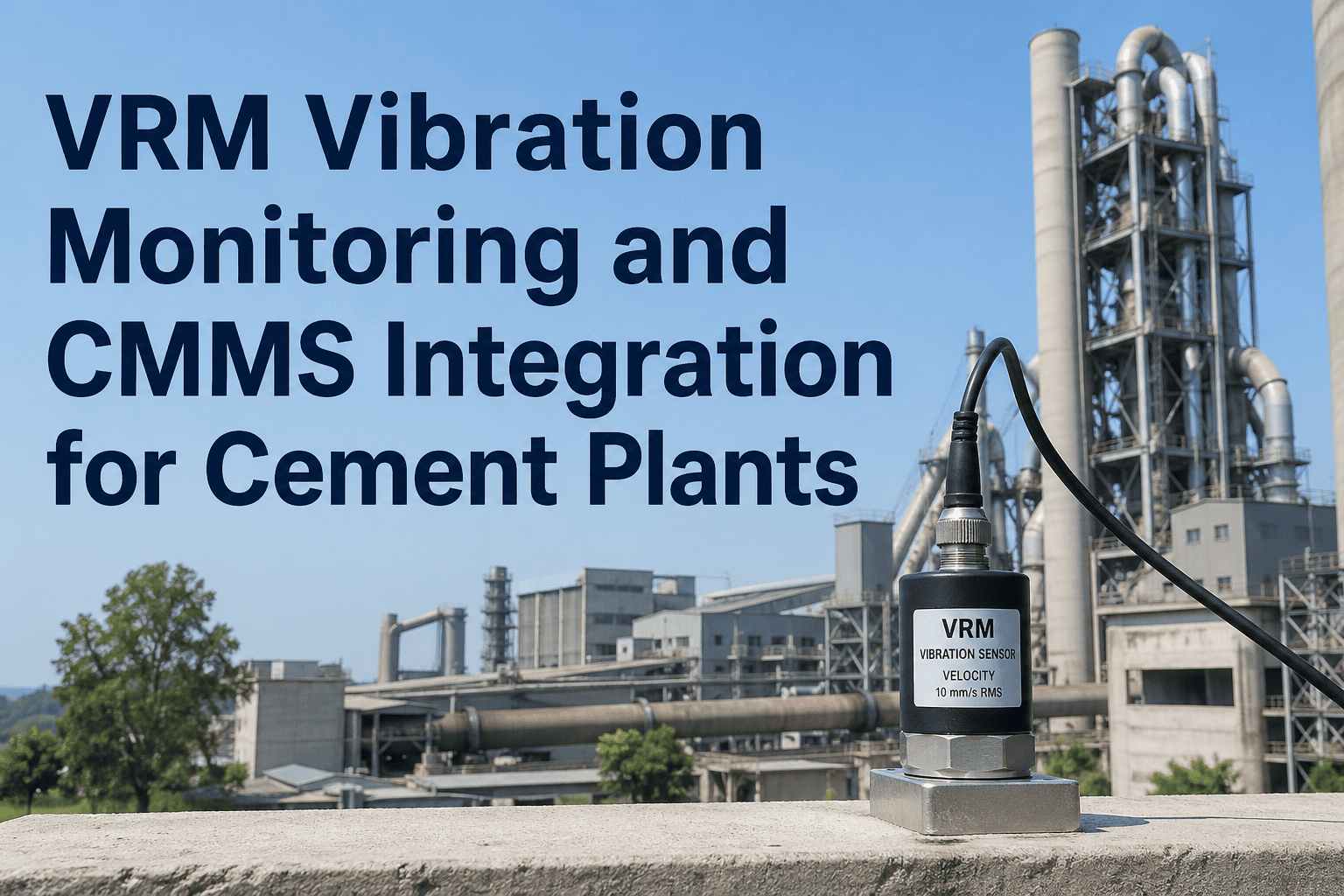
Mounting accelerometers on crusher bearing housings captures velocity (mm/s RMS) per ISO 10816-3. Trending 10–1000 Hz catches bearing defect frequencies, imbalance, misalignment, and looseness before secondary damage propagates.
Mantle, concave, and blow bar life modeling
Throughput-tonnage counters inside the CMMS track cumulative feed against rated wear life. When a cone crusher mantle reaches 60% of rated hours, the system auto-flags a planned inspection during the next 48-hour window.
Lubricant condition and bearing temperature fusion
Particle counters and RTD bearing-temperature inputs feed the CMMS asset record. A rising vibration RMS paired with a 6°C bearing-temp drift over 72 hours is a high-confidence bearing-failure precursor — triggers an emergency work order.
Exception-driven work order generation
Oxmaint consolidates sensor thresholds, wear counters, and inspector findings into one asset health score. When the score crosses amber (≤70), a corrective work order auto-generates with parts, labor estimate, and safety permits pre-attached.
Crusher-type failure modes and their vibration fingerprints
Jaw, cone, and impact crushers each generate distinct vibration signatures as they degrade. The table below maps the dominant failure mode to its tell-tale frequency band, the ISO 10816 severity threshold for action, and the recommended CMMS response.
| Crusher Type | Dominant Failure Mode | Vibration Signature | Action Threshold | CMMS Response |
|---|---|---|---|---|
| Jaw Crusher | Frame & pitman bearing wear | 1× & 2× RPM spike; high-frequency bearing defect tones (BPFO/BPFI) | 7.1 mm/s RMS (ISO Zone D) | Inspection WO + lube oil sample within 24h |
| Cone Crusher | Mantle/concave wear, eccentric bushing failure | Sub-synchronous whirl; 1× RPM axial rise; head spin | 4.5 mm/s RMS axial | Plan mantle swap at next 48h shutdown |
| Impact Crusher | Blow bar breakage, rotor imbalance | Sudden 1× RPM amplitude jump; phase angle shift > 30° | 11.2 mm/s RMS | Emergency stop + rotor balance WO |
| Hammer Mill | Hammer pin wear, screen breach | 2× & 3× RPM sidebands; broadband impact floor rise | 9.0 mm/s RMS | Schedule hammer reversal within 7 days |
| Roll Crusher | Roll face scalloping, bearing fatigue | Harmonic cluster at 4×–6× RPM; amplitude modulation | 5.6 mm/s RMS | Plan roll resurfacing within 14 days |
Quantifying the payback of a crusher PdM program
Cement plants evaluating crusher PdM should model savings against the cost of sensor hardware, CMMS licensing, and reliability engineering hours. Below is a worked example for a typical two-line cement plant with 6 monitored crushers.
ΔU = unplanned outage hours avoided per year · Hcr = crusher-line dependency factor (0.85) · $/hr = production loss per hour · CPdM = annual PdM program cost
82 fewer unplanned crusher-hours per year, 6 monitored crushers, $42K annual PdM cost (sensors + CMMS + 0.5 FTE reliability engineer). Payback achieved in < 6 months.
Turn crusher vibration data into work orders that prevent failures
Deploy Oxmaint CMMS in your cement plant and connect sensor thresholds, wear counters, and inspector findings to a single crusher asset health score — with exception-driven work orders that fire before the bearing seizes.
Month-by-month crusher PdM implementation timeline
A structured rollout avoids the common failure mode of bolting sensors onto crushers without a CMMS workflow to act on the data. Here is a proven 12-month sequence for a cement plant moving from reactive to predictive crusher maintenance.
Asset criticality ranking & sensor audit
Rank all crushers by criticality (primary limestone > clinker > additive). Audit existing sensors, confirm mounting points, and baseline vibration velocity (mm/s RMS) on each bearing housing per ISO 10816-3. Target: 100% of critical crushers baselined.
Oxmaint asset hierarchy & threshold setup
Build crusher asset hierarchy in Oxmaint, map sensor data streams, configure amber/red vibration thresholds, and link wear-life counters to auto-generated inspection work orders. Train maintenance planners on exception-driven dispatch.
Pilot on top 2 crushers — refine thresholds
Run live monitoring on the two highest-criticality crushers. Tune thresholds against real alarm data to reduce false positives. First predicted bearing intervention typically occurs within 6–8 weeks — validate the work order flow end-to-end.
Roll out to all crushers & integrate oil/thermal
Extend monitoring to all remaining crushers. Integrate particle-counter and RTD temperature streams into the CMMS asset record so the health score fuses vibration + wear + oil + thermal — giving the reliability team a single verdict per asset.
KPI reporting, MTBF tracking, ROI validation
Publish crusher availability, MTBF, and unplanned-downtime-trend dashboards to plant management. Validate ROI against the formula baseline. At month 12, a typical plant reports 3–4 percentage-point crusher availability uplift and a 25–35% drop in unplanned events.
What cement plants see after deploying crusher PdM
Reliability leaders at cement operations report measurable improvements within the first year of connecting crusher vibration data to a CMMS-driven work-order workflow. Below are aggregated outcomes from three plant profiles.
"Oxmaint flagged a 1× RPM axial rise on our primary cone crusher three weeks before the planned shutdown. We found the eccentric bushing had shifted 0.4mm — a fix that would have cost us $180K in unplanned downtime had it failed in service."
"We cut crusher spare-parts inventory by 38% because the CMMS wear counter tells us exactly when to order a mantle — not the calendar. Our buyer now triggers purchase requests from the Oxmaint work order, not from a guess."
"After 11 months on Oxmaint, our impact crusher blow-bar breakage events dropped from 4 per year to 1. The rotor-imbalance alarm gives our operators 20–30 minutes to feather the feed before a catastrophic bar break."
Crusher predictive maintenance — five questions answered
How is vibration-based crusher PdM different from routine scheduled inspections?
Scheduled inspections follow a fixed calendar regardless of actual asset condition, which means they either over-maintain healthy crushers or miss a failure that develops between intervals. Vibration-based PdM continuously trends bearing health and triggers a CMMS work order only when a threshold is crossed — typically 10–21 days before functional failure. This shifts maintenance from time-based to condition-based, cutting unnecessary interventions while catching real degradation earlier. You can see the live workflow by booking a Book a Demo session.
Which ISO standard governs crusher vibration severity thresholds?
ISO 10816-3 is the primary reference for vibration severity on machines with power ratings between 15 kW and 300 kW, which covers most cement plant crushers. It defines four zones (A good, B acceptable, C unsatisfactory — short-term operation, D unacceptable — immediate action). For crushers specifically, the axial direction on cone crusher eccentric bearings and the radial direction on jaw crusher pitman bearings are the most diagnostic measurement axes.
Can Oxmaint CMMS integrate with our existing vibration sensors and PLCs?
Yes. Oxmaint accepts vibration data via standard industrial protocols (OPC-UA, Modbus TCP, and MQTT) from most modern vibration transmitters and online condition monitors. If your crushers currently use portable data collectors, inspector readings can be entered manually or via the mobile app until permanent sensors are installed. Begin configuring your integrations with a Start Free Trial account.
What is the typical sensor investment for monitoring one crusher line?
A primary crusher line usually requires 4–8 accelerometers (two per main bearing, inboard and outboard, radial and axial), one signal conditioner or wireless transmitter per pair, and CMMS licensing. Hardware cost typically ranges from $6,000 to $14,000 per crusher depending on whether you use wired or wireless topology. Against an avoided downtime value of $8,200/hour, the sensor investment pays for itself with a single prevented failure.
How long does it take to see measurable results after deploying crusher PdM?
Most cement plants see their first predicted intervention within 6–8 weeks of go-live, once baseline vibration trends stabilize. Measurable KPI improvements — crusher availability uplift, MTBF increase, and unplanned-event reduction — typically appear in months 4–6 and reach their full 3–4 percentage-point availability gain by month 12. Plants that aggressively tune thresholds during the pilot phase (months 5–7) tend to reach full ROI fastest.
Stop repairing crushers after they fail — start predicting before they do
Deploy Oxmaint CMMS across your cement plant's crusher lines and connect vibration, wear, oil, and thermal data into one exception-driven work-order engine. Your reliability team gets a single health score per crusher — and the work order fires before the bearing seizes.
Free 14-day trial · No credit card