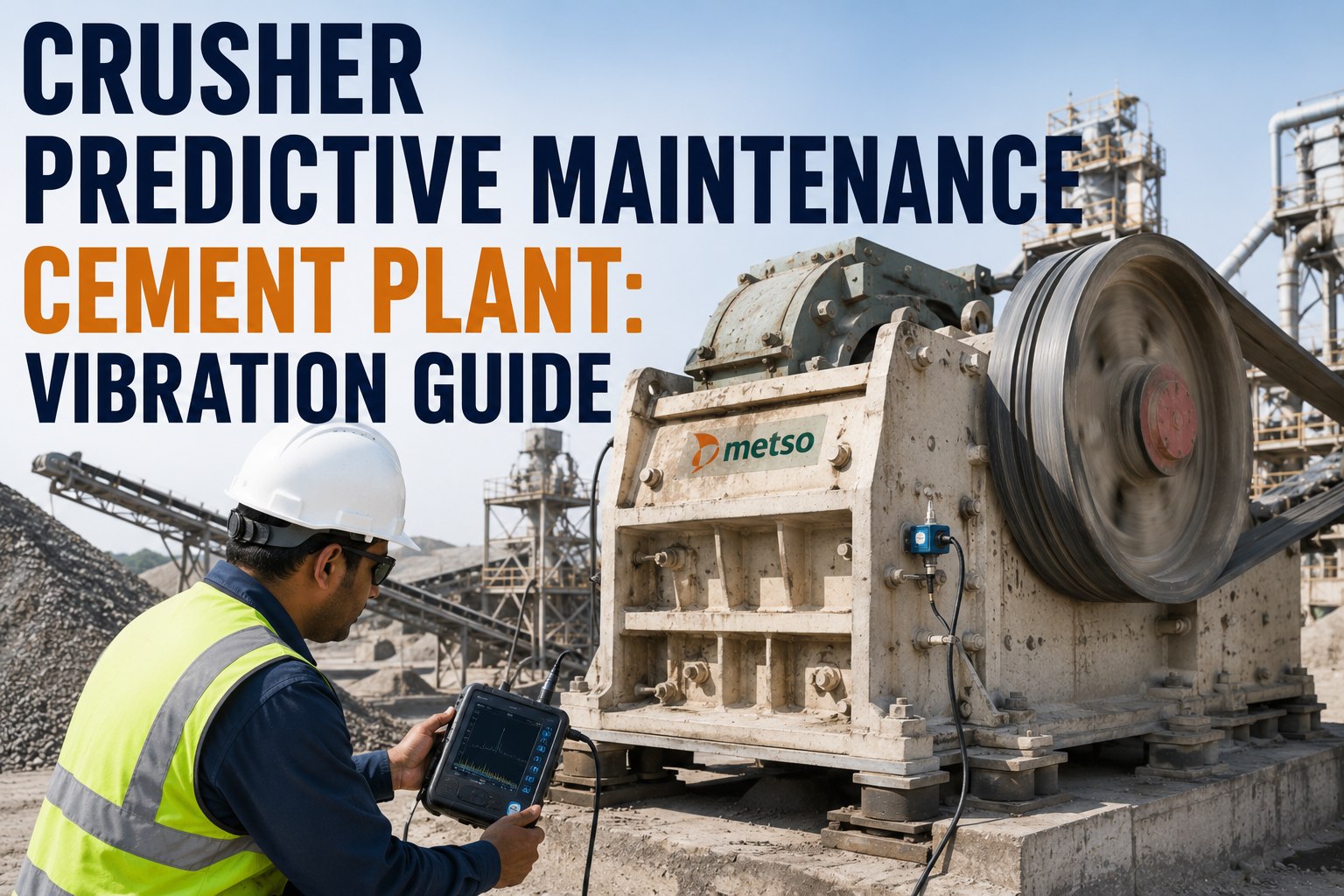
In a cement plant, the crusher is where the entire production chain begins — and where an unplanned failure creates the longest, most expensive stoppages. A crusher bearing failure that forces a 12-hour emergency repair doesn't just cost the bearing replacement; it halts the raw meal feed to the kiln, disrupts the grinding circuit schedule, and — in plants without sufficient buffer stockpile — triggers a kiln slowdown that takes hours to recover. Crusher failures are also among the most predictable in the plant: bearing deterioration, liner wear, and motor overload all generate detectable signals weeks before a breakdown. OxMaint AI predictive maintenance helps cement plant teams detect those signals early, schedule proactive repairs, and keep the raw material feed running. Book a demo to see the AI platform in action.
AI Predictive Maintenance — Crusher Maintenance
Crusher Predictive Maintenance for Cement Plants
Predict crusher bearing, motor, and liner failures weeks before breakdown. OxMaint AI monitors vibration, temperature, and power draw to keep raw material feed running and emergency repair costs low.
Typical Crusher Failure Lead Times
Main shaft bearing
3–6 weeks
Liner wear (concave / mantle)
4–8 weeks
Motor overload trend
2–4 weeks
Eccentric bearing
2–5 weeks
All detectable with continuous vibration and power monitoring
The Real Cost of a Crusher Breakdown
Maintenance managers in cement plants know the part cost when a crusher fails. What's often underestimated is the full production loss. A 12-hour crusher repair stops approximately 4,000–10,000 tonnes of raw material throughput depending on plant scale. If the kiln feed buffer is depleted, a kiln slowdown follows — adding 6–12 hours of recovery time and fuel waste on top of the repair itself. The economic case for predictive maintenance on crushers isn't built on the repair cost avoided; it's built on the production loss prevented.
Emergency Repair Scenario
Unplanned crusher stop
12–24 hrs
Emergency bearing procurement
2–5x list price
Kiln feed buffer depleted
Likely above 8 hrs
Kiln slowdown recovery
+6–12 hrs added
Total production impact
High
vs
Predictive Maintenance Scenario
Planned crusher stop window
4–6 hrs (scheduled)
Spare parts procurement
At list price, pre-staged
Kiln feed buffer managed
Pre-filled before stop
Kiln continuity
Maintained
Total production impact
Minimal
Catch Crusher Failures Before They Stop Your Kiln
OxMaint AI monitors crusher bearing vibration, motor current draw, and liner wear indicators continuously — and alerts your team weeks before a failure, so you plan the repair on your schedule, not the crusher's.
How OxMaint AI Predicts Crusher Failures
OxMaint's AI predictive maintenance engine monitors the signals that precede crusher failures and models their progression against each machine's own operating baseline — not against generic industry averages. The result is early warning specific to your crusher, your feed material, and your operating conditions.
Signals Monitored
Signal
Failure Mode Detected
Lead Time
Bearing RMS vibration (drive and non-drive end)
Main shaft and eccentric bearing deterioration
3–6 weeks
Motor current draw trend
Feed overload, liner wear, tramp metal impact
2–4 weeks
Bearing temperature (main, eccentric, countershaft)
Lubrication failure, overload, seal degradation
1–3 weeks
CSS (closed-side setting) drift
Liner wear, eccentric wear, setting mechanism wear
4–8 weeks
Oil pressure and temperature (lubrication system)
Lube pump failure, filter blockage, oil degradation
Days to weeks
AI Failure Prediction Workflow
1
Baseline Training
OxMaint AI learns each crusher's normal operating signature over 2–4 weeks — vibration patterns under different feed rates, temperature profiles across shifts, and current draw during normal and peak load.
2
Continuous Anomaly Detection
The AI monitors incoming sensor data in real time against the learned baseline. Deviations — gradual bearing frequency shifts, creeping motor current increases, CSS drift — are flagged as anomalies before human operators notice them.
3
Failure Prediction and RUL Estimate
When an anomaly trend is confirmed, OxMaint generates a remaining useful life estimate and predicted failure window based on degradation rate — giving the maintenance planner a specific timeframe to schedule the repair.
4
Work Order and Parts Coordination
OxMaint generates a planned work order with the predicted failure mode, recommended repair action, required spare parts, and estimated repair window. Parts availability is checked against inventory automatically before the order is confirmed.
Frequently Asked Questions
Which crusher types does OxMaint support for predictive maintenance?
OxMaint supports gyratory, jaw, cone, and impact crushers commonly used in cement raw material crushing circuits. Sensor configuration and AI baselines are set per crusher type and operating context.
Book a demo to discuss your specific crusher fleet.
What sensors are needed to implement OxMaint AI crusher monitoring?
A minimum viable setup includes vibration accelerometers on main bearings, motor current monitoring from the MCC, and bearing temperature sensors. OxMaint also accepts data from existing condition monitoring hardware already installed on your crusher.
How does OxMaint handle liner wear prediction without a direct wear sensor?
OxMaint tracks motor current draw trends and CSS (closed-side setting) measurements as indirect indicators of liner wear progression. When combined with the crusher's throughput history, these signals provide a reliable liner wear curve for replacement planning.
Start your free trial to configure your liner tracking setup.
How long does it take for the AI to generate reliable predictions?
OxMaint requires 2–4 weeks of normal operating data to establish a crusher-specific baseline. After that, anomaly detection is active continuously and failure predictions are generated as degradation trends develop — typically 2–8 weeks before a failure event.
Can OxMaint be used for crushers only, or does it cover the full cement plant?
OxMaint covers the full cement plant asset hierarchy — from crushers through raw mills, kilns, coolers, and finish grinding circuits. Teams typically start with the highest-criticality assets like crushers and expand as confidence in the platform grows.
Start Predicting Crusher Failures — Not Just Responding to Them
OxMaint AI predictive maintenance gives cement plant teams the early warning they need to prevent crusher bearing failures, reduce emergency repair costs, and protect kiln continuity. The raw material feed is too critical to manage reactively.