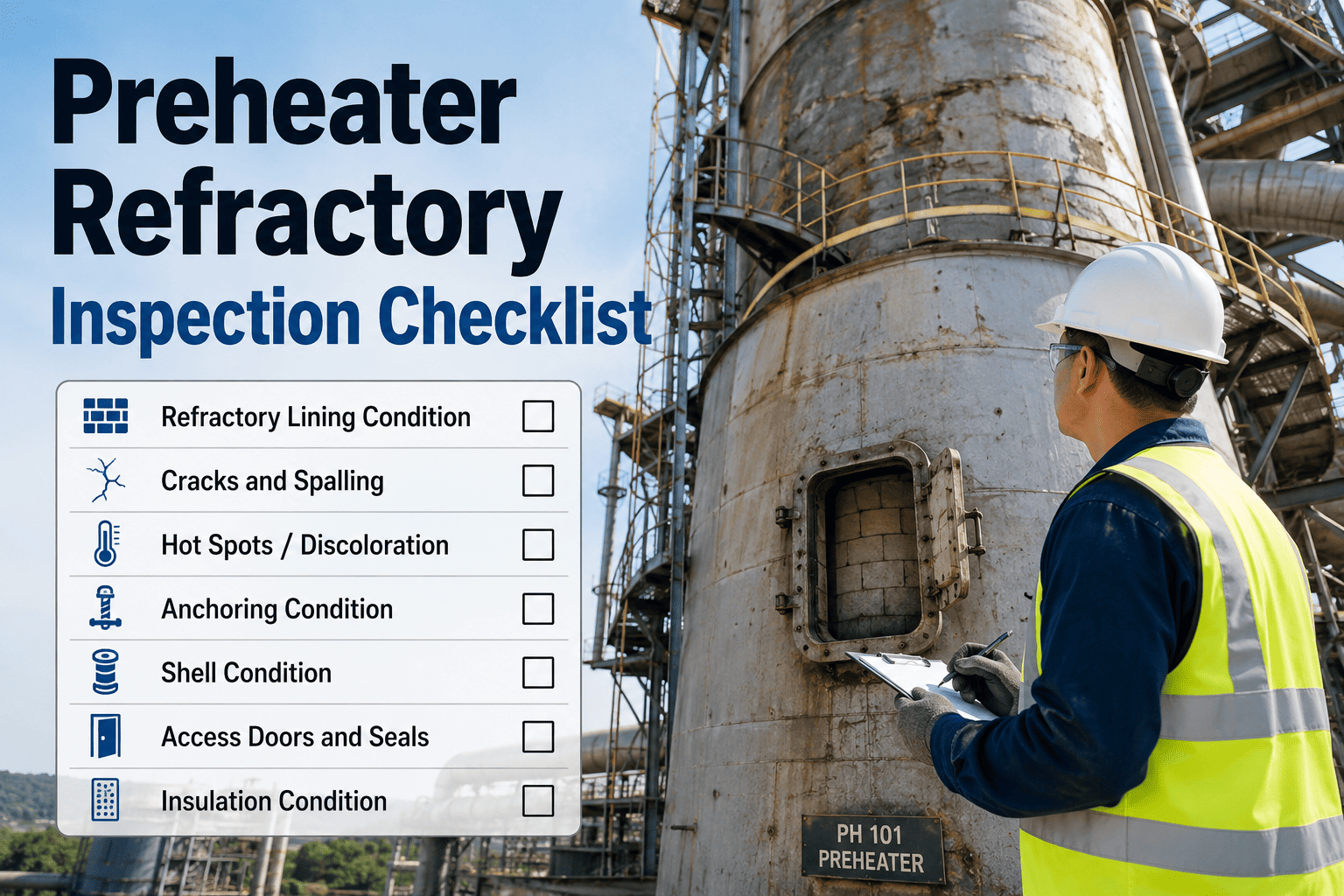
A preheater tower blockage event costs a cement plant between $180,000 and $650,000 in lost output and emergency clearing labor — and over 60% of those events trace back to refractory failures and coating buildup in cyclone stages that were visible at the prior inspection but never escalated to a corrective action. The preheater tower is a 60 to 100 meter vertical structure operating at temperatures between 300°C and 900°C across four to six cyclone stages, with riser ducts, calciner vessels, and meal distribution systems that each carry distinct wear patterns and failure modes. Worn refractory lining in the lower cyclone stages causes shell hot spots, increased radiation losses, and structural risk that can make an emergency shutdown mandatory. A structured digital inspection program — with zone-by-zone condition grading, photo documentation, and direct linkage to shutdown scope planning — is the difference between catching a refractory failure at the monitoring stage and discovering it during an unplanned stop. OxMaint's CMMS maps your entire preheater tower as a structured asset hierarchy, digitizes your inspection checklists on mobile, tracks shell temperature trends and buildup observations across campaigns, and generates shutdown scope work orders from inspection findings automatically. Start your free trial and bring your preheater refractory inspection program into OxMaint today.
Preheater & Cooler Maintenance · Inspection Management · OxMaint
Preheater Refractory Inspection Checklist
A zone-by-zone digital inspection framework for cement plant preheater towers — covering cyclone stages, riser ducts, calciner vessels, shell temperatures, repair assessments, and shutdown readiness — with full photo documentation and automatic work order generation in OxMaint.
$650K
Maximum cost of a single unplanned preheater blockage event including clearing and lost production
60%+
Of preheater shutdowns caused by coating buildup in plants without structured inspection programs
8–36 hr
Duration of a typical preheater blockage clearing event — every hour is lost clinker production
30–45%
Refractory campaign life extension achievable with structured zone-by-zone inspection programs
Tower Zone Map
Preheater Tower Inspection Zones: What to Check at Every Level
Every zone in the preheater tower has a distinct failure mode, inspection trigger, and action threshold. This zone map structures your inspection from the top cyclone stage down to the calciner — the sequence that matches a shutdown inspection walkdown and ensures no zone is missed.
Stage 1
Upper Cyclones (Stage 1–2)
300–500°C
Stage 3–4
Mid-Tower Cyclones
500–700°C
Stage 5–6
Lower Cyclones (Critical Zone)
700–900°C
Calciner
Precalciner Vessel & Riser Duct
850–950°C
Upper Cyclones — Stage 1 & 2
Shell external temperature scanned — IR walkdown, readings logged against previous campaign baseline
Cyclone cone and dip tube — buildup presence checked via inspection door, borescope if cone not accessible
Expansion joint condition — no cracking, no separation at flange connections, no cold air infiltration
Flap valve (meal distribution) — movement free, no excessive wear on seat, no seizure noted
Access door condition — seal integrity confirmed, no cold air infiltration path created at door frame
Mid-Tower — Stage 3 & 4
Riser duct lining — accessible sections inspected for breakthrough, borescope at duct bends
Cyclone cone tip condition — no partial blockage, cone geometry intact, no stalactite buildup hanging into cone
Shell ovality — no visible distortion of cyclone body indicating refractory anchor failure or thermal stress
Brick thickness at inspection points — measured and compared to minimum 80mm action threshold, photo documented
Downcomer pipe condition — no coating narrowing bore by more than 15%, cleaning work order raised if exceeded
Lower Cyclones — Stage 5 & 6 (Critical)
Shell hot spots — IR scan every 2 weeks during operation, any point above 300°C triggers immediate work order
Refractory brick condition — thickness measured at 12, 4, and 8 o'clock per zone, lowest value recorded
Anchor integrity — exposed anchors, hollow-sounding refractory (hammer test), delamination patterns photographed
Coating buildup thickness — measured at cone and riser connection, campaign rate of growth calculated in OxMaint
Meal pipe seal condition — no bypass path between stages, no cold air infiltration through worn seals
Condition grading: PASS / MONITOR / REPAIR REQUIRED — entered in OxMaint per zone, repairs linked to shutdown scope
Calciner Vessel & Tertiary Air Duct
Calciner vessel refractory — brick and castable condition at fuel injection zones, no breakthrough or spalling
Tertiary air duct lining — accessible sections inspected, wall thickness measured at wear bends
Calciner shell temperature profile — hot spots above 250°C in castable zones flagged for immediate monitoring
Fuel injection nozzle ports — no buildup blocking port geometry, nozzle tip accessible and undamaged
Explosion relief vent and damper condition — functional, no mechanical obstruction, seal intact
Refractory deterioration that's visible at inspection but not escalated causes 74% of all unplanned preheater stops.
OxMaint enforces zone grading on every inspection, auto-generates repair work orders for MONITOR and REPAIR REQUIRED findings, and links them directly to your next shutdown scope — so nothing gets missed between the inspector and the planner.
Between-Shutdown Monitoring
Preheater Refractory Monitoring During Operation: Weekly & Continuous Tasks
Full internal refractory inspections happen at planned shutdowns every 6–12 months. Between shutdowns, this continuous monitoring program provides early warning of developing failures — giving your team the lead time to plan a repair at the next scheduled stop rather than respond to an emergency.
Weekly
Infrared Shell Scanning
Full IR walkdown of all cyclone stages and calciner vessel — all zones
Temperature readings logged against previous week — rate of change calculated automatically in OxMaint
Any zone above 250°C (castable) or 300°C (brick) triggers work order escalation to maintenance planner
Photo of any new hot spot with GPS coordinates and stage number — uploaded to asset record
Every Shift
Process Parameter Review
Stage-by-stage cyclone temperature readings — cold zone more than 30°C below adjacent stage flags blockage risk
Draft pressure differential across each cyclone stage — rising pressure drop indicates increasing buildup
O2 profile at preheater exit — increasing infiltration indicates seal degradation at expansion joints or meal pipes
Abnormal kiln feed fluctuation — cone cone discharge irregularity logged and escalated if pattern repeats
Monthly
Condition Trend Review
Hot spot temperature trends reviewed in OxMaint — rate of growth above 5°C per week triggers planning review
Coating buildup rate compared against previous campaign — accelerating growth triggers cleaning scope addition
False air measurement at each stage — internal leakage above 2% indicates flap valve or seal degradation
Shutdown scope updated — any monitoring findings with deteriorating trend added to next planned stop
Shutdown Readiness
From Inspection Finding to Shutdown Scope: How OxMaint Closes the Gap
1
Inspection Finding
Technician completes zone inspection on OxMaint mobile. Grades lower cyclone Stage 5 as REPAIR REQUIRED — brick below 80mm, shell hot spot at 320°C confirmed by photo.
›
2
Automatic Work Order
OxMaint auto-generates a corrective work order tagged to Stage 5 cyclone with defect classification, photo attachment, and priority level — sent immediately to the maintenance planner.
›
3
Shutdown Scope Update
Planner adds the repair to the next planned shutdown scope in OxMaint — refractory crew, material quantities, and access scaffolding requirements linked to the work order.
›
4
Repair & Verification
Shutdown repair completed and signed off in OxMaint — completion photo, brick thickness post-repair, and inspector sign-off recorded against the asset history before restart authorization.
Common Questions
Preheater Refractory Inspection — What Maintenance Teams Ask
How often should preheater refractory internal inspections be performed in cement plants?
Full internal refractory inspections — including brick thickness measurement, dip tube condition assessment, and buildup mapping — should occur at every planned major shutdown, typically every 6–12 months depending on operational hours and campaign history. Between shutdowns, weekly infrared shell scans of the lower cyclone stages and monthly false air measurements provide the monitoring layer that feeds the shutdown scope with actionable data.
Start your free trial and configure your preheater inspection schedule in OxMaint.
What shell temperature triggers an immediate refractory repair in a cement preheater?
For brick-lined zones, any shell temperature above 300°C detected during an IR scan indicates the lining has thinned to the point where heat transfer through the remaining brick is accelerating — requiring a REPAIR REQUIRED grading and work order escalation to the planning team. For castable-lined zones, the trigger is 250°C. OxMaint's mobile inspection form includes configurable threshold alerts that fire automatically when a logged temperature exceeds the plant-defined limit.
Book a demo to see the threshold alert configuration in OxMaint.
What is the primary cause of coating buildup blockages in preheater cyclones?
The majority of coating buildup events in cyclone stages 4 and 5 originate from raw meal with elevated alkali, sulfur, and chloride content cycling between the kiln and preheater. When fuel or raw material quality changes, the buildup rate can increase sharply within days. Structured buildup thickness measurements at each inspection — trended against campaign history in OxMaint — detect rate acceleration weeks before a blockage event occurs.
How does OxMaint link preheater inspection findings to shutdown planning?
Every MONITOR or REPAIR REQUIRED grading in OxMaint's preheater inspection form automatically generates a linked work order that goes directly into the shutdown planning queue. The planner sees the defect photo, zone location, severity rating, and inspection date — without any manual transfer of paper notes. This eliminates the most common gap between inspection teams and planners that causes refractory findings to arrive at the shutdown scope too late to procure materials.
Start your free trial to build your shutdown scope workflow in OxMaint.
What is false air infiltration and how does it indicate refractory or seal degradation?
False air infiltration is cold ambient air entering the preheater system through gaps in expansion joints, worn flap valve seats, cracked access door seals, and degraded meal pipe connections. When internal leakage exceeds 2%, separation efficiency drops measurably and thermal efficiency of the entire tower decreases — increasing fuel consumption and reducing kiln feed temperature. Monthly O2 profile measurements across stages in OxMaint track false air trends and identify which stage is the infiltration source.
Preheater Inspection · Refractory Tracking · OxMaint CMMS
Every Zone. Every Shutdown. Every Hot Spot. Tracked and Escalated Automatically.
OxMaint digitizes preheater refractory inspections zone by zone, tracks shell temperatures and buildup rates across campaigns, auto-generates shutdown scope work orders from REPAIR REQUIRED findings, and archives every inspection record for audit readiness — so your next planned shutdown fixes what the last inspection found, not what the last emergency revealed.