Cement plant coolers run on banks of five to fifteen fans, pulling ambient air through the clinker bed to bring material down from roughly 1,500°C to near 100°C before it reaches the transport conveyors. When one of those fans loses airflow to a worn impeller or a failing bearing, nothing looks wrong on the control room screen at first — clinker temperature just climbs a little, secondary air recovery slips, and downstream conveyors start carrying material hotter than they were built for. Left untracked, that single fan is often the reason the kiln itself goes down two hours later, because the cooler can no longer keep pace with what the kiln is discharging. See how OxMaint catches that failure weeks before it reaches the kiln.
Kiln Reliability — Clinker Cooler Fans
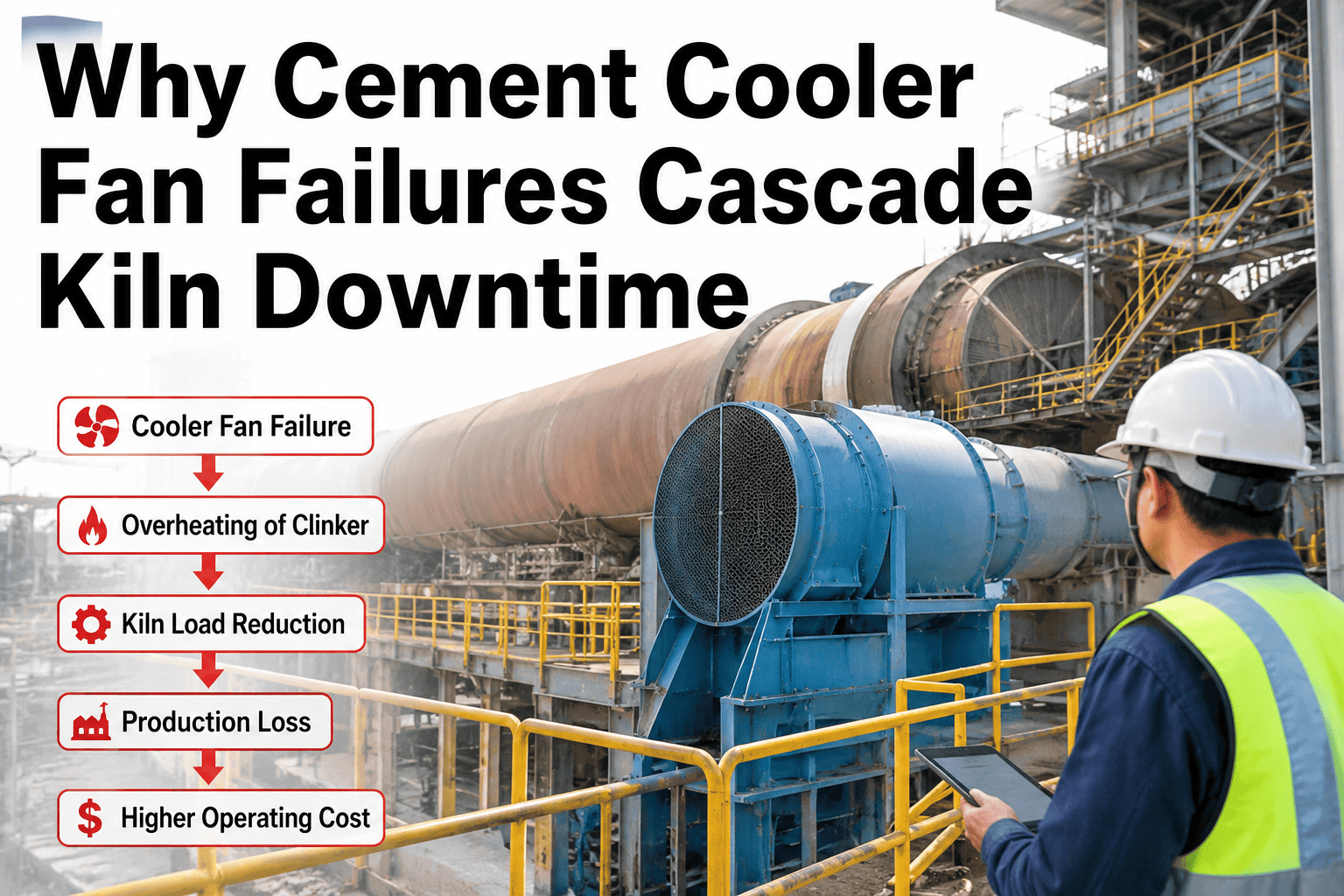
Why Cement Cooler Fan Failures Cascade Into Kiln Downtime
One eroding impeller is rarely a cooler problem for long. Track fan vibration, under-grate pressure, and secondary air temperature in OxMaint before a bearing that costs a few thousand dollars to fix turns into a kiln stoppage that costs six figures.
$18K–$45K
Lost production per hour of kiln shutdown
4–10 wks
Early-warning window from vibration trending
5–15
Fans per cooler bank — one failure strains them all
90%+
PM compliance linked to measurable downtime drop
The Two-Hour Countdown From Fan Wear to Kiln Stop
A clinker cooler fan almost never fails without warning — it erodes. Clinker dust hitting the impeller blades at high velocity wears the leading edge asymmetrically, building a mass imbalance that shows up as rising vibration weeks before the bearing actually seizes. The problem is that most plants aren't watching that trend, so the failure feels sudden even though the fan was telling on itself the entire time. Once that fan drops out of the bank, here is roughly how fast the rest of the process reacts.
T+0
Impeller wear crosses the critical threshold
Blade-tip erosion finally tips the fan into an imbalance the bearing can't absorb, or a bearing already running hot on cumulative dust ingress finally seizes. Nobody on the floor sees it happen.
T+20 min
Under-grate pressure and airflow drop
The affected zone's under-grate pressure deviates more than 15% from baseline. Secondary air temperature heading back to the kiln starts sliding, and nobody has connected it to the fan yet.
T+45 min
A red river forms in the clinker bed
Cooling air now takes the path of least resistance around the starved zone. Fine, hot clinker channels through as a visible red-hot stream instead of cooling evenly across the grate width.
T+90 min
Downstream equipment absorbs the heat
Conveyors, bucket elevators, and crusher housings built for cooled clinker now handle material well above their thermal tolerance. Belt and liner wear accelerates on every load that passes through.
T+2 hr
The kiln throttles or trips
The cooler can no longer keep pace with kiln discharge. Operators either cut kiln feed to protect the grate and downstream conveying, or the interlock trips the line outright — and the clock on lost production starts running.
Why Clinker Cooler Fans Fail in the First Place
Cooler fans work in one of the harshest airflow environments in the plant — abrasive clinker dust, cycling thermal loads, and continuous duty across banks that can draw two to five megawatts combined. Four failure modes account for most of the unplanned trips maintenance teams deal with.
01
Impeller Blade Erosion
Fine clinker dust erodes blade leading edges asymmetrically, building a progressive imbalance that grows measurably every week the fan runs unmonitored.
02
Bearing Heat and Dust Ingress
Bearing housings run hot in the cooler's thermal envelope. Dust bypassing worn seals contaminates the grease, and lubrication breaks down long before a scheduled change.
03
Seal and Labyrinth Wear
Worn shaft seals let hot, dust-laden air bypass the intended path, quietly reducing airflow efficiency long before any alarm threshold is crossed.
04
Duct and Damper Fouling
Clinker fines build up in ductwork and inlet dampers, changing the fan's operating point on its curve and forcing it to work harder to move the same volume of air.
Stop Losing the Cascade to Guesswork
OxMaint connects fan vibration, under-grate pressure, and secondary air temperature into one condition record per cooler zone — so the pattern is visible weeks before the kiln ever feels it.
Six Signals That Predict a Fan Failure Weeks Out
Fan failures on a cooler bank rarely arrive out of nowhere. Each of these six signals, tracked consistently, gives an engineer weeks of runway instead of a two-hour scramble after the kiln has already stopped.
1
Rising 1× running-speed vibration
The classic signature of a growing impeller imbalance, detectable four to ten weeks before the fan reaches a trip threshold.
2
Under-grate pressure drifting from baseline
Any zone deviating more than 15% from its established baseline within a single shift deserves an immediate look, not a note for next week.
3
Secondary air temperature sliding
A slow, consistent drop across shifts at constant kiln output points to airflow bypassing the clinker bed rather than cooling it.
4
Power draw diverging from the fan curve
When amp draw no longer matches the expected point on the fan's performance curve, efficiency loss is already underway, even if vibration hasn't tripped an alarm yet.
5
Bearing housing temperature creep
A slow upward creep between manual rounds is often the only warning a bearing gives before it seizes outright.
6
Visible red-river channeling
By the time a red river is visible during a walk-down, airflow imbalance has already been active for a while — treat it as confirmation, not first notice.
What This Cascade Actually Costs a Plant
None of these numbers are theoretical — they're the range maintenance and reliability teams report when a cooler fan failure is left to cascade instead of being caught early.
$18K–$45K
Lost clinker production for every hour the kiln is down
$80K–$200K
Typical repair and production loss from one avoided grate breakthrough
0.8%
Added fuel cost for every 10°C of secondary air recovery lost
$120K+
Refractory brick replacement risk from a rushed, unplanned cooldown
Traditional Fan Monitoring vs. OxMaint
Frequently Asked Questions
Why does one cooler fan failure force a full kiln shutdown?
The cooler bank works as a system — losing one fan drops airflow in that zone, forms a red river of poorly cooled clinker, and stresses downstream conveyors. Once the cooler can't keep pace with kiln discharge, feed gets cut or the line trips to protect equipment.
How early can OxMaint actually catch a failing fan?
Vibration trending typically surfaces a growing impeller imbalance four to ten weeks before a fan would trip on its own.
Book a demo to see that detection window against your own cooler data.
What sensor data does the platform need to monitor cooler fans?
Fan vibration, bearing temperature, under-grate pressure by zone, and secondary air temperature are the four inputs that give the clearest early picture, whether they come from installed sensors or manual rounds entered into the system.
Can OxMaint tell the difference between a fan problem and a grate plate problem?
Yes. Because pressure, vibration, and temperature are tracked by zone and by asset, a fan-driven airflow drop and a grate-plate-driven channeling pattern show up as distinct trend signatures rather than one unexplained alarm.
How long does it take to get a cooler fan program running?
Most plants have asset templates configured and the first automated work orders running within one to two weeks.
Start a free trial to load your cooler assets and see it firsthand.
Catch the Fan Before It Catches the Kiln
OxMaint tracks every cooler fan, pressure zone, and air-temperature trend in one place — so the next impeller imbalance becomes a scheduled bearing swap, not an unplanned kiln stop.