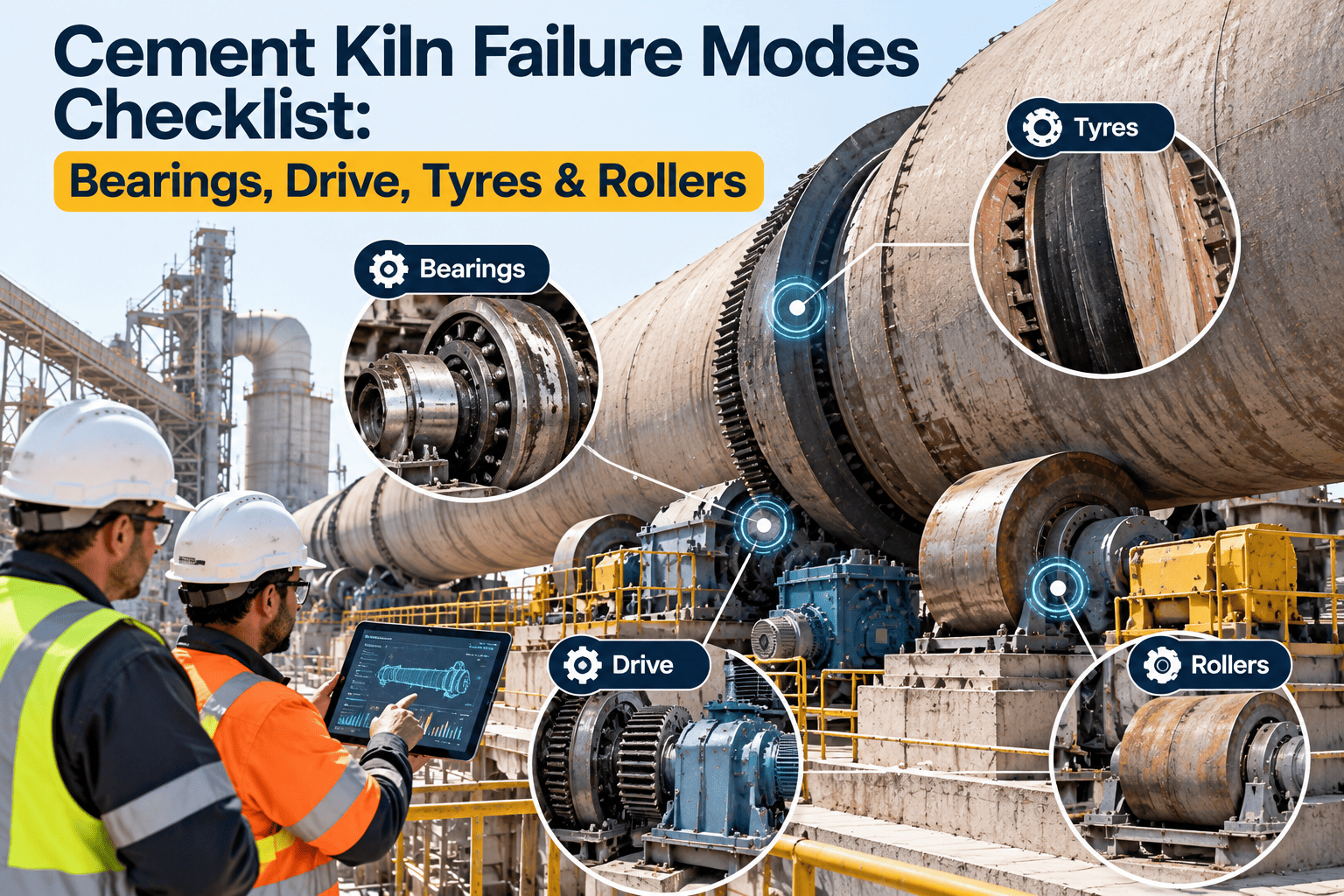
Cement kilns and preheater circuits are the assets where a single failure mode can wipe out an entire quarter's maintenance budget — a refractory brick collapse, a preheater cyclone blockage, or a tyre creep event routinely translates into 12 to 72 hours of unplanned outage at $40–90K per hour in lost clinker production. FMEA (Failure Mode and Effects Analysis) is the structured method that surfaces those modes before they surface in the downtime log, ranking each by Severity, Occurrence, and Detection so that the limited maintenance dollar lands where the risk is genuinely highest. This guide walks through kiln and preheater FMEA methodology, RPN scoring, and the CMMS structure that converts an analysis spreadsheet into living PM tasks on the floor. Ready to operationalize your analysis instead of filing it? Start Free Trial and import your asset hierarchy today.
FMEA FOR CEMENT ASSETS
Which kiln failure mode is quietly building toward your next 48-hour outage?
Most cement plants run 4,000–8,000 assets through a single pyro line — and 80% of unplanned downtime traces back to fewer than 15 failure modes in the kiln and preheater. FMEA finds them first. RPN ranks them. CMMS keeps the prevention tasks alive.
FMEA METHODOLOGY
From asset function to ranked risk in five disciplined steps
A defensible FMEA follows a strict sequence — skip a step and the RPN scores become opinion instead of evidence. Cement plants that align this sequence to ISO 55000 asset management principles typically cut unplanned pyro downtime 18–30% within the first operating cycle.
Function & performance boundaries
Define what the kiln shell, tyre, riding ring, support roller, and preheater stages must deliver — e.g. "rotate at 3.5–4.2 rpm with shell ovality under 0.3% and exit gas temperature 320–360°C." Without a measurable function, every downstream score is guesswork.
Failure mode brainstorming
Cross-functional team (mechanical, process, refractory, reliability) lists every way each function can fail — coating collapse in cyclone stage 4, shell crack at tyre junction, support roller bearing spalling, kiln inlet seal leakage. Capture modes, not symptoms.
Effect & severity scoring (S, 1–10)
Score the consequence of each mode on a 1–10 scale. A kiln shell crack that halts production for 14 days scores 9–10; a worn seal gasket causing 1% thermal inefficiency scores 3–4. Anchor each score to a real cost or safety benchmark.
Occurrence & detection scoring (O, D)
Occurrence reflects how often the mode actually initiates (historical MTBF data). Detection measures whether current controls — thermography, vibration, shell scanner — catch it before failure. Both use the same 1–10 scale where 10 is worst.
RPN calculation & action threshold
Multiply S × O × D. Most cement programs set the action trigger at RPN ≥ 125 or any single Severity ≥ 8 regardless of RPN. Rank the list, assign owners, and push the top 20% into the CMMS as PM tasks or condition-monitoring routes.
RPN SCORING
The RPN formula that turns engineering judgment into a sortable priority list
Risk Priority Number compresses three independent judgments into a single comparable score. The formula itself is simple — the discipline is in the calibration of each input.
RISK PRIORITY NUMBER
RPN = Severity × Occurrence × Detection
Each factor scored 1 (best) to 10 (worst). RPN range: 1 (negligible) to 1,000 (critical).
A worked example: preheater cyclone blockage at stage 4. Severity 8 (14-hour outage to clear, ~$60K lost production). Occurrence 5 (happens roughly twice per year on this fuel mix). Detection 6 (gas-temperature differential catches it only 40% of the time before total blockage). RPN = 8 × 5 × 6 = 240. That score demands a corrective action — in this case, an automated differential-pressure alarm plus a weekly stage-4 coating inspection route in the CMMS.
KILN & PREHEATER FAILURE MODES
The 12 highest-RPN modes that dominate pyro-line downtime
Drawn from FMEA workshops across mid-size cement operations (1,500–5,000 TPD kilns), this is the shortlist your analysis should interrogate first. These modes account for 70–85% of recorded pyro outage hours in benchmark plants.
| Asset / Function | Failure Mode | Effect | S | O | D | RPN |
|---|---|---|---|---|---|---|
| Kiln shell | Crack at tyre junction due to fatigue | 14-day outage, shell replacement | 10 | 3 | 6 | 180 |
| Preheater cyclone 4 | Coating collapse / blockage | 12–18 hr outage, gas bypass | 8 | 5 | 6 | 240 |
| Support roller bearing | Spalling / lubrication failure | Roller change, 24–36 hr | 9 | 4 | 4 | 144 |
| Kiln tyre | Creep > 6 mm/rev (loose fit) | Shell ovality, refractory loss | 7 | 6 | 5 | 210 |
| Preheater fan | Impeller erosion / imbalance | Vibration trip, draft loss | 7 | 5 | 4 | 140 |
| Kiln inlet seal | Gas leakage / packing wear | 1–3% thermal efficiency loss | 4 | 7 | 5 | 140 |
| Refractory burning zone | Brick lining collapse | Shell hot spot, forced stop | 9 | 4 | 5 | 180 |
| Preheater gas duct | Buildup / blockage at elbow | Draft restriction, 6–10 hr | 6 | 6 | 5 | 180 |
| Kiln drive girth gear | Pitting / tooth wear | Reduced torque, vibration | 8 | 3 | 5 | 120 |
| Preheater cyclone 1 | Dip tube erosion / detachment | Separation efficiency drop | 5 | 7 | 5 | 175 |
| Kiln shell scanner | Calibration drift / blind zone | Hidden hot spots, undetected | 8 | 5 | 7 | 280 |
| Clinker cooler grate | Plate distortion / fall-through | Cooling loss, clinker quality | 6 | 5 | 5 | 150 |
Notice the kiln shell scanner at RPN 280 — a detection-system failure, not a primary equipment failure. Your FMEA must include instrumentation and protective functions as assets, or the highest-risk modes stay invisible.
CMMS INTEGRATION
From spreadsheet to scheduled PM — the structure that keeps FMEA alive
An FMEA that lives in a spreadsheet dies in a spreadsheet. The CMMS must carry each high-RPN action forward as a scheduled task with a trigger, a procedure, and a feedback loop back to the analysis.
01
Map failure mode to asset node
Every failure mode in the FMEA links to a specific asset in the CMMS hierarchy — kiln shell, support roller assembly, preheater stage-4 cyclone. This is the join key that makes everything else queryable.
02
Trigger type per task
Calendar-based PM (monthly coating inspection), runtime-based (every 8,000 kiln-hours), or condition-based (shell temperature > 380°C triggers scan). Match the trigger to the failure mode's P-F interval.
03
Procedure & acceptance criteria
Each task carries a checklist with measurable pass/fail criteria — "tyre creep ≤ 3 mm/rev," "stage-4 ΔP 1.8–2.4 kPa." Without criteria, the technician's note becomes the only record.
04
RPN feedback loop
When a PM finds an incipient failure, log the finding against the FMEA row. Recalculate Occurrence and Detection annually — RPN scores should trend downward as controls mature. If they don't, the control isn't working.
05
Spare-parts linkage
High-RPN modes should have critical spares flagged in the CMMS BOM — roller bearing, inlet seal set, refractory brick batch. A 30-day sourcing lead time on a 240-RPN mode is itself a reliability gap.
06
Reliability KPI dashboard
Track mean time between failures for each mode, PM compliance percentage, and RPN reduction over time. A mature cement FMEA program shows 20–35% RPN reduction on the top 20 modes within 18 months.
WORKED EXAMPLE
A 3,200-TPD plant, $1.8M in recovered downtime, one operating cycle
A mid-continent cement operation with a single 3,200-TPD kiln ran a full kiln-and-preheater FMEA across 47 asset nodes. The analysis identified 132 failure modes; 19 scored RPN ≥ 125. Here's what happened when those 19 moved from spreadsheet to CMMS-scheduled tasks.
$1.8M
Downtime cost recovered in year one from 11 prevented high-RPN events
23%
Reduction in unplanned pyro-line hours within 12 months
47
Asset nodes analyzed across kiln, preheater, cooler, and ancillary drives
"
The stage-4 cyclone blockage mode had been hitting us twice a year at $60K a pop. FMEA gave it an RPN of 240 and we built a weekly differential-pressure inspection route in Oxmaint. We haven't had a full blockage in 14 months. That single PM task paid for the entire CMMS rollout.
— Reliability Manager, 3,200-TPD integrated cement plant
Turn your last downtime event into a prevented next one
Import your asset hierarchy, run a kiln-and-preheater FMEA, and schedule every high-RPN task in one afternoon.
FREQUENTLY ASKED
Cement FMEA — the questions reliability leaders actually ask
How often should a cement plant refresh its kiln FMEA?
A full kiln and preheater FMEA should be revisited every 12–18 months, or immediately after any major event (shell crack, refractory collapse, drive failure) that reveals a mode not previously captured. RPN scores for existing modes should be reviewed quarterly using actual failure data from the CMMS. The refresh cycle aligns with ISO 55000 asset management review cadence and keeps Occurrence and Detection scores anchored to real operating history rather than workshop estimates that drift stale within a single campaign.
What RPN threshold should trigger a corrective action in a cement plant?
Most cement reliability programs set the action trigger at RPN ≥ 125, with an override for any single Severity score ≥ 8 regardless of the calculated RPN. The override matters because a kiln shell crack (Severity 10) with low Occurrence and good Detection can still produce a deceptively low RPN — yet the consequence of missing it is catastrophic. The threshold should be documented in your reliability standard and applied consistently across all asset classes, not just pyro.
Can FMEA work without a CMMS, or is the spreadsheet version enough?
A spreadsheet captures the analysis but cannot execute the prevention. Without CMMS integration, high-RPN modes become PM tasks only if someone remembers to schedule them — and the feedback loop from completed inspections back to recalculated RPN scores is manual or absent entirely. To see how Oxmaint links each FMEA row to a scheduled PM task with measurable acceptance criteria, Book a Demo and we'll walk through a kiln FMEA mapped to live work orders.
Who should be in the room during a kiln and preheater FMEA workshop?
A minimum of five roles: reliability engineer (facilitator), mechanical maintenance supervisor, process engineer, refractory specialist, and a senior kiln operator. Add the condition-monitoring technician if vibration or thermography routes are in scope. Skipping any role skews the failure-mode list — operators know modes engineers never see, and refractory specialists catch brick-lining failure modes that mechanical teams routinely miss. Budget two full days for a kiln-and-preheater scope on a single pyro line.
How do we score Detection when we have partial condition monitoring?
Detection scoring must reflect the actual probability that current controls catch the mode before functional failure — not the theoretical capability of the instrument. If a shell scanner covers 85% of the kiln length but has a known blind zone at the tyre, Detection for a crack-initiation mode in that zone scores 7 or 8, not 3. Document the control gap explicitly in the FMEA notes; those gaps become the business case for instrumentation upgrades, which is one of the highest-leverage outputs of the entire exercise.
Your kiln FMEA should be a living program, not a binder on a shelf
Import your asset hierarchy, score failure modes, and schedule every high-RPN task inside a CMMS built for cement reliability teams.
Free 14-day trial · No credit card