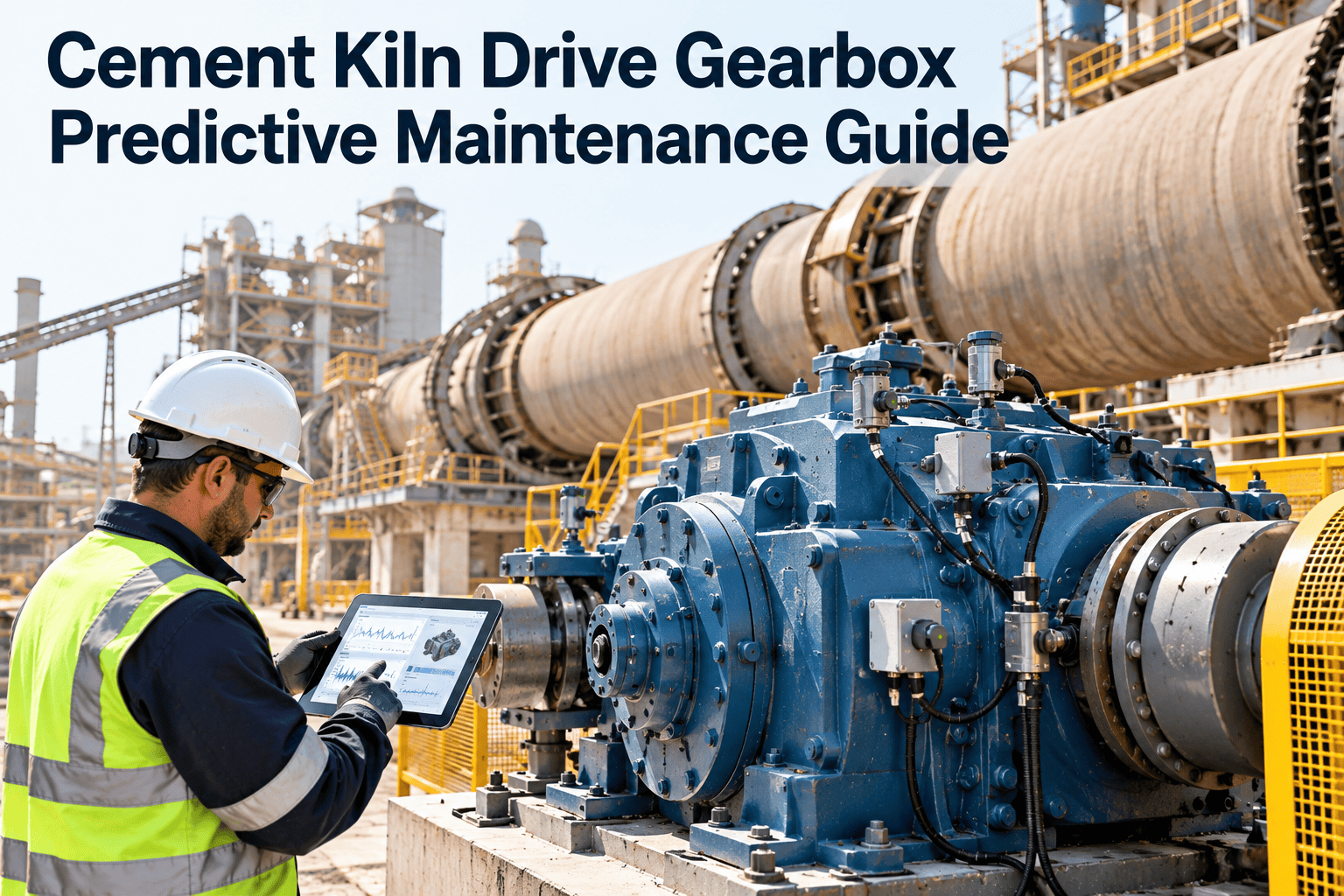
Gearbox failure is one of the most common and costly failure modes in cement plant operations. In ball mills, gear misalignment, tooth wear, and lubrication breakdown are among the top three causes of unplanned stoppages. In vertical roller mills, gearbox strain from uneven feed rates and high-torque events can bring the entire grinding circuit to a halt within seconds. Kiln drive gearboxes operate under continuous heavy loads while transferring massive torque through girth gear and pinion systems — and when they fail, the entire production line stops with lead times of weeks to months for major component replacement. A documented case from August 2024 at a cement facility showed gearbox vibration values trending dangerously high after just 37,700 operating hours, forcing an immediate overhaul. After the overhaul, vibration returned within one month due to oil contamination from dust particles — requiring a complete flush and replacement of 5,000 liters of lubricant. This is the reality of gearbox maintenance in cement plants: harsh conditions, high stakes, and zero tolerance for neglect. The global open gear market for cement applications alone is valued at approximately $1.2 billion annually. Sign up for Oxmaint to track every gearbox inspection, oil sample result, vibration reading, and alignment check across your entire plant — and catch developing failures before they become production-stopping emergencies.
Gearbox Maintenance for Cement Mills and Kilns
Practical Maintenance Reference for Drive System Reliability in Cement Manufacturing
$1.2BAnnual global market for cement mill and kiln open gears and gearbox components
37,700 hrsOperating hours at which a cement mill gearbox showed critical vibration in a 2024 documented case
40%Kiln MTBF improvement achieved through structured drive system maintenance programs
Gearbox Types in Cement Plant Drive Systems
Cement plants use three fundamentally different gearbox configurations, each with distinct failure characteristics, maintenance requirements, and monitoring approaches. Understanding which gearbox type is installed on each piece of equipment is the starting point for building an effective maintenance program. Book a demo to see how Oxmaint catalogs every gearbox by type, location, and maintenance history in a single searchable asset register.
Open Gear Systems
Used On: Ball mills, rotary kilns (girth gear + pinion)
Open gears transmit high torque from the motor and pinion to rotate the massive cylinder of the mill or kiln. Girth gears are among the largest single components in a cement plant, manufactured from high-strength alloy steels like 42CrMo4. They operate exposed to ambient dust, temperature extremes, and continuous loading — making lubrication management and alignment the two most critical maintenance factors.
Tooth wear and pitting
Pinion-to-gear misalignment
Lubrication film breakdown
Root cracking from fatigue
Enclosed Helical/Planetary Gearboxes
Used On: Vertical roller mills, bucket elevators, large fans
Enclosed gearboxes contain the gear train, bearings, and lubricant within a sealed housing. Vertical roller mill gearboxes are particularly critical — they handle extremely high radial and axial loads from the grinding table while operating in dust-heavy environments. Oil contamination from cement dust is the dominant failure driver, as documented in the 2024 case where dust particles in the oil caused vibration to spike within weeks of a full overhaul.
Oil contamination
Bearing degradation
Gear tooth surface fatigue
Seal failure and dust ingress
Kiln Drive Gearboxes
Used On: Rotary kiln main drive, auxiliary drive systems
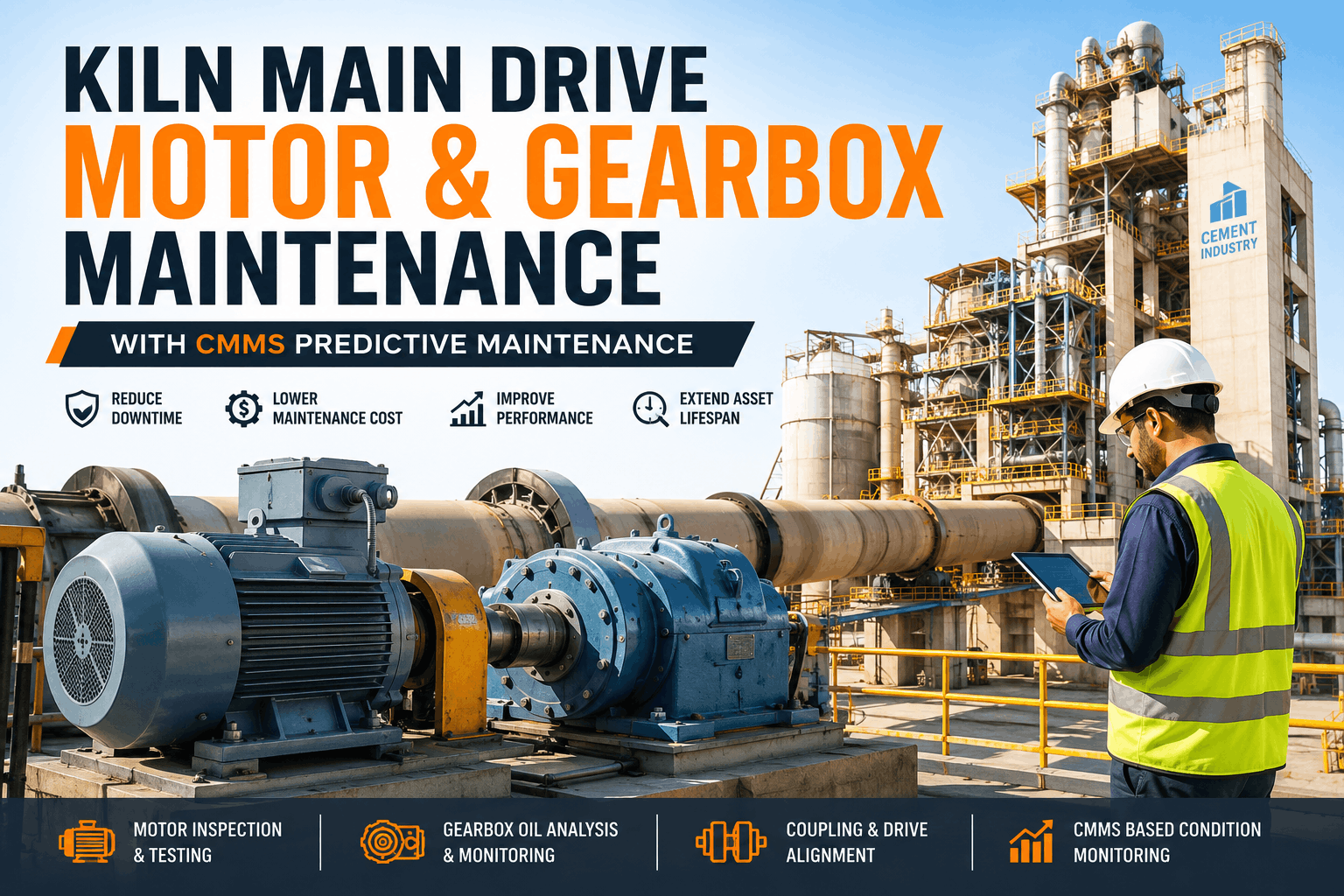
Kiln drive systems combine enclosed gearboxes with open girth gear arrangements. The main drive operates under continuous heavy load while compensating for kiln thermal expansion, shell ovality, and support roller alignment variations. Auxiliary drives provide slow-speed rotation during maintenance and emergency conditions. Both systems require precise alignment monitoring because even millimeter-level deviations create accelerated wear patterns across the entire gear train.
Girth gear misalignment
Coupling wear
Thermal expansion effects
Foundation settlement drift
Failure Modes and Diagnostic Indicators
Every gearbox failure in a cement plant follows a progression — from initial degradation through detectable symptoms to functional failure. The window between detectable symptoms and breakdown is where maintenance intervention must occur. The diagnostic table below maps each failure mode to its detectable indicators and the monitoring technique that catches it earliest.
| Failure Mode |
What Happens |
Early Warning Signs |
Detection Method |
Lead Time |
| Gear Tooth Wear |
Progressive loss of tooth profile from abrasion, pitting, or spalling under sustained load |
Increasing vibration at gear mesh frequency, iron particles in oil analysis, audible gear whine |
Vibration analysis + oil analysis |
Weeks to months |
| Bearing Failure |
Rolling element or race degradation from fatigue, contamination, or lubrication starvation |
Rising temperature at bearing housing, vibration at bearing defect frequencies, metallic particles in oil |
Vibration + thermal + oil analysis |
2–8 weeks |
| Oil Contamination |
Cement dust, moisture, or wear debris infiltrates lubricant and degrades its protective film |
Oil color change, elevated particle count in samples, reduced viscosity, visible sediment in sight glass |
Oil sampling every 90 days |
Days to weeks |
| Misalignment |
Gear axes shift from design position due to foundation movement, thermal expansion, or wear |
Uneven tooth contact pattern, asymmetric wear marks on gear face, elevated vibration at 1x and 2x RPM |
Laser alignment + contact pattern check |
Ongoing monitoring |
| Seal Degradation |
Shaft seals harden, crack, or wear, allowing dust entry and oil leakage |
Oil leaks at shaft penetrations, dust accumulation inside housing, dropping oil level between top-ups |
Visual inspection + oil level tracking |
1–4 weeks |
| Overload Damage |
Torque spikes from uneven mill feed, material surges, or process upsets exceed gear design limits |
Torque measurement spikes, vibration events correlated with feed rate changes, audible impact sounds |
Torque monitoring + vibration |
Real-time detection |
Oil Analysis: The Most Cost-Effective Gearbox Diagnostic
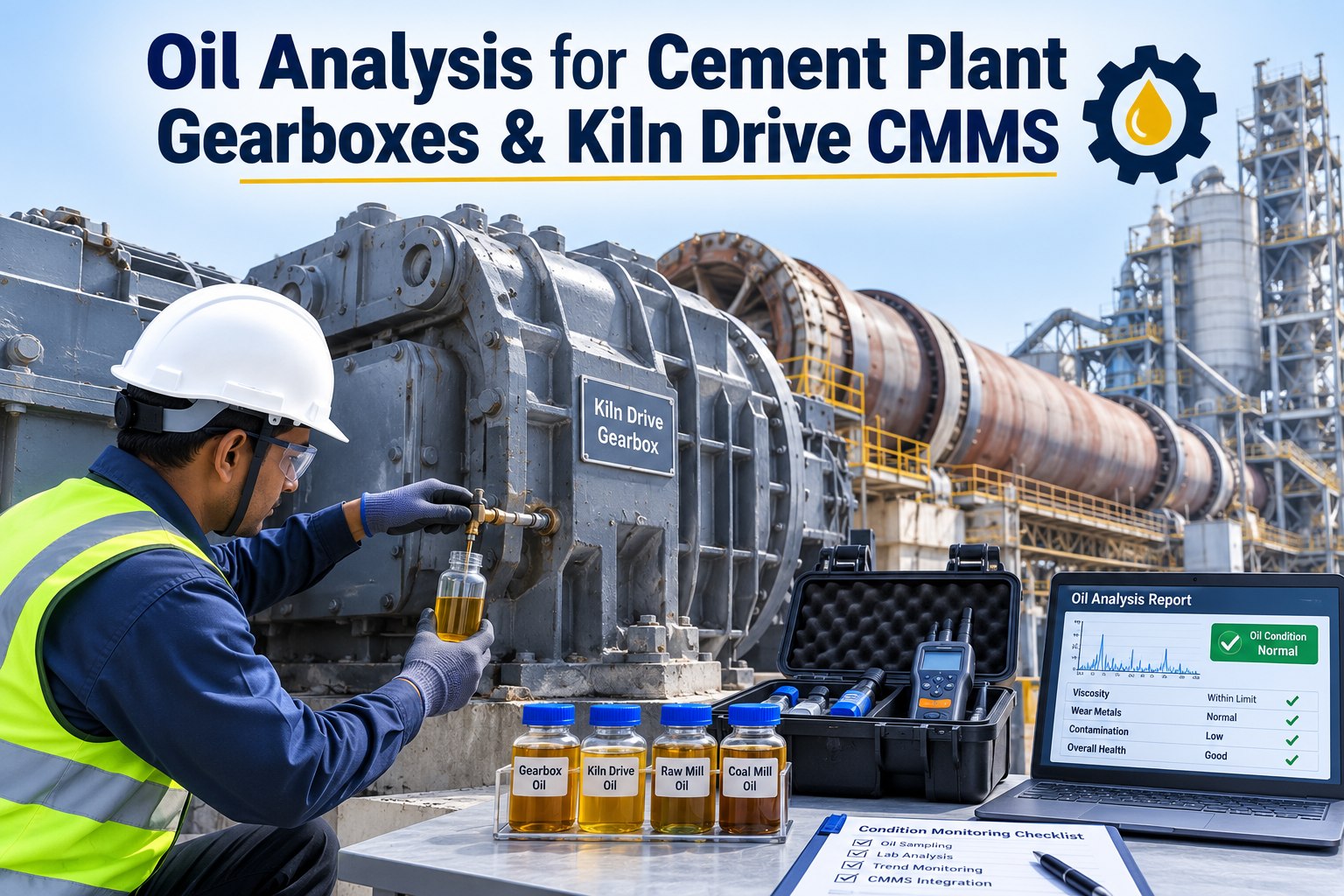
Oil analysis is the single most informative and cost-effective diagnostic tool for enclosed gearboxes in cement plants. A standard sample costs a fraction of what a single hour of unplanned downtime costs — yet it reveals contamination levels, wear metal concentrations, lubricant degradation, and moisture content that predict failures months in advance. The 2024 cement mill gearbox case demonstrated this directly: vibration returned within one month of an overhaul because oil contamination was not caught quickly enough. After switching to accelerated sampling during the post-overhaul period, contamination was identified and corrected before any component damage occurred. Sign up for Oxmaint to schedule oil sampling automatically, log results against trend baselines, and trigger alerts when any parameter crosses your defined thresholds.
Wear Metals (Fe, Cu, Cr)
Iron from gears, copper from bearings/bushings, chromium from hardened surfaces
Rising trend = active component wear. Investigate immediately if iron exceeds 100 ppm or doubles between samples.
Particle Count (ISO 4406)
Total contamination level measured as particles per milliliter at defined size ranges
Target ISO 18/16/13 for enclosed gearboxes. Exceeding 20/18/15 indicates filtration failure or external contamination.
Viscosity (cSt at 40°C)
Lubricant thickness determines film strength and load-carrying capacity at the gear mesh
Deviation of more than ±10% from baseline indicates oil degradation, contamination, or incorrect oil grade. Replace immediately.
Moisture Content (ppm)
Water in oil accelerates corrosion, reduces film strength, and promotes microbial growth
Target below 200 ppm. Above 500 ppm requires immediate oil replacement and seal inspection. Moisture sources: condensation, seal leaks, cooler tube failure.
Silicon (Si) Content
Silicon indicates dust contamination — the primary external contaminant in cement plant gearboxes
Any upward trend in silicon signals seal failure or breather contamination. Clean or replace breathers and inspect all shaft seals.
Acid Number (TAN)
Total Acid Number measures oxidation-driven acidity that attacks gear surfaces and seals
Replace oil when TAN exceeds 2.0 mg KOH/g or doubles from new-oil baseline. High TAN accelerates all other degradation modes.
Never Miss Another Oil Sample or Vibration Check
Oxmaint schedules every gearbox inspection, oil sample, alignment check, and vibration reading automatically — and generates work orders the moment any result crosses your defined alarm thresholds.
Maintenance Intervals by Gearbox Type
Maintenance frequencies must be calibrated to the specific gearbox type and operating environment. Factory-recommended intervals are starting points — cement plant conditions (high dust, thermal cycling, continuous operation) typically require tighter intervals than manufacturer defaults. The schedule below reflects cement-industry best practice refined from documented plant reliability programs. Book a demo to see how Oxmaint automates these schedules with calendar and meter-based triggers.
Open Gears (Girth Gear & Pinion)
DailyVisual check of lubrication film coverage, spray nozzle function, and tooth contact pattern
WeeklyInspect gear tooth surfaces for pitting, spalling, or abnormal wear marks. Check backlash measurement.
MonthlyMeasure gear root runout and tooth profile deviation. Inspect pinion bearing condition and lubrication.
QuarterlyFull alignment survey using laser alignment or contact pattern analysis. Document tooth wear progression with photos.
AnnuallyComprehensive gear condition assessment during planned shutdown. Magnetic particle inspection on high-stress root areas.
Enclosed Gearboxes (VRM, Ball Mill Drives)
DailyCheck oil level, oil temperature, and sight glass clarity. Listen for abnormal noise. Verify cooling system operation.
Every 90 DaysOil sampling and laboratory analysis — wear metals, particle count, viscosity, moisture, TAN. Accelerate to monthly if any parameter is trending.
Every 500 hrsVibration data collection on all bearing positions. Compare against baseline and previous readings.
QuarterlyInspect shaft seals and breathers for dust ingress. Check oil filter differential pressure. Replace filters if ΔP exceeds limit.
AnnuallyThermal imaging survey. Gearbox internal borescope inspection where ports allow. Full oil system flush and replacement if analysis indicates.
Kiln Drive Systems (Main + Auxiliary)
Per ShiftMonitor kiln drive motor current, gearbox oil temperature, and auxiliary drive readiness. Log any unusual vibration or noise.
WeeklyInspect girth gear tooth condition from safe access point. Check pinion bearing temperature and lubrication system pressure.
MonthlyMeasure girth gear-to-pinion alignment using dial indicators or laser. Check all coupling conditions and bolted connections.
QuarterlyVibration analysis on main drive motor, gearbox, and pinion bearings. Oil analysis on enclosed gearbox section. Thermal survey of drive train.
At Kiln StopFull girth gear and pinion inspection with wear measurement. Gearbox internal inspection. Coupling and foundation bolt torque verification.
Alignment: The Silent Gearbox Killer
Misalignment is responsible for more premature gearbox failures in cement plants than any other single cause. Even millimeter-level deviations between the girth gear and pinion create uneven load distribution across the tooth face, accelerating wear on one side while leaving the other underloaded. In kiln drives, thermal expansion during operation shifts alignment from the cold-set position — meaning alignment must be checked and optimized under both cold and hot running conditions. Foundation settlement over years of operation introduces slow-drift misalignment that is invisible without periodic measurement but accumulates to destructive levels. Sign up for Oxmaint to log alignment measurements with date-stamped trending so drift becomes visible before damage occurs.
Signs of Misalignment
Asymmetric wear pattern visible on gear tooth face — heavy wear on one end, light on the other
Elevated vibration at 1x and 2x rotational frequency on pinion or motor bearings
Uneven backlash readings measured at multiple points around the gear circumference
Elevated bearing temperature on one side of the gearbox compared to the other
Audible change in gear mesh tone — grinding or whining that varies with load or temperature
Alignment Best Practices
Use laser alignment tools for all enclosed gearbox installations — dial indicators are acceptable only as backup
Record alignment under both cold and hot conditions for kiln drives — thermal growth must be compensated
Establish alignment baselines at commissioning and compare every quarterly check against the original reference
Check foundation bolts for loosening after every thermal cycle — bolt relaxation is a primary source of alignment drift
Document tooth contact patterns with marking compound at every planned shutdown — photographs provide trend evidence
Condition Monitoring Technologies for Gearboxes
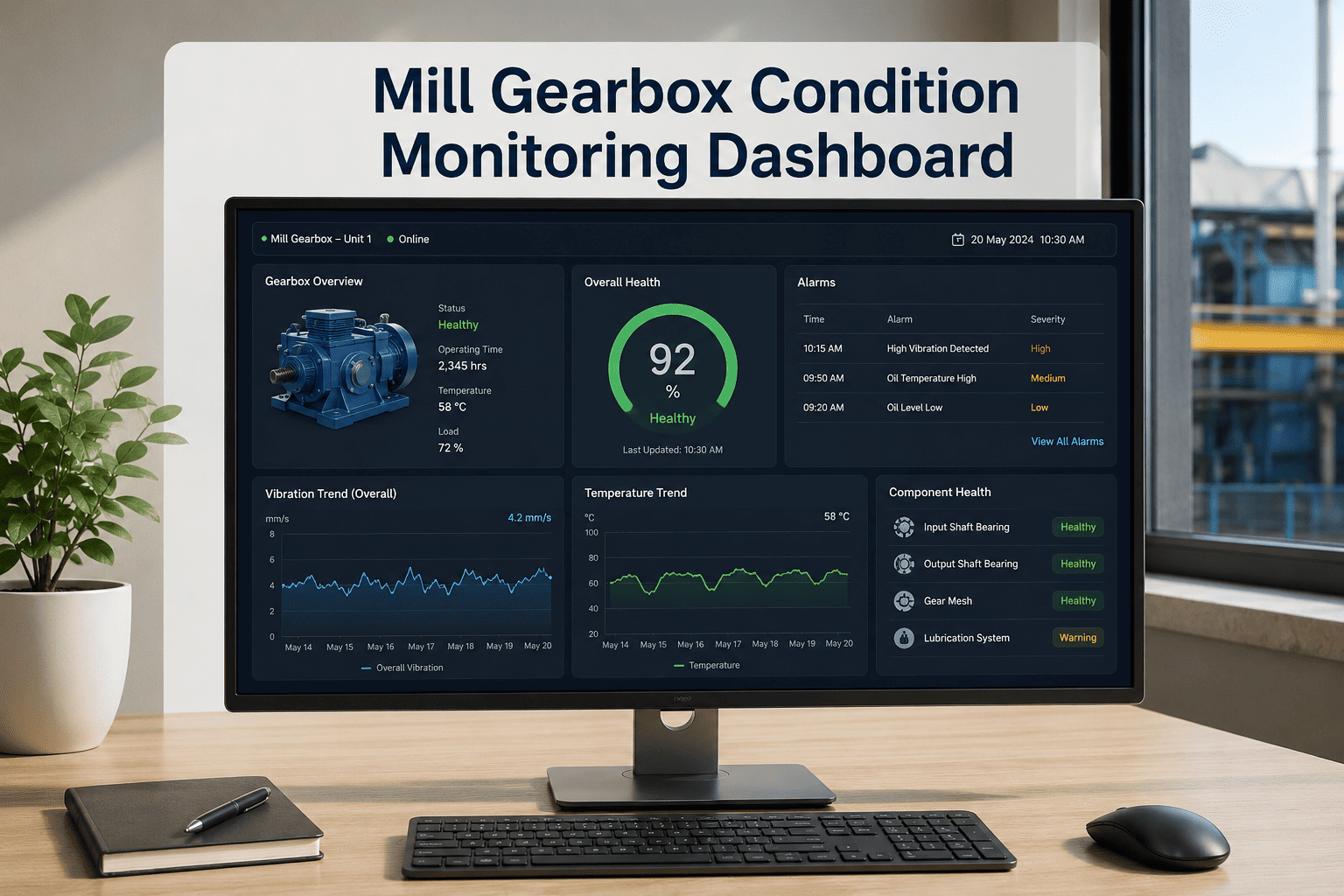
Modern cement plant gearbox monitoring integrates multiple data streams — vibration, oil condition, temperature, and torque — to build a comprehensive picture of gearbox health. The most effective programs correlate these data sources rather than treating them in isolation. A vibration spike is more meaningful when the oil analysis from the same period shows rising iron content. A temperature increase is more diagnostic when correlated with torque data showing load changes.
Vibration Analysis
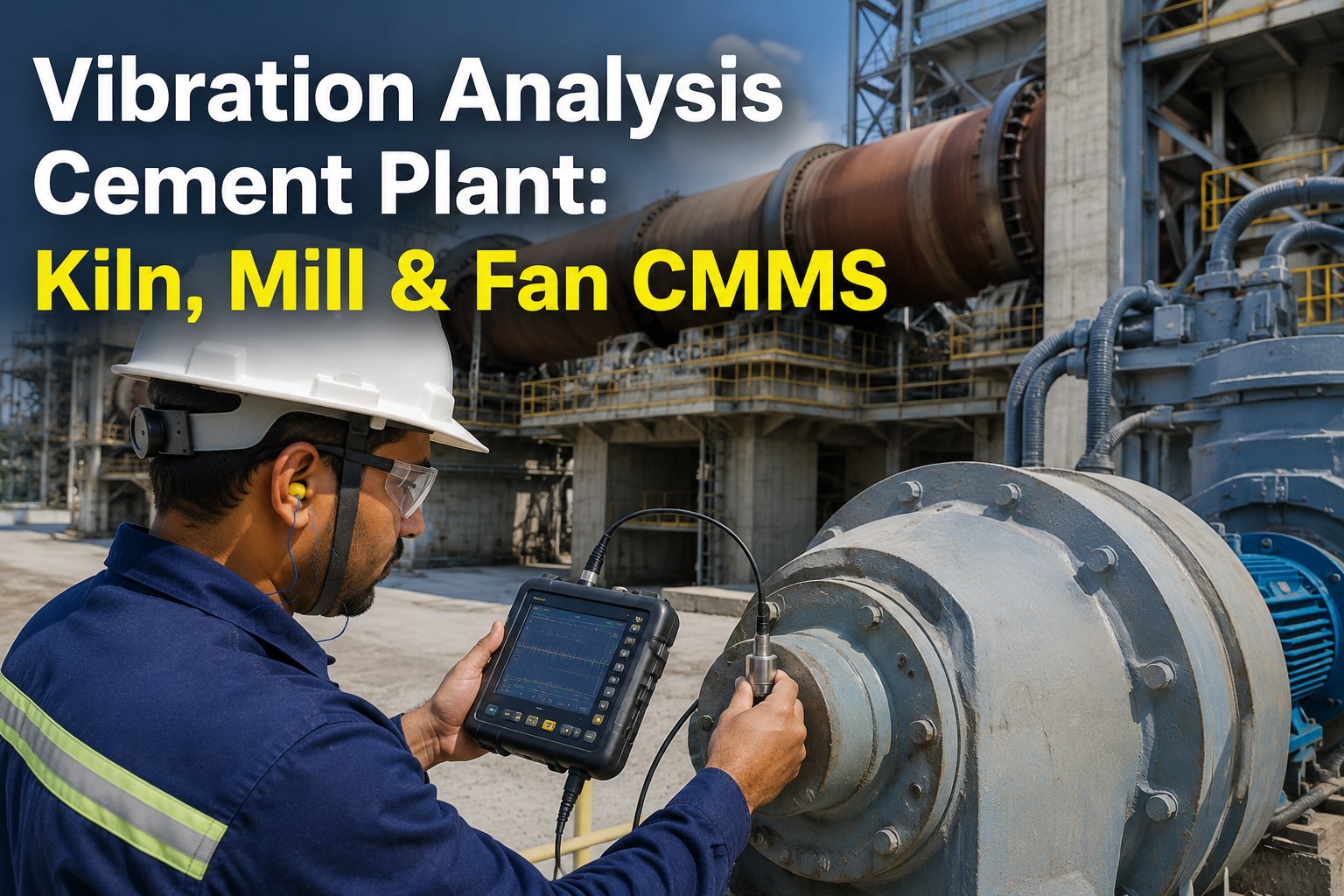
Detects gear mesh anomalies, bearing defects, imbalance, and misalignment through frequency spectrum analysis. Continuous online monitoring is recommended for VRM and kiln main drive gearboxes. Portable route-based collection is adequate for secondary drives.
Catches: Tooth wear, bearing degradation, misalignment, looseness — 2 to 8 weeks before failure
Oil Analysis Program
Reveals contamination, wear rates, and lubricant degradation through laboratory testing of scheduled samples. The most cost-effective single diagnostic for enclosed gearboxes. Must include wear metals, particle count, viscosity, moisture, and TAN at minimum.
Catches: Contamination, active wear, lubricant breakdown, seal failure — weeks to months before failure
Thermal Monitoring
Infrared thermography identifies hot spots on bearing housings, gear casings, and electrical connections. Continuous temperature sensors on critical bearings provide real-time alerting. Elevated temperatures indicate friction, overload, or lubrication problems.
Catches: Bearing overheating, lubrication starvation, cooling system failure — 1 to 4 weeks before failure
Torque & Load Monitoring
Measures mechanical torque on the drive shaft to detect overload events, feed rate instability, and process upsets that stress the gearbox beyond design limits. Particularly important for VRM gearboxes where uneven feed creates destructive load spikes.
Catches: Overload events, feed instability, process upsets — real-time detection and alerting
Integrate All Gearbox Data in One Platform
Oxmaint connects vibration data, oil analysis results, thermal readings, and torque measurements into a unified asset health view — so your reliability team sees the full picture, not isolated data points.
Lubrication Management for Open and Enclosed Gears
Lubrication is the difference between a gearbox that lasts 15 years and one that fails in 3. Open gears require specialized high-viscosity adhesive lubricants applied through spray systems, while enclosed gearboxes rely on circulating oil systems with filtration, cooling, and regular condition monitoring. In both cases, the cement plant environment — extreme dust loading, temperature variations, and continuous operation — demands tighter control and more frequent intervention than standard industrial applications.
Open Gear Lubrication
Use spray-applied adhesive lubricants specifically formulated for open gear applications — standard grease is not acceptable
Verify spray nozzle coverage pattern daily — incomplete coverage creates metal-to-metal contact zones that initiate pitting
Adjust lubricant viscosity grade seasonally — higher viscosity in summer heat, lower in winter cold — to maintain consistent film thickness
Clean gear teeth of old lubricant buildup during planned shutdowns — excessive buildup traps abrasive particles against the tooth surface
Monitor lubricant consumption rate — sudden increases indicate application system malfunction or tooth surface changes
Enclosed Gearbox Lubrication
Use only the manufacturer-specified oil grade — substitutions change film strength, thermal stability, and additive compatibility
Maintain oil temperature within 40–65°C during operation — monitor with continuous sensors and verify cooling system performance daily
Replace oil filters when differential pressure reaches the manufacturer's specified limit — do not wait for scheduled changes
Install desiccant breathers on all gearbox vents to prevent moisture and dust ingress — replace breathers when saturation indicator changes color
After any gearbox overhaul or repair, flush the entire oil system before filling with new lubricant — residual contamination from repairs causes rapid degradation
Frequently Asked Questions
How often should gearbox oil be sampled in a cement plant?
Standard practice is every 90 days for enclosed gearboxes operating in cement environments. However, sampling should be accelerated to monthly or even bi-weekly under specific conditions: immediately following a gearbox overhaul or repair, when any previous sample showed trending parameters, during seasonal temperature transitions that affect oil viscosity, or after any process upset that may have caused overloading. The 2024 cement mill case demonstrated that standard 90-day intervals can miss rapidly developing contamination — the plant ultimately adopted weekly sampling during the post-overhaul stabilization period to catch the dust contamination issue early.
What causes premature gear tooth failure in cement mills?
The most common causes are misalignment between the girth gear and pinion (creating uneven load distribution across the tooth face), inadequate lubrication film thickness (allowing metal-to-metal contact that initiates pitting), oil contamination from cement dust ingress (abrasive particles accelerating surface wear), and overload events from uneven or excessive feed rates to the mill. In vertical roller mills specifically, gearbox strain from feed instability is a leading failure driver — research shows that evening out the feed rate significantly reduces gearbox stress and extends component life.
How do you detect gearbox problems before they cause a breakdown?
The most effective approach combines four monitoring streams: vibration analysis detects gear mesh anomalies and bearing defects 2–8 weeks before failure; oil analysis reveals contamination, wear metals, and lubricant degradation weeks to months in advance; thermal monitoring identifies overheating bearings and lubrication problems 1–4 weeks ahead; and torque monitoring catches overload events in real time. The key is correlating these data sources — a vibration increase combined with rising iron in the oil tells a much clearer story than either measurement alone.
What alignment tolerance is acceptable for kiln girth gears?
Girth gear-to-pinion alignment tolerance is typically specified as uniform tooth contact across a minimum of 80% of the face width, with backlash variation around the gear circumference not exceeding the manufacturer's specification (commonly 0.5–1.0mm depending on gear module). Alignment must be verified under both cold and hot running conditions because kiln thermal expansion shifts the girth gear position significantly during operation. Laser alignment is the preferred measurement method, with dial indicator checks as backup. Any alignment deviation that produces visible asymmetric wear on the tooth face requires immediate correction.
How does a CMMS improve gearbox maintenance in cement plants?
A CMMS like Oxmaint automates every aspect of gearbox maintenance: it schedules oil sampling and vibration data collection based on operating hours or calendar dates and ensures nothing is missed; it stores all historical oil analysis results, vibration spectra, and alignment measurements with trend visualization so deterioration becomes visible over time; it triggers work orders automatically when any monitored parameter exceeds a defined threshold; it tracks all gearbox maintenance history including parts replaced, costs incurred, and downtime logged; and it calculates MTBF for each gearbox to measure whether reliability is improving or declining.
When should a gearbox be overhauled versus replaced?
The overhaul-versus-replace decision depends on four factors: the remaining useful life of the gear housing and major structural components (if the housing is cracked or severely worn, replacement is more economical); the availability and cost of replacement internal parts (bearings, gears, shafts, seals); the total accumulated operating hours versus the manufacturer's design life; and the plant's strategic production plan (if a major expansion or technology upgrade is planned within 3–5 years, a targeted overhaul may be more appropriate than full replacement). A comprehensive internal inspection during a planned shutdown provides the data needed to make this decision objectively.
What is the expected lifespan of a well-maintained cement mill gearbox?
With proper maintenance — including rigorous oil analysis, vibration monitoring, alignment management, and timely component replacement — enclosed cement mill gearboxes typically achieve 80,000 to 120,000 operating hours (approximately 10–15 years of continuous operation). Open girth gears on ball mills and kilns can last 20–30 years when properly lubricated and aligned. However, these lifespans assume the gearbox is not subjected to repeated overload events, oil contamination is caught and corrected promptly, and alignment is maintained within specification throughout the operating life. Neglecting any one of these factors can reduce lifespan by 50% or more.